I sat on the opposite end, keeping my dirty work clothes from brushing against his neat cardigan.
“The house gets very quiet during the week,” Harold said, his voice barely louder than the wind.
“I imagine it does,” I said.
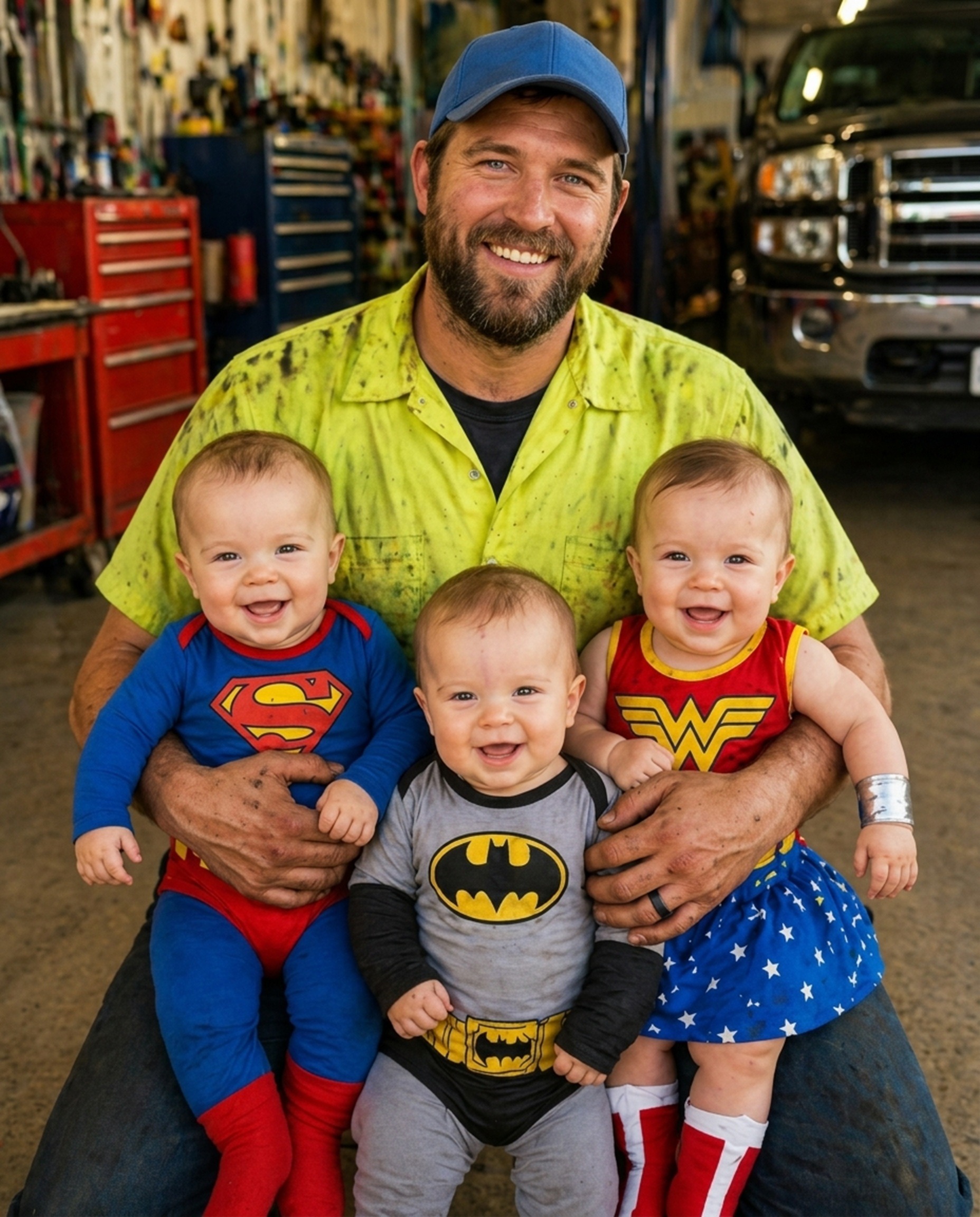
“It feels like we have found a home here, Mr. Lawson,” I said.
The words came out before I could stop them, honest and raw.
Harold looked at me, a softness in his eyes that made him look younger than seventy-eight.
“I was a father once,” Harold said, his fingers tightening on the edge of the bench. “A long time ago.”
“I know,” I said quietly, thinking of the faded photograph of the woman in the yellow dress.
“When I look at your children,” Harold said, “I do not feel quite so old.”
He reached into his pocket and pulled out a small piece of peppermint candy, unwrapping it with slow, deliberate movements.
“You are a good man, Evan,” Harold said. “You remind me of what is decent in this world.”
I rubbed my bare wrist, the old shame of keeping the wallet overnight rising in my chest.
If he knew the truth about that night, he would not be sitting here with me.
But he did not know, and looking at his calm face, I let myself believe that the past was fully behind us.
A dark blue pickup truck slowed down as it passed the front of the house, its tires crunching on the loose gravel.
The driver, a thick-necked man with a baseball cap pulled low, stared toward the porch for a long moment before speeding away.
Harold did not seem to notice the truck, his eyes closed as he enjoyed the warmth of the fading sun.
I stood up, brushing a few stray bits of dried grass from my jeans.
“We should get going before it gets too cold for the kids,” I said.
“Of course,” Harold said, opening his eyes and smiling. “Take care of them, Evan.”
I walked down the steps, calling out to the triplets to gather their toys.
As Emma ran toward me, she turned and waved to the porch.
“Goodbye, Mr. Lawson!” Emma yelled.
Harold waved back, his hand small and pale against the dark wood of the house.
I watched my children play in the garden, feeling a sense of security I had not felt in years.
The blue patrol car rolled over the gravel lot of Carter’s Auto Repair at exactly eight in the morning. The engine idled with a low, steady rumble before Officer Roger Cole switched it off. I was already lifting the garage door, the cold autumn air rushing in to mix with the smell of old grease and floor sealant.
Roger climbed out of the cruiser, his boots crunching on the loose stones. He adjusted his heavy leather utility belt, the metal handcuffs clinking against his flashlight. He looked tired, his eyes slightly bloodshot from the night shift.
“Morning, Evan,” Roger said, his voice carrying that slow, deliberate authority. “I need a quick oil change before the day shift gets busy. The department scheduler has me down for nine hundred miles overdue.”
“Bring her right onto bay two,” I said. “I have the filter on the shelf. It will take fifteen minutes.”
I walked back to the tool chest, my left hand instinctively reaching to rub my bare wrist where my watch used to sit. The metal lift controls were cold under my palm. Roger lined the patrol car up with the steel tracks, the tires squeaking on the smooth gray concrete.
He stayed inside the car until the lift was locked in place. I secured the safety pins at the base of the pillars. Roger stepped out, looking up at the undercarriage of the Ford as I raised it above our heads.
“How are the kids?” Roger asked. He stood near the workbench, his fingers tapping the leather casing of his radio.
“They are doing well,” I said. “Noah is building some kind of fort out of cardboard boxes in the kitchen. Emma keeps asking when we are going back to Mr. Lawson’s yard.”
Roger did not answer right away. He walked over to the oil drain barrel, his boots leaving faint dusty prints on the floor.
“You have been spending your Saturdays out there,” Roger said.
“I have,” I said, reaching for the fifteen-millimeter wrench. “Harold has a lot of dead pine branches that need cutting. The triplets like running in the high grass.”
I fitted the wrench onto the oil pan plug. The black oil began to trickle out into the funnel, warm and thick.
“He is a good man, Harold,” Roger said. “He worked thirty-five years carrying the mail on route four. Never took a sick day until his wife passed.”
“He told me some stories about the old post office,” I said. “He seems lighter lately. More than when I first knocked on his door.”
Roger leaned his shoulder against the brick wall of the bay. He looked out the open garage door toward the main road, where the morning traffic was beginning to build.
“He is lighter because you gave him his life back, Evan,” Roger said. “But he was never supposed to have that cash in his wallet in the first place.”
I stopped turning the oil filter. The wet metal canister was slick in my gloved hand. I looked over at Roger, waiting for him to continue, but he just stared at the road.
“What do you mean?” I asked.
“That fifteen thousand dollars,” Roger said, his voice dropping a register. “That was his entire emergency fund. He kept it in a savings account at the county bank for twelve years.”
I set the dirty filter in the reclamation bin. “Why did he take it out?”
“Because of a man named Vance,” Roger said. “Runs a company called Vance Brothers Roofing out of Toledo. He showed up at Harold’s house in August.”
I wiped my hands on a clean shop rag. The rag cost twelve dollars a pack now, and I used them sparingly, but my fingers were covered in black soot.
“Harold did not mention any roof work,” I said.
“That is because there was no roof work,” Roger said. “Vance told Harold that his shingles were rotting. He told him the city would condemn the cottage if he did not get it fixed immediately.”
I looked at the oil still dripping from the pan into the collector. “Can the city do that to an old man?”
“No,” Roger said. “But Harold did not know that. He is seventy-eight, Evan. He lives alone with his memories, and he gets anxious when people start talking about building codes and court dates.”
Roger took a small notepad from his breast pocket. He did not open it, just flipped it over in his hand.
“Vance had him sign a contract,” Roger said. “A three-page document with fine print that said Harold agreed to pay fifteen thousand dollars for an inspection and initial materials.”
“Fifteen thousand just to look at the roof?” I asked.
“That was the penalty clause,” Roger said. “If Harold tried to cancel the work, the contract said Vance could put a lien on the house. Vance told him he would take the cottage and sell it at sheriff’s auction.”
I stood under the oil pan, the cold air from the open door hitting the back of my neck. My mind went back to the night I found the wallet under the lift, the thick stack of bills smelling of old paper and leather.
“So Harold went to the bank,” I said.
“He withdrew every dollar,” Roger said. “He was supposed to meet Vance on the corner of Maple and Tenth on Tuesday morning to hand over the cash.”
“Why the corner?” I asked. “Why not at the house?”
“Because Vance did not want anyone seeing him take it,” Roger said. “But Harold lost the wallet on Monday night when he stopped by here to get his taillight bulb replaced.”
I felt a sudden chill that had nothing to do with the autumn breeze. “He lost it in my shop.”
“He did,” Roger said. “And when he realized it was gone, he thought his life was over. He thought Vance was going to take his home and he would have nowhere to go.”
I turned back to the tool cart to find the new oil filter. My hand was steady, but my mind was racing through the timeline.
“He was going to give all of it to a thief because he was scared,” I said.
“That is exactly what he was going to do,” Roger said.
“Why did he not call you?” I asked. “Why didn’t he call the sheriff’s office?”
“He was embarrassed, Evan,” Roger said. “People his age, they get terrified of losing their independence. They think if they admit they got cheated, their kids or the state will put them in a home.”
I lubricated the rubber gasket on the new filter with a drop of clean oil. “But you know about it now.”
“I found out because I saw Vance’s truck parked down the street from Harold’s house last Friday,” Roger said. “I know the truck. I have seen it outside three other senior residences in the county this year.”
“Did you arrest him?” I asked.
“I cannot arrest him for a signed contract,” Roger said, tapping his belt again. “Not without proof of fraud. Vance makes sure his paperwork looks legal on the surface.”
I threaded the new filter onto the engine block, turning it until it seated against the metal.
“So Vance is still coming after him,” I said.
“He is,” Roger said. “He called Harold twice yesterday. He told him he was coming back this Saturday to collect his money or start the court filings.”
I grabbed the oil plug wrench and tightened the bolt. The metal clicked as it locked into place. I felt a tight knot forming in the center of my chest.
“What is Harold going to do?” I asked.
“He is terrified,” Roger said. “He has the money back in his safety deposit box now, but he thinks the contract is legally binding. He thinks he has to pay.”
I lowered the lift slowly, the hydraulic fluid hissing in the quiet garage. The patrol car settled back onto its tires with a soft bounce.
“How much oil does this take?” I asked, my voice flat.
“Six quarts,” Roger said. “The synthetic blend.”
I walked over to the bulk oil dispenser and filled a clean plastic pitcher. The amber liquid flowed smoothly, thick and silent. I carried it back to the car, popped the hood, and began pouring it into the valve cover.
“You saved him from losing his savings that night, Evan,” Roger said, standing close to the fender. “If you had kept that wallet, or if someone else had found it, Harold would have had nothing to fight with.”
I did not say anything. I kept my eyes on the oil level in the pitcher, watching the numbers on the side drop from six to five, then four.
“He thinks you are a hero,” Roger said.
“I just returned a wallet,” I said.
“To you, it was just a wallet,” Roger said. “To him, it was his whole life.”
I finished pouring the oil and replaced the yellow cap. I closed the heavy steel hood, the latch engaging with a sharp metallic clang that echoed through the empty shop.
“That will be forty-eight dollars,” I said, wiping my hands on the rag once more.
Roger pulled a green county voucher from his pocket and signed his name at the bottom. He handed it to me across the counter.
“Thank you, Evan,” he said.
“Saturday morning,” I said, looking at the voucher. “What time did you say Vance was coming?”
“He told Harold he would be there at ten,” Roger said.
I folded the voucher and placed it in the cash drawer. “I will be at Harold’s yard at eight to clear the rest of those pine branches.”
Roger nodded once, his face expressionless. “I might be driving by that way around ten myself.”
He walked out to his car, opened the door, and slid into the driver’s seat. The engine started with a clean, sharp turn of the key.
I watched him back out of the driveway, the tires throwing up a few small pebbles as he turned onto the main road.
I walked back to my bay, the quiet of the shop returning. The heavy wrench was still in my hand, its metal surface cold against my palm.
I gripped the wrench tightly, my chest burning with anger at the thought of someone taking advantage of Harold.
We arrived at Harold’s cottage at exactly nine o’clock on a Saturday morning.