“Evan Carter?” he asked, his voice slow and heavy.
“Yes, Roger,” I said, trying to find a normal tone. “We went to high school together, remember?”
He did not smile, and he did not offer his hand.
“I need you to step out onto the porch for a minute, Evan,” he said.
The tightness in my throat went cold, spreading down into my chest like well water.
I stepped past the threshold, letting the screen door click shut behind me.
Through the wire mesh, I could see Emma standing by the kitchen table, her finger still wound in her hair.
“Is there a problem with the shop?” I asked, looking down at his polished boots.
“We need to talk about what you did last night,” Cole said.
My tongue felt thick, dry as a piece of emery cloth.
“I did not do anything wrong,” I said.
He adjusted his collar, his eyes moving past my shoulder toward the living room window.
“That is what we need to clear up,” he said.
“If this is about the Lawson house, I went there to give him his property,” I said. “I didn’t take a dime.”
Cole reached down, his fingers brushing the heavy leather of his utility belt.
“The gentleman reported his wallet missing yesterday afternoon,” he said. “We have to follow the timeline.”
“He got it back,” I said. “He was holding it when I drove away.”
A red sedan slowed down as it passed the duplex, the driver leaning over the steering wheel to look at the patrol car parked at the curb.
It was Mrs. Gable from three doors down, her pale face pressed against the side glass.
“I have my children inside,” I said, my voice dropping to a whisper. “They are five years old.”
“I know how old they are,” Cole said, his hand resting near his belt buckle. “But you need to come with me to the station.”
“The station?” I asked, my chest tightening. “For what?”
“We have some questions about a missing item,” he said.
“I told you, I gave him the wallet,” I said. “I drove all the way out there in the middle of the night to do the right thing.”
“And we appreciate that,” Cole said, his face remaining completely blank. “But there are some details that do not align with the report.”
My neighbors across the street, the Miller brothers, were standing near their driveway holding rakes, watching us.
They did not pretend to work.
They just stood there in their flannel shirts, staring at the deputy on my porch.
“I can call my sister to watch the kids,” I said, looking back at the screen door. “Just give me five minutes to dial her.”
“I already called Mrs. Gable,” Cole said. “She is walking up the driveway right now.”
I looked toward the street and saw her coming, her wool sweater pulled tight around her shoulders.
She looked at me with a mixture of pity and curiosity that made my face burn.
“It will only be an hour, Evan,” she said as she reached the bottom step. “Go on and do what you have to do.”
“Thank you, Clara,” I said, but the words felt like sand in my mouth.
“The children are in the kitchen eating,” I added, looking at her. “There is milk in the fridge.”
She nodded, her eyes shifting to Cole and then back to me.
Cole took my elbow, his grip firm but not painful, guiding me down the wooden stairs.
Every window on our street seemed to have a curtain pulled back, a white face peeking out from the dark glass.
I had lived in this town my whole life, and now I was walking down my own sidewalk with a deputy at my back.
He opened the heavy rear door of the cruiser, the vinyl inside smelling of rubber floor mats and old coffee.
I climbed into the back, my knees hitting the hard plastic barrier.
The door shut with a heavy, flat sound that cut off the noise of the autumn wind.
The metal screen between the front and back seats was thick, covered in small round holes.
Cole got into the driver’s seat, adjusted his rearview mirror, and started the engine.
The cruiser pulled away from the curb, passing Mrs. Gable, who was now standing on my porch with her hands on Emma’s shoulders.
I leaned forward as far as the seatbelt would let me.
“I returned every dollar, officer, I swear I did not touch a thing,” I said, my breath fogging the wire mesh.
Cole did not look back at me through the mirror.
He kept his hands at ten and two on the steering wheel, his eyes on the road ahead.
“We will talk when we get there, Evan,” he said.
“I went straight to his house,” I said. “It was past midnight, but he was awake. He took the wallet from me.”
“I have the report here,” Cole said, tapping a yellow folder on the passenger seat.
“The fifteen thousand was all there,” I said, my voice rising. “Every single bill. I did not even keep a dollar for gas.”
The car turned left onto Main Street, passing the auto shop where my toolbox sat locked.
I thought about my boss, about what he would say if he saw me in the back of a county car.
“I found it under the hydraulic lift,” I said. “It must have slipped out of his pocket when he was looking at his brakes.”
Cole remained silent, his eyes scanning the morning traffic.
“Why would I return it if I was going to steal from him?” I asked, my voice cracking slightly. “I could have just kept the whole thing.”
“People do strange things when they get nervous, Evan,” Cole said.
The town fell away, replaced by the wider spaces of the county road where the houses sat further back from the ditch.
The brown corn husks in the fields stood broken and dry, waiting for the first frost.
I pressed my forehead against the cold side window, watching the telephone poles go by.
If they locked me up, the electric bill would not get paid, and the landlord would have the notice on the door by Friday.
I thought of Noah’s face when he looked at my hands, and Emma’s constant questions that I could never answer.
The car began to slow down, but we had not reached the county courthouse yet.
We were still two miles north of the municipal building.
The patrol car turns onto a familiar street, and Evan realizes they are stopping at Harold’s peeling green house.
Officer Cole killed the engine, and the sudden quiet in the front seat of the patrol car made my ears ring. I sat with my hands flat on my thighs, watching Harold Lawson walk slowly down his front porch steps in a faded wool cardigan that looked older than I was.
My fingers twitched, automatically reaching to rub my left wrist where my steel watch used to sit before the pawnshop on Maple Street took it to cover last month’s groceries. I looked at the peeling green paint on Harold’s siding, expecting the deputy to reach for his leather utility belt and tell me to get out.
“Go on,” Cole said, his voice slow and deliberate as he pushed his heavy door open. “He doesn’t bite, Evan.”
I stepped out of the cruiser, the damp autumn air immediately cutting through my thin denim jacket. My boots crunched on the gravel driveway as I walked toward the wooden steps, my chest still tight with the fear of what was coming.
Harold stopped at the bottom step, adjusting his flannel collar against the morning breeze. He did not look like a man who had spent the night calling the police on a thief; instead, his face creased into a warm, genuine smile that showed the deep lines around his eyes.
“Good morning, young man,” Harold said, his voice holding that old-fashioned, formal politeness. “I hope the deputy didn’t frighten you too much with his early morning visit.”
“I was a little confused, Mr. Lawson,” I said, keeping my voice low. “I thought everything was settled last night when I brought the wallet back.”
Cole walked up behind me, his heavy black boots clicking against the concrete walkway. “I told him you looked like you were heading to a county cell, Harold. He was practically sweating through his shirt.”
“My apologies for the dramatics,” Harold said, gesturing toward the two green plastic chairs sitting on the porch. “Please, come up out of the damp. The air is heavy today.”
I followed him up the steps, the wood yielding slightly under our weight with a soft creak. Harold sat down slowly, his knees making a small popping sound that made me want to reach out and steady him, but I kept my hands in my pockets.
He did not look frail, but his movements had the careful deliberation of someone who knew exactly how much strength he had left. He reached into his trousers and pulled out the worn black leather wallet I had spent the night staring at under my kitchen light.
I felt a hard lump form in my throat, my mind immediately jumping back to the red shut-off notice waiting on my kitchen counter. Three hundred dollars by November fifteenth, or the duplex went dark.
“I wanted to show you something,” Harold said, his thumb sliding into a small, hidden seam behind the bill compartment. “The deputy here helped me verify that everything was exactly as I left it when I lost it near your shop.”
Cole nodded, tapping his belt. “Fifteen thousand dollars, right down to the last single. Not a dime missing, Evan. I counted it myself this morning to make sure.”
“I didn’t touch a single bill,” I said, looking from Cole to the old man.
Harold ignored the money entirely, his fingers gently pulling a small, square slip of paper out of the hidden silk lining near the back. He held it out to me with a hand that shook just a fraction.
It was a faded photograph of a woman in a bright yellow dress, standing next to a teenage girl with the same dark, thick curls. The edges of the paper were soft and yellowed with age, showing the grain of a print made decades ago.
“This is Clara, my late wife, and our daughter, Sarah,” Harold said, his eyes fixing on the small square of paper with a quiet intensity. “This is the only copy left in the world.”
I looked at the photograph, the girl’s smile bright and clear despite the aging paper. “They look very nice, Mr. Lawson.”
“They were,” Harold said, his voice dropping to a soft whisper. “Clara passed twenty years ago, and Sarah followed her just a few years later. The negatives were lost in a basement flood back in ninety-eight.”
He carefully slid the photo back into the lining, treating the paper as if it were made of spun glass. “If that wallet had gone into a sewer or a trash bin, I would have lost them forever. The money is just paper, but these are my girls.”
“I’m glad you got them back,” I said, meaning it, even as the image of my empty refrigerator flashed in my mind.
“Which brings me to why I asked Roger to bring you here,” Harold said, leaning forward and resting his hands on his knees. “I am seventy-eight years old, Evan, and this house is getting away from me.”
He pointed toward the corner of the porch, where the wooden gutter was split and dripping dirty water onto the foundation.
“The gutters are full of pine needles, the back steps are rotting, and I have a dozen storm windows that need to be washed and hung before the first hard freeze,” Harold said.
“I’m a mechanic, Mr. Lawson,” I said. “I spend sixty hours a week under car lifts, and my weekends are pretty thin.”
“I can pay forty dollars an hour,” Harold said, not blinking. “I would expect about eight hours of work every Saturday.”
Three hundred and twenty dollars a week. That was more than my weekly groceries and the gas for my truck combined.
But Saturdays were the only days I had to watch the triplets without paying Mrs. Gable down the street to keep an eye on them.
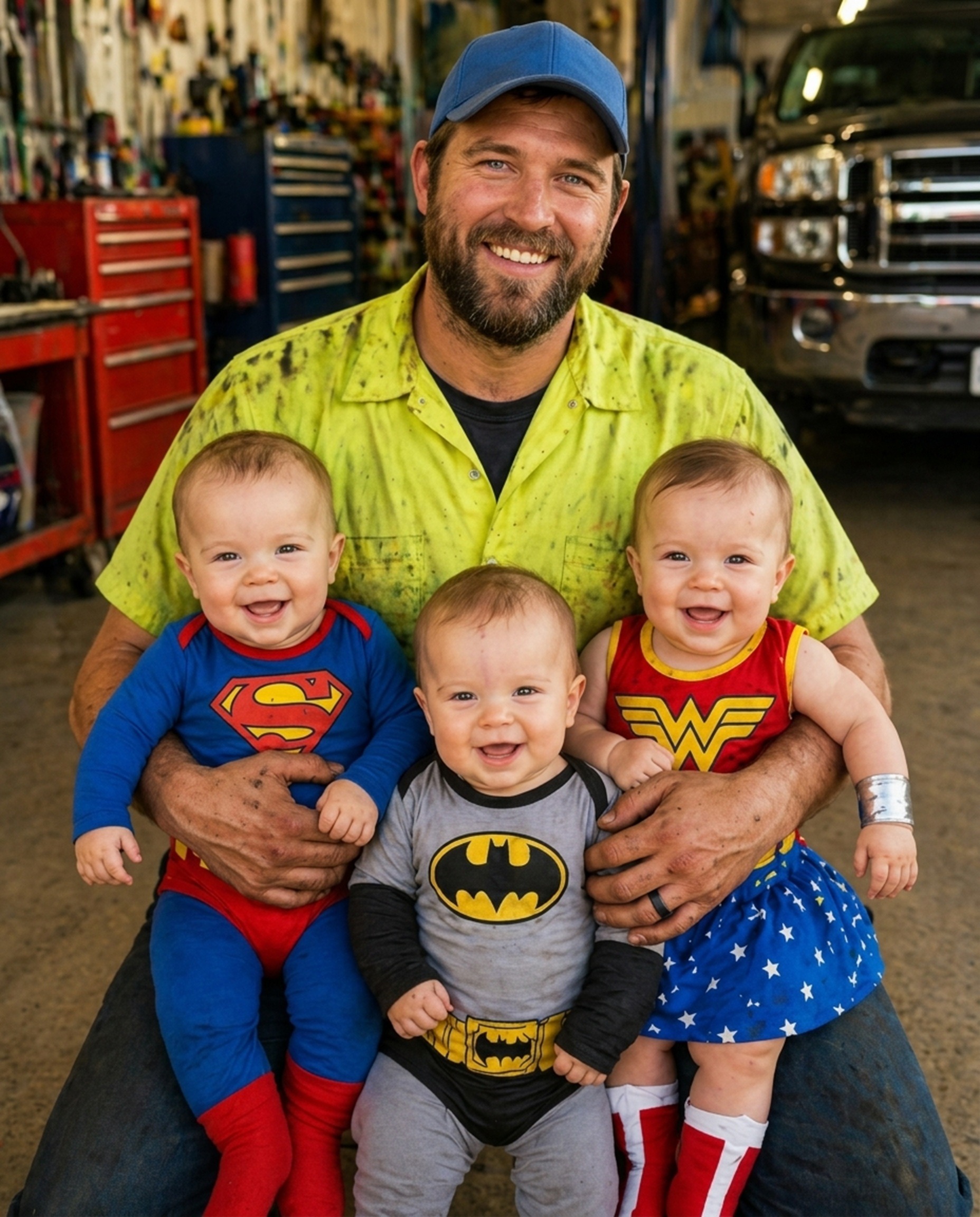
“I can’t leave my kids,” I said, shaking my head. “Emma, Noah, and Liam. They’re only five, and they don’t do well with strangers.”
Harold smiled, a soft creasing of his eyes that reached his temples. “The yard is too quiet, and I could use some life around here.”
I looked over the railing at the wide, deep yard. It was surrounded by an old chain-link fence, overgrown with wild blackberry bushes but completely enclosed and safe from the street.