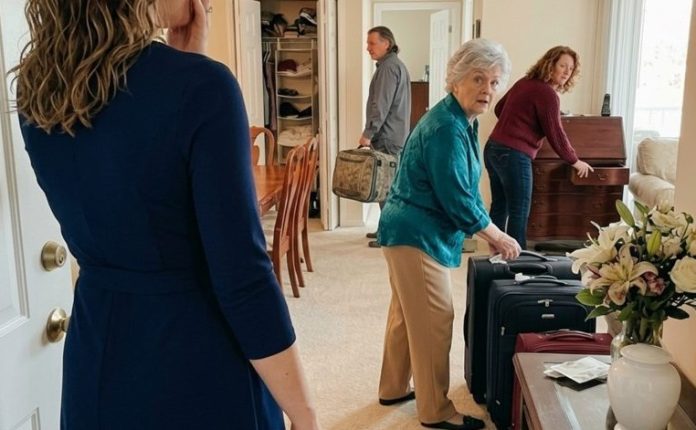
The moving truck arrived at nine on Wednesday morning, and I watched two men carry Sarah's business inventory out of my house.
There were more boxes than I had realized.
Some were stacked three high in the guest room. Others had been pushed beneath the bed or behind furniture.
The men worked methodically, checking each carton against my inventory before loading it.
I stood in the hallway holding the clipboard.
Every time they removed another stack, a piece of the room reappeared.
First the window.
Then the old chest of drawers.
Finally, a stretch of hardwood floor I had not seen properly in nearly two years.
One of the movers asked whether the empty display rack was going too.
“Yes, please.”
He folded it and carried it downstairs.
When the last carton was gone, the guest room looked unexpectedly large.
I opened the window.
Fresh air moved the curtains.
There was a faint rectangular mark on the floor where one of the stacks had stood.
I knelt and rubbed it with a cloth.
It came away easily.
I remained there for a moment, looking around.
The room had not changed.
Only the things occupying it had.
That distinction seemed important.
I paid the moving company as agreed and kept the receipt with the delivery confirmation.
David emailed later to say everything had arrived safely.
Sarah had been upset when the truck appeared, but she had accepted the boxes.
They had filled most of the garage.
David wrote that they would sort the inventory over the weekend.
I answered that I was glad the delivery had gone smoothly.
Then I went upstairs and placed fresh sheets on the guest bed.
It was a small thing.
But I liked seeing the room prepared for someone who might actually sleep there.
Thursday brought a call from Helen.
The listing photographs were ready.
She sent them to my email, and I opened them on the laptop.
The house looked beautiful.
The kitchen seemed brighter than I remembered.
The living room appeared spacious without the extra furniture I had moved aside.
The upstairs rooms looked welcoming.
For a moment, I felt an unexpected wave of pride.
Arthur and I had maintained the property through ordinary life.
We had painted, repaired, saved, and improved.
We had done it without knowing whether anybody else would someday appreciate our work.
Looking at the photographs, I could see that our efforts had lasted.
Helen had written a description emphasizing the home's condition, generous rooms, mature landscaping, and convenient location.
She had not invented grand claims or promised features the property did not have.
I appreciated that.
“Do you think it looks all right?” she asked when I called.
“It looks better than I expected.”
“That's because you've taken good care of it.”
I smiled.
Arthur would have liked hearing that.
Helen explained that several prospective buyers had already requested appointments.
We agreed on a schedule that would allow me time to prepare the house without feeling rushed.
Then she mentioned the lakeside condominium.
It was still available.
The seller had agreed to an appointment for Friday.
“Would you like to see it?” Helen asked.
I looked toward the window.
The maple tree moved gently in the breeze.
“Yes,” I said. “Very much.”
Friday morning, I drove toward the lake.
The road left the busiest part of town and passed through neighborhoods with smaller houses and open spaces.
As I approached the water, the traffic became lighter.
I turned into a quiet development with low buildings, landscaped paths, and a small parking area.
Helen was waiting near the entrance.
She led me along a paved walkway to a ground-floor unit with pale siding and a private patio.
The front door opened into a bright living room.
There were no stairs.
No narrow passages.
No enormous hallway requiring a collection of furniture to make it feel occupied.
The kitchen had white cabinets, modern appliances, and a window overlooking a little garden.
I stood near the sink and imagined making breakfast there.
I could see myself watering plants while the kettle heated.
Helen showed me the two bedrooms.
One was large enough for my bed and a reading chair.
The second would accommodate my sewing machine, a desk, and a guest bed.
There was a closet near the entrance for coats and shoes.
A laundry area sat beside the bathroom.
Everything was close enough to be convenient without feeling cramped.
Then Helen opened the patio door.
Outside, a paved terrace looked toward a line of trees.
Beyond them, through a gap in the branches, I could see the water.
It was not a dramatic view.
No sweeping cliffs or distant mountains.
Just a quiet stretch of blue-gray lake beneath the morning sky.
I stepped outside.
A breeze moved through the leaves.
Somewhere nearby, a bird called.
I stood there longer than necessary.
Helen waited patiently.
Finally, she asked, “What do you think?”
I looked around the small patio.
“It feels manageable.”
She smiled.
“That's an interesting first impression.”
“I mean it as a compliment.”
“I thought you did.”
We examined the condominium carefully.
Helen explained the monthly association fee, the maintenance responsibilities, and the rules governing exterior changes.
I asked about roof repairs, insurance, parking, and the condition of the shared areas.
I wanted no surprises.
The property was not perfect.
The patio would need cleaning.
A bedroom wall was painted a shade of green I disliked.
One kitchen drawer did not close smoothly.
But those were ordinary problems.
Nothing suggested that I would spend my retirement maintaining a house far larger than I needed.
Before leaving, I sat on the edge of the living room sofa.
“Could I have a few minutes alone?” I asked.
“Of course.”
Helen stepped outside.
I looked around.
For thirty years, I had made decisions while imagining Arthur beside me.
I could almost hear him commenting on the kitchen cabinets.
He would have examined the windows and checked the electrical outlets.
He would have liked the patio.
He would have complained that the seller had not repaired the drawer.
I smiled at the thought.
Then I asked myself the question I had avoided for months.
Would I choose this place if David and Sarah had never mentioned my house?
The answer came quietly.
Yes.
I had wanted a smaller home before the restaurant dinner.
I had wanted fewer maintenance responsibilities.
I had wanted to spend mornings near the water and afternoons sewing or reading without wondering which repair would demand my attention next.
The confrontation had not created those wishes.
It had made me stop postponing them.
When Helen returned, I told her I was seriously interested.
She explained the next steps and suggested reviewing the property's documents before making an offer.
I agreed.
I would proceed carefully.
I had waited a long time to make a decision for myself.
There was no reason to rush the important details.
On Saturday morning, David arrived to help clear the garage.
He wore old jeans and a faded sweatshirt.
I gave him a pair of work gloves.
We moved gardening equipment, sorted unused paint cans, and carried several boxes to the driveway.
At first, we talked only about practical things.
Which tools still worked.
Which shelves could be donated.
Whether the old lawn mower was worth repairing.
Then David noticed a wooden toolbox beneath the workbench.
He knelt and lifted it.
“Dad's?”
“Yes.”
He opened the lid.
Inside were screwdrivers, a worn tape measure, and several small compartments filled with nails and fittings.
Arthur had labeled the compartments with neat handwriting.
David ran his thumb over one of the labels.
“I remember this.”
“He never threw away a screw if he thought it might be useful.”
David laughed softly.
“He used to make me sort them.”
“He said it taught patience.”
“It taught me that there were a thousand different kinds of screws.”
We laughed together.
It was the first easy conversation we had shared since the steakhouse dinner.
David closed the toolbox.
“Are you keeping it?”
“I haven't decided.”
“Could I have it?”
I looked at him.
“Would you use it?”
“Probably. My tools are scattered all over the garage.”
“Then take it.”
He hesitated.
“Are you sure?”
“Yes.”
He held the box carefully.
“Thank you.”
There was a difference between that exchange and the conversation at the restaurant.
He had asked.
I had considered the request.
Then I had chosen to give him something.
Neither of us had treated the gift as an obligation.
By late morning, we had filled several donation bags.
We were carrying an old folding chair to the driveway when Helen called.
She sounded pleased.
“Georgia, we've received an offer.”
I set the chair down.
“Already?”
“A young couple toured the house yesterday. They came back this morning with their agent.”
I glanced toward David.
He was watching me.
Helen explained the proposed purchase price, financing arrangements, inspection contingency, and preferred closing timeline.
The offer was strong.
The buyers had provided appropriate documentation.
They were particularly interested in the backyard and the maple tree near the driveway.
I looked at the tree.
It had been there through nearly every important moment of David's childhood.
Now two people I had never met wanted to build their own memories beneath its branches.
Helen cautioned me not to make a decision before reviewing the terms thoroughly.
We arranged to meet that afternoon.
When I ended the call, David was standing beside the old folding chair.
“Was that about the house?”
“Yes.”
“Someone made an offer?”
“Yes.”
He looked toward the porch.
“That was fast.”
“It was.”
He said nothing for a moment.
Then he asked, “Are you going to accept?”
“I need to review everything first.”
He nodded.
To his credit, he did not ask me to refuse.
We finished our work more quietly.
Later, Helen came to the house with the documents.
We sat at the kitchen table while she explained the offer in detail.
The buyers were a couple planning to start a family.
They liked the neighborhood, the garden, and the condition of the property.
They had even asked whether the maple tree had been planted by the original owners.
I smiled at that.
Arthur would have enjoyed knowing somebody had noticed.
After reviewing the terms, I accepted the offer.
The agreement remained subject to the usual conditions, including inspection and financing.
I understood that the sale was not final until closing.
Still, it was a significant step.
When Helen left, I sat alone in the kitchen.
The late afternoon sun fell across the table.
For a moment, I wanted Arthur there.
Not because I doubted my decision.
Because I wanted someone who remembered the beginning to see how carefully I was bringing this chapter to an end.
I went upstairs and took our wedding photograph from the dresser.
Arthur was smiling broadly.
I looked young and nervous.
Neither of us had any idea how much ordinary work and happiness would fit into the years ahead.
“I think you'd like the new place,” I said quietly.
The photograph offered no answer.
I had not expected one.
Over the following weeks, the sale moved through inspections, paperwork, and final arrangements.
I made a carefully considered offer on the lakeside condominium, and it was accepted with terms that allowed the transactions to be coordinated.
Helen helped me keep track of the deadlines.
I consulted the appropriate professionals whenever I needed clarification.
I was determined not to make a careless financial decision simply because the emotional decision had been difficult.
Meanwhile, David came regularly to help pack.
At first, I worried that he might see each visit as an opportunity to persuade me to change my mind.
He did not.
He helped move furniture, wrapped dishes, and carried donation boxes to the car.
He asked before discarding anything.
Sometimes we talked.
Sometimes we worked in silence.
One afternoon, while sorting a hall closet, we found an old photograph of David and Arthur standing on the porch.
Both were covered in blue paint.
Arthur had decided to repaint the railing one summer, and David had insisted on helping.
The job took twice as long because David kept dropping the brush.
In the photograph, Arthur was laughing.
David looked proudly serious.
My son stared at it for a long time.
“I remember that day.”
“So do I.”
“Dad let me paint the last section.”
“He did.”
“It looked terrible.”
“He fixed it after you went inside.”
David laughed.
Then his expression changed.
“Mom, would Dad be disappointed in me?”
I put down the stack of papers I was holding.
“About what?”
He looked at the photograph.
“Friday night. The way I've been handling things.”
I considered my answer.
Arthur had loved our son fiercely.
He had also expected him to take responsibility when he made mistakes.
“He would want you to do better,” I said. “But that wouldn't make him stop loving you.”
David swallowed.
“I don't know why I didn't speak up.”
“You've told me you were trying to avoid an argument.”
“I was.”
“Sometimes avoiding an argument means allowing somebody else to be hurt.”
He nodded.
“I know that now.”
I sat beside him on the floor.
“Your father wasn't perfect, David. Neither am I. We both made mistakes. But he tried very hard not to let fear decide how he treated people.”
David studied the photograph.
“I should have told Sarah and Brenda that the house was yours.”
“Yes.”
“And that you didn't owe us anything.”
I touched his shoulder.
“You could have started by telling them not to speak to me that way.”
He lowered his head.
“I should have.”
We sat quietly.
Then he placed the photograph in a box marked KEEP.
I did not ask whether he meant to keep it for himself or for me.
There would be time to decide.
In the weeks that followed, David began telling me small things about his household that he had previously avoided discussing.
He and Sarah had made a list of their monthly expenses.
They were surprised by how much money disappeared through purchases that neither remembered making.
They canceled services they rarely used.
They reduced restaurant visits.
They arranged their own telephone and internet accounts.
Sarah began sorting the boutique inventory in the garage.
Some merchandise was sold online at discounted prices.
Other items were donated.
The amount recovered was less than Sarah had originally hoped.
But at least the boxes were no longer sitting untouched in my house.
David told me these things without asking for money.
That was new.
And I was careful not to turn every conversation into a lecture.
They were learning.
The process was uncomfortable.
I did not need to make it more so.
On moving day, the house was filled with the sounds of footsteps and furniture being carried through doorways.
I had chosen what to keep and what to donate.
Arthur's books went into sturdy cartons.
Our photographs were wrapped carefully.
I kept the dishes we had used for Thanksgiving dinners and the small blue pottery bowl David made in school.
I gave away furniture that would not fit comfortably in the condominium.
The decisions were sometimes painful.
A home accumulates more than belongings.
It gathers versions of the people who lived there.
A child's height marked inside a closet.
A repaired chair.
A drawer containing keys to locks that no longer exist.
An old calendar with appointments from a year nobody can quite remember.
I found myself stopping often.
Not because I wanted to change my mind.
Because I wanted to acknowledge what I was leaving.
David carried the last box to the truck.
Then he stood beside me in the living room.
The walls looked strange without pictures.
Every sound echoed.
“I didn't think I'd ever see it like this,” he said.
“Neither did I.”
He walked to the front window.
The maple tree filled much of the view.
“Do you think the buyers will keep it?”
“I hope so.”
He nodded.
“Dad would want that.”
“Probably.”
Then he surprised me.
“But I think he'd want you to be happy too.”
I looked at him.
“Yes,” I said. “I think he would.”
We walked through the house one final time.
I checked the windows and doors.
I opened the kitchen cabinet where Arthur had once hidden birthday presents.
It was empty.
David noticed me looking.
“Remember when Dad put my bicycle helmet in there?”
I laughed.
“He thought you would never look in the kitchen.”
“I found it three days before my birthday.”
“And pretended to be surprised anyway.”
David smiled.
For a moment, we were simply a mother and son remembering a good man.
There was no argument about money.
No discussion about who deserved the house.
Only the ordinary tenderness of shared history.
Outside, the movers were securing the truck.
I locked the front door and handed over the keys according to the arrangements for the completed sale.
Then I turned toward the maple tree.
Its leaves moved softly.
I placed my palm against the trunk.
“Thank you,” I whispered.
David stood beside me without speaking.
We drove separately to the condominium.
By late afternoon, the movers had carried everything inside.
Arthur's chair stood near the living room window.
My bed fit comfortably in the main bedroom.
The sewing machine occupied a corner of the second room.
I placed several favorite plants on the patio.
There were still boxes to unpack, and I had not yet decided where every picture would hang.
But the space already felt peaceful.
That evening, I made a simple supper.
I ate beside the window while the light faded across the trees.
I did not have to climb stairs to reach the bedroom.
I did not have to think about cleaning four bedrooms.
I did not have a hallway crowded with somebody else's belongings.
The condominium was smaller.
My responsibilities were smaller too.
And that was precisely what I had wanted.
Two weeks later, David came to install curtain rods.
He worked carefully, measuring twice before drilling.
Arthur would have approved.
While I made coffee, David mentioned that he and Sarah had started an emergency savings account.
They had also created a budget they reviewed together each week.
“It's not perfect,” he admitted.
“Most budgets aren't.”
“We've had to change quite a few things.”
“That's normal.”
He adjusted the curtain bracket.
“Sarah's working more hours at the dental office.”
“Is she doing all right?”
“She seems happier now that we have a plan.”
I nodded.
Then he hesitated.
“Mom, Sarah wants to apologize.”
I set the coffee cups on the counter.
“Does she?”
“Yes. She's been talking about Friday night.”
“Which part?”
He looked at me.
“All of it.”
I waited.
“She knows she was wrong,” he continued. “And she knows she made things worse when we came to your house the next morning.”
I thought about Sarah standing on my porch, angry that the phone service had stopped.
I thought about Brenda treating my home as something her daughter could claim.
And I thought about David, who had finally begun to acknowledge what his silence had cost.
“Sarah may come and speak with me,” I said. “But I want her to be honest.”
David nodded.
“She will be.”
“I hope so.”
He looked relieved.
“Does that mean we can finally put everything behind us?”
I shook my head gently.
“We can work toward a better relationship. But we're not returning to the financial arrangements we had before.”
He considered that.
Then he nodded.
“I understand.”
It was a simple answer.
But this time, I believed he meant it.
A few days later, Sarah called.
I recognized her voice immediately.
She sounded nervous.
“Georgia, would it be all right if I came by on Sunday?”
I looked around my new living room.
The curtains were hanging neatly.
The plants were thriving near the window.
Arthur's photograph stood beside my favorite books.
“Yes, Sarah,” I said. “Sunday would be fine.”
After we ended the call, I stood for a moment holding the phone.
I did not know what she would say.
I did not know whether she would truly understand why things had changed.
But I knew one thing with certainty.
This time, any relationship we rebuilt would have to begin with respect rather than obligation.
END PART 4