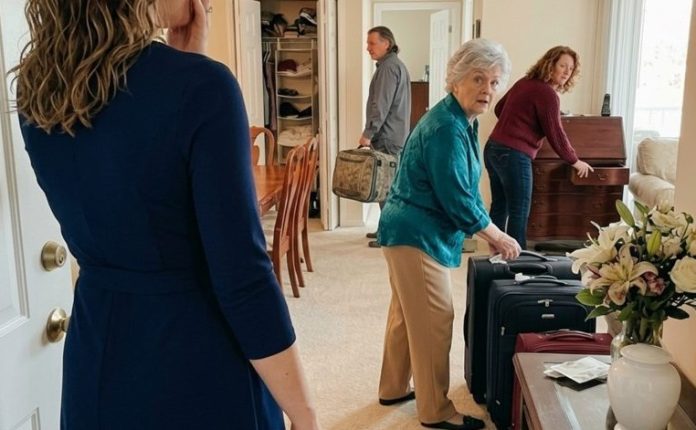
Sarah arrived on Sunday afternoon carrying a small bouquet of grocery-store flowers.
She came alone.
I noticed that before anything else.
There was no Brenda standing behind her, no David preparing to explain what she meant, and no expression of irritation at being required to have an uncomfortable conversation.
Just Sarah, holding flowers wrapped in clear plastic, looking uncertain about whether I would invite her inside.
“Hello, Georgia.”
“Hello, Sarah.”
She shifted the bouquet from one hand to the other.
“I hope these are all right. I wasn't sure what you liked.”
“They're lovely.”
I stepped aside.
“Come in.”
She entered slowly.
Her gaze moved around the living room.
The sun was coming through the windows, falling across the pale rug and the bookshelves I had brought from the old house.
Several potted plants stood beside the patio door.
Arthur's chair occupied the corner near the window.
Sarah looked toward it.
“You brought his chair.”
“Yes.”
“I remember David saying you might give it away.”
“I considered it. Then I decided I still wanted it.”
She nodded.
The chair was worn in places, and its upholstery no longer matched any other piece of furniture.
But Arthur had sat in it nearly every evening.
Sometimes he read.
Sometimes he watched the news.
Sometimes he fell asleep with a newspaper folded across his chest.
I liked having it near the window.
Sarah placed the flowers on the kitchen counter.
“Your new place is beautiful,” she said.
“Thank you. I'm very comfortable here.”
She looked toward the patio.
“It's quieter than I expected.”
“That was one of the reasons I liked it.”
She smiled faintly.
Then the smile disappeared.
“Georgia, I know I owe you an apology.”
I did not rush to reassure her.
I had spent years smoothing over awkward moments before anyone else had to take responsibility for them.
This time, I wanted to hear what she had come to say.
Sarah folded her hands.
“At the restaurant, I was disrespectful. I had no right to speak to you the way I did.”
I waited.
“And when we came to your house the next morning, I made things worse.”
She glanced toward the flowers.
“I acted as though you had stolen something from us.”
I pulled out a chair at the kitchen table.
“Would you like to sit down?”
“Yes, please.”
We sat opposite each other.
For several seconds, neither of us spoke.
Then Sarah took a breath.
“I've been thinking about how everything happened.”
“I'm listening.”
“Mom had been talking about your house for months. She kept saying it didn't make sense for one person to live somewhere so large.”
I looked at her.
“Did you agree?”
“At first, I thought she had a point.”
Sarah's voice was quiet.
“Then I started imagining what it would be like if David and I lived there.”
I appreciated that she did not pretend the idea had belonged entirely to Brenda.
“We'd have room for an office,” she continued. “Maybe a proper space for my business. We wouldn't have to worry about the townhouse mortgage.”
She looked embarrassed.
“I got carried away.”
“Did you ever think about where I would live?”
She lowered her eyes.
“Not enough.”
“That was the part I couldn't understand, Sarah. You were discussing my house as though I weren't still living in it.”
“I know.”
“You and Brenda talked about what would be convenient for you. But neither of you asked what I wanted.”
Sarah nodded slowly.
“That's true.”
I watched her for a moment.
She seemed different from the woman who had sat across the steakhouse table with her arms folded and her mouth set in a hard line.
She was still Sarah.
Still proud.
Still uncomfortable when she had to admit a mistake.
But she was making an effort not to hide behind excuses.
“When you refused,” she said, “I felt embarrassed in front of my mother.”
I waited.
“And I blamed you for that embarrassment.”
“That was unfair.”
“Yes.”
She looked directly at me.
“I didn't want to admit that I had been hoping you would agree.”
The admission was uncomfortable.
I could see that.
But it was also the first explanation she had given me that made sense of her behavior.
“Why did you tell me to pay and leave?” I asked.
She pressed her fingers together.
“I was angry. I wanted the conversation to stop, and I wanted you to feel as uncomfortable as I did.”
She paused.
“I know how awful that sounds.”
“It was hurtful.”
“I understand.”
“Do you?”
Her eyes filled.
“I think I do now.”
I looked toward the window.
For several seconds, I watched the branches moving outside.
Then I turned back to her.
“Sarah, I paid for everyone's dinner because I didn't want to argue in public. But I was deeply hurt that you expected me to pay after telling me to leave.”
She wiped beneath one eye.
“I've thought about that part a lot.”
“Your mother insulted me. You supported her. And David sat there without defending me.”
“I know.”
“You made me feel as though my presence at dinner mattered only while I was willing to provide something.”
Sarah's face tightened.
“I'm sorry.”
This time, the words were steady.
Not dramatic.
Not offered to end the conversation.
She seemed prepared to hear whatever I said next.
I told her about the first year I had helped with their expenses.
I reminded her how worried David had been when his work became uncertain.
I explained that paying the phone and internet bills had seemed like a small way to give them breathing room while they adjusted.
“It wasn't a hardship at first,” I said.
“I know.”
“But after five years, nobody even mentioned the arrangement.”
She nodded.
“I didn't realize how much it bothered you.”
“I didn't say enough about it.”
She looked surprised.
“I should have been clearer,” I continued. “I kept agreeing to things because I thought it was easier than disappointing you.”
Sarah considered that.
“David said something similar.”
“What did he say?”
“That you kept helping because you didn't want us to struggle.”
“He's right.”
“And we made that into something you were supposed to do.”
I nodded.
“Yes.”
She looked toward the kitchen counter.
“I'm sorry we treated your help that way.”
I stood and filled the kettle.
“Would you like some tea?”
She looked almost startled.
“Yes. Thank you.”
I took down two cups.
One was plain white.
The other had a small blue flower painted near the handle.
Sarah watched me prepare the tea.
For years, our conversations had often involved things she needed.
A place to store something.
Help with an expense.
A question about borrowing an appliance.
An invitation that usually included some practical request.
Now we were sitting in my kitchen with nothing to negotiate.
The unfamiliarity of it made the room seem unusually quiet.
I placed her cup on the table.
“Have you and David managed to arrange the services you need?”
“Yes.”
“Everything working?”
She gave a small, embarrassed laugh.
“Everything works.”
“Good.”
“We found a phone plan that costs less than we expected. And David changed the internet package because we were paying for more speed than we really needed.”
“That sounds sensible.”
She stirred her tea.
“We should have done it years ago.”
“Perhaps. But you've done it now.”
She looked at me carefully.
“I don't expect you to pay those bills again.”
I held her gaze.
“I'm glad.”
“I mean it. Even if things become difficult.”
“That matters.”
Sarah set down her spoon.
“I used to think you didn't understand how expensive everything was for us.”
I raised my eyebrows slightly.
She gave a rueful smile.
“I know. You worked your whole life. You raised David. Of course you understand.”
“Expenses can be frightening,” I said. “Especially when they arrive unexpectedly.”
“But we've been pretending some expenses were unavoidable when they were really choices.”
I thought about the salon appointment.
I did not mention it.
Sarah did.
“My card was declined that Saturday.”
“David told me.”
She looked embarrassed.
“Mom had to pay.”
“I'm sorry that happened.”
She shook her head.
“It was humiliating. But not because you canceled the phone service. That was our own spending.”
I appreciated the distinction.
“I knew the balance was getting close to the limit,” she continued. “I just didn't want to think about it.”
She stared into her tea.
“I kept telling myself I'd sell more things from the boutique and catch up.”
“Did you?”
“Not enough.”
She explained that the business had begun with enthusiasm.
She loved choosing clothing and photographing merchandise.
At first, friends and coworkers bought from her.
Then sales slowed.
She ordered new inventory, hoping different products would attract customers.
Some items sold.
Many remained in boxes.
Eventually, the unsold merchandise occupied more space than the business could justify.
She had been reluctant to admit that the venture was no longer working as she had imagined.
“That's why I hated having the boxes returned,” she said.
I looked at her.
“Because you had nowhere to put them?”
“That was part of it.”
“What was the other part?”
She took a breath.
“Seeing everything in our garage made it impossible to pretend I was still running a successful business.”
I nodded.
That was an honest answer.
“I wasn't trying to embarrass you,” I said.
“I know that now.”
“I needed my rooms back.”
“You had every right.”
She looked down.
“We've sold a lot of the inventory at a discount. Some things went for almost nothing.”
“That must have been disappointing.”
“It was. But at least we're dealing with it.”
She smiled faintly.
“David says the garage looks better every weekend.”
I laughed.
“That sounds encouraging.”
She laughed too.
It was the first time we had shared an easy moment since the restaurant.
We talked for nearly an hour.
Sarah explained that she was taking additional shifts at the dental office.
David had started reviewing their budget with her every Sunday evening.
They had reduced unnecessary purchases and were trying to build a reserve for emergencies.
It was not a dramatic transformation.
They had not suddenly become wealthy.
They still had a mortgage, a car payment, groceries, insurance, and ordinary household costs.
But they were beginning to understand where their money went.
And they were no longer assuming that I would quietly cover whatever remained.
Eventually, Sarah mentioned Brenda.
“Mom wasn't happy that you sold the house.”
I looked up.
“I suspected she wouldn't be.”
“She kept saying you were being stubborn.”
I smiled slightly.
“Your mother has mentioned that before.”
Sarah gave a small sigh.
“She thought you should have kept the house until David inherited it.”
“And what did you say?”
Sarah looked at me.
“I told her it wasn't our decision.”
I waited.
“I told her you had the right to sell your own property and live wherever you wanted.”
The words were simple.
But I knew they could not have been easy for Sarah to say to her mother.
Brenda was accustomed to being listened to.
Disagreeing with her often created more arguments than agreeing.
“She wasn't pleased,” Sarah admitted.
“I imagine not.”
“But I told her to stop criticizing you to me.”
I looked down at my cup.
The tea had gone cool.
“That means more to me than you might realize.”
Sarah seemed relieved.
“I should have said it months ago.”
“Perhaps.”
I did not want to pretend the past had disappeared simply because she had finally spoken honestly.
But I was willing to acknowledge the effort she was making.
After a while, Sarah stood.
“I should go. David's making dinner tonight, and he asked me to pick up a few things.”
I walked her to the door.
She paused beside the flowers.
“I almost forgot those.”
“You brought them for me.”
She smiled.
“I did.”
“I'll put them in water.”
She looked around the room once more.
“I'm glad you're happy here.”
“Thank you.”
She hesitated.
Then she asked, “Could I give you a hug?”
It was such a small request.
But after everything that had happened, I appreciated that she asked.
“Yes,” I said.
She embraced me briefly.
I returned the hug.
It did not mean everything had been forgiven and forgotten.
Trust would require time and consistent behavior.
But I was no longer standing at a locked security door while somebody demanded that I restore an arrangement that had become unfair.
We had spoken as two adults.
That was worth something.
After Sarah left, I placed the flowers in a glass vase beside the window.
They were ordinary supermarket flowers.
A few yellow blooms.
Several white ones.
Nothing expensive.
I liked them.
In the weeks that followed, our relationship changed gradually.
Not all at once.
There were awkward conversations.
Occasional silences.
Moments when Sarah seemed uncertain whether she could ask for anything without making me uncomfortable.
I told her that asking was not the problem.
Expecting an automatic yes was.
There were times I agreed to help with something.
There were times I declined.
The important difference was that nobody treated my decision as an insult.
David called more often.
Sometimes he asked how I was doing.
Sometimes he told me about work.
Occasionally, he called simply because he had seen something that reminded him of Arthur.
One Saturday, he telephoned after finding an old photograph of the maple tree.
It was barely taller than he had been when they planted it.
“Mom, I forgot how small it was.”
“Your father insisted it would grow.”
“He was right.”
“He usually was about trees.”
David laughed.
Then he asked whether the new owners had contacted me.
They had.
The young couple sent Helen a brief message thanking me for leaving the garden in such good condition.
They intended to keep the maple tree.
I told David.
He was quiet for a moment.
“Dad would have liked that.”
“Yes,” I said. “He would.”
The house had found new people to shelter.
That brought me comfort.
I missed certain things.
The sound of rain against the old kitchen windows.
The familiar creak in the staircase.
The wide front porch where Arthur and I had sat during summer evenings.
Sometimes I woke from a dream in which I was still living there.
For a few seconds, the new bedroom looked unfamiliar.
Then I heard the quiet hum of the refrigerator and remembered where I was.
I did not regret moving.
I simply missed parts of a life that had mattered.
I began developing new routines.
Most mornings, I walked near the lake.
There were people who used the same path at nearly the same time each day.
We started recognizing one another.
A woman with a little brown dog always stopped to admire my flowers.
An older gentleman carried a newspaper beneath his arm and insisted that the weather forecast was wrong.
We exchanged greetings.
Occasionally, I sat on a bench and read for half an hour before returning home.
I joined a small sewing group that met twice each month.
For the first time in years, I could leave the house for an afternoon without thinking about yard work waiting when I returned.
I still maintained my home.
There were bills, repairs, and responsibilities.
But they were suited to the space I needed.
My retirement felt less like an endless list of chores.
I found myself enjoying simple things I had postponed.
A leisurely breakfast.
A long telephone call with an old friend.
A book finished in two afternoons instead of two months.
One evening, I took Arthur's old toolbox from a cabinet and found a small brass screw tucked into a corner.
David had taken the main toolbox, but I had kept a few familiar tools.
I held the screw between my fingers.
Arthur had always saved things he believed might be useful.
I smiled.
Then I put it back.
There were some habits I had no intention of changing.
Several months after the move, David invited me to dinner.
“Just the three of us,” he said.
“What's the occasion?”
“No occasion. We thought you might like to come over.”
I checked my calendar.
“I'd love to.”
There was a pause.
Then he added, “And Mom?”
“Yes?”
“You don't have to bring anything.”
I laughed.
“Am I allowed to bring dessert if I want to?”
“Of course.”
“Then I'll decide.”
It was a small exchange.
But it represented a change I had hoped for.
My choices were becoming choices again.
On Saturday afternoon, I baked a lemon cake using the recipe Arthur had loved.
I had not made it in years.
The batter smelled of butter and grated lemon peel.
While it baked, I washed the mixing bowls and opened the patio door to let in the afternoon air.
I carried the cake to David and Sarah's townhouse that evening.
When I arrived, the front lawn was tidy.
The driveway was clear.
The blue tarps that had once covered boxes near the garage were gone.
David opened the door before I reached the bell.
“Mom!”
He hugged me.
Then he took the cake from my hands.
“Lemon?”
“Your father's favorite.”
He smiled.
“I remember.”
Inside, Sarah was setting the table.
She had prepared roasted chicken, vegetables, and potatoes.
Nothing elaborate.
The kitchen smelled wonderful.
“Georgia, I'm glad you came,” she said.
“Thank you for inviting me.”
She looked at the cake.
“That looks lovely.”
“David says I'm not required to bring anything, but he didn't forbid dessert.”
Sarah laughed.
“Then I'm glad you ignored him.”
I sat in the living room while they finished preparing dinner.
Their townhouse looked different.
There were fewer shopping bags beside the stairs.
The second bedroom door was open, and I could see David's desk neatly arranged near the window.
The garage, visible through the kitchen doorway, was no longer crowded with inventory.
They had worked hard.
I noticed.
At dinner, we talked about ordinary things.
David's work.
Sarah's coworkers.
The weather.
A problem with a neighbor's fence.
The new flowers I had planted on my patio.
Nobody mentioned the house I had sold.
Nobody asked about my bank accounts.
Nobody suggested that I should be paying for something.
It was simply dinner.
I had almost forgotten how pleasant that could be.
After we finished eating, David brought out the cake.
He cut it into generous slices.
Sarah made coffee.
Then David mentioned their emergency fund.
“We've been putting something aside every payday,” he said.
“That's wonderful.”
“It's not a huge amount.”
“It doesn't need to be.”
He smiled.
“We paid for the car repair last month without using a credit card.”
“That must have felt good.”
“It did.”
Sarah nodded.
“It was the first unexpected expense in a long time that didn't turn into an argument.”
I looked at them.
“That sounds like progress.”
“It is,” David said.
He did not show me the balance in the account.
He did not ask whether I thought it was enough.
And I did not ask to see their records.
They were building something that belonged to them.
That was enough for me.
After dessert, Sarah carried the dishes into the kitchen.
I offered to help.
She shook her head.
“You're our guest tonight.”
I smiled.
“Then I'll sit here and enjoy my coffee.”
David began clearing the table.
I watched him carry the plates to the sink.
He and Sarah worked together without discussing who should do what.
They seemed comfortable in their own home.
I remembered Brenda's words at the steakhouse about how cramped the townhouse was.
Looking around now, I saw something she had overlooked.
They had room for the life they were actually living.
Perhaps not every life they imagined.
But enough space to be comfortable.
Enough space to work.
Enough space to save money and make plans.
They did not need my four-bedroom house to become responsible adults.
They needed to begin making decisions together.
When it was time to leave, David walked me to my car.
The evening air was cool.
A porch light illuminated the path.
He waited while I placed my handbag on the passenger seat.
Then he said, “Mom, there's something I still need to tell you.”
I turned toward him.
“What is it?”
He looked down briefly.
“I'm sorry I didn't defend you at the restaurant.”
I waited.
“I know I said I was sorry before. But I don't think I ever really explained it.”
He took a breath.
“I was afraid Sarah would get angry. I was afraid Brenda would make a bigger scene. And I thought if I stayed quiet, everyone would calm down.”
I nodded.
“Instead, you left me sitting there alone.”
He looked at me.
“Yes.”
His voice was steady.
“I did.”
For months, I had carried the memory of his silence.
I had not wanted revenge.
I had wanted him to understand what it had felt like.
“David, the things Brenda said were insulting,” I told him. “What Sarah did was cruel. But your silence was the part that hurt me most.”
His eyes lowered.
“I know.”
“You were the person at that table who understood what the house meant to your father and me.”
“I should have spoken.”
“Yes.”
He looked toward the townhouse.
“Sarah and I have talked about it. I told her I won't sit quietly again if someone in our family is treated that way.”
I considered him.
“That's important. But it also matters how you treat Sarah when you disagree with her.”
He looked surprised.
“I know.”
“Being a good husband doesn't mean agreeing with everything your wife says. And being a good son doesn't mean agreeing with everything your mother says.”
He smiled faintly.
“Dad used to say something like that.”
“He said many sensible things.”
“He did.”
I looked at my son.
He was taller than Arthur had been.
His hair was beginning to thin slightly near the temples.
There were lines around his eyes that had not existed when he was younger.
He was no longer the little boy who had helped plant the maple tree.
He was a grown man.
He had made mistakes.
He would make others.
So would I.
But I could see that he was trying to become more thoughtful.
That mattered.
“I love you, David,” I said.
His eyes filled.
“I love you too, Mom.”
He embraced me.
This time, I did not feel that he was seeking reassurance that everything would return to the way it had been.
He seemed to understand that something had changed permanently.
We could remain a family without recreating the arrangements that had hurt us.
Before I got into the car, he smiled.
“Will you come again next month?”
“I'd like that.”
“Sarah wants to try making one of Dad's old recipes.”
I laughed.
“Which one?”
“The chicken casserole.”
“Oh dear.”
David laughed too.
“He always put too much pepper in it.”
“And he insisted that was how it was supposed to taste.”
We stood there smiling.
For a moment, I felt Arthur close to us.
Not as a voice telling us what to do.
Not as a reason to keep everything unchanged.
But as a memory we could share without being trapped by it.
Driving home, I turned on the radio.
An old song began playing.
Arthur had loved it.
He used to sing along while washing dishes, usually getting half the words wrong.
I remembered him standing at the kitchen sink, tapping the rhythm against a plate.
The memory made me smile.
When I reached the condominium, the parking area was quiet.
I carried my handbag inside and turned on the small lamp beside the sofa.
The room welcomed me with familiar shapes.
Arthur's chair.
The bookshelves.
The flowers Sarah had brought weeks earlier, now replaced by fresh blooms from the market.
I made a cup of tea and stepped onto the patio.
The lake was barely visible through the trees.
Evening light rested on the water.
A breeze moved the leaves above the walkway.
I sat down.
For a while, I thought about the old house.
I pictured its front porch and the maple tree.
I remembered David as a child racing down the stairs.
I remembered Arthur measuring a shelf twice before cutting the wood.
I remembered birthdays, ordinary suppers, and afternoons spent working in the garden.
I was grateful for those years.
Then I thought about the steakhouse.
The white tablecloth.
The expensive dinner.
Brenda's confident suggestion that I should surrender my home.
Sarah ordering me to pay and leave.
David looking down at his glass.
For a long time, I had wished that evening had never happened.
Now I understood that it had forced me to confront something I had been avoiding.
My generosity had become an arrangement nobody questioned.
My house had become an expectation.
And my future had gradually disappeared beneath other people's plans.
I had not stopped loving my family when I canceled those bills.
I had not stopped loving David when I decided to sell the house.
I had not rejected Sarah when I asked her to take responsibility for her words.
I had simply begun making decisions that included my own needs.
Some people might have thought I should have continued helping because I could afford to.
Others might have believed I should have refused to speak to David and Sarah after what happened.
Neither response felt right for me.
I wanted a relationship with my son.
I wanted the possibility of a peaceful relationship with my daughter-in-law.
But I wanted those relationships to exist because we cared about one another.
Not because my bank account made their lives easier.
I took a sip of tea.
The water had cooled slightly, but I did not mind.
Inside, the clock ticked softly.
I looked through the patio door at my living room.
There were no unopened cartons from someone else's business.
No bills for another household waiting on the desk.
No four-bedroom house to maintain because other people expected it to remain available.
There was simply a home I had chosen.
And a life I was still learning to enjoy.
I had been a wife for many years.
I had been a mother for even longer.
Those parts of my life would always matter.
But I was also Georgia.
A woman who loved sewing, gardening, quiet mornings, and walking beside the lake.
A woman who had worked for decades and wanted to enjoy her retirement.
A woman who could make her own decisions, even when those decisions disappointed people she loved.
I looked toward the water as the last light faded.
Tomorrow, I planned to visit the library.
Later in the week, my sewing group was meeting.
On Sunday, I might call David just to ask how he was doing.
There was no emergency to solve.
No payment to arrange.
No argument waiting to be settled.
That thought made me happier than I could have imagined on the night I left the restaurant.
The house Arthur and I had loved now sheltered another family.
David and Sarah were learning to manage the home they had chosen.
And I had found a place where the next years of my life could belong to me.
I finished my tea, went inside, and closed the patio door against the evening breeze.
For the first time in a long while, I was looking forward to tomorrow without wondering what somebody else would need from me.
END PART 5
Disclaimer: This fictional story was created with AI assistance for entertainment. Names, characters, dialogue, and events are fictional. Any resemblance to actual people or events is coincidental.