By Saturday afternoon, I had received three messages from people who were angry with me and one from a service provider confirming that an account was closed.
Only the fourth message asked me to verify something rather than apologize for something.
I found that distinction unexpectedly comforting.
Sarah had attempted to contact me using Brenda's phone. Her first message asked whether I had considered the consequences of what I had done.
The second accused me of behaving vindictively.
The third said David was trying to finish his work from a coffee shop and that I should be ashamed of myself.
I read them at my kitchen table.
Then I put the phone facedown and finished eating my lunch.
It was not that I felt nothing.
On the contrary, I felt more than I wanted to.
David was my only child. There had been years when the sound of his voice could change the course of my entire day.
When he was small, he would come home from school, drop his backpack beside the kitchen door, and tell me every detail of whatever had happened.
He talked about teachers, lunchroom disagreements, science projects, and the girls he was too shy to speak to.
Arthur used to say that David had inherited my talent for remembering conversations and his father's talent for avoiding unpleasant ones.
We had laughed about it then.
I was not laughing now.
I had spent much of Saturday morning wondering whether I could have handled the restaurant differently.
Perhaps I should have asked to speak to David privately.
Perhaps I should have refused to pay the check.
Perhaps I should have left without saying anything.
But every version of the evening ended with the same fact.
My son had watched someone insult me and had chosen to remain silent.
Then, when the practical support I provided disappeared, all three had hurried to my house to demand that it be restored.
Nobody had come to ask whether I was all right.
That realization stayed with me long after I had cleared the lunch dishes.
I went upstairs carrying a roll of packing tape and a notebook.
For years, I had told people that my house felt too large.
I said it casually, usually while talking about cleaning windows or managing the garden.
But as I walked through the bedrooms, I began noticing how much of the space had gradually ceased to belong to me in any meaningful sense.
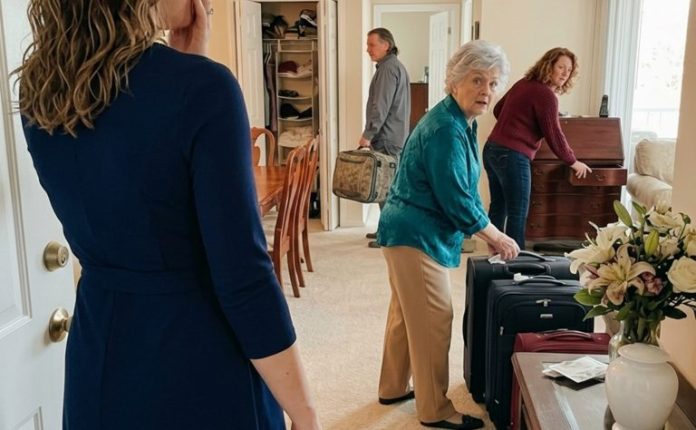
The guest room contained a double bed, an old chest of drawers, and thirteen cartons from Sarah's clothing business.
Some had shipping labels attached.
Others were marked with a black marker.
WINTER TOPS.
ACCESSORIES.
CLEARANCE ITEMS.
In the room where I kept my sewing machine, another stack stood beside the closet.
I recognized several of the boxes because I had helped Sarah carry them upstairs eighteen months earlier.
At the time, she had explained that her online business was experiencing a temporary slowdown.
She intended to reorganize the inventory and relaunch the following season.
I had encouraged her.
Starting a business was difficult. Arthur and I had both worked long hours, and I admired anyone willing to make an honest effort.
When Sarah asked whether she could store a few things temporarily, I agreed.
A few boxes became twenty.
Twenty became nearly forty.
Eventually, I could barely reach the sewing table without moving something.
I had stopped inviting my friends to use the guest room because I would have needed to clear a path first.
The last time I mentioned the boxes, Sarah had sighed and said she did not have enough space at home.
I remembered answering that we would work something out.
I had said those words so often that they had become automatic.
I opened my notebook and began making an inventory.
There were cartons of clothing, plastic bins of accessories, a folding display rack, several unused garment bags, and a small machine for printing shipping labels.
I photographed the boxes without opening sealed packages.
I was not interested in examining Sarah's merchandise or deciding what it was worth.
I simply wanted an accurate record of the belongings that needed to be returned.
After an hour, I sat on the edge of the guest bed.
Dust floated through the sunlight near the window.
I looked at the pale curtains Arthur had helped me hang years earlier.
The room was supposed to be available for people I wanted to welcome.
Instead, it had become an extension of a business I did not own.
I wondered how many small agreements had accumulated in my life until they resembled permanent obligations.
The phone rang again.
Brenda's number appeared.
I considered ignoring it.
Then I answered.
“Hello?”
It was David.
“Mom, it's me.”
His voice was tired.
“Hello, sweetheart.”
That old word came naturally, despite everything.
He was quiet for a moment.
“Can we talk without everybody getting upset?”
“I would like that.”
“Sarah's really angry.”
“I understand.”
“She says you planned this to hurt us.”
“Did you tell her I had been paying those bills for five years?”
He exhaled.
“She knows.”
“Does she?”
“Mom.”
“I'm asking a serious question, David. Does Sarah understand that those were my accounts, paid from my retirement income?”
He hesitated.
“She understands now.”
That answer told me more than a long explanation would have.
He had never considered the need to discuss it with her.
The services had simply been there.
Like the kitchen light when someone flipped a switch.
Like the heat that came on when the thermostat dropped.
Like a mother who would take care of things without making anybody uncomfortable.
“I bought temporary internet access,” David said. “It'll get me through the weekend.”
“I'm glad.”
“We'll have to set up our own phone accounts.”
“Yes.”
“It's going to cost more than we expected.”
I let that sentence settle.
“Then you'll know what I was paying.”
He said nothing.
I heard a car passing behind him.
“Are you outside?” I asked.
“I'm sitting in the parking lot.”
“Where's Sarah?”
“She went with her mother to get her hair done.”
I looked at the clock.
It was nearly two.
The salon visit was not my concern.
Yet the contrast troubled me.
David was sitting in a parking lot, trying to finish work after losing a service I had paid for.
Sarah was spending the afternoon at an expensive appointment.
I did not comment.
People are entitled to decide how to spend their money.
But they are also responsible for the consequences of those decisions.
“There's something else,” I said.
He sounded wary.
“What?”
“I need Sarah's business inventory removed from the house.”
“Mom, we don't have room for all that.”
“I know. That's why it's been here.”
“Can we deal with it another time?”
“We've been dealing with it another time for almost two years.”
He was silent.
“I've counted the boxes,” I continued. “I'll arrange for them to be transported to your address. You and Sarah can decide what to keep, sell, or donate.”
“You're sending everything back?”
“Yes.”
“She's going to be furious.”
“David, I'm not doing this to make your wife angry. I'm doing it because I would like to use my own rooms.”
He drew a slow breath.
“Okay. Send me the list.”
I almost asked whether he thought Sarah would allow it.
Instead, I asked for his email address to confirm that it was still the same.
It was.
Before we ended the call, he said, “Mom?”
“Yes?”
“Did you get home all right last night?”
I closed my eyes.
It was such a small question.
It was also the one I had waited to hear for nearly twenty hours.
“Yes, David. I got home safely.”
“Good.”
He seemed about to say something else.
Then another voice sounded in the background, and he ended the call.
I remained seated for several minutes with the phone in my hand.
I did not want to punish him.
That was important to me.
I wanted him to understand that actions had consequences, even when nobody raised their voice.
I also wanted to stop protecting him from the ordinary responsibilities of adulthood.
There is a peculiar temptation in motherhood to keep solving problems long after children have acquired the skills to solve them themselves.
When David was sixteen, Arthur insisted that he learn how to replace a flat tire.
David complained that he would simply call roadside assistance.
Arthur made him practice anyway.
“You might need help someday,” he said. “But it matters that you know what you're asking somebody else to do.”
I had forgotten that lesson.
Or perhaps I had remembered it for everything except money.
That afternoon, I contacted a local moving service and explained that I needed an estimate for transporting boxed household goods between two addresses.
The woman who answered asked how many cartons there were.
When I told her, she paused.
“That's quite a collection.”
“It has accumulated.”
“We can give you a firm price after seeing the photographs.”
I sent the images and measurements.
Within an hour, she provided an estimate and several available collection dates.
I chose Wednesday.
That would give David and Sarah time to arrange space and prepare for the delivery.
I emailed David the inventory and the collection details.
I explained that the boxes would remain sealed and that I would pay the one-time transportation cost because I was the person initiating the move.
I did not want the return of their belongings to become another financial argument.
The expense was worth reclaiming my rooms.
After sending the email, I made a second list.
This one concerned the things I actually wanted in my house.
My sewing table near a window.
A guest bedroom that could accommodate visitors.
A place for the books I had been stacking on the hallway floor.
A kitchen that did not contain bags of supplies belonging to somebody else's business.
Halfway down the page, I stopped writing.
I had filled a notebook with ways to make my existing house more useful.
But perhaps usefulness was not the only question.
Perhaps I should have been asking what kind of life I wanted to have.
By late afternoon, the weather had turned gray.
I carried a basket of laundry downstairs and looked through the living room window.
Two maple leaves had stuck to the glass.
Arthur would have fetched a ladder to clean them off immediately.
I smiled at the memory.
He had been meticulous about the outside of the house.
I had always been more concerned with the inside.
Between us, we had maintained the property for decades.
Since his death, I had managed the repairs myself, but the responsibility had become heavier.
Last winter, I paid to replace a section of guttering.
In spring, a plumber had repaired a pipe behind the upstairs bathroom.
The yard needed regular attention, and the back steps would eventually require replacement.
None of those jobs was disastrous.
But they consumed time and money I could have spent elsewhere.
I opened the desk drawer and took out the lake property folder again.
One photograph showed a two-bedroom condominium with a small private patio.
Another showed a compact brick house near a walking trail.
I had begun collecting the listings several months earlier, after visiting the lakeside area with a friend.
We had walked along the water, eaten sandwiches on a bench, and watched two children trying to launch a toy sailboat.
I remembered thinking that I could get used to spending mornings there.
Then I had come home and pushed the idea aside.
It seemed easier to remain where everyone expected me to be.
I had considered downsizing before Brenda ever raised the subject.
That was the difference she had failed to understand.
Moving because I chose to was one thing.
Being ordered to surrender my home so that another family could enjoy it was something entirely different.
My phone vibrated.
This time, the message was from David's email account.
He had received the inventory.
He wrote that Sarah was unhappy but that they would make arrangements for the boxes.
He also asked whether I could keep the warehouse membership active for another month.
I read the request twice.
Then I wrote back.
No, David. The membership arrangement has ended. You and Sarah can purchase one if you decide it is worthwhile.
I reread my reply before sending it.
It was neither hostile nor apologetic.
I was beginning to understand that a boundary did not need an elaborate defense.
Sometimes a clear answer was enough.
That evening, I made vegetable soup and ate at the kitchen table with the radio playing quietly.
I did not hear from Sarah.
I learned later that she had spent part of the afternoon at an upscale salon with Brenda.
The appointment cost one hundred eighty dollars.
When Sarah presented her credit card, the payment was declined.
She tried again.
The same result appeared.
Brenda eventually paid.
The incident had nothing to do with my canceling their phone service. I had no access to Sarah's personal bank or credit accounts.
But it exposed something the household had been ignoring.
Their discretionary spending had continued while their available money grew increasingly limited.
For years, my monthly contributions had allowed them to overlook the gap.
Now even Brenda was beginning to question how they managed their finances.
I did not know any of that on Saturday evening.
All I knew was that I had a quiet kitchen, a difficult relationship with my son, and a folder of property photographs I could not stop examining.
Sunday morning brought sunshine.
I went outside with a cup of coffee and stood beneath the maple tree.
Its branches moved gently in the breeze.
The bark had become rough and deeply ridged.
I could still picture David at nine years old, holding the sapling upright while Arthur filled the hole with soil.
David had wanted the tree to grow quickly.
Arthur told him that most worthwhile things required patience.
“Will it be taller than the house?” David had asked.
“One day, perhaps.”
Now it was.
I pressed my palm against the trunk.
For years, I had treated the tree as a reason to remain.
But Arthur had planted it so that it could grow.
He had not planted it to keep me from growing older or discovering new things.
I went inside and made a pot of coffee.
Then I sat at the kitchen table with a calculator and my notebook.
I began comparing the cost of maintaining my current home with the expenses of living somewhere smaller.
I included property taxes, insurance, routine maintenance, utilities, lawn care, and the repairs I expected over the next several years.
I had a pension and savings.
I was not in immediate financial difficulty.
But I was spending a considerable amount of time maintaining space I no longer needed.
A smaller home would not automatically make life easier. Condominiums had association fees, and some communities imposed restrictions that would not suit me.
I needed to examine those matters carefully.
Still, the figures were worth considering.
I had spent years reviewing other people's payroll records and preparing sensible budgets.
For my own retirement, I had allowed emotion and habit to make many of the decisions.
I put the calculator aside.
There was a particular photograph in the folder that I kept returning to.
The condominium had a ground-floor entrance, a modern kitchen, two bedrooms, and a small patio.
It was near the lake, but not so close that every window faced passing visitors.
The listing mentioned a walking path, private parking, and a modest garden area.
I imagined placing Arthur's old chair beside the living room window.
I imagined keeping my sewing machine in the second bedroom.
I imagined having fewer stairs to climb when my knees were stiff.
Then I imagined David's reaction.
He would be surprised.
He would probably be upset.
He might ask what would happen to the house he had always considered part of his future.
I noticed that I was already constructing arguments against a decision I had not yet made.
This time, I stopped myself.
I was allowed to consider a move without obtaining my son's approval.
That afternoon, I walked through the house with a different purpose.
I did not look for reasons to remain.
I looked at what I would choose to take with me if I left.
Arthur's books.
The photographs.
The small oak table in the upstairs hallway.
The blue pottery bowl David made for me in fourth grade.
Several pieces of furniture that had become dear through years of use.
Other things were simply things.
I had stored them because there was room.
My wedding dress remained in a box in the upstairs closet, carefully wrapped in tissue paper that had yellowed with age.
A broken lamp sat beside it.
There were three sets of curtains I had never used again.
I found enough spare dishes to serve a gathering twice the size of any I had hosted in recent years.
It struck me that I had been carrying the weight of an entire household's history through rooms that no longer reflected my daily life.
I did not want to erase that history.
I wanted to decide which parts deserved a place in my future.
On Monday morning, I woke before six.
I made breakfast, watered the houseplants, and reviewed the folder again.
Then I found the business card of a real estate agent named Helen, whom I had met through a friend several months earlier.
Helen had been working in the area for many years.
She knew the neighborhoods around my house and had helped several people find smaller homes after retirement.
I had kept her card without mentioning it to anyone.
At nine fifteen, I called.
“Helen Carter's office,” a woman answered.
I introduced myself and asked whether Helen was available.
A moment later, a pleasant voice came on the line.
“Georgia! I remember you. How can I help?”
I glanced toward the kitchen window.
The maple tree filled much of the view.
“I've been thinking about selling my house,” I said.
Helen did not immediately congratulate me or ask how quickly I wanted to list it.
Instead, she asked a sensible question.
“Have you decided that moving is right for you, or are you still exploring?”
I liked her for that.
“I'm exploring seriously,” I answered. “I would like to understand what the house might be worth and what I could afford afterward.”
“Then we should start with information, not pressure.”
We discussed the property's age, improvements, condition, and location.
I explained that the roof had been replaced several years earlier and that the kitchen had been updated after Arthur's death.
Helen asked about the number of bedrooms and bathrooms, the lot, and the surrounding homes.
She suggested visiting the following morning.
“Tuesday at ten?” she asked.
“That would be perfect.”
Before ending the call, I asked something that had been troubling me.
“Is it foolish to consider leaving a house I've owned for thirty years?”
Helen was quiet for a moment.
“Not necessarily. But you should know whether you're moving toward something you want or away from something you're trying to escape.”
I thought about Brenda at the steakhouse.
I thought about Sarah ordering me to leave.
I thought about David staring at his glass.
Then I pictured the little patio near the lake.
“Perhaps both,” I said.
“That's worth sorting out before you sign anything.”
After we hung up, I walked into the living room.
For the first time in years, I imagined someone else sitting on the sofa, looking through the windows, and discussing where their furniture might go.
The thought was painful.
It was also strangely exciting.
Later that day, David emailed to confirm that he would be home when the boxes arrived Wednesday.
There was no apology.
There was no question about how I was doing.
But there was a practical acknowledgment that the belongings would be returned.
I appreciated that small movement toward responsibility.
I replied with the delivery information and nothing more.
Then I spent the afternoon cleaning the downstairs windows and gathering paperwork Helen would need.
I found the property deed in the filing cabinet.
The mortgage discharge was in a separate folder.
There were receipts for the roof, kitchen improvements, and recent repairs.
I arranged them neatly across the dining table.
As I worked, a memory surfaced.
Several years earlier, David had visited after a heavy storm.
A branch had fallen near the back fence, and he helped me cut it into manageable pieces.
We worked until dusk, laughing about how Arthur would have insisted on saving the wood for some future project.
Afterward, we sat on the porch drinking lemonade.
David had looked at the house and said, “I hope this place always stays in the family.”
At the time, I thought it was a tender remark.
Now I wondered whether he had gradually begun to treat it as a promise.
I had never promised him the house.
Arthur had never promised it either.
We had expected our son to build his own life.
We had hoped he would remain close to us.
Those were different things.
By evening, I had gathered everything Helen requested.
I placed the documents in a folder beside the front door.
Then I took the lake photographs from my office and added them.
The two sets of papers lay together.
One concerned the home I might leave.
The other concerned the home I might choose.
I stood looking at them for a long time.
For the first time, my retirement was beginning to feel like something I could shape rather than something I had to preserve for other people's convenience.
When Helen arrived the following morning, I intended to show her the whole house.
Every room.
Every repair.
Every feature Arthur and I had built our lives around.
And when she asked what I wanted to do next, I intended to answer for myself.
END PART 2