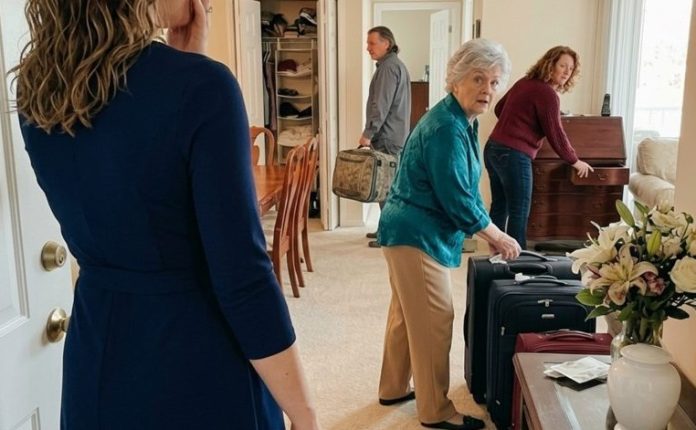
Brenda was halfway through her steak when she asked how soon I intended to move out of my house. My son, David, stopped cutting his food, but he did not look surprised.
That frightened me more than the question.
We were seated in a downtown steakhouse where the lights were low enough to make everyone look rested and the waiters carried plates as carefully as wedding gifts. I had been invited to a family dinner, not a discussion about surrendering the home where I had lived for thirty years.
I placed my knife beside my plate.
“I'm sorry, Brenda. Move out of which house?”
She dabbed the corner of her mouth with her napkin.
“Your house, Georgia. The one with four bedrooms.”
Sarah, my daughter-in-law, glanced at her mother and then at David. Their exchange was brief, but something about it told me I was the only person at the table who had not expected this conversation.
My name is Georgia Owens. I was sixty-four that autumn, ten years widowed, and recently retired from a job keeping payroll records for the local school district.
I had one child, David, who was thirty-two and married to Sarah. They lived fifteen minutes away in a townhouse with a narrow driveway, two bedrooms, and a kitchen that Sarah complained could barely accommodate two people.
Their home was perfectly respectable. They had chosen it themselves.
My house was larger, certainly, but its size had never seemed unreasonable while my husband, Arthur, was alive. We had bought it when David was two, using savings we had accumulated by taking extra shifts and postponing nearly everything that could be postponed.
Arthur installed bookshelves in the living room. I painted the kitchen cabinets twice. We spent three summers improving the backyard, and Arthur planted a maple tree near the driveway with David's help.
By the time Arthur died, the mortgage was long gone.
The house had become mine to care for.
Not mine to distribute whenever somebody else decided they needed more space.
David had telephoned on Wednesday evening to invite me to dinner.
“We haven't all sat down together in a while,” he said.
That was true. His work had become demanding, Sarah had begun taking additional hours at a dental office, and I had spent several weekends helping a friend sort donations for the community library.
I had been pleased by the invitation.
I even bought a new scarf for the occasion, a soft blue one that reminded me of a dress Arthur used to admire.
David had not mentioned that Sarah's mother would be joining us.
I learned about Brenda's visit when I arrived and saw her examining the menu as if she were preparing a formal complaint.
Brenda lived in Chicago and visited her daughter several times each year. She was a woman who had opinions about every possible arrangement, from the proper temperature of drinking water to how frequently adults should replace their living room furniture.
Her opinions were usually delivered as instructions.
That evening she considered the restaurant too cold, the bread insufficiently warm, and the service unnecessarily slow.
Sarah apologized to her mother for each inconvenience, although none of them was Sarah's responsibility.
David seemed intent on keeping the evening peaceful.
I recognized that expression.
It was the same one he wore as a boy when he had broken something and hoped Arthur would notice only after he had gone upstairs.
After the server brought our meals, Brenda began discussing David and Sarah's townhouse.
“They're doing their best,” she said. “But honestly, I don't know how anyone expects them to build a future in such a cramped place.”
I took a sip of water.
“They've made some lovely improvements.”
“Decorating isn't the problem.”
“What is?”
“Space. Stability. Assets.”
She pronounced the last word as though it settled an argument I had not known we were having.
Sarah pushed a piece of potato around her plate.
“Mom thinks we've been making things harder than necessary.”
Brenda smiled at me.
“Your mother has a solution,” she told David.
He kept his gaze on his dinner.
I felt something cold settle beneath my ribs.
Brenda continued before anyone could interrupt.
“Georgia, you've had the benefit of that property for decades. You don't need four bedrooms at your age. David and Sarah could put the space to better use.”
“What exactly are you suggesting?”
“That you give them the house. You could move into a smaller apartment. Something convenient, with an elevator and fewer responsibilities.”
For a moment, I genuinely thought I had misheard her.
I looked at Sarah.
She did not appear shocked.
Instead, she looked impatient, as though her mother had finally raised a subject she had been waiting to discuss.
“Mom is thinking about the family,” Sarah said.
“So am I.”
“Then surely you can see her point.”
“I can see that you would like my house.”
Brenda sighed.
“Must you make everything sound so confrontational?”
I nearly laughed.
She had suggested that I remove myself from my own home and transfer it to two employed adults. Yet somehow my refusal was the difficult part of the conversation.
Arthur and I had not acquired that property through luck.
He had worked maintaining electrical systems at a manufacturing plant. I had taken extra bookkeeping assignments during school holidays. We bought secondhand furniture and repaired things other people might have replaced.
On Saturdays, Arthur often returned from the hardware store with a small paper bag containing screws, nails, or fittings.
“Another expensive weekend?” I would tease.
“Cheaper than hiring somebody.”
He would grin, then spend the afternoon fixing something that had been bothering him for months.
I could still remember him standing in our unfinished kitchen, sawdust in his hair, insisting that the crooked cabinet door would eventually hang straight.
When the house was paid off, he brought home a small bakery cake and wrote PAID IN FULL across the cardboard box.
We ate it at the kitchen table.
David had been young, but he remembered.
He remembered because Arthur made him sign a pretend certificate declaring the Owens family free of mortgage payments.
That certificate was still tucked into a photograph album in my bedroom.
I looked at my son across the restaurant table.
“You know what that house means to me,” I said.
He shifted in his chair.
“Mom, nobody is saying you don't care about it.”
“Your mother-in-law is asking me to give it away.”
Brenda put down her fork with deliberate care.
“I'm suggesting that a mother should consider her child's future.”
“My child is thirty-two.”
“And still your child,” she replied.
I could hardly argue with that.
David would always be my child.
But there was a difference between loving him and believing he had a claim to the roof over my head.
I had spent five years struggling to understand where that difference belonged.
When David and Sarah first married, they seemed determined to establish their own household.
They bought inexpensive dishes, assembled furniture from flat boxes, and laughed about the crooked bookshelf David installed in their second bedroom.
Then David went through a difficult period at work.
His employer reorganized several departments. His income became uncertain for a time, and Sarah was still working irregular hours.
They asked whether I could help with a few household expenses until things settled.
Of course I agreed.
I added their mobile phone lines to my account because it was easier than arranging separate payments.
Later, when David began working from home, I paid for their broadband service.
Sarah needed a warehouse membership for household shopping and supplies for a small online clothing business she was trying to establish. I included her on mine.
It was supposed to last several months.
Several months became a year.
A year became two.
Eventually, nobody mentioned the arrangement at all.
The bills simply continued arriving in my name.
David's employment stabilized. He earned seventy-five thousand dollars annually, a salary that would have astonished Arthur when we were first married.
Sarah worked part-time at the dental office and occasionally sold clothing from her remaining boutique inventory.
They were not wealthy, but they were not helpless.
Still, whenever I considered suggesting that they take responsibility for their own services, some new expense seemed to arise.
A car repair.
An insurance payment.
An unexpected purchase for the house.
I kept telling myself that a mother could afford to be patient.
At the restaurant, Sarah leaned toward me.
“Georgia, you've said yourself that maintaining that place is getting harder.”
“That doesn't mean I'm ready to give it to you.”
“You hardly use the upstairs rooms.”
“I use the house.”
“Not all of it.”
“Sarah, please listen to what you're saying.”
She glanced at her mother.
Brenda gave a little shake of her head.
“People become unreasonable when they're attached to possessions,” Brenda observed.
I wanted to remind her that she owned a condominium in Chicago and had never offered it to her daughter.
Instead, I looked at David.
“Do you agree with them?”
His knife stopped moving.
The restaurant seemed suddenly louder.
Glasses touched plates. A server laughed softly near the kitchen doors. Somewhere behind me, somebody was celebrating a birthday.
David cleared his throat.
“I think everyone's getting upset.”
“That wasn't my question.”
“Can we talk about something else?”
“Do you agree that I should give you my house?”
Sarah answered before he could.
“We're not demanding anything. Mom is pointing out what would make sense.”
“Giving someone my house is a demand when they've made it clear that refusing is unacceptable.”
Brenda drew herself upright.
“You've misunderstood my intentions.”
“Then explain them.”
She spread her hands.
“David is your only son. Surely the house will belong to him eventually. Why make him wait until you're gone?”
The words landed harder than I expected.
Not because they were particularly clever or cruel.
Because she said them so casually.
I was sitting at dinner, perfectly healthy, still making plans for my retirement, and Brenda had reduced the remainder of my life to an inconvenient waiting period.
I looked down at my hands.
There were small brown spots along my wrists now. My wedding ring had become slightly loose since Arthur died.
I was older than I had once imagined being.
I was not finished living.
“Brenda,” I said, “the house is where I live. It is not something I am holding for other people until they need it.”
Sarah exhaled sharply.
“There you go again.”
“Again?”
“Making us sound greedy.”
I met her eyes.
“I'm asking you to respect an answer you don't like.”
Her face reddened.
For the first time, I noticed that the neighboring table had fallen unusually quiet.
Sarah noticed too.
She lowered her voice, but the anger remained.
“If you're determined to ruin dinner, Georgia, then pay the bill and leave.”
I waited.
One second.
Two.
David remained motionless.
I had expected him to intervene before things reached that point. I had expected him to tell Sarah she was speaking to his mother, or perhaps suggest that everyone needed a little time to calm down.
He did neither.
He studied the condensation on his glass.
I heard myself say his name.
“David?”
He swallowed.
“Mom, please. Let's not make a scene.”
A scene.
His wife had ordered me to pay for four people's dinner and leave the table.
Yet I was the one he feared might make a scene.
Something inside me shifted.
It was not a dramatic feeling. I did not suddenly hate my son or regret raising him.
I simply saw the situation without the excuses I had been supplying for years.
He had grown accustomed to my help.
So had Sarah.
And somewhere along the way, they had begun confusing my willingness to give with their right to receive.
I stood and folded my napkin.
“All right.”
Sarah blinked.
“What?”
“I'll settle the bill.”
Brenda adjusted her necklace.
“There really is no need to be theatrical.”
“I'm leaving because Sarah asked me to.”
I placed my chair neatly beneath the table.
David looked up at last.
“Mom, wait.”
I paused.
For a moment, I hoped he would finally say something that mattered.
Instead, he asked, “Are you going to drive home now?”
“Yes.”
“Okay.”
I walked away before he could see how badly that small exchange hurt.
At the front desk, I asked whether I could settle the entire table's check.
The manager printed it for me.
The total, including the tip, came to two hundred fifty dollars.
I paid with my card and kept the receipt.
It seemed important, although I could not have explained why at the time.
When I passed the dining room on my way out, I saw David looking toward the entrance.
He did not stand.
Outside, the air smelled faintly of rain and car exhaust. I walked to my vehicle without putting on my scarf.
I sat behind the steering wheel for several minutes before starting the engine.
Ten years earlier, after Arthur's funeral, David had stood beside me in our driveway and promised I would never have to manage everything alone.
I had not asked him to make that promise.
I knew he had meant it.
But promises mean very little if people stop noticing the person standing in front of them.
The drive home took twenty minutes.
By the time I turned onto my street, the neighborhood was quiet.
My porch light illuminated the lower branches of the maple tree Arthur had planted.
Its trunk was thick now, and several limbs stretched across the driveway.
I parked beneath it and sat looking at the house.
For years, the thought of living anywhere else had seemed almost disloyal to Arthur.
I had told myself I stayed because of our memories.
But that evening I wondered whether memories were the only reason.
Perhaps I had also stayed because David expected the house to remain exactly where he had left it.
Perhaps keeping everything familiar had become another way of protecting him from change.
Inside, I hung my scarf in the hallway and took off my shoes.
I did not cry immediately.
I washed my hands, put the kettle on, and stood at the kitchen window while it heated.
Arthur's old coffee mug was on the shelf above the sink. I sometimes used it for tea because its handle was comfortably large.
I carried it into my office.
My laptop was sitting beside a stack of utility statements.
I had always been careful about records. Decades of working with school payroll had taught me that promises were easier to understand when their details were written down.
I opened the folder containing the household accounts.
There were the two mobile phone lines.
There was the broadband subscription at David and Sarah's townhouse.
There was the warehouse membership that Sarah used for shopping and occasional business purchases.
Every account was registered to me.
Every payment came from my bank.
I scrolled through several years of statements, remembering how often I had ignored the amounts because I thought checking them too closely would make my generosity seem conditional.
But generosity did not require me to become invisible.
I reviewed the cancellation terms carefully.
The phone lines could be suspended at the end of the day. The broadband account could be closed through its online management portal. The warehouse membership permitted me to remove additional household members.
I was not withdrawing money from anyone else's account.
I was not interfering with their wages or rent.
I was simply discontinuing services I had paid for voluntarily.
There were practical consequences, of course.
David would need another connection for his work.
Sarah would have to arrange her own phone service.
They would experience inconvenience.
I understood that.
I also understood that neither had asked whether I could still afford the arrangements, or whether I wanted to continue them.
I had become the person who handled those expenses so that nobody else needed to think about them.
I scheduled the phone suspension for 11:59 that night.
The broadband cancellation was confirmed.
I removed Sarah's access to my warehouse membership.
Three confirmation messages appeared in my inbox.
I saved copies.
Then I closed the laptop.
I did not send David an angry message.
I did not post anything online.
There were no threats or demands for an apology.
I cleaned the kitchen counter, rinsed Arthur's mug, and went upstairs.
Sleep took longer than usual.
Several times, I imagined David calling to ask whether I had made it home safely.
He did not.
At eight the following morning, I was in the kitchen making toast when I noticed that the phone beside the fruit bowl was unusually quiet.
No messages.
I checked the cancellations again.
Everything had been processed.
A little after nine, I heard a car pull into the driveway.
I recognized David's vehicle before I looked outside.
He climbed out first.
Sarah followed, moving quickly toward the porch.
Brenda emerged from the rear passenger seat, holding her handbag against her coat.
All three had come.
Sarah reached the front door and struck the brass knocker repeatedly.
“Georgia! Open up!”
I set my breakfast plate beside the sink.
The bread had gone cold.
Walking through the hallway, I could hear Brenda talking sharply behind her daughter.
David stood farther back, both hands in his pockets.
I opened the wooden door but kept the steel security door locked.
Sarah's face was flushed.
“Our phones are disconnected,” she said.
“I know.”
“And the internet isn't working.”
“I know that too.”
She stared at me.
“You did this deliberately?”
“Yes. I ended the accounts I was paying for.”
Brenda pushed forward.
“What kind of mother behaves like this over one unpleasant conversation?”
I looked at her.
“What kind of family asks a woman to surrender her home during dinner?”
“That was a suggestion.”
“It was a demand by the time Sarah told me to pay and leave.”
Sarah crossed her arms.
“You're trying to humiliate us.”
“No, Sarah. I'm declining to continue paying your bills.”
David finally stepped closer.
“Mom, I have a report due Monday. I need the internet.”
“I understand.”
“Can you switch it back on just until I get something arranged?”
I considered him.
His request was practical. His voice was quieter than his wife's.
But he had known for years that the service belonged to my account.
He had never offered to transfer it.
“You can purchase temporary access and arrange your own service,” I said. “You know how to do that.”
Sarah turned sharply toward him.
“David, tell her she can't do this.”
He rubbed the bridge of his nose.
“She can close her own accounts, Sarah.”
I looked at him.
It was the first time since dinner that he had acknowledged my right to decide something without asking the rest of them.
It was not enough to mend what had happened.
But I heard it.
Brenda glanced past the security door into the hallway.
“Look at all this space. You would rather let rooms sit empty than help your own family.”
“You are welcome to disagree with how I live,” I said. “You are not entitled to decide for me.”
Sarah's mouth tightened.
“So we're supposed to cancel everything now?”
“You will need to decide what matters most and what you can pay for.”
A neighbor across the street had stepped onto his porch with a broom.
Sarah noticed him watching.
She lowered her voice.
“Everyone will think we've done something terrible.”
“No one outside this family needs to know anything about our finances.”
David touched her elbow.
“Come on. We'll sort this out.”
Brenda continued talking, but he guided them back to the car.
I closed the wooden door and leaned against it.
I had imagined that standing firm would produce some sudden feeling of victory.
It did not.
My hands were cold.
My breakfast was ruined.
The people I loved were angry, and I did not know whether they would ever understand why I had made that decision.
But I did know I would not reverse it simply to end an argument.
Later that morning, I went upstairs to put away a quilt I had washed.
Two of the spare bedrooms were crowded with Sarah's old boutique inventory.
There were cartons of scarves, plastic bags filled with clothing, unopened boxes of accessories, and a folding display rack that had been leaning against my sewing cabinet for nearly two years.
I had asked David to collect those things repeatedly.
He always promised to find time.
I opened one box and found a bundle of sales tags yellowed at the edges.
That room had once been David's bedroom.
Arthur had painted the walls pale blue when David was eleven.
Now the space looked like somebody else's storeroom.
I sat on the edge of the old bed and wondered when I had stopped making decisions about my own rooms.
Eventually I carried the quilt into my office.
While putting away some papers, I found a folder beneath my desk calendar.
Inside were photographs of smaller houses and condominiums near a lake about forty minutes away.
I had collected them over several months.
There were notes about maintenance costs, floor plans, walking paths, and the distance to the nearest grocery store.
I had not shown the folder to David.
Whenever I imagined telling him, I could already hear the objections.
What about the family house?
What about the spare bedrooms?
What about the things Sarah was storing?
I spread the photographs across my desk.
For the first time, I examined them without automatically considering what my son might think.
One showed a small patio beside a quiet stretch of water.
There was space for a table, two chairs, and several pots of flowers.
I pictured myself sitting there with a book.
Then I looked toward the hallway where the other bedrooms were filled with somebody else's boxes.
I realized I had spent years defending the right to remain in my house without asking whether remaining there was still what I wanted.
I put the lake photographs back into their folder.
I did not yet know what I would do with them.
But I knew I was finished allowing other people to make my decisions for me.
END PART 1