PART 9: The Adoption Process Turned Years of Ordinary Motherhood Into the Record Nobody Could Dismiss
The months that followed were full of paperwork.
Not dramatic paperwork.
No cinematic courtroom battles.
Mostly forms, signatures, certified copies, appointments, and careful questions asked by people whose job was to turn a lived relationship into something the law could recognize.
At first, I resented that.
I had been Ella’s mother through fevers, grief, school mornings, bad dreams, missing teeth, and endless negotiations over vegetables. Nobody had required a judge to certify any of those moments.
Yet now I found myself sitting across from my lawyer discussing documents that would prove what every ordinary day already showed.
School records.
Medical records.
Michael’s custody documents.
Death certificate.
My marriage certificate.
Proof of residence.
Emergency contacts.
Statements showing I had been responsible for Ella’s care before and after Michael died.
Each item sounded clinical.
Together, they told our life.
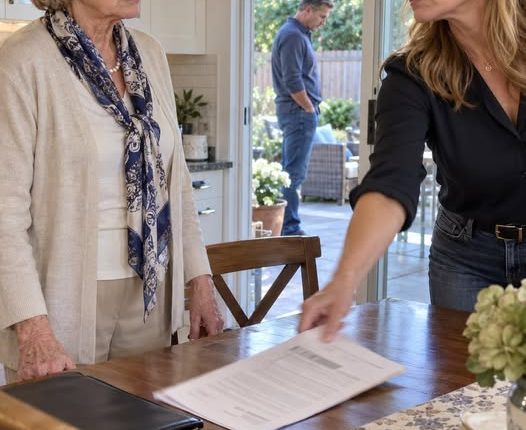
One afternoon, my lawyer spread several documents across the conference table.
“This is good.”
I looked at her.
“What does good mean in lawyer language?”
“It means straightforward.”
“That sounds suspiciously optimistic.”
She almost smiled.
“Rachel has signed the consent.”
I stared at the page.
Her signature sat near the bottom.
Neat.
Legible.
Final enough to make my chest tighten.
“She really did it.”
“Yes.”
“No conditions?”
“None that interfere with the adoption.”
I read the page again.
My parents had brought Rachel into our lives expecting conflict.
They had found the one unresolved legal vulnerability I feared most and pushed directly on it.
Instead, Rachel had looked at Ella.
Actually looked.
And decided not to destabilize her.
That difference mattered.
For all her failures in the past, Rachel had done something my parents had repeatedly refused to do.
She placed Ella’s wellbeing ahead of her own claim.
I folded my hands in my lap.
“What happens next?”
My lawyer walked me through the remaining steps.
Reviews.
Scheduling.
Final documentation.
Waiting.
So much waiting.
That part nearly drove me mad.
I had survived Michael’s funeral.
My parents’ rejection.
The wedding.
The place card.
Rachel appearing on my porch.
But somehow a court calendar had the power to make me check my phone every ten minutes.
Ella handled the waiting better.
At least on the surface.
She occasionally asked questions.
“When will the judge say yes?”
“I don’t know yet.”
“Do judges take vacations?”
“Yes.”
“That seems unfair.”
I laughed.
“They’re people.”
“They should still hurry.”
“I agree.”
Then she would return to coloring or building something on the floor as if we had been discussing the weather.
Sometimes I envied how easily children can move between enormous fears and ordinary life.
One evening, she was drawing at the kitchen table while I sorted another stack of adoption documents.
She looked up.
“Do I get a new birthday?”
“No.”
“Good.”
“Why?”
“I like mine.”
“That’s convenient.”
She considered.
“Do I get a new name?”
“You can keep your name.”
“I like my name too.”
“Excellent. This process is going well.”
She smiled.
Then her expression became serious.
“Will Daddy still be my daddy?”
The question stopped me.
I set down the document in my hand.
“Always.”
“Even if you adopt me?”
“Always.”
Her shoulders relaxed.
That was the fear under the question.
She had already lost Michael once.
She did not want becoming legally mine to erase him.
I moved into the chair beside her.
“Adoption doesn’t take Daddy away.”
“Okay.”
“It just makes the law understand that I am still here.”
Ella looked at me.
“Like paperwork for love?”
I swallowed.
“Something like that.”
She nodded as though that explanation made perfect sense.
Maybe it did.
The strange part was that formalizing our relationship forced me to revisit how much of our family had been built without legal certainty.
Michael and I never doubted what I was to Ella.
Ella certainly did not.
Yet grief had frozen the final paperwork in place, and I had allowed emotional truth to substitute for legal completion.
I did not blame myself for that anymore.
After Michael died, survival took priority.
Getting Ella through each night mattered more than forms.
Feeding us mattered.
Sleeping mattered.
Returning to work mattered.
Some tasks become impossible when grief has filled every available part of a person.
But grief could no longer be the reason I left a door open.
Especially after my parents proved they were willing to push through it.
I kept Mom’s threat saved.
You’ll regret it.
We’ll make sure of it.
I no longer read the message often.
I did not need to.
Its meaning had changed.
At first, it frightened me because I did not know what they planned.
Now I understood.
They found Rachel.
Told her I was a stranger.
Told her Ella should not be with me.
They expected biology to do their punishment for them.
Instead, Rachel signed the consent that moved us closer to final adoption.
Sometimes cruelty collapses under the weight of its own assumptions.
My parents assumed everyone else would see family the way they did.
Blood first.
Appearances second.
Love somewhere far behind.
Rachel did not.
Elizabeth apparently had not either.
That mattered more than any argument I could have made.
I heard occasional fragments about Andrew through relatives who did not understand that I had stopped wanting updates.
Elizabeth had not returned.
The marriage had not recovered.
I never contacted her.
She never contacted me.
I respected that.
Whatever happened between them belonged to them.
I did not need to become part of their divorce simply because the place card had exposed something she could no longer ignore.
The first time a relative tried to explain why Elizabeth left, I stopped them.
“She doesn’t owe me an explanation.”
“But don’t you want to know?”
“No.”
That answer surprised both of us.
I meant it.
For most of my life, my family’s version of events had pulled me into endless analysis.
Why did Mom say that?
Why did Dad choose Andrew again?
Why did Andrew think he could laugh?
Why did Elizabeth leave?
Eventually, questions can become another way of remaining attached to people who have already shown you enough.
The only question I needed answered was whether Ella would be safe.
Every signed form moved us closer.
One afternoon, the call finally came.
My lawyer’s name appeared on my screen while I was standing in the grocery store comparing cereal prices.
I answered immediately.
“Hello?”
“We have the date.”
Everything around me seemed to go quiet.
“When?”
She told me.
I wrote it on the back of my shopping list because my hands were suddenly shaking too much to trust my memory.
A courthouse date.
A final hearing.
Not another review.
Not another temporary step.
The day a judge could make permanent what Ella and I had already lived for years.
I stood in the cereal aisle staring at my own handwriting.
Then I started laughing.
A woman pushing a cart nearby glanced at me.
I did not care.
That evening, I told Ella.
She froze halfway through putting pajamas on.
“The judge date?”
“Yes.”
“The real one?”
“The real one.”
She stared.
Then jumped onto the bed.
“Finally.”
I laughed.
“Please put your pants on before celebrating.”
She ignored me and bounced twice.
Then stopped suddenly.
“Mama?”
“What?”
“Can we get ice cream after?”
The question hit me harder than she knew.
Ice cream.
The place we went after the wedding.
Where she asked whether I was really her mother.
Where she asked whether I would give her back.
I smiled.
“Yes.”
“With sprinkles?”
“Obviously.”
Ella grinned.
And for the first time, the memory of that café did not feel like a wound.
It felt like a line connecting fear to something we were finally about to finish.
END PART 9