PART 12: The Family Tried to Erase Ella, but Their Cruelest Move Made Our Bond Permanent
A year after the courthouse hearing, life had become wonderfully ordinary.
That was the word I kept returning to.
Ordinary.
School mornings.
Lunch boxes.
Homework.
Laundry.
Bedtime.
Ella losing one shoe five minutes before we needed to leave.
Me finding it somewhere that made no sense.
The adoption papers stayed locked away.
I could recite almost every line from memory anyway.
Not because I reread them constantly.
Because the day they became final marked the first time since Michael died that I felt the ground beneath us stop shifting.
Ella was mine.
Legally.
Officially.
Permanently.
No unfinished process.
No vulnerable gap.
No parent or grandparent could use uncertainty as leverage again.
That certainty changed me as much as it changed her.
I had spent too much of my life believing love was enough to compensate for people who refused to behave lovingly.
My parents taught me that lesson slowly.
Michael taught me the opposite.
He showed up.
Listened.
Made room.
He treated Ella and me as people rather than accessories to some family image.
After he died, I feared losing the family we created because I had never finished translating that love into law.
My parents found the weakness.
They thought exposing it would destroy me.
Instead, they gave me the push I had been too grief-stricken to give myself.
Rachel’s decision completed the rest.
I still thought about her occasionally.
I kept the agreement I made with myself.
Ella would know her history.
Not through whispers.
Not through shame.
Not through relatives using biology as a weapon.
When she became old enough to understand more, I would tell her the truth carefully.
Rachel had struggled.
Lost custody.
Recovered.
Returned late.
Then chose not to destabilize Ella’s life.
That choice did not erase the past.
It deserved to remain part of the truth.
Families are complicated.
Children should not have to carry adult shame in order to understand where they came from.
Andrew disappeared from my daily life.
So did Mom and Dad.
I heard occasional updates through relatives.
Andrew rebuilt something after the divorce.
My parents continued living with consequences they once thought belonged to other people.
None of that became my concern.
That was perhaps the most unexpected ending.
Not revenge.
Irrelevance.
Their lives continued somewhere outside mine.
Mine became quieter.
Ella grew.
The wedding stopped being the defining story of our family.
That mattered.
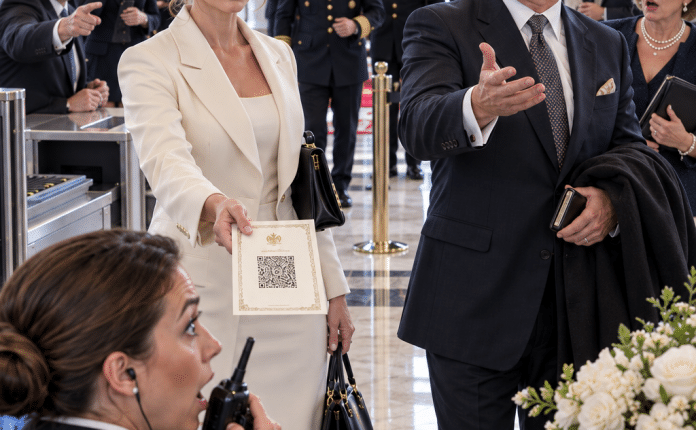
For a while, every memory seemed to orbit that ballroom.
Chandeliers.
White roses.
Cream card.
Fake daughter.
My mother laughing.
Andrew smirking.
Dad telling me not to overreact.
Elizabeth standing.
Then leaving.
Now those details belonged to one terrible day.
Not our identity.
Sometimes Ella still asked questions.
One afternoon, she sat on the kitchen counter while I cut fruit.
“Do you think Grandma knew I could read?”
“I think she really believed you couldn’t.”
“That was dumb.”
“Yes.”
“What if I couldn’t?”
I stopped cutting.
“What do you mean?”
“Would it be okay then?”
“No.”
Ella nodded.
“Good.”
That was an important distinction.
The cruelty did not become acceptable merely because they expected the victim not to understand it.
My mother had laughed and said:
We didn’t think she could read yet.
As if harm only counted once the target recognized it.
Ella had grown enough to see the flaw without anyone explaining it.
She took a strawberry from the cutting board.
“Can I have another?”
“You already stole one.”
“Can I steal another?”
“At least you ask permission.”
She grinned.
Then ran outside.
I stood at the counter smiling.
Children recover in pieces.
So do adults.
I used to think my parents’ favoritism shaped everything about me.
Firstborn.
Wrong gender.
Background child.
Then Michael gave me another identity.
Partner.
Then Ella.
Mama.
After Michael died, my parents tried taking even that word away.
She is not your child.
Give her back.
Fake daughter.
For years, they treated family like a hierarchy they had the authority to define.
Andrew belonged because he reflected well on them.
Michael did not because his life looked complicated.
Ella did not because she lacked the correct biology.
I was acceptable when I stayed useful and quiet.
The moment I made choices they could not control, I became the problem.
Their mistake was believing I still needed their definition.
I did not.
The final proof sat in a folder inside my home.
But the paper was not what created our family.
It protected what already existed.
One rainy evening, Ella climbed into bed beside me after a nightmare.
For one second, the years collapsed.
She had done the same thing after Michael died.
Back then, she was small enough to fit almost entirely against my side.
Now her legs stretched farther down the bed.
“What happened?”
“Bad dream.”
“You want to tell me?”
“No.”
“Okay.”
She settled beside me.
A few minutes passed.
Then:
“Mama?”
“Yeah?”
“You’re still here.”
My throat tightened.
“I’m still here.”
She nodded.
Then went back to sleep.
That was the ending.
Not Andrew losing money.
Not Elizabeth leaving.
Not Mom and Dad embarrassing themselves by demanding reimbursement from people they wanted to impress.
Those were consequences.
The ending was simpler.
I stayed.
When Michael died, I stayed.
When Ella woke crying, I stayed.
When my parents told me she was not mine, I stayed.
When they humiliated her publicly, I picked her up and left with her.
When they found Rachel, I did not run.
When the adoption became frightening and complicated, I finished it.
I stayed where love required staying.
And I left where love was being used as an excuse for cruelty.
My parents tried to destroy me.
They reached for the one fear they believed would make me surrender.
Instead, they forced the unfinished adoption into the open.
Rachel signed the consent.
The court closed the loophole.
Ella became my daughter in every way the law could recognize.
The last time I looked at the cream-colored place card, I considered throwing it away.
Then I changed my mind.
I placed it behind the adoption order.
Not because I needed the cruelty.
Because the contrast told the entire story.
Fake daughter.
Then a court order saying otherwise.
Two definitions.
Only one mattered.
My parents had wanted Andrew’s wedding to display the perfect family.
Instead, it revealed them.
Elizabeth saw Andrew.
Rachel saw Ella.
I finally saw my parents without excuses.
And Ella learned something I wished no child ever had to learn, but something I would spend the rest of my life making sure she never doubted again.
Family is not determined by who gets to print a name on a card.
It is built by the person who keeps showing up.
That night, I switched off the bedroom light.
Ella slept beside me for another hour before I eventually carried her back to her own room.
She barely stirred when I tucked the blanket around her.
Franklin was beside her pillow.
I kissed her forehead.
Then stood in the doorway.
My daughter.
No qualifier.
No explanation.
No loophole.
Mine.
And I was hers.