Written in Olivia’s neat, rounded print, using the same blue ink as the pen on the kitchen table, was a single word.
I stood there for several minutes, the green ribbon draped over my palm like a small, quiet weight. Kayla had been wearing a yellow one, and the boy in the front row had a bright orange band tied around his wrist during the ceremony.
They all had words written on the inside, you see.
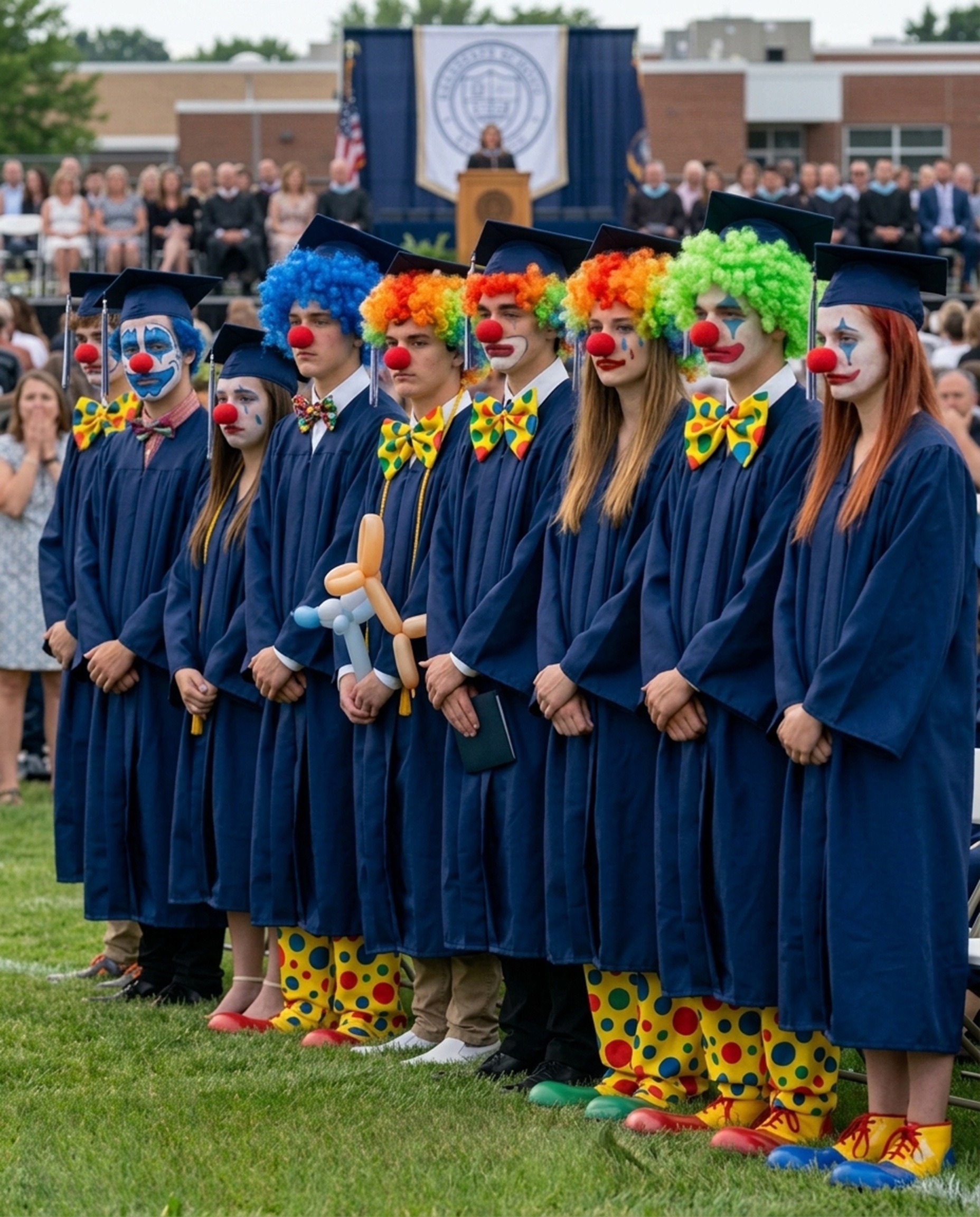
I remembered the way the students had stood up one by one, showing their mismatched socks and joke noses, their gowns parted to reveal the bright flashes of ribbon.
Each piece of fabric carried a different word, a tiny testament to the things Olivia had seen in them during their four years together.
I had to find out what she wrote on the others.
I carried the green ribbon back into the living room, where Brian was sitting on the edge of the sofa. He had finally taken off his dress shoes, his blue socks showing against the faded wool of our rug.
“It says kind,” I said, holding the green strip out to him. “Olivia wrote it herself on the back of the trim.”
He took the ribbon, holding it under the light of the floor lamp. He turned it over, his rough thumb passing over the blue lettering twice before he set it down on the side table.
“Kayla told me the others have them too,” I said, sitting in the armchair opposite him. “Brave on some, loved on the others. She spent the entire month of April cutting those ribbons and writing on them in her bedroom while we thought she was just resting.”
He did not ask how I knew.
Brian cleared his throat, his eyes fixing on the framed print of the Oakhaven valley that hung above the fireplace. He checked his silver wristwatch again, though only five minutes had passed since we left the kitchen.
“It is like a template,” he said, his voice tight. “When you build a cabinet, you layout the pieces before you cut the timber so you don’t waste the good oak.”
“We have forty-one thousand dollars in the savings bonds,” I said, my voice dropping an octave. “The money we set aside for her tuition at Ohio State.”
Brian did not look up, but his shoulders went rigid under his white shirt. The clock on the mantel ticked once, a sharp, metallic sound that seemed to mark the distance between us.
“That was for her future, Evelyn,” he said.
“This is her future,” I said.
I smoothed my skirt again, the floral pattern familiar under my palms. The savings bonds were sitting in the safety deposit box at the Oakhaven State Bank, forty-one thousand dollars in crisp paper that we had accumulated over fifteen years of skipping summer trips and keeping the old Buick running.
“We are going to use her college fund to keep her work going, Brian,” I said.
He looked at me then, his gray eyes searching my face for some sign of hesitation. The heavy fan in the hallway seemed to grow louder, filling the silence while he processed the words.
“A permanent scholarship,” he said, the words falling slowly. “For the kids who don’t always get the high marks, but the ones who look out for the rest.”
“The ones Olivia always noticed,” I said.
He stood up and walked to the window, looking out at the gravel driveway where the gray Buick sat in the gathering dusk. The car had eighty-two thousand miles on it, and the muffler would need replacing before the autumn rains started.
“It will take some restructuring,” Brian said, his hand resting on the window frame. “Marcus will know how to set up the foundation so the principal stays whole.”
“We will call him tomorrow morning,” I said.
He did not agree, but he did not say no.
“He will talk about tax dividends and structural growth,” Brian said, a faint smile touching the corner of his mouth. “But he will get the paperwork done right.”
I left him by the window and walked up the stairs to the bedroom. The air was cooler up here, carrying the faint scent of the lilac bushes that grew along the backyard fence.
I sat at the small writing desk in the corner of our room, turning on the brass lamp. The yellow light pooled over a pad of lined paper and Olivia’s favorite blue ink pen, which I had brought up from the kitchen.
I began to write, my handwriting shaky at first, then growing steadier as the sentences took shape on the page.
The Olivia Miller Memorial Scholarship, I wrote at the top of the sheet.
My hand was steady now.
I did not write about grades or athletic achievements, you see. I wrote about the quiet things, the small acts of decency that go unnoticed in a crowded hallway.
I specified that the recipient must be chosen by a committee of peers and teachers, based on the qualities of kindness and quiet leadership. The forty-one thousand dollars would remain untouched, the annual interest providing a thousand dollars each year for a graduating senior.
The paper felt thin under my hand, but the words carried a weight that the bank accounts never could.
There was no turning back from this.
I wondered if the school board would accept a criteria that did not rely on grade point averages or test scores. Principal Davis was a formal man, and the rules of the district were rigid, built on decades of precedent that favored the highest achievements.
I knew we would have to fight Principal Davis on this point.
But I knew Kayla would help me find the right words to convince them.
I read through the draft twice, correcting a spelling mistake in the third paragraph. The house was quiet now, the only sound the occasional hum of a passing car on the state route half a mile away.
I signed my name at the bottom of the rough scholarship draft.
Marcus tapped his blue pen against the yellow legal pad, the plastic clicking in a steady, dry rhythm that matched the hum of the air conditioner. The office smelled of old paper and leather chairs, a quiet room high above the main street of Oakhaven.
“The structure here is what secures the longevity,” Marcus said, pointing the tip of his pen at a column of figures. “A donor-advised fund allows the principal to remain untouched while we yield enough annual growth to cover the award. We are looking at a system built for structural growth, not a one-time payout.”
I smoothed my floral skirt, pressing the fabric flat against my knees. The paper on his desk showed the forty-one thousand dollars, our entire college savings for Olivia, now divided into neat, bloodless percentages.
“We want it to last,” I said. “It has to be there every year, you see.”
Brian shifted in his chair, his silver wristwatch catching the fluorescent light as he turned his arm to check the face. It was ten past ten.
“We need to sand down the rough edges of this thing before we take it to the school,” Brian said, his voice low but steady. “If we do not get the grain right from the start, the whole piece will warp later on.”
Marcus nodded, his expression remaining perfectly professional as he slid a three-page document across the desk toward us.
“This draft designates you both as the sole advisors,” Marcus said. “You control the distribution criteria, which means the school cannot divert these funds to general maintenance or athletic equipment.”
I looked at the top page, where our daughter’s name was typed in bold black letters. The words Olivia Miller Memorial Scholarship looked heavy on the white paper, as if they had been stamped there by a machine that did not care about the girl who used to leave her shoes in the middle of the kitchen floor.
“Is this legally binding?” I asked.
Marcus tapped the page with his blue pen. “Once you sign the transfer, the money belongs to the foundation, but the criteria are locked.”
I reached for the pen, but Brian laid his hand over mine, his palm warm and slightly rough from his afternoon hours in the garage.
“We have to present this to the board at two,” Brian said. “Let us keep the paper in the folder until we see if Davis is on our side.”
I let go of the pen, the metal clip on my purse clicking as I tucked the unsigned draft into my folder.
The drive to the high school administration building was quiet, the gray Buick carrying us past the park where the maple trees were already heavy with summer leaves. The parking lot was mostly empty, save for a few yellow school buses parked in the far lane.
Principal Davis met us at the double doors of the board room at exactly two o’clock. He looked formal in his dark blue suit, his gold-rimmed glasses catching the light as he took them off to polish them with the wide end of his silk tie.
“The board members are already seated,” Principal Davis said, his voice measured and quiet. “They have reviewed the financial outline you sent, Mrs. Miller. They are prepared to listen.”
We followed him into the room, where seven people sat around a long oak table. The smell of fresh floor wax was strong, reminding me of the morning of the graduation ceremony.
I sat at the foot of the table, opening my folder and placing the draft on the polished wood.
“We are not offering this money for the highest grade point average,” I said, looking at the board members. “And we are not looking for the varsity captain.”
A woman near the middle of the table, her gray hair pulled back in a tight clip, leaned forward. “The district has several academic trusts already, Mrs. Miller. Our current guidelines prioritize students in the top ten percent of the graduating class.”
“This scholarship will search for the quiet ones, the ones Olivia always noticed,” I said.
Brian leaned his elbows on the table, his fingers interlaced. “If you only reward the ones who are already at the top, you leave a lot of good wood on the forest floor. We want to find the student who keeps the peace, the one who helps without asking for a trophy.”
Principal Davis finished polishing his glasses and slid them back onto his nose, the gold frames sitting perfectly straight.
“The criteria must be objective enough for our committee to evaluate,” Davis said. “How do you measure kindness?”
I reached into my purse and pulled out the small blue ink pen that Olivia had kept in her desk drawer, placing it beside the paper.
“You look at what they do when they think nobody is watching,” I said. “You ask the hall monitors, the cafeteria staff, and the librarians. They know who the kind ones are, you see.”
The board members looked at each other, the silence in the room stretching until the clock on the wall gave a loud, metallic tick.
The gray-haired woman tapped her pencil against her notebook. “We would need a separate nomination form. One that allows peer reviews and staff recommendations rather than standard transcripts.”
“We have already drafted that form,” Brian said, sliding a second sheet of paper across the table. “It is simple. No grade requirements, just a space for three people to describe how the nominee made the school a better place to be.”
Principal Davis picked up the draft, his eyes moving slowly down the page as he read the questions we had written the night before.
“This is unusual,” Davis said. “It bypasses our standard rubric.”
“That is the point,” I said.