A low murmur rippled through the rows of parents seated around me, a sudden shift in the air that made me stiffen. It was the sound of seventy people trying to decide if they should laugh or complain.
Principal Davis stopped mid-sentence, his gaze landing on the middle row of graduates.
Kayla stood up from her seat near the center aisle, her movement sudden enough to draw every eye in the back rows. Her thumb was already at work, twirling the small silver ring around her thumb with a rapid, frantic motion that I could see even from thirty yards away.
She began walking toward the stage steps, her chin held high and her shoulders square.
“Kayla,” Principal Davis said, his microphone catching the warning tone in his voice before he could turn it off.
She did not pause, her sneakers squeaking softly against the polished floor wax as she reached the bottom of the wooden steps. Two other students in her row stood up as if on cue, their hands tucked behind their backs.
I leaned forward, my fingers tightening on the edge of Olivia’s graduation cap resting in my lap. The cardboard inside the cap bent slightly under my thumb, and I quickly let go, smoothing the dark blue fabric back into place.
Kayla climbed the steps and stood beside the podium, her hand reaching out toward the thin neck of the microphone.
Principal Davis stepped back, his tie still slightly crooked from where he had used it to clean his lenses. He looked down at his printed program, then back at Kayla, his face tightening into a pale, anxious mask.
“The program allows for student reflections at the conclusion of the roll call,” the principal said, his voice carrying only to the first few rows.
“We need to do this now, sir,” Kayla said, her voice clear even without the microphone.
The silence that followed was thin and brittle, like winter ice on the driveway.
Principal Davis looked at the crowd, then at the school board members seated in a neat row behind him, before he finally took three steps back. He left the podium entirely to her.
Kayla adjusted the height of the microphone, the metal pole sliding down with a harsh, metallic screech that made several people in the front row flinch.
She looked out over the sea of parents, her eyes searching the rows of folding chairs. I knew she was looking for me, but in the back row, surrounded by tall winter coats and wide shoulders, I was hard to find, you see.
She cleared her throat, the sound booming through the black speakers mounted on the brick walls.
“Before we hand out the diplomas, we have a promise to keep,” Kayla said, her words coming in a rapid, earnest burst.
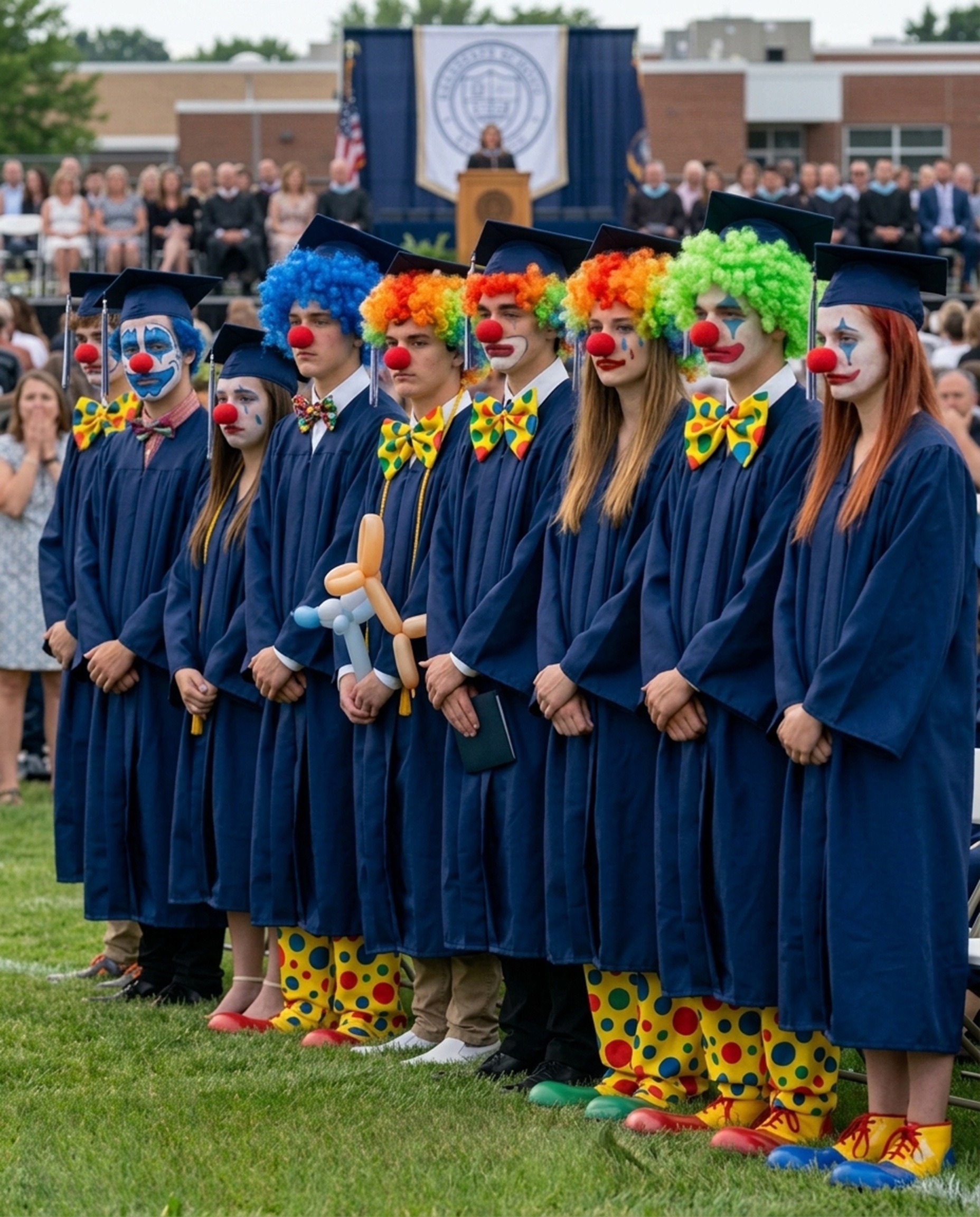
She reached down and unzipped the front of her graduation gown, letting the blue polyester fall away from her shoulders. Underneath, she was wearing a bright green t-shirt and a pair of suspenders decorated with tiny yellow rubber ducks.
A scattered round of laughter broke out from the junior varsity baseball team sitting near the exit.
I watched her from the back, my breath held so tight my chest ached. Kayla adjusted the suspenders, her fingers snapping the elastic against her chest as she tried to steady her breathing.
In the second row of students, a quiet boy named Arthur stood up to help her by holding up a hand painted sign, though his face was entirely red. He was the quiet boy who worked in the school kitchen after hours, always keeping to himself, and seeing him stand there made my throat tighten.
He held the sign high, though his hands shook so much the wooden stick rattled against his metal chair.
Kayla looked at him and nodded once, her expression softening for a brief second before she turned back to the microphone.
“We promised we would not let this day be ordinary,” Kayla said, her voice shaking slightly before she found her footing.
She looked down at her hands, her silver ring catching the overhead fluorescent lights.
The laughter from the back rows began to die down, replaced by a heavy, expectant quiet that seemed to press against the brick walls of the assembly hall. Parents who had been whispering a minute ago were now leaning forward in their seats.
Kayla looked up from the podium, her gaze cutting through the crowd of hundreds.
She looked directly at me.
Kayla kept her eyes on mine, her thumb ring catching the glare of the overhead stage lights. The silence in the assembly hall grew so heavy that I could hear the steady hum of the black fan working in the corridor behind the double doors.
“Most of you are probably wondering why we look like this,” Kayla said into the microphone. Her voice came out in a rapid, earnest burst that vibrated through the black speakers on the brick walls.
She reached down and adjusted the bright yellow suspenders stretching over her shoulders. The bright fabric stood out against the formal black of her graduation gown like a dandelion growing through a crack in the Oakhaven pavement.
“We did not plan this to be disrespectful to the school or to Principal Davis,” Kayla said, looking briefly at the side of the stage. “We did it because Olivia Miller designed these ribbons and socks in her bedroom three months ago.”
My hand froze against the floral skirt I had been smoothing over my knees. The blue graduation cap on my lap felt suddenly heavy, its stiff square corner pressing into my palm.
“She made me promise that we would carry out the plan,” Kayla said, her voice rising to reach the back row where I sat. “Every single piece of color you see on us today is for her.”
A low murmur rippled through the rows of parents sitting in front of me. I saw Mrs. Gable, who lived down the street from us, turn her head to look back in my direction, but I kept my eyes fixed on Kayla.
“She knew she would not be standing here with us,” Kayla said, her fingers twirling the silver band on her thumb. “But she did not want us to walk across this stage with only a blank space where she belonged.”
Principal Davis stood near the steps of the stage, his hands clasped behind his back. He took off his gold-rimmed glasses and began to polish the lenses with the thick end of his blue tie, his movements slow and measured.
To my left, a tall boy in the front row of the student section stood up from his folding chair. It was Tommy, who used to mow our lawn on summer afternoons when his lawnmower wasn’t broken.
Tommy pulled the hem of his black graduation gown up to his shins. He was wearing a pair of neon green and yellow striped socks that reached nearly to his knees.
Beside him, two girls stood up and reached into their wide sleeves. They pulled out bright orange plastic joke noses and slipped them over their faces, blinking through the small eye holes.
“She bought forty-one dollars of colorful fabric ribbon on the Tuesday before Easter,” Kayla said, her voice steadying as more students began to stand. “We cut them up on my kitchen table while her mother was at the grocery store.”
I remembered the yellow receipt I had found tucked inside the drawer, the one with the faded ink that I could not account for. I had spent weeks wondering what Olivia had done with forty-one dollars in cash during a brief afternoon when she had asked Brian to drive her to the craft shop near the highway.
“We spent three hours deciding which colors went to which person,” Kayla said. “Olivia had a list of every student in our class.”
More graduates stood up in the third and fourth rows, their gowns rustling like dry leaves. A girl with dark braids turned toward the audience to reveal a large, mismatched pink bow pinned to the shoulder of her gown.
The parents around me began to whisper, their voices blending into a dry rustle that rose toward the steel rafters. A man two rows ahead of me leaned over to ask his wife a question, but she only shook her head and kept her eyes on the stage.
“She wanted us to laugh today, especially the ones who find it hard,” Kayla said.
She looked down at the empty folding chair in the very front row where the single white rose lay on the polished wood. The rose looked small and pale against the bright yellow ribbon someone had tied around its stem while the assembly hall was filling up.
“She told me that graduation should not feel like a dry sermon,” Kayla said. “She said she did not want her mother sitting in the crowd thinking about a quiet room and a closed box.”
My thumb traced the gold embroidery on the corner of the blue cap in my lap. I thought of the folded blue note currently tucked inside the brass latch of my purse, the one she had hidden behind her wooden jewelry box.
She had asked me to come here, you see. She had written those few lines in her favorite blue ink pen because she knew the hall would be filled with these ridiculous, bright ribbons.
“She made me swear that I would not tell anyone until we were all in our seats,” Kayla said, looking back at the long row of standing students. “She did not want the school to cancel the ceremony or confiscate our socks.”
A soft, hesitant laugh came from the middle of the crowd. Principal Davis did not put his glasses back on, but he stopped polishing them and held them by the temple pieces, looking at the students.
“We promised we would not let this day be ordinary,” Kayla said, her voice dropping into a quieter, more deliberate tone. “And we promised we would show her mother that Olivia was not alone when she was planning this.”
I looked at the boy Tommy, who was still standing with his bright green socks showing. He caught my eye and gave a small, solemn nod, the kind of nod his father used to give my husband Brian when they met at the edge of the driveway.
The realization settled over me like a cold draft under a door.
For weeks, I had carried the heavy belief that Olivia had spent her last month locked in her own mind, preparing for her departure in a lonely, isolated silence that we could not reach. I had pictured her staring at the ceiling of her bedroom, holding her fears close because she did not want to burden us with them.
But she had been plotting this. She had been sitting at her small desk, using her favorite blue ink pen to write down names and coordinate ribbon lengths with her best friend.
She had accepted her path months before I had even allowed myself to admit the doctors were out of options, you see. She had looked at the future and decided that her friends should have laughter, even if she could not be there to share the joke.
“This is for you, Mrs. Miller,” Kayla said, her voice carrying clearly through the high ceiling of the hall. “She wanted you to see that she was still here.”
The girl with the dark braids who had pinned the pink bow to her gown began to clap. Her palms made a sharp, flat sound that seemed to startle the row of teachers sitting behind the podium.
Tommy joined in, his large hands creating a deeper, slower rhythm. Within seconds, the entire front row of graduates was clapping, their mismatched ribbons shaking against the black fabric of their shoulders.
I looked at Principal Davis to see if he would step to the microphone to restore the order he valued so much. He stood perfectly still by the wooden steps, his gold-rimmed glasses still hanging from his fingers as he watched the students.
The applause spread to the middle rows of parents. The woman in front of me who had been whispering to her husband stood up, her hands moving quickly, her face turned toward the stage.
I remained in my seat, my fingers pressed against the blue cap on my lap. The hum of the heavy black fan in the hallway was completely gone now, buried under the sound of hundreds of hands coming together.
The sound rose toward the rafters, warm and rhythmic, filling every corner of the large room until the walls seemed to vibrate with it.
My palms were cold against the dark blue fabric of Olivia’s graduation cap, which lay flat on my floral skirt. The applause rolled across the rows of folding chairs, a steady, thrumming beat that made the wooden floorboards vibrate under my shoes.
Principal Davis stood at the microphone, his gold-rimmed glasses catching the harsh glare of the stage lights. He reached up with one hand, unfastening his silk tie slightly so he could use the tip to polish the lenses, his movements formal and measured.
“We have one more name,” he said, his voice dropping its formal edge as the microphone hummed with a quiet static.
He looked directly toward the back row where the late arrivals and the families who preferred the shadows always sat.
“To accept the diploma for Olivia Miller, we invite her mother, Evelyn, to the stage.”
My fingers tightened on the cardboard edge of the cap, and I felt the small embroidered button in the center press into my thumb. The silence that followed was not empty; it was filled with the collective breath of three hundred people waiting to see what I would do.
I stood up, smoothing my floral skirt with a slow, deliberate stroke of my hands to make sure the fabric hung straight. The gray Buick was parked three hundred yards away in the gravel lot, its eighty-two thousand miles of road dust coating the fenders, but the short walk to the stage felt infinitely longer.
I walked down the long side aisle, my heels making a sharp, solitary sound against the polished floor. To my left, rows of young faces looked up, their bright yellow and green ribbons pinned to their blue gowns, waving slightly as I passed.
Principal Davis watched me approach, his tie still slightly crooked from his polishing. He did not look back at the crowd; his eyes stayed on my face, full of a quiet, formal pity as I reached the bottom step of the stage.