Several people in the row in front of us turned their heads to look.
“I am doing just fine, Sarah,” I said, smoothing my floral skirt over my knees.
“We are all praying for you,” she said, leaning closer so her shoulder pressed against mine. “It must be absolute torture sitting here seeing all these happy children.”
I kept my eyes fixed on the empty stage.
“Olivia wanted me to come,” I said.
“Well, it is brave of you,” Sarah said, her voice still loud enough to compete with the hum of the crowd. “Most people would have stayed behind closed doors.”
Sarah leaned over, her gold charm bracelet clinking against the metal armrest of her chair.
“Is Brian coming?” she whispered, her eyes wide with a sort of urgent curiosity.
“No,” I said. “He had some things to finish at the house.”
“Oh, of course,” she said, her voice dropping to a theatrical whisper. “Men handle these things so differently.”
A man two rows ahead turned completely around, his eyes scanning my face with a look of soft, painful pity.
I felt the heat rising in my neck, my skin tightening under their stares.
I wanted to slip out of the row and find a dark corner, but the weight of the cap on my lap kept me pinned to the metal seat.
“I think the ceremony is about to start,” I said, keeping my voice as flat as possible.
Sarah patted my arm once, her palm dry and warm, before she finally turned her attention to her own program.
She began pointing out various names in the pamphlet, whispering about who was going to which college.
I did not look at the program in my own lap.
The printed names on the white paper would only have one entry missing, and I did not need to see the blank space to know it was there.
Instead, I kept my eyes on the wooden podium at the center of the stage, where a microphone stood waiting.
The low rumble of the crowd quieted as the side doors opened.
The graduating class began to file in, two by two, their black gowns rustling as they walked down the center aisle.
I searched the line of teenagers, looking for Kayla.
She walked near the middle of the line, her silver thumb ring catching the light as she clutched her rolled diploma holder.
As she passed my row, her eyes darted toward me for a fraction of a second, but she did not smile.
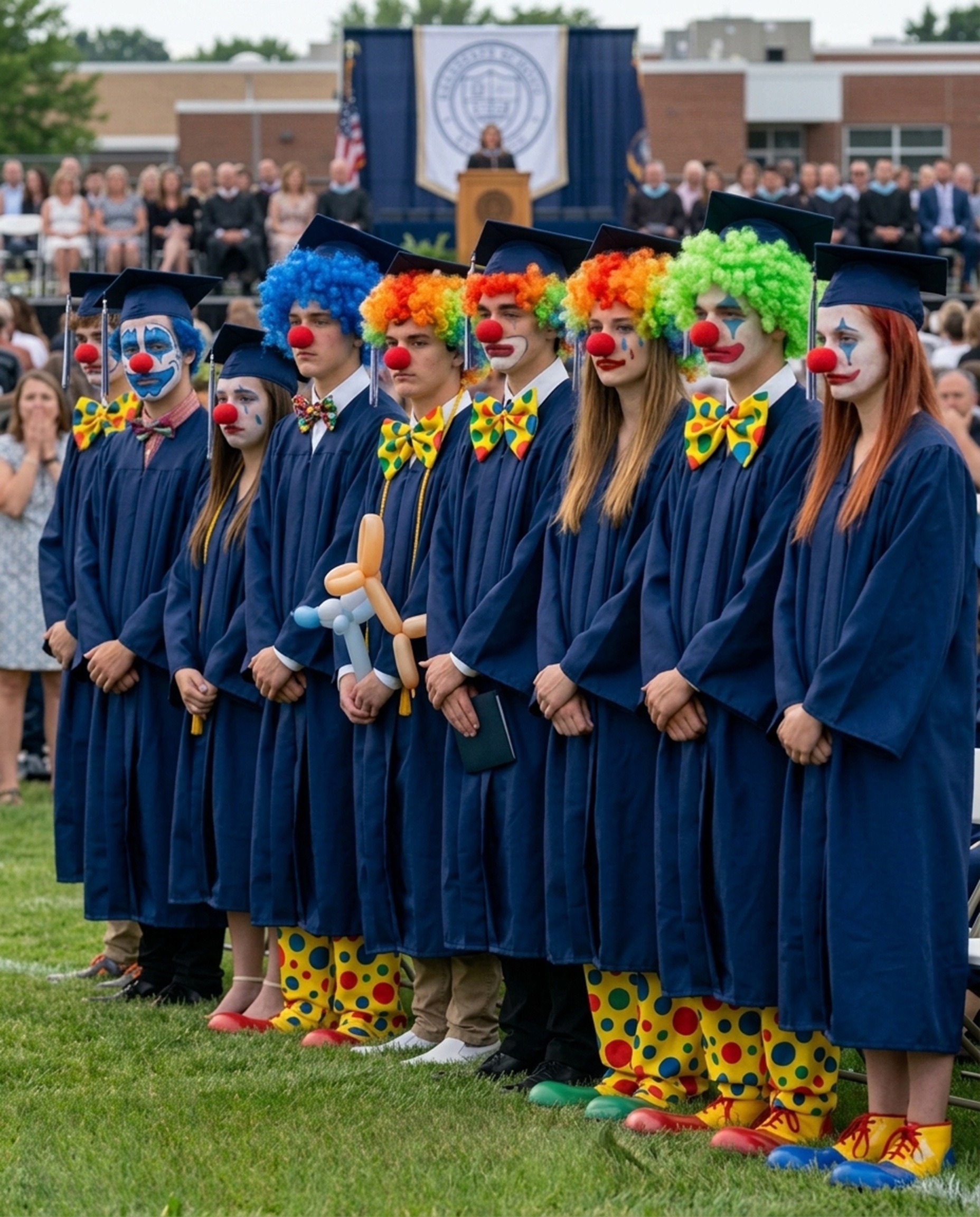
Then I noticed something strange about the way some of the boys in the back of the line were walking.
Their black gowns seemed bulkier than they should have been, bulging slightly at the sides as if they were carrying large objects underneath.
One of the girls near Kayla had a bright flash of pink silk peeking out from the bottom of her sleeve.
Another boy had a thick, cylindrical shape tucked under his arm, hidden beneath the dark fabric.
I leaned forward, trying to see what they were holding, but they kept their arms pressed tight to their sides.
The whispering among the parents in the rows ahead of me started up again, a low murmur of curiosity.
I held Olivia’s cap tight against my ribs, my fingers digging into the cardboard.
I am here, Olivia, but I feel so incredibly small.
The students took their places in the front rows, the black gowns settling into a sea of dark fabric.
In the very front row, right in the center, sat a single chair that remained empty.
On the seat of that chair, resting on the polished wood, was a single white rose.
I looked at the rose, its petals bright against the dark wood of the chair.
The silence in the room stretched out, heavy and expectant, as the principal stepped up to the microphone.
My eyes remained fixed on that single white rose across the room.
The wooden seat felt hard against my back as the brass band in the corner finished the prelude, their instruments giving one last low rumble before the silence took over. Down in the third row of the graduating class, a tall boy shifted in his seat, and his black gown parted just enough to show a bright stripe of yellow ribbon pinned to his trousers.
A few chairs to his left, a girl with braided hair reached down to adjust her ankle, revealing a thick band of emerald green satin tied around her calf.
I smoothed my floral skirt, pressing the fabric flat against my knees to keep my hands busy, you see.
More colors winked from beneath the dark polyester hemlines as the students settled. A flash of orange here, a strip of sky blue there, completely out of place against the navy and black dress code Principal Davis had insisted upon in his spring newsletter.
I leaned forward, trying to see if Kayla was among them, but her row was too far down.
The boy with the yellow ribbon turned his head to whisper to his neighbor, his thumb flicking against the satin stripe.
The girl next to him nodded, her hand sliding into her pocket and pulling out a small square of purple fabric that she quickly tucked back under her sleeve.
The air in the room was warm, smelling of damp wool and the lavender perfume the woman next to me had sprayed too heavily.
At ten-thirty, the line of students began to shift as the late arrivals filed toward the back rows before the speeches started.
Kayla walked past my aisle, her steps quick and silent on the worn wooden floorboards, her silver thumb ring catching the light from the high windows.
She did not look at me directly, but as she brushed past my shoulder, her hand darted out and dropped a heavy blue pen onto my lap.
It was Olivia’s favorite pen, the one with the tiny plastic star cracked at the clip, the one she used for her biology diagrams, you see.
Before I could call out to her, Kayla was already ten paces down the aisle, her black gown billowing slightly as she took her place near the front.
I picked up the pen, my thumb finding the rough edge of the cracked plastic clip where Olivia had chewed on it during her finals.
Why Kayla had it, or why she had chosen this exact moment to hand it back to me, was a knot I could not untangle.
The principal stepped up to the wooden podium, his gold-rimmed glasses catching the glare of the overhead stage lights.
He polished them with the wide end of his blue tie, his movements slow and practiced, before resting his hands on the edges of the dark wood.
To his right, a short boy in the second row reached into his gown and pulled out a bright orange wig, slipping it over his hair with a single, swift motion.
A soft murmur rippled through the row behind him, a quick rustle of programs and shifting feet.
Principal Davis cleared his throat into the microphone, the high-pitched squeal of the feedback making several parents in the front row flinch.
“Welcome, families, faculty, and distinguished guests, to the sixty-fourth commencement,” he began, his voice flat and measured.
Beside the boy in the orange wig, two more students reached into their pockets and pulled out mismatched neon green socks, pulling them over their dress shoes.
The whispers in the rows around me grew louder, a low hum of confusion passing from row to row like a draft.
“This is not what I expected, but it feels like her,” I whispered to myself, my fingers tightening around the cracked blue pen.
On my left, an older man in a gray suit leaned toward his wife, pointing a thick finger toward the middle aisle.
“What in the world are those kids wearing?” he muttered, his voice carrying over the principal’s words.
Two girls in the front row unzipped their gowns halfway, revealing bright pink suspenders crossed over their white shirts.
More ribbons appeared, yellow and green and violet, waved by hands that had suddenly emerged from the wide sleeves of the black robes.
The sight of dozens of mismatched ribbons waving in the crowd was all I could see.
The principal cleared his throat, the sound sharp and scraping through the overhead speakers. He adjusted his grip on the edges of the wooden podium, his gold-rimmed glasses slipping slightly down his nose as he peered over the assembly. I sat in the very back row, the hard plastic of the folding chair pressing into my spine while I smoothed my floral skirt.
Principal Davis took off his glasses and began polishing them with the wide end of his blue silk tie. In the hallway behind me, the heavy black fan hummed, sending a rhythmic, warm draft across the back of my neck. The smell of fresh floor wax was strong, thick enough to make my head headache if I breathed it in too deeply.
“Every class leaves its own particular mark on Oakhaven,” Principal Davis said, his voice dropping into that formal, measured cadence he always used when addressing the public. “But this year, we have been tested in ways that require a different kind of strength.”
He paused, his eyes scanning the rows of graduates who were still rustling under their blue polyester gowns. A yellow ribbon peeked out from beneath one boy’s collar, bright and defiant against the dark fabric. Another girl in the third row seemed to be hiding something bulky under her knees.
“Resilience is not merely surviving the winter,” the principal continued, replacing his glasses and leaning forward. “It is the decision to rebuild the structure when the storm has passed.”
He spoke of long-term growth and structural integrity, using the sort of language Marcus often used when we talked about our retirement accounts. It was dry, safe language designed to keep everyone in their seats, you see. But the graduates were not listening to the words.