Marjorie turned her eyes to me, her sharp accent softening into something thin and desperate. The clipped, formal way she usually spoke seemed to slip away, leaving her looking every one of her eighty-one years. She reached out, her fingers stopping just short of my sleeve.
“Avery,” she whispered, her voice cracking slightly. “We do not need to involve the authorities in old family business. It is not what Bradley would have wanted.”
I twisted the plain gold band on my left ring finger, slowly turning it twice around my knuckle. I did not speak for several seconds. The silence in the room was long, stretching out until Declan shifted his feet on the rug.
“The loan documents from five years ago,” Marjorie said, her eyes shifting toward the deputy before returning to mine. “The ones from Bradley’s father’s estate. There is no reason to show those to anyone. It was all a misunderstanding.”
“You signed those names yourself, Marjorie,” I said, my voice quiet in the crowded room.
“It was a temporary arrangement,” she said, her chest rising and falling quickly under her linen blouse. “We can settle this ourselves. If those papers go to the sheriff, it will ruin Declan’s chances with his creditors.”
I looked at Declan, who was staring at the floor, his hand frozen halfway through his slicked-back hair. He smelled of pine cologne and stale sweat, his usual loud bluster completely gone. He did not look at me, nor did he laugh at his own jokes. He looked smaller now, stripped of the easy confidence he had carried into my home.
“They did not come as family, Avery, they came as collectors,” I murmured, repeating the words Bradley had whispered to me in the hospital room.
Marjorie flinched, her index finger finally stopping its tap against the wood. “Please. We will leave. We will leave now. We do not need the suitcases.”
“Leave the keys on the counter,” I said, pausing between each word to let the weight of them settle in the room. “And do not come back to St. Augustine.”
“And the charges?” Marjorie asked, her eyes wide as she looked for a promise.
“If you are gone in five minutes, I will not file the complaint,” I said.
Marjorie let out a long, ragged breath, her shoulders dropping an inch. She believed she had negotiated a victory, unaware that I was simply clearing her clutter from my husband’s memory. She did not know that the peace Bradley wanted was not one bought with revenge, but with distance.
She reached into her small leather purse, pulled out the duplicate brass key she had held so triumphantly earlier, and set it on the entry table. It made a light, hollow sound against the wood.
“Come, Declan,” she said, her voice returning to its sharp, clipped tone, though her hand shook as she adjusted her collar. “We are leaving.”
The deputy took Declan by the elbow, his grip firm but professional. “Let’s go, sir. Down the hall.”
Declan pulled his arm back, though he did not try to run. He muttered under his breath, his words a low, angry drone that echoed off the coquina-stone walls of the building corridor.
“Twenty-two thousand,” Declan growled, looking back over his shoulder at me as they reached the door. “He had it in the Rowan account all along. He was holding out on us, Avery. He was always holding out.”
“Keep moving,” the deputy said, pressing him toward the elevator.
I stood in the doorway, watching his shadow lengthen against the polished tile of the hall. The elevator chimed, the door slid open, and the deputy guided him inside.
Declan did not look back a second time before the steel doors slid shut between us, cutting off his muttering.
Fiona stood near the threshold of the condo, her large canvas purse clutched tightly against her ribs. She was shifting her weight from foot to foot, her breath coming in rapid, thin gasps.
Elena stepped into her path, her silver watch strap catching the hallway light as she crossed her arms. “The folder in your bag, Fiona.”
“It is just some old recipes,” Fiona whispered, her hands rustling against the canvas. “Sentimental things Bradley promised I could have before he went.”
“It is the blue-sealed harbor trust deed and the study surveillance records,” Elena said, her voice remaining perfectly even. “I suggest you return them now.”
Fiona looked at the deputy, who was returning down the hallway, his boots clicking on the tile. Her fingers loosened their grip on the bag.
She reached inside, pulled out the thick legal folder, and dropped it onto the floor. The paper made a sharp slap against the tile as it landed, some of the pages sliding out across the threshold.
“I hope you are satisfied,” Fiona whispered, her voice trembling.
Elena knelt, her knees making a small cracking sound in the quiet hallway. She gathered the scattered pages, checking the blue seal on the main deed before nodding up at me. There was the photo of the study, the surveillance printout showing Declan searching the desk, and the ledger of family debts that Bradley had kept so meticulously.
“Everything is here, Avery,” Elena said, standing up and brushing her skirt. “The original deeds, the files, even the photos.”
“Let them go,” I said. “I do not want to see any of it again.”
Elena placed the papers back into the manila envelope, smoothing down the edges of the folder. “I will keep these in the office vault. They are your shield if they ever try to contact you again.”
Fiona did not wait for the elevator. She turned and began walking quickly down the concrete stairs, her heels clicking against the steps until the sound faded completely into the lower levels.
Luis, the building manager, stood by the elevator lobby, his heavy plastic clipboard still held against his chest. He gave me a brief, respectful nod, his eyes lingering on the brass key on the counter before following the deputy out.
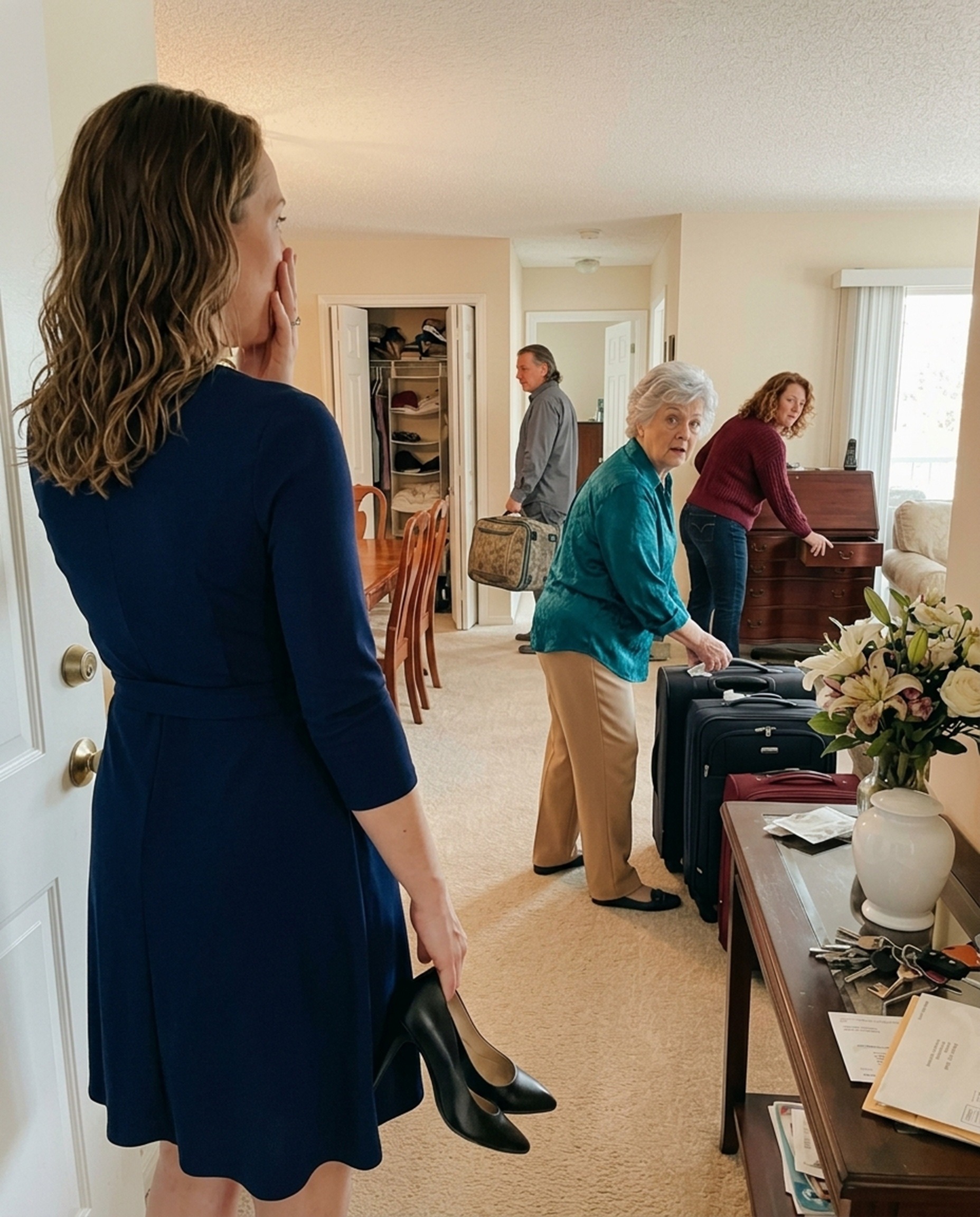
I walked back into the living room, where the three empty suitcases sat in the center of the rug. The silence of the apartment felt heavy, almost physical, pressing against my ears.
The smell of the damp evening air drifted in from the balcony, carrying the scent of salt water and wet stone from the harbor below.
Elena stood by the dining table, neatly sliding the recovered documents back into her leather briefcase. She looked up as I sat down in Bradley’s favorite armchair, my hands resting on the cool fabric of the armrests.
“They are gone, Avery,” Elena said, her voice gentler than it had been all evening. “They will not return. They know the consequences now.”
“It seems very quiet,” I said, twisting my gold band again.
“The silence is yours now,” Elena said, clicking the latches of her briefcase shut. “You earned it.”
Elena opened her briefcase once more and withdrew a long, cream-colored envelope. She walked over and set it on the table beside my chair.
“Bradley asked me to give you this once the transition was complete,” she said.
I looked at the handwriting on the front. It was Bradley’s precise, academic script, written before his hand had begun to tremble in the hospital. The ink was dark and steady.
“He wanted you to have the final instructions in his own words,” Elena said, adjusting her watch strap. “He knew you would need them.”
I did not open the envelope yet, letting it rest on the dark wood of the side table.
“He was very careful, Avery,” Elena said, looking out toward the dark balcony. “He knew how they would approach you. He spent his final weeks making sure you would not have to fight them alone.”
“I did not realize how much he kept to himself,” I said, pausing to look at the empty space on the wall where the landscape painting hung. “He protected me from them for forty years.”
“He did,” she said. “But he also knew you had the strength to finish it. He told me that himself when we signed the papers on the ninth.”
“I am alone now, Elena,” I said.
“You are safe now, Avery,” she replied. “There is a difference.”
She adjusted the strap of her watch one last time and picked up her leather briefcase from the chair. “I will be at the office by nine tomorrow if you need anything. Rest.”
I stood up and followed her to the hallway, the cool tile smooth against my feet. The brass key sat on the side table, glinting in the soft light of the lamp.
Elena walked out, her heels making a soft, rhythmic sound that faded as she approached the elevator lobby.
The heavy entry door clicking shut, leaving the condo silent for the first time in weeks.
The grey light of dawn slid through the slats of the wooden blinds, throwing long, parallel stripes across the study floor.
I stood in the doorway for several minutes, listening to the absolute lack of movement in the halls of the condo.
The air smelled of damp coquina stone from the harbor outside, thick and cool after the night of heavy rain.
On the floor near the cherry wood bookshelf, the fragments of my favorite ceramic jar lay scattered like pale shells on a beach.
It was a salt-glazed cobalt jar we had found at an estate sale in Ocala twenty-three years ago, the blue glaze still bright against the grey clay.
I knelt down on the rug, my joints stiff from a night of fitful, shallow sleep, and began to gather the sharp curved pieces.
My plain gold wedding band scraped against the wood as I picked up a large shard that had rolled under the oak desk.
I twisted the band around my ring finger, a habit that usually calmed my nerves when the house grew too loud.
Now, the house was entirely silent, but the habit remained.
One by one, the blue and white pieces went into the small metal wastebasket, clinking softly as they settled against the bottom.
The clay was dry and dusty under my fingers.
It had survived three moves, from our first small apartment near the university to the brick house in Georgia, and finally here to the historic district of St. Augustine.
Bradley had always told me that things made of earth were resilient, but they still had their limits when met with enough force.
I used a small hand broom to sweep the remaining white powder into the dustpan.
The quietness of the room was almost physical, pressing against my ears after the days of shouting and packing tape.
The dust of the old clay left dry grey smudges across the palms of my hands.
A single dried petal from the ruined floral arrangement remained stuck to the polished floorboards near the baseboard.
I picked it up, rolled it between my thumb and forefinger until it crumbled into grey dust, and blew it away.
There was no hurry anymore; the transition deadline of October fifteenth had passed, and the family was gone.
The small brass clock on the wall read seven minutes past six.
I carried the wastebasket to the kitchen, my slippers making no sound on the tile.
In the kitchen, the counters were exactly as the family had left them when the deputy escorted them out.
I rinsed my dusty hands at the copper sink, watching the dark water swirl down the drain.
I took the tin of black chicory coffee from the pantry and measured three level scoops into the old metal pot.