“Let them pack,” Elena said, her voice cool and steady. “I am preparing the formal notices and coordinating with the local authorities. Do not let them take anything out the front door, and remember what Bradley told you before he went sleep.”
“He told me to laugh first,” I said.
“Then do exactly that,” Elena said. “I will call you the moment the deputy is cleared to assist us downstairs.”
I ended the call and slipped the phone back into my linen pocket, my hand steady for the first time all evening as I took a deep breath of the chicory-scented air.
Just then, the deep, mechanical horn of the evening drawbridge sounded from the harbor, vibrating through the wooden floorboards beneath my bare feet and breaking the silence.
I pushed the pantry door open and walked back into the hallway, leaving the quiet shadow of the shelves behind me. Marjorie was still standing by the stove, her fingers tapping against the ceramic mugs as she waited for the hot water to steep.
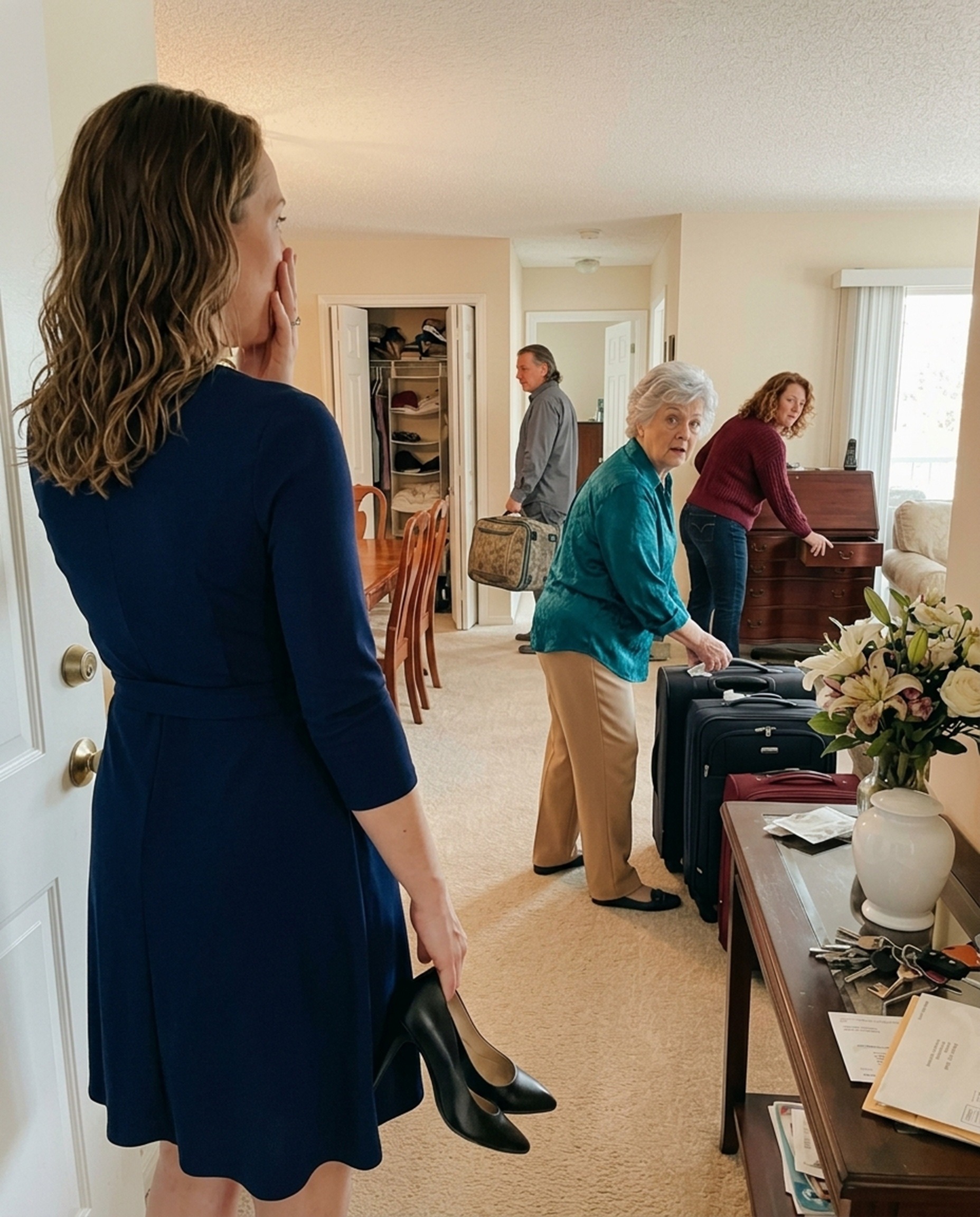
I walked past the kitchen and entered the dining room, where the mahogany table sat under the dim crystal chandelier. Declan was leaning over the heavy sideboard, his large frame blocking the light from the window as he rummaged through the small drawers.
He was sliding his fingers along the velvet-lined compartments where we kept the formal silverware, his movements clumsy and urgent. The strong, sharp scent of his pine cologne seemed to fill the entire room, making the air feel thick and unpleasant.
“These silver spoons are quite old, Avery,” Declan said, running his hand through his slicked-back hair as he turned to face me. He laughed, a loud, forced sound that rattled the empty crystal glasses on the table.
“I seem to recall Bradley saying these belonged to his father’s side of the family,” Declan said, holding up a heavy serving piece. “We should probably keep them with the other heirlooms for safekeeping.”
“They belonged to my mother’s family,” I said slowly, pausing between my words to let them sink into his confidence.
“Well, we will have to verify that in the records,” Declan said, his eyes darting toward the drawers again. “Bradley owed me quite a bit of support for that consulting venture last winter, and we need to settle the balance.”
I watched him, my anxiety melting into a cold, clear confidence as I remembered the trust documents Elena had verified. “Bradley did not owe you anything, Declan.”
Declan laughed again, though the sound was thinner this time, his forced familiarity faltering under my steady gaze. “We will let the lawyers figure that out, cousin. In the meantime, it is best to keep these safe so they do not go missing.”
He reached into the drawer again, his thick fingers wrapping around three silver serving spoons and tucking them into his vest pocket. I did not move to stop him, remembering Elena’s warning to let them show their hands before we acted.
The knowledge of the Harbor Trust deed felt like a shield between me and his greed, turning his actions into nothing more than a desperate display.
From the hallway, a sharp rustling sound broke the quiet of the house, followed by the sound of paper sliding across the floor. I turned away from Declan and walked toward the linen closet near the study entrance.
Fiona was standing there, her fingers pulling hard on the brass handle of the locked closet door. She was holding a stack of old utility bills and papers, shifting them constantly from hand to hand as if she could not stay still.
“This door is locked, Avery,” Fiona whispered rapidly, her breath coming in quick, shallow puffs that smelled of peppermint. “Where is the key for this?”
“There is nothing in there for you, Fiona,” I said slowly.
“Bradley kept his personal diaries and trust records in the study closets,” Fiona whispered, her eyes darting to my face and then back to the brass handle. “We need to examine them to make sure nothing is missing before the estate is processed.”
“You are wasting your time,” I said, crossing my arms and standing my ground.
“We are family, Avery,” Fiona said, her voice rising slightly as she rustled the papers in her hands. “We have a right to know what Bradley left behind, and we are only trying to help you with the transition.”
Marjorie walked out of the kitchen, carrying the wooden tray with two steaming mugs of tea. She stopped beside Fiona, her chin lifted high as she looked down at me with a cold, superior gaze.
“It is time to be sensible, Avery,” Marjorie said, tapping her index finger against the edge of the tray. “You cannot manage this large condo on your own, and the family must protect its investments.”
I looked at Marjorie, then at Fiona, and then at Declan who had walked out of the dining room with the silver spoons in his hand. They believed they had successfully taken control of the home, standing in my hallway like conquerors who had already won.
I thought of Bradley’s quiet voice in the hospital, telling me to stand firm against their demands. The cost of this confrontation was my peace, the quiet grieving process I had wanted so desperately to preserve.
But as I looked at their eager, predatory faces, I realized I did not want peace on their terms.
I let out a clear, steady laugh that makes the entire room go silent.
Marjorie sat on the sofa, her back straight as a coquina wall. She stopped tapping her finger on the side table and lifted her chin.
“There is no need for hysteria, Avery,” Marjorie said, her sharp accent cutting through the quiet room. “We are only looking for a sensible way forward for everyone involved.”
I twisted the plain gold band on my left ring finger. I waited, letting the silence stretch between us until the space felt heavy.
“A sensible way,” I said.
“Exactly,” Marjorie said. “We know Bradley was a cautious man, but he was also family. We want to ensure you are looked after against any sudden difficulties.”
She paused to smooth her wool skirt.
“We are prepared to offer you a monthly allowance of fifteen hundred dollars,” Marjorie said. “It would come directly from the family holdings, starting this Friday.”
I looked at her, keeping my face entirely blank.
“Fifteen hundred,” I said.
“For up to two years,” Marjorie said, her tone softening into something that sounded almost like grease. “It would give you time to find a smaller, more manageable apartment near the mainland.”
I did not answer her. I simply watched the way she kept her eyes fixed on my face, waiting for a nod.
“We are family, Avery, we can settle this without lawyers,” she said.
Before I could speak, Declan called out from the dining room.
“Avery, you might want to look at this,” Declan said.
His voice carried a forced cheerfulness that made me press my thumb against my ring. I walked into the dining area, where the heavy oak table was covered in old electric bills and tax notices.
Declan ran his hand through his slicked-back hair. The sharp scent of his pine cologne seemed to hang over the table like a damp mist.
“Bradley owed me some capital,” Declan said, holding up a yellowed slip of paper. “We had a verbal agreement on a short-term commercial venture back in April.”
He laid the paper flat on the dark wood.
“Nine thousand five hundred dollars,” Declan said. “He signed for it right here at the bottom.”
I leaned closer to the table, looking at the dark ink.
The signature was written in a fluid, continuous loop. Bradley always paused between his first name and his middle name, leaving a distinct gap where the pen lifted from the paper.
“That is not his handwriting,” I said.
“Of course it is,” Declan said, laughing quickly and looking toward the hallway. “He was probably tired when he signed it.”
“Bradley never used a ballpoint pen for legal documents,” I said, pointing to the blue ink. “He only used his black fountain pen.”
Declan took the paper back and folded it into his front pocket.
“Well, the bank will see it differently when the estate goes to probate,” Declan said.
I turned away from him and walked down the short hallway toward the study.
Fiona was standing near the built-in bookshelves, her hands full of manila folders from the bottom drawer. The constant rustle of paper stopped the moment she saw me in the doorway.
“I was just thinking about your sweaters,” Fiona whispered, her voice rapid and thin. “The wool ones in the bedroom closet need to be packed before the dampness gets to them.”
She took a step closer to her large leather purse on the desk.
“I can help you wrap them,” Fiona whispered. “We should start on the closets tonight.”
“The closets can wait,” I said.
“We must be practical, Avery,” Fiona whispered, shifting her weight from one foot to the other. “The transition date is October fifteenth, and that is only a few weeks away.”
She reached out and picked up a thick, blue folder from the desk, sliding it quickly under her arm.
I knew the blue folder was empty. I had moved Bradley’s actual papers to the kitchen hours ago, leaving only the old tax receipts from our first year in the condo.
“I will handle the bedroom myself,” I said.
Fiona turned her back to me, pretending to inspect a small framed print on the wall. I saw her hand slide the blue folder into the deep side pocket of her purse.
“As you wish,” Fiona whispered. “But the clock is running.”
I walked back toward the kitchen, my slippers silent on the hallway runner.
Marjorie was already there, standing by the stove. She had found the tin of chicory coffee and was measuring it into the drip pot.
“You look pale, Avery,” Marjorie said, her voice dropping into a warm, grandmotherly tone. “Let me make us some tea instead.”
She took two ceramic mugs from the rack.
“Bradley always spoke so highly of your patience,” Marjorie said as she poured the hot water. “He knew you were a quiet woman.”
She set the mug on the counter and looked at me with a soft smile.
“He loved this kitchen,” Marjorie said.
Her eyes drifted from my face to the upper cupboards near the pantry, then back again.
“He did,” I said.
“We only want to preserve his legacy,” Marjorie said, pushing the white mug toward me. “If you sign the relocation agreement tonight, we can have the first check in your hand tomorrow morning.”
She reached into her cardigan pocket and pulled out a folded sheet of paper.