Bradley dropped his linen handkerchief into his chicory coffee instead of his pocket, and the white fabric drank the dark liquid until it turned the color of river silt.
He did not seem to notice. He sat at the pine table in our kitchen, his eyes fixed on the narrow strip of saltwater visible between the historic buildings across the street. His sixty-four-year-old face was drawn, the lines around his mouth deeper than they had been even a week ago.
The kitchen had low ceilings with exposed cypress beams, and the smell of damp coquina stone from the building’s original foundation was always stronger on these humid autumn mornings. I stood by the sink, holding the daily mail I had just retrieved from the lobby.
“The mail is late today,” I said, setting the stack of envelopes on the counter.
I sorted through them slowly, sliding the bill for our monthly condo dues to the top. The total was six hundred dollars, a number that always seemed too high for an apartment in the historic district, even with the view of the bay.
Underneath the utility bills lay a small, thick envelope from Cathedral Place. I opened it and found a legal retainer receipt for four thousand dollars, made out to Elena Cruz, Attorney at Law.
“Bradley,” I said, holding the paper by its edge. “Why did you send Elena four thousand dollars last Tuesday? We already settled our estate documents three years ago.”
He reached for his mug, his fingers missing the handle on his first attempt. He cleaned his reading glasses with a dry corner of the stained handkerchief before he answered.
“If anything happens to me, Avery, you must call Elena Cruz immediately,” he said.
He spoke in his
The morning light through the blinds had a gray, heavy look that belonged to St. Augustine in October. Bradley reached for his reading glasses on the bedside table, but his fingers slipped off the wire frames twice.
He took his linen handkerchief from the pocket of his hospital gown and rubbed the lenses with slow, circular motions. He did this every time he was about to speak of something that troubled him.
“Avery,” he said, his voice barely rising above the hum of the equipment. “The manual dexterity is declining. I require a physical baseline.”
I stood near the edge of the mattress and watched him set the glasses back on his nose. I reached into my purse for a ballpoint pen and a small notepad I had brought from the kitchen counter.
“Just write your name,” I said, my voice slow and even. “The doctor said the strength in your right hand would return by noon.”
Bradley pressed the pen against the blank white paper. His thumb turned white against the plastic casing, but the tip of the pen only skittered across the page in a jagged line that looked like a broken fence.
He tried again, his jaw tightening until the skin over his cheekbones went pale. He managed a shaky letter B, followed by a jagged line that did not resemble his signature at all.
“The motor pathways are compromised,” he said, setting the pen down with a small, sharp tap. “An unacceptable margin of error.”
I picked up the pad and looked at the trembling mark. I twisted the plain gold band on my left ring finger, turning it twice until the metal warmed against my skin.
“It is just the medication, Bradley,” I said, waiting a long moment before each word. “The nurses said the IV fluids make everyone clumsy.”
“My family is not clumsy,” he whispered, his eyes fixed on the empty wall opposite the bed. “They are remarkably agile when they sense a vacancy.”
He closed his eyes, his breathing shallow and quick against the white pillow. He did not speak again for twenty minutes, even when the nurse came in to adjust his saline drip.
I sat in the vinyl chair by the window and watched the gray clouds move over the St. Johns River. The silence in the room felt different now, heavy with a weight we had never named.
I went down to the basement cafeteria at two o’clock to buy a cup of black chicory coffee. The basement room smelled of wet steam and fried onions.
Declan was already sitting at a corner table near the tray return, his slicked-back hair shining under the fluorescent lights. The heavy scent of his pine cologne reached me before I even reached the register.
“Avery, cousin,” he said, calling out loud enough to make a nurse at the salad bar turn around. “I thought that was you. Come sit.”
I held my hot paper cup with both hands and sat opposite him on the blue plastic chair. I did not want him in the room, but he had already pulled a chair out for me.
“How is the scholar?” Declan asked, leaning forward until his elbows rested on the laminate table. “The doctors giving him the good stuff?”
“He is resting,” I said, pausing to let the noise of a tray cart pass by. “The doctors are monitoring his heart.”
Declan ran a hand through his hair and laughed, a short, barking sound that had no humor in it. “Classic Bradley. Even his heart has to work on a schedule.”
He took a bite of a glazed donut and wiped his mouth with the back of his hand. “Listen, Avery. I was talking to Marjorie this morning. We were trying to organize some of his old consulting files, just in case he needs things handled while he is laid up.”
“There is nothing to handle,” I said. “He closed his active accounts last year.”
“Right, sure,” Declan said, leaning closer. “But did he keep the old corporate records under his middle name? Rowan? We were looking for some of the maritime consulting papers from the nineties.”
I stared at him over the rim of my cup. “Rowan is his mother’s family name. He never used it for his business.”
“You sure about that?” Declan laughed again, tapping his knuckles on the table. “He always kept his real work separate from his name.”
I set my coffee down before my hand could shake. “He used his own name, Declan. He had no reason to hide.”
“Well, people change their minds when the tax collector starts looking around,” Declan said, his voice dropping slightly. “Marjorie thought there was a separate ledger for the consulting firm.”
“There is no other ledger,” I said.
Declan shrugged, his smile fading into a thin line. He looked past my shoulder toward the double doors of the cafeteria.
“We just don’t want any surprises, Avery,” he said. “If there is something we should know, it is better we find it first.”
He stood up, leaving his half-eaten donut on the paper wrapper, and walked out without saying goodbye.
I left the hospital at four and drove the short distance to Cathedral Place. Elena Cruz’s office was quiet, the smell of damp coquina stone from the old walls rising through the floorboards.
Elena sat behind her mahogany desk, her silver watch strap clicking against the wood as she adjusted her sleeve. She had Bradley’s preliminary hospital admission chart in a folder before her.
“The clinical projection is not favorable, Avery,” Elena said, her voice completely level. “His cognitive capacity is intact, but the physical decline is accelerating.”
“He is trying to write,” I said, my words coming slowly. “He tried this morning. It was barely a line.”
Elena adjusted her watch strap again, her precise eyes meeting mine. “You must secure his personal papers immediately. Every ledger, every bank statement, and every piece of correspondence in the condo.”
“The files are in his study,” I said. “He kept everything in the oak desk. I have never had to look at them. I always assumed our finances were simple.”
Elena looked down at the chart, her face showing no emotion. “Bradley’s affairs are rarely simple, Avery. He was an asset investigator for thirty years. He knew exactly how people hide things, and he knew how to hide things himself.”
“Hide them from whom?” I asked, my thumb twisting the gold band.
“From the people who believe they are entitled to them,” Elena said. “His mother has been calling my office since nine this morning, demanding to know if there is a filed will.”
“She called you?” I asked.
“She wanted to know who has the authority to sign for the estate,” Elena said, her voice dropping into a colder, professional tone. “I told her that those details were confidential, but she is persistent. She will not stop with phone calls.”
She slid a receipt for my four thousand dollar legal retainer across the dark wood. I folded the paper and slipped it into my purse without looking at the numbers.
“He has accounts and arrangements that do not appear on your joint tax returns, Avery,” Elena said. “You need to gather those documents before anyone else gains entry to the home.”
“What kind of arrangements?” I asked, my thumb finding my gold ring again.
“The kind that require specific preservation,” Elena said. “He was very clear with me. If his family begins asking about his business names, you must lock the study.”
“Declan asked about the name Rowan today,” I said.
Elena did not look surprised. She merely closed the folder and set a small steel key on the desk between us. “Take this. It fits the lower drawer of his desk. He brought it to my office three weeks ago.”
I looked at the small key. I had lived with Bradley for thirty years, and I had never known he kept a separate key with his lawyer.
“What is in that drawer, Elena?” I asked.
“Information that will protect you,” she said, her voice dropping a fraction of a tone. “But only if you are the one holding it.”
I took the key and slipped it into the zippered pocket of my purse.
The evening drawbridge horn sounded from the harbor as I walked into our condo. The sound was a low, vibrating note that always made the living room windows rattle.
I found Fiona standing in the hallway outside Bradley’s study. She was holding a plastic grocery bag that rustled constantly as she shifted her weight from one foot to the other.
“I brought some chicken salad from the deli,” Fiona whispered, her voice a rapid, breathy rush. “I knew you wouldn’t have time to cook, Avery. I just let myself in with the spare key Marjorie has.”
“Marjorie does not have a spare key,” I said, my voice slow and even. “I have the only duplicate.”
Fiona rustled the plastic bag again, her eyes darting toward the open door of the study. “Oh, well, Declan said he found one under the planter by the stairs. I didn’t think you’d mind. We are family, after all.”
“The planter by the stairs is empty,” I said. “And the front door remains locked.”
Fiona’s face went tight, her fingers twitching against the plastic bag. “Well, someone must have left it open then. We are only trying to help, Avery. You don’t have to be so defensive about everything.”
She stepped into the study before I could stop her, her hand immediately reaching out to touch the edge of Bradley’s heavy oak desk.
“He always loved this desk,” Fiona whispered rapidly. “My grandfather had one just like it. It belongs in the family, really. All these old papers of his must be such a burden for you. I can help you sort through them.”
“They are not a burden,” I said, standing in the doorway so she could not pass deeper into the room. “The desk is private, Fiona. I must ask you to leave the study now.”
“There’s no need to be rude,” Fiona whispered, her eyes shifting to the lower drawers of the desk. “We are only looking out for Bradley’s things. Some of these files might contain family records that don’t concern you.”
“Everything in this room concerns me,” I said.
She shuffled past me, her shoulder brushing mine as she went toward the kitchen. I waited until I heard her car pull out of the driveway before I went back into the study.
I locked the study door from the inside and sat in Bradley’s leather chair. The desk smelled of old paper and the cedar shavings he used to keep the moths away.
I looked at the surface of the desk, noting how a stack of envelopes had been shifted slightly to the left. Someone had already been through the top drawers.
I pulled the small steel key Elena had given me from my purse. It slid into the lock of the deep bottom drawer with a smooth, heavy click.
Inside the drawer, beneath a stack of blank printer paper, lay a thick ledger bound in black leather. It was not a corporate ledger, and the cover had no business name on it.
I opened the first page and recognized Bradley’s precise, neat handwriting from three years ago, before his fingers had begun to fail him.
The first entry was dated the spring after his father died. It was a record of several payments transferred to Declan, marked with his initials and the words “no interest, no repayment.”
I turned the pages slowly, the paper dry against my fingers. Every single page was a detailed record of money given to his mother and his cousins over two decades.
The total at the bottom of the fifth page was forty-eight thousand dollars, and none of the entries showed a single payment of return.
I realized then that Bradley had kept this ledger entirely to himself, never mentioning a single dollar of these loans during our evening talks on the balcony.
I had believed we had no secrets between us. I had believed our life was built on a quiet, shared simplicity, but this black book proved he had been fighting a private war against his own family for years without ever telling me.
I heard a floorboard creak in the hallway outside, and my breath caught in the quiet room.
I stood up, holding the heavy leather book against my ribs, and hurried into the kitchen.
Avery sliding the leather ledger under a stack of old magazines in the kitchen cupboard.
The gravel at Memorial Lutheran gritted under my shoes while the morning heat began to rise from the asphalt.
Marjorie stood by the passenger door of her rented sedan, her fingers tapping against the roof of the car. Her gray hair was pinned back in a tight, neat bun that seemed to pull the skin of her temples taut.
“These arrangements are yellow,” Marjorie said, her index finger tapping a steady rhythm on the painted metal. “Bradley always preferred white glads. It looks like a grocery store clearance.”
I twisted the plain gold band on my left ring finger, turning it twice before I answered.
“The florist did what I asked,” I said.
“The bill was sent to the estate address,” Marjorie said, her voice dropping into a lower register. “Four thousand dollars for a simple chapel service seems excessive. We must be careful with the remaining funds.”
“The funeral expenses are already paid,” I said.
Marjorie lifted her chin, her eyes scanning the low coquina stone wall of the church before they settled back on my face.
“Who currently holds the title to the Marine Street condo?” she asked.
She asked it in her sharp, clipped accent, as if she were inquiring about a dry cleaning receipt.
“It is settled,” I said, pausing between my words. “Bradley took care of it.”
“Bradley was a consultant, Avery, not an estate attorney. I need to see the deed.”
“The deed is where it belongs,” I said.
“If there is no formal will registered with the county, the property must be inventoried,” Marjorie said, her finger stopping its tap. “We cannot leave valuable real estate in limbo. It is my duty to my son to ensure his affairs are resolved correctly.”
“The affairs are resolved,” I said.
“When his father passed, we did not have these delays,” Marjorie said, her voice rising slightly. “Everything was handled within forty-eight hours because we worked as a family. I expect the same level of cooperation now.”
I looked at her, letting the silence stretch between us until she shifted her weight.
“We will need to verify that with the county clerk if you cannot produce the physical paper,” she said.
A young couple from the congregation walked past us, nodding their heads in quiet sympathy. Marjorie smiled at them, her expression instantly softening into the deep grief of a bereaved mother, then turned back to me with her eyes narrowed.
“We are his family,” she whispered. “We have a right to know what remains in his name.”
She did not wait for my response, turning on her heel to walk toward the heavy oak doors of the sanctuary.
Inside the church, the air was cool and smelled of damp stone and beeswax.
I sat in the side chapel during the prelude, trying to find a moment of quiet before the pews filled.
Declan found me there, his heavy steps echoing on the tile floor as he slid into the wooden pew beside me. He smelled strongly of pine cologne, and his slicked-back hair caught the blue light from the stained-glass window.
“I can help you audit Bradley’s old consulting firm,” Declan said, leaning in close.
His voice was too loud for the small chapel.
He ran a hand through his hair and gave a forced, barking laugh.
“A widow shouldn’t have to wade through old tax forms and client ledgers,” he said. “I can take all those boxes off your hands this afternoon.”
“No,” I said, my voice flat. “The business is closed.”
“Well, closed doesn’t mean the records are gone,” he said, laughing again. “He kept his real work separate from his name. Everything was under Bradley Rowan Consulting, wasn’t it?”
I looked at him, keeping my expression entirely still.
“He always kept his real work separate from his name,” I said.
“Exactly,” Declan said, nodding quickly. “Which means there are accounts under Rowan that the local banks don’t even have listed under his social security number yet. I just need the login details or the ledger from his desk. It saves everyone a lot of legal trouble.”
“The files are not available,” I said.
“I know he had that client in Jacksonville,” Declan said, his voice dropping to a harsh whisper. “The one who paid in cash for the asset searches. There has to be a physical record of those payments in the study.”
“The business papers are in order,” I said.
“He had the classic Mercedes too,” Declan said, shifting closer. “The one in the garage downstairs. Is the title for that in the desk as well? I could take it for a spin, make sure the battery doesn’t die on you.”
“The car is registered,” I said.
I did not answer him further, keeping my eyes fixed on the altar.
Declan pulled his phone from his pocket, aiming the camera at the printed program and obituary resting on the small table by the chapel entrance. He snapped three rapid photos, his thumb clicking against the screen.
“Just keeping a record,” he whispered.
He stood up and slid his phone into his jacket pocket, his eyes darting toward the main aisle where the first guests were arriving.
The reception hall after the service was filled with the low murmur of voices and the scent of hot chicory coffee.
I stood near the long table, holding a small plate with a single piece of pound cake that I had no intention of eating.
Fiona approached me from the side, her breathy whispers arriving before she did.
“Are the monthly condo dues fully paid?” she asked, her hands rapidly folding and unfolding a paper napkin. “The six hundred dollars. Is it clear through October fifteenth?”
I took a slow breath, letting the silence stretch between us.
“Bradley handled the household accounts,” I said.
“Because if there is a pending balance, it affects the valuation,” Fiona whispered, her fingers tearing a small strip from the edge of the napkin. “The estate cannot carry liabilities into the winter.”
“The condo is not for sale,” I said.
“We have to look at the numbers, Avery,” she said, her voice rising slightly before she hushed herself. “The association dues are high. Six hundred dollars a month is a lot for a single woman to carry on a fixed income.”
“I am fine,” I said.
“And the furniture, of course,” Fiona whispered, her eyes shifting around the room. “The leather wingback chairs in the study were his father’s. We should probably move those out before the humidity ruins the leather.”
“The condo has central air,” I said.
“The silver tea set on the dining room sideboard too,” she whispered, ignoring me. “The one with the rose pattern on the handles. That belonged to his great-aunt. It really should go to someone who has family dinners.”
“I use it,” I said.
“For one person? It seems like a waste of polishing,” she said, pulling a cheap plastic pen from her purse and beginning to write figures on the torn paper. “October fifteenth is the deadline for the transition. We need to make sure everything is inventoried by then.”
I set my plate down on the table and walked away without answering her, leaving her scribbling on the napkin.
The sun had dipped below the horizon by the time I drove to Cathedral Place, leaving the sky a bruised purple.
Elena met me in the gravel parking lot behind her quiet office, her face pale in the twilight.
She adjusted her silver watch strap, her eyes scanning the quiet street before she spoke.
“Marjorie has already made inquiries with two local real estate agents on Bay Street,” Elena said.
My hand went to my ring finger, twisting the gold band.
“She asked about the market value of the Marine Street condo,” Elena continued, her voice measured and legalistic. “She wants to know how quickly it can be listed.”
“It is not her home,” I said.
“They do not love information, Avery, they love access,” Elena said, her voice dropping lower. “And they are moving quickly because of the transition deadline on October fifteenth.”
“What did Marjorie sign after Bradley’s father passed away?” I asked, the question rising from the memory of the old ledger.
Elena shook her head slightly. “We are still gathering those records from the bank.”
“I active-tested the small camera lenses Bradley put in the study bookshelves last week,” I said. “The ones hidden behind the leather-bound books.”
“Good,” Elena said. “Keep them running. If they enter that room, we need every second on tape.”
“Is there a real threat to the condo?” I asked.
“If they file a motion in probate court before October fifteenth, they can attempt to freeze the transfer of the property,” Elena said. “They are trying to find any document that suggests Bradley did not have the capacity to sign the trust.”
“He was clear,” I said. “Until the very end.”
“We know that, but the court requires documentation if they challenge it,” Elena said, looking down at her watch. “If they manage to get inside the condo, they will try to physically occupy the space. Once they are in, the police will treat it as a domestic dispute and refuse to interfere.”
“They do not have a key,” I said.
“Make sure it stays that way,” Elena said, looking toward the street as a silver sedan turned the corner, its headlights dim in the evening mist. “You need to go home, Avery. And do not open the door for them tonight.”
I got into my car and started the engine, my hands gripping the steering wheel.
As I pulled out of the gravel lot, the silver sedan fell into line three car lengths behind me.
I watched the headlights in my rearview mirror as they followed me past the plaza and down toward the historic district.
The tires of the silver sedan crunched on the gravel parking pad behind my building, stopping exactly three spaces away from my rear bumper. I did not look back at them as I walked toward the side entrance of the historic brick building.
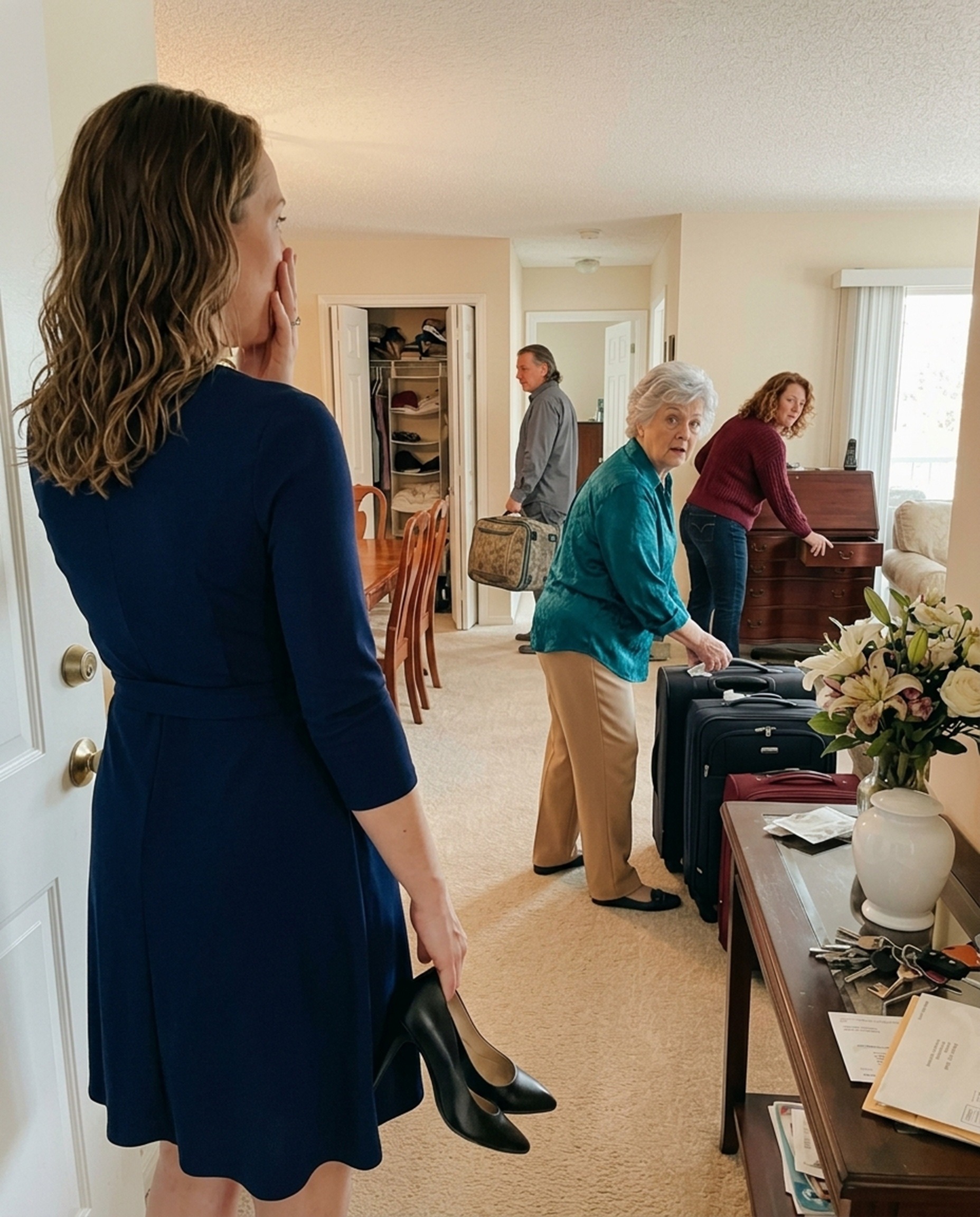
The elevator ride to the third floor felt longer than usual, the hum of the old motor vibrating through the soles of my patent leather heels. When I reached the end of the corridor, my front door was already unlatched.
I stepped inside, my hand instantly going to the plain gold band on my left ring finger, twisting it twice around the knuckle.
In the center of the living room, Marjorie stood beside the dining table, her chin lifted high as she pointed a manicured finger toward the hallway. Two large gray canvas bags lay flat on the cushions of my sofa, their zippers fully undone.
“Put the leather-bound volumes in the smaller grip, Declan,” Marjorie said, her voice sharp and clipped. “The regional histories stay in the crate.”
She turned her head slowly, her eyes running down my black funeral dress before she met my gaze. She did not offer a greeting.
“You are late returning from the cemetery, Avery,” Marjorie said, tapping her index finger against the polished mahogany of my sideboard. “We have a great deal of packing to finish before the administrative offices close.”
I stood near the coat rack, my fingers still working the gold band.
“This is my home, Marjorie,” I said, pausing between the words to keep my voice even. “Bradley and I lived here for twelve years.”
Marjorie made a small, dry sound in the back of her throat, her finger continuing its steady tap on the wood.
“My son is gone, and this property was purchased with family capital,” Marjorie said, her accent tightening around the vowels. “We require the keys to the unit by five o’clock.”
I looked past her toward the narrow hallway that led to the study.
Declan emerged from the shadows of the corridor, carrying a heavy cardboard box overflowing with Bradley’s reference books. The sharp, synthetic scent of his pine cologne reached me before he even stepped into the room.
“Hey there, Avery,” Declan said, laughing quickly and shifting the box to one hip. “Just doing some of the heavy lifting for the old lady.”
He stopped in the middle of the hallway, completely blocking the path to our bedroom.
“Bradley owed me quite a bit of cash for that land project in Putnam County,” Declan said, running his free hand through his slicked-back hair. “Thirty-five thousand dollars, to be exact.”
I waited, letting the silence stretch between us until Declan shifted his weight.
“Bradley never mentioned any debt to you, Declan,” I said.
Declan laughed again, the sound echoing off the plaster walls.
“Well, Bradley kept a lot of things to himself, didn’t he?” Declan said, leaning closer. “The point is, I have a right to get my investment back out of this estate.”
I wondered how much Bradley had actually given him over the years, and whether any of it had ever been returned.
I squeezed past Declan, the rough cardboard of his box scraping against the sleeve of my jacket. The door to Bradley’s study was wide open, and the small green lamp on his desk was already burning.
Fiona was kneeling beside the lower desk drawer, her hands full of legal-sized manila folders. She was shifting them rapidly, the heavy paper rustling in her grip like dry leaves.
“Fiona,” I said, my voice dropping. “Please step away from his desk.”
Fiona did not look up, her fingers sliding over the tabs of the folders with practiced speed.
“I am looking for his personal correspondence from nineteen ninety-eight,” Fiona whispered, her breath coming in quick, shallow puffs. “The family papers belong to us, Avery.”
She slid three folders into a canvas tote bag at her feet.
“Those are Bradley’s private files,” I said, waiting three seconds before I spoke again. “You have no right to touch them.”
Fiona finally raised her face, her eyes narrowing as she clutched a stack of tax receipts to her chest.
“And who are you now?” Fiona whispered. “A widow. That is all.”
She turned back to the drawer, her fingers moving to the next green hanging folder.
The hum of the traffic from Cathedral Place filtered through the glass of the window, sounding distant and thin. I turned back toward the entryway, where Marjorie was waiting by the small console table.
Marjorie held her hand out, palm upward, her fingers curling slightly. Resting in the center of her skin was a bright brass key, its shape identical to the one I carried in my purse.
“I had this made during our visit last Thanksgiving,” Marjorie said, her chin tilting upward as she looked at me. “The association documents clearly state that the primary family line retains occupancy rights in the event of a tenant’s passing.”
She tapped the key against the brass tray on the table.
“You have no legal standing here, Avery,” Marjorie said. “Your things should be cleared out by sunset.”
I looked down at the floor, my feet aching from the hours spent standing on the damp grass of the cemetery. I reached down and slid my feet out of my black patent leather pumps.
I stood barefoot on my own rug, holding my high heels in one hand.
I set my high heels down on the Persian rug in the entryway, the leather making a soft, dry sound against the wool. Through the open window, the damp smell of coquina stone drifted in from the street below, mixed with the salt air of the harbor.
In the kitchen, the overhead light cast a sharp yellow glow across the granite countertops where Marjorie stood. She had already filled the electric kettle, her eighty-one-year-old hands moving with a practiced, administrative efficiency that made my shoulders tighten.
“You look entirely drained, Avery,” Marjorie said, her clipped accent cutting through the quiet of the hallway. “I am going to make us some hot chamomile tea, and then we shall sit down to arrange the transition.”
I did not answer her right away, letting the silence stretch between us as I walked slowly into the kitchen. I twisted the plain gold band on my left ring finger, feeling the familiar, smooth metal against my skin as I tried to anchor myself.
Marjorie lifted her chin and tapped her index finger on the edge of the stove. “We must have absolute order if we are going to resolve Bradley’s affairs by the fifteenth, and we cannot afford any emotional delays.”
“The kettle is already hot,” I said slowly, pausing between my words to ensure my voice did not shake.
“Then we shall drink,” Marjorie said, reaching for two ceramic mugs from the rack above the sink. “Sit down, Avery, because you are hovering in the doorway like an uninvited guest in your own home.”
She behaved as though she had bought the place herself, her eyes scanning the custom cupboards as if she were taking a mental inventory of the hinges and the wood quality. I knew she had already been asking local real estate agents about the value of the property, trying to calculate how much she could squeeze from Bradley’s memory.
“The monthly condo dues here are six hundred dollars,” Marjorie said, adjusting the placement of the mugs on the counter. “That is quite a heavy burden for a single woman with no independent income, especially now that the consulting business has ceased operations.”
I did not offer any correction or defense, letting her believe whatever she liked about my finances and our private accounts. I slid my right hand into the deep pocket of my linen trousers, my fingers brushing against the cool glass of my phone.
“I will get the sugar from the pantry,” I said, speaking with deliberate slowness to keep my composure.
Marjorie did not turn around, her attention focused entirely on sliding the tea bags into the mugs and arranging a small silver tray she had found in our sideboard. I stepped back into the narrow hallway and pulled the heavy pantry door shut behind me, plunging myself into the shadow of the tall wooden shelves.
The small space smelled of dried bay leaves and the rich, dark aroma of black chicory coffee we had bought together at the market last month. I pulled my phone from my pocket, my thumb finding Elena Cruz’s name on the screen and pressing dial before my courage could waver.
The call connected on the second ring, the quiet hum of the line filling my ear and bringing a sudden sense of reality back into the house.
“Avery,” Elena said, her voice dropping into its usual measured, legalistic tone without any unnecessary inflection. “Are you in a safe place to speak, or are they still occupying the main rooms?”
“I am in the pantry,” I whispered, keeping my eyes fixed on the thin crack of yellow light beneath the door. “Marjorie is in the kitchen making tea, and Declan and Fiona are searching through the drawers in the other rooms.”
“Listen to me carefully,” Elena said, her voice steady and reassuring over the line. “I have just completed the search of the county registry on Cathedral Place, and I have the official copies in my hand.”
I waited, holding my breath against the damp, close air of the pantry, my heart rate slowing as I listened.
“Six days before he was admitted to St. Johns Memorial, Bradley executed the transfer documents,” Elena said.
“The transfer?” I asked, my voice barely a whisper against the receiver.
“The St. Augustine Harbor Trust deed is officially recorded,” Elena said. “The entire property, including the condo, was legally moved out of his personal estate and placed under the trust’s protection.”
I gripped the edge of a pine shelf, my fingers brushing against a tin of spices to keep my balance. “But what about his other files, Elena? Declan was asking about accounts under the name Rowan, and he seemed very specific about it.”
“Bradley used his middle name Rowan for all his consulting and business accounts for a very specific reason,” Elena said, her tone hardening slightly.
I waited, listening to the distant, hollow sound of a dresser drawer sliding open in the guest bedroom down the hall.
“He did it to hide his real estate holdings from his predatory family,” Elena explained. “He knew that if they tracked his personal name through public records, they would find this condo and attempt to claim it the moment he passed.”
A fragile hope began to stir under my ribs, warm and unexpected, replacing the cold weight that had settled over me since the funeral.
“So they have no claim to this house?” I asked.
“None whatsoever,” Elena said. “The trust governs everything now, and you are the sole trustee. But you must remain calm, Avery, and you must not let them know we have the recorded deed yet.”
“Why should I keep it a secret?” I asked.
“Because we need them to show their intentions clearly before the transition deadline of October fifteenth,” Elena said. “If they attempt to remove physical property or sign documents, it establishes their unlawful intent.”
“They are already packing his suitcases in the study,” I whispered.
“Let them pack,” Elena said, her voice cool and steady. “I am preparing the formal notices and coordinating with the local authorities. Do not let them take anything out the front door, and remember what Bradley told you before he went sleep.”
“He told me to laugh first,” I said.
“Then do exactly that,” Elena said. “I will call you the moment the deputy is cleared to assist us downstairs.”
I ended the call and slipped the phone back into my linen pocket, my hand steady for the first time all evening as I took a deep breath of the chicory-scented air.
Just then, the deep, mechanical horn of the evening drawbridge sounded from the harbor, vibrating through the wooden floorboards beneath my bare feet and breaking the silence.
I pushed the pantry door open and walked back into the hallway, leaving the quiet shadow of the shelves behind me. Marjorie was still standing by the stove, her fingers tapping against the ceramic mugs as she waited for the hot water to steep.
I walked past the kitchen and entered the dining room, where the mahogany table sat under the dim crystal chandelier. Declan was leaning over the heavy sideboard, his large frame blocking the light from the window as he rummaged through the small drawers.
He was sliding his fingers along the velvet-lined compartments where we kept the formal silverware, his movements clumsy and urgent. The strong, sharp scent of his pine cologne seemed to fill the entire room, making the air feel thick and unpleasant.
“These silver spoons are quite old, Avery,” Declan said, running his hand through his slicked-back hair as he turned to face me. He laughed, a loud, forced sound that rattled the empty crystal glasses on the table.
“I seem to recall Bradley saying these belonged to his father’s side of the family,” Declan said, holding up a heavy serving piece. “We should probably keep them with the other heirlooms for safekeeping.”
“They belonged to my mother’s family,” I said slowly, pausing between my words to let them sink into his confidence.
“Well, we will have to verify that in the records,” Declan said, his eyes darting toward the drawers again. “Bradley owed me quite a bit of support for that consulting venture last winter, and we need to settle the balance.”
I watched him, my anxiety melting into a cold, clear confidence as I remembered the trust documents Elena had verified. “Bradley did not owe you anything, Declan.”
Declan laughed again, though the sound was thinner this time, his forced familiarity faltering under my steady gaze. “We will let the lawyers figure that out, cousin. In the meantime, it is best to keep these safe so they do not go missing.”
He reached into the drawer again, his thick fingers wrapping around three silver serving spoons and tucking them into his vest pocket. I did not move to stop him, remembering Elena’s warning to let them show their hands before we acted.
The knowledge of the Harbor Trust deed felt like a shield between me and his greed, turning his actions into nothing more than a desperate display.
From the hallway, a sharp rustling sound broke the quiet of the house, followed by the sound of paper sliding across the floor. I turned away from Declan and walked toward the linen closet near the study entrance.
Fiona was standing there, her fingers pulling hard on the brass handle of the locked closet door. She was holding a stack of old utility bills and papers, shifting them constantly from hand to hand as if she could not stay still.
“This door is locked, Avery,” Fiona whispered rapidly, her breath coming in quick, shallow puffs that smelled of peppermint. “Where is the key for this?”
“There is nothing in there for you, Fiona,” I said slowly.
“Bradley kept his personal diaries and trust records in the study closets,” Fiona whispered, her eyes darting to my face and then back to the brass handle. “We need to examine them to make sure nothing is missing before the estate is processed.”
“You are wasting your time,” I said, crossing my arms and standing my ground.
“We are family, Avery,” Fiona said, her voice rising slightly as she rustled the papers in her hands. “We have a right to know what Bradley left behind, and we are only trying to help you with the transition.”
Marjorie walked out of the kitchen, carrying the wooden tray with two steaming mugs of tea. She stopped beside Fiona, her chin lifted high as she looked down at me with a cold, superior gaze.
“It is time to be sensible, Avery,” Marjorie said, tapping her index finger against the edge of the tray. “You cannot manage this large condo on your own, and the family must protect its investments.”
I looked at Marjorie, then at Fiona, and then at Declan who had walked out of the dining room with the silver spoons in his hand. They believed they had successfully taken control of the home, standing in my hallway like conquerors who had already won.
I thought of Bradley’s quiet voice in the hospital, telling me to stand firm against their demands. The cost of this confrontation was my peace, the quiet grieving process I had wanted so desperately to preserve.
But as I looked at their eager, predatory faces, I realized I did not want peace on their terms.
I let out a clear, steady laugh that makes the entire room go silent.
Marjorie sat on the sofa, her back straight as a coquina wall. She stopped tapping her finger on the side table and lifted her chin.
“There is no need for hysteria, Avery,” Marjorie said, her sharp accent cutting through the quiet room. “We are only looking for a sensible way forward for everyone involved.”
I twisted the plain gold band on my left ring finger. I waited, letting the silence stretch between us until the space felt heavy.
“A sensible way,” I said.
“Exactly,” Marjorie said. “We know Bradley was a cautious man, but he was also family. We want to ensure you are looked after against any sudden difficulties.”
She paused to smooth her wool skirt.
“We are prepared to offer you a monthly allowance of fifteen hundred dollars,” Marjorie said. “It would come directly from the family holdings, starting this Friday.”
I looked at her, keeping my face entirely blank.
“Fifteen hundred,” I said.
“For up to two years,” Marjorie said, her tone softening into something that sounded almost like grease. “It would give you time to find a smaller, more manageable apartment near the mainland.”
I did not answer her. I simply watched the way she kept her eyes fixed on my face, waiting for a nod.
“We are family, Avery, we can settle this without lawyers,” she said.
Before I could speak, Declan called out from the dining room.
“Avery, you might want to look at this,” Declan said.
His voice carried a forced cheerfulness that made me press my thumb against my ring. I walked into the dining area, where the heavy oak table was covered in old electric bills and tax notices.
Declan ran his hand through his slicked-back hair. The sharp scent of his pine cologne seemed to hang over the table like a damp mist.
“Bradley owed me some capital,” Declan said, holding up a yellowed slip of paper. “We had a verbal agreement on a short-term commercial venture back in April.”
He laid the paper flat on the dark wood.
“Nine thousand five hundred dollars,” Declan said. “He signed for it right here at the bottom.”
I leaned closer to the table, looking at the dark ink.
The signature was written in a fluid, continuous loop. Bradley always paused between his first name and his middle name, leaving a distinct gap where the pen lifted from the paper.
“That is not his handwriting,” I said.
“Of course it is,” Declan said, laughing quickly and looking toward the hallway. “He was probably tired when he signed it.”
“Bradley never used a ballpoint pen for legal documents,” I said, pointing to the blue ink. “He only used his black fountain pen.”
Declan took the paper back and folded it into his front pocket.
“Well, the bank will see it differently when the estate goes to probate,” Declan said.
I turned away from him and walked down the short hallway toward the study.
Fiona was standing near the built-in bookshelves, her hands full of manila folders from the bottom drawer. The constant rustle of paper stopped the moment she saw me in the doorway.
“I was just thinking about your sweaters,” Fiona whispered, her voice rapid and thin. “The wool ones in the bedroom closet need to be packed before the dampness gets to them.”
She took a step closer to her large leather purse on the desk.
“I can help you wrap them,” Fiona whispered. “We should start on the closets tonight.”
“The closets can wait,” I said.
“We must be practical, Avery,” Fiona whispered, shifting her weight from one foot to the other. “The transition date is October fifteenth, and that is only a few weeks away.”
She reached out and picked up a thick, blue folder from the desk, sliding it quickly under her arm.
I knew the blue folder was empty. I had moved Bradley’s actual papers to the kitchen hours ago, leaving only the old tax receipts from our first year in the condo.
“I will handle the bedroom myself,” I said.
Fiona turned her back to me, pretending to inspect a small framed print on the wall. I saw her hand slide the blue folder into the deep side pocket of her purse.
“As you wish,” Fiona whispered. “But the clock is running.”
I walked back toward the kitchen, my slippers silent on the hallway runner.
Marjorie was already there, standing by the stove. She had found the tin of chicory coffee and was measuring it into the drip pot.
“You look pale, Avery,” Marjorie said, her voice dropping into a warm, grandmotherly tone. “Let me make us some tea instead.”
She took two ceramic mugs from the rack.
“Bradley always spoke so highly of your patience,” Marjorie said as she poured the hot water. “He knew you were a quiet woman.”
She set the mug on the counter and looked at me with a soft smile.
“He loved this kitchen,” Marjorie said.
Her eyes drifted from my face to the upper cupboards near the pantry, then back again.
“He did,” I said.
“We only want to preserve his legacy,” Marjorie said, pushing the white mug toward me. “If you sign the relocation agreement tonight, we can have the first check in your hand tomorrow morning.”
She reached into her cardigan pocket and pulled out a folded sheet of paper.
The header on the paper read Voluntary Release of Occupancy.
“It is just a formality for the insurance company,” Marjorie said.
Her hand was trembling slightly as she set her floral teacup back onto the saucer.
My phone began to hum against my palm before the porcelain stopped rattling on the dining room table.
I stepped back into the kitchen and slid the wooden pocket door shut, shutting out the heavy scent of Declan’s pine cologne.
“Avery, I am glad you answered,” Elena Cruz said, her voice coming through the receiver with its usual professional chill.
“I am in the kitchen,” I whispered, keeping my eyes on the narrow gap in the doorway. “They are still here.”
“I have just finished decrypting the second directory in the Harbor Trust archive,” Elena said. “The files Bradley uploaded during the first week of September.”
I turned my wedding band around my finger, the metal warm against my skin. “What is in them?”
“Police incident reports from nine years ago,” she said. “Along with three separate forensic handwriting analyses.”
I looked down at the empty chicory coffee pot on the counter, remembering how Bradley had always insisted on organizing his old consulting files by year. “Whose handwriting?”
“His mother’s,” Elena said. “And his cousin Declan’s.”
The refrigerator compressor kicked on with a low, dull rattle that vibrated through the floorboards.
“They are not here for sentimental pieces, Avery,” Elena continued. “They are trying to cover up a pattern that began before Bradley’s father passed away.”
“What did they take?” I asked.
“Six short-term private loans totaling eighty-five thousand dollars,” she said. “Every application was backed by forged signature pages from the family’s old real estate partnership.”
My thumb stopped moving against my ring. “Bradley kept the originals?”
“He kept the original wet-ink documents in his safety deposit box on Cathedral Place,” Elena said. “And he left digital copies with my office to be released if anyone contested his final trust.”
The line went silent for three seconds, the quiet of the empty kitchen pressing against my ears.
“I am coming over,” Elena said.
The call ended with a sharp click, leaving me alone with the hum of the refrigerator.
I slid the pocket door back into the wall and walked into the dining room, where the overhead light cast long, pale shadows across the table.
Marjorie sat straight in her chair, her index finger resting against the edge of her saucer.
“Who was on the phone, Avery?” she asked, her chin lifting slightly.
“Our attorney,” I said, sitting down in the chair Bradley had occupied for thirty years. “Elena Cruz.”
Marjorie made a soft, clicking sound with her tongue. “We do not require an attorney to settle a simple family transition.”
“It was never a transition, Marjorie,” I said, leaning forward to look at her hands. “It was an audit.”
She tapped her index finger once on the table, her fingernail making a sharp, plastic sound against the wood. “We are only interested in what is rightfully ours.”
“Then we should discuss the eighty-five thousand dollars from nine years ago,” I said.
The silence that followed was heavy and cold, stretching across the room until the distant horn of the evening drawbridge sounded from the harbor.
Marjorie did not move her hand, but the skin around her knuckles turned a flat, dull white. “I have no idea what you are talking about.”
“Three short-term loans,” I said, my voice remaining level and slow. “Signed with your husband’s name three weeks after he was admitted to the memory care facility in Jacksonville.”
“That is a lie,” she said, her voice dropping into a thin whisper.
“Bradley spent six months tracking the bank transfers,” I said. “He kept the original loan applications with the forged signatures.”
Declan stepped out of the hallway, his hands stuffed deep into his pockets, his slicked-back hair catching the yellow light from the chandelier.
“We don’t need to listen to this, Aunt Marjorie,” he said, his loud voice shaking slightly. “She is just trying to stall because she knows she has to be out of here by the fifteenth.”
“The loan from the historical preservation fund was for forty-eight thousand dollars, Declan,” I said, turning to look at him. “Your name was on the secondary deposit slip.”
Declan stopped three feet from the table, his hand coming out of his pocket to run through his hair. “Bradley was a consultant, Avery. He wrote down a lot of things that never happened.”
“He did not hide his past, Marjorie,” I said, turning my eyes back to her pale face. “He documented yours.”
Fiona appeared in the doorway of the study, holding a thick manila folder against her chest.
“What is going on in here?” Fiona whispered, her eyes darting between Marjorie and the kitchen door.
“Avery is telling stories,” Declan said, but he did not look at Fiona, his eyes remaining fixed on the kitchen counter behind me.
“They are not stories, Fiona,” I said. “Your mother signed the papers, and Declan carried the checks to the bank on Anastasia Island.”
Fiona’s grip on the folder loosened, and the corner of the heavy paper slipped from her hand.
Three white sheets of paper slid out, drifting onto the dark rug near her feet.
“You don’t know what you’re talking about,” Fiona said, her voice rising to a breathy squeak.
“The sheriff’s department in St. Johns County has the reports,” I said, looking at the papers on the floor. “They have had them for nine years.”
Marjorie stood up so quickly her chair scraped against the tile, the legs screeching in the quiet room.
“Bradley would never do that to his own family,” Marjorie said, her voice cracking for the first time since she had arrived.
“He did it to protect himself,” I said. “And he did it to protect me.”
Declan took a step toward the study door, his boots heavy on the pine floor. “We are taking the files, Marjorie. There is nothing she can do to stop us.”
“The files you are holding are copies, Fiona,” I said, not moving from my chair. “The originals are already with the trustee.”
Fiona bent down to retrieve the papers she had dropped, her fingers fumbling with the edges against the rug.
“We have five days until the fifteenth,” Declan said, his voice dropping into a harsh, flat tone. “The locks can’t be changed until then.”
“The lock change was authorized three months ago,” I said.
Marjorie stood perfectly frozen in the center of the dining room.
I turned away from Marjorie and walked toward the study, guided by the sound of wood scraping heavily against the heart pine floor.
Declan had his thick arms wrapped around the corner of Bradley’s heavy oak desk. He grunted, his face turning a dark, mottled red under his slicked-back hair as he tried to slide the massive piece of furniture toward the doorway.
“You need to step away from his desk,” I said, speaking slowly.
He did not look up, only strained harder against the weight of the wood, his boots slipping slightly on the polished floorboards.
“Bradley kept a record of the twenty-two thousand dollars,” I said after a long pause.
Declan let go of the desk with a sudden drop that made the floorboards groan. He wiped his sweaty palms on his trousers, smelling strongly of pine cologne.
“That was a private business arrangement,” he said, laughing dryly as he took a step toward me.
“It was a personal loan,” I said, twisting the gold band on my finger. “One that you never repaid a single dollar of.”
He laughed again, though the sound was hollow in the high-ceilinged room.
“There is no paperwork to prove that, Avery,” he said. “Bradley was a lot of things, but he was not a fool who kept old receipts.”
“He kept everything, Declan,” I said.
I stood directly in the center of the doorway, blocking his path to the hall.
He did not slow down as he approached. He took two long strides and shoved his shoulder straight into mine to force his way out of the room.
The physical impact sent me back against the hard doorframe, my shoulder throbbing as he brushed past me without looking back.
In the living room, Marjorie had recovered her posture and was sitting on the edge of the sofa, her chin lifted high.
“You have no legal right to remain in this building past October fifteenth,” she said, her voice sharp and clipped.
I stood by the hallway entrance, keeping my hand pressed against my sore shoulder.
“This is my home, Marjorie,” I said.
“It was Bradley’s home,” Marjorie said, tapping her index finger against her leather purse. “And now it belongs to his family. I will call the sheriff myself to have you removed as a squatter.”
She stood up slowly, smoothing the front of her dark wool skirt.
“You will leave this house with nothing but your clothes,” I said, my voice remaining low and steady.
Marjorie let out a short, harsh breath that was almost a laugh.
“We will see what the county authorities have to say about your presence here when the deadline arrives,” she said.
I did not answer her. I turned and walked toward the small balcony that overlooked the water, needing to feel the cool air.
I stepped out onto the narrow concrete ledge and watched the rain fall over the harbor.
The drawbridge horn blew in the distance, a low, melancholy sound that echoed across the dark water.
My phone vibrated in my palm, the screen lighting up with Elena’s name.
“Avery,” Elena said when I answered. “I have just received a notification from Bradley’s bank.”
“What has happened?” I asked, looking down at the empty street below.
“Declan has filed a temporary emergency claim against the estate accounts,” Elena said, her voice measured and quiet. “He submitted a document claiming a outstanding business debt against Bradley’s personal name.”
“Can he do that?” I asked.
“He has done it,” Elena said. “The bank has frozen your active household accounts until we can clear the title next week.”
A cold weight settled in my stomach as I realized I had no access to my own household money.
“How am I supposed to pay the monthly condo dues?” I asked.
“We will handle it,” Elena said. “But for now, you must not sign anything they offer you.”
I hung up the phone and stared out at the grey rain washing over the coquina stone wall across the street.
I walked back inside, my shoes silent on the rug as I entered the hallway.
Fiona was coming out of the study, struggling to carry a heavy cardboard box filled with Bradley’s old reference files.
She was moving too fast, her narrow shoulders hunched over the edges of the box.
As she tried to navigate the narrow passage, her hip struck the tall ceramic pedestal table in the corner.
The blue-and-white ceramic vase that Bradley had bought on our anniversary tipped sideways.
It hit the tile floor with a sharp, explosive crack that echoed through the entire apartment.
The white lilies fell into the wet pile of shards, their pale petals instantly bruising against the hard stone.
Fiona did not stop to look down or apologize.
The sound of the broken ceramic pieces scraping against the hallway tile as Fiona kicks them aside.
I walked into the kitchen and closed the swinging door behind me to block out the noise of their searching.
The air in the kitchen smelled faintly of the black chicory coffee I had brewed that morning, a bitter comfort that felt days away now.
A receipt for the monthly condo dues of six hundred dollars sat on the marble counter, right next to the stack of sympathy cards I had not yet opened.
Beyond the glass, the damp smell of coquina stone rose from the historic street below, carried on the humid night air.
I pulled my phone from my apron pocket and opened the camera app.
My hands were steady as I pushed the door open just enough to slide the lens through the gap, aiming it toward the wreckage in the study.
I took three photographs of the overturned chair, the papers strewn across the rug, and the empty space where the heavy desk drawer had been pried open.
I attached the images to a text message to Elena Cruz, our estate attorney.
My fingers hovered over the screen for a moment before I typed a single line: They are clearing out his papers.
I pressed send and leaned against the cool granite countertop, waiting.
A small green bubble appeared on the screen, followed by three typing dots that rose and fell.
Elena’s reply came through in less than a minute: I am downstairs in the lobby with the building manager and two officers from the sheriff’s department.
I put the phone back in my pocket.
The knot of anxiety that had kept my shoulders tight since the memorial service finally loosened.
For days, I had tried to find a way to make Marjorie understand that we could settle this quietly, like family.
I had hoped we could avoid the public mess of a legal battle.
But as I looked at the kitchen cabinet where I had hidden Bradley’s private ledger, I knew there was no room left for gentleness.
They had not come to grieve Bradley.
They had come to strip the house bare.
And I was finished trying to protect them from the consequences of their own choices.
I pushed the kitchen door open and walked into the dining room, where the overhead chandelier cast a harsh light on the long mahogany table.
Marjorie sat in the center chair, her chin lifted high as she lined up Bradley’s silver-plated pocket watches in a neat row.
She did not look up when I entered, but her index finger began its rhythmic tapping against the polished wood.
“There are three sterling serving spoons missing from the velvet chest, Avery,” she said, her voice clipped and dry.
I sat down at the opposite end of the table, leaving six feet of empty space between us.
“The silver belongs to the estate, Marjorie,” I said, speaking slowly and letting a long pause fill the room before I finished.
“The estate is family business,” Marjorie said, tapping her finger harder. “Where did Bradley keep the keys to the safety deposit box at the downtown branch?”
I twisted the plain gold band on my left ring finger, feeling the familiar groove in my skin.
I did not answer her.
“I asked you a question, Avery,” she said, finally raising her eyes to glare at me. “We know he maintained an account under his middle name, Rowan.”
“Your silence is not going to protect you,” Marjorie said, leaning forward. “We have the right to inventory every item in this apartment before the transition deadline on the fifteenth.”
I looked at her lined face, searching for any trace of the woman who had once sent Bradley handwritten notes during his first year of college.
There was nothing there but calculation.
“You have no rights here,” I said quietly.
“We have the right of blood,” Marjorie said, her finger pausing on a silver pocket watch. “And that is stronger than any piece of paper you might have hidden in your desk.”
I let her words hang in the quiet of the room, offering no correction.
From the study, the sound of a heavy book hitting the floorboard echoed through the hallway.
I stood up from the table, leaving Marjorie with her rows of pocket watches, and walked toward the back of the condo.
Declan was standing on his tiptoes, his hand reaching behind the leather-bound volumes of old Florida history on the top shelf.
His slicked-back hair had come loose, a few dark strands sticking to his forehead, and the sharp scent of his pine cologne filled the small room.
“There has to be a ledger for the consulting firm,” Declan muttered, not turning around. “He wouldn’t have kept twenty-two thousand dollars in a simple checking account.”
I leaned against the doorframe, my eyes tracking his movements as he pulled down a thick volume on coquina masonry.
Directly behind the spot where the book had been, a tiny black plastic square sat nestled into the dark oak paneling.
A minuscule red light on the corner of the square blinked once every three seconds.
Bradley had installed the small security camera three months before his final illness, linking the feed directly to a secure digital drive.
Declan’s fingers brushed right past the lens as he shoved another book aside.
The camera was recording every gesture, every pulled drawer, and every stolen document.
And the images were streaming directly to the digital folder Elena was carrying in her briefcase downstairs.
“You won’t find what you are looking for in those books, Declan,” I said.
He jumped slightly, then turned around with a forced, booming laugh that rattled the glass in the desk lamp.
“Just looking for some of Bradley’s old journals, Avery,” he said, running his hand through his hair. “For sentimental reasons, of course.”
“You assumed that because he was quiet, he was easy to overlook,” I said.
Declan’s laugh faded, his eyes narrowing as he looked at me.
“He was my cousin, Avery,” he said, stepping toward the desk. “I knew him a lot longer than you did.”
“He knew you too,” I said, thinking of the detailed records of the unauthorized loans Bradley had preserved in his files.
He reached for another shelf, his shoulder brushing against the oak frame.
“We’re going to find the papers, Avery,” he said, his voice dropping. “It’s better for everyone if you just tell us where they are.”
I turned away before he could answer, walking back toward the main living area.
In the living room, Fiona was kneeling on the Persian rug beside the heavy leather suitcase.
She was struggling with the metal zipper, her breathy whispers rising as she tried to force the leather edges together over a stack of file folders.
The folder she had taken from the study desk was wedged tightly near the hinge, the top corners of the paper bent and torn.
“This won’t close,” Fiona whispered to herself, her hands rustling the paper as she tried to reposition the contents.
She looked up and saw me standing by the entryway.
“We need to get these downstairs before the rain starts again,” she said, her voice hurried. “We can carry the rest in the morning.”
I did not move from my position near the heavy brass front door lock.
“The suitcases stay here, Fiona,” I said.
Fiona stood up, smoothing her skirt with quick, nervous gestures.
“We are taking what belongs to Bradley’s father,” she said, her whisper rising in pitch. “You have no legal standing to stop us.”
“We will see about that,” I said.
From the hallway outside, the faint, low hum of the building’s elevator began to rise through the concrete floorboards.
Marjorie walked out of the dining room, her fingers still clutching two of the gold pocket watches.
“We are leaving now, Avery,” Marjorie said, her chin lifted high. “And we will return tomorrow with a moving van.”
I kept my eyes on the front door, waiting for the green light on the intercom panel to flash.
The rain outside began to tap against the glass balcony doors, a steady, rhythmic sound that filled the quiet apartment.
My phone buzzed twice in my palm.
I raised the screen and read the text from Elena: We are in the elevator now.
I turned the brass deadbolt and pulled the heavy wood inward, refusing to look at Marjorie as she tried to crowd my shoulder.
Marjorie caught the edge of the door with her fingertips, her knuckles turning a sharp, paper white. “We do not require any intrusion tonight, Avery. Close it.”
Beyond her hand, the bright corridor light fell across Elena Cruz, who stood with her hands folded over her leather briefcase. Next to her was Luis, holding his heavy plastic clipboard against his chest, and behind them both stood a tall county deputy, his hands resting easily on his utility belt.
“Good evening, Marjorie,” Elena said. Her voice was flat, measured, and entirely without inflection.
Marjorie lifted her chin, her index finger beginning its rapid, silent tap against the brass strike plate of the door frame. “This is a private family matter, Ms. Cruz. We are in the middle of preparing my son’s belongings for transport.”
“It is not a private matter when it involves unauthorized entry,” Elena said, stepping forward so firmly that Marjorie had to take a step back into the entryway.
Luis followed her, his eyes scanning the three cardboard boxes sitting by the coat rack. He did not look at Marjorie, keeping his gaze fixed on his clipboard. “The association received a report of unauthorized moving activity after hours.”
“I am Bradley’s mother,” Marjorie said, her voice clipped and sharp. “I do not require authorization to be in my late son’s home.”
“Actually, Mrs. Keller, you do,” Elena said, walking past her into the living room.
I closed the door behind the deputy, my fingers instantly finding the plain gold band on my left ring finger. I twisted it twice, feeling the cold metal slide against my skin, before I followed them into the living room where Declan and Fiona were waiting.
Fiona was standing by the armchair, her large canvas purse clutched to her stomach as if she could hide the shape of the folders she had slipped inside it. Declan was leaning against the dining table, his hand frozen halfway through his slicked-back hair.
The scent of his heavy pine cologne seemed to fill the entire space, sharp and artificial against the damp coquina stone smell drifting in from the balcony.
“What is this, Avery?” Declan asked, his voice forced and loud, though his eyes darted quickly to the deputy’s uniform. “You brought a cop into Bradley’s house?”
“This is not Bradley’s house,” Elena said, setting her briefcase flat on the dining table and flicking the brass latches open.
Marjorie marched in from the entryway, her breath coming in quick, shallow puffs. “Do not speak to my nephew in that tone. Bradley owned this condominium. The deed is in his name, and as his family, we are his legal representatives.”
Elena pulled a document from her briefcase. The paper was heavy, off-white, and bound at the top with a brilliant blue wax seal that caught the light of the table lamp.
“This is the official deed for this property, recorded with the county six days before Bradley passed away,” Elena said. She laid it flat on the wood, right in front of Marjorie.
Marjorie did not touch it. She stared at the blue wax seal as if it were an insect. “Bradley had no other deeds. He had a simple consulting business.”
“Bradley was an asset investigator, Mrs. Keller,” Elena said, adjusting her silver watch strap with a single, precise click. “He understood exactly how to secure what mattered to him.”
“What is that paper?” Fiona whispered, her voice rapid and breathy as she rustled the strap of her purse. “It looks like a fake.”
“It is the deed to the St. Augustine Harbor Trust,” Elena said, her eyes locked on Marjorie’s pale face. “Bradley transferred the ownership of this entire condominium, along with his primary consulting accounts, into the trust on the ninth of October.”
The room went completely quiet, save for the faint sound of the evening drawbridge horn echoing from the harbor outside.
“A trust?” Marjorie said. The word seemed to stick in her throat. She tapped her finger against the edge of the dining table, though her hand had begun to shake. “That cannot be legal. I am his mother. I would have been notified.”
“A private trust requires no public notice, and it does not pass through probate,” Elena said. “The trust is the sole owner of this property. Avery is the sole trustee, and she is the sole beneficiary.”
“This is absurd,” Marjorie said, her chin lifting higher as she tried to salvage her dignity. “We have been paying the bills here. We have contributed to this household.”
“The records show otherwise,” Luis said, tapping his clipboard. “The six hundred dollars in monthly condo dues have been paid by automatic draft from the Rowan account for the past four years. The association has never received a payment from you, Mrs. Keller.”
Declan took a step forward, his loud demeanor suddenly cracking. “Wait a minute. What about the consulting business? What about the accounts under Rowan?”
“The Rowan accounts were holding accounts for the trust’s real estate assets,” Elena said. “Which Bradley kept separate specifically to protect them from unauthorized family inquiries.”
Fiona looked at Marjorie, her fingers clutching her purse so tightly the canvas groaned. “Marjorie, you said there was no trust. You said he didn’t have the money for a trust.”
“He didn’t,” Marjorie muttered, her face turning a strange, ash-gray color in the lamplight.
“He did,” I said. I spoke slowly, pausing between my sentences to make sure my voice remained steady. “He spent months preparing this.”
Marjorie turned on me, her eyes narrow and sharp. “You knew about this. You sat there in the hospital and let me think we had to handle his affairs.”
“I knew Bradley wanted me to be safe,” I said, twisting the gold band on my finger again. “I did not know the details until Elena showed me the paperwork.”
“This is a scam,” Declan said, his voice rising again as he pointed a finger at Elena. “You set this up to cheat us. Bradley promised me twenty-two thousand dollars from his consulting firm. We had an agreement.”
“If you have a written agreement, Declan, you may file a claim against the estate,” Elena said, her voice remaining perfectly level. “However, the trust assets are entirely separate from the personal estate. And as for your presence here tonight, it is a civil trespass.”
Luis stepped forward, his heavy plastic clipboard raised. “Mrs. Keller, I have the building log here. Yesterday afternoon, you presented a duplicate brass key to my staff and claimed you had authorization to change the entry locks.”
Marjorie did not answer. She kept her chin lifted, but her eyes were fixed on the blue-sealed deed.
“Who authorized the lock change, Marjorie?” Elena asked, her eyes cold. “Because Bradley revoked your access months ago.”
The silence in the room was absolute. Even Declan had stopped moving, his hand hovering near his pocket.
“The building registry shows that Bradley personally removed your name from the guest list in August,” Luis said, his professional tone cutting through the tension. “He explicitly stated that no duplicate keys were to be issued to anyone other than Avery.”
“He had no right,” Marjorie whispered. “I brought him into this world.”
“He had every legal right to secure his home,” Elena said. “And the duplicate key you used tonight was created without authorization from the trustee.”
Fiona took a slow step backward, trying to distance herself from the cardboard boxes stacked near the hallway. “We were just helping. We were only packing up his personal things so Avery wouldn’t have to do it alone.”
“With suitcases?” Luis asked, pointing his pen toward the two large leather bags resting by the sofa. “The security cameras show you bringing those empty suitcases into the lobby at six o’clock.”
I looked at the suitcases, then at Marjorie. The shame of having Luis and the deputy witness this sordid family scramble was bitter, but there was a quiet, cold vindication settling in my chest. Bradley had seen this exact moment in his mind. He had planned for it down to the very hour.
“We have a right to his personal papers,” Declan insisted, his face reddening. He lunged toward the heavy oak desk in the corner of the room, his hand catching the brass drawer handle. “Bradley told me years ago that if anything happened to him, the records in this desk belonged to the family.”
Elena pulled a third sheet of paper from her folder. “This is the revoked access authorization, signed and notarized six days ago. It explicitly states that no family member is permitted to remove any document, ledger, or physical item from this residence.”
Declan gripped the handle of the desk, his knuckles white. “This is my family’s history! You can’t keep us from our own blood.”
“I will have my own lawyers look at this,” Marjorie said, her voice shaking slightly as she stood up.
“You are welcome to do so,” Elena replied, calmly sliding another copy toward her. “But you will do so from outside this building.”
“The deputy is here to ensure that no property leaves this unit tonight,” Elena said, her voice rising slightly but remaining precise. “If you touch that drawer again, you will be removed in cuffs.”
The deputy shifted his weight, his heavy leather belt creaking in the silence of the room. He looked at Declan with a calm, unimpressed expression.
Declan looked at the deputy, then at Elena’s blue-sealed document, and finally at Marjorie, who had sunk onto the edge of the dining chair, her finger tapping a slow, defeated rhythm on her knee.
Declan letting go of the leather suitcase handle as the deputy steps into the room.
The deputy, a tall man with a heavy leather belt that creaked as he shifted his weight, stepped between Declan and the luggage. He looked down at the three packed cases on the rug, then back at Declan. His hand rested casually near his radio, not threatening, but solid. He had a quiet, professional demeanor that seemed to push the air out of the room.
“These bags stay here,” the deputy said, his voice flat.
“The items inside those bags belong to the St. Augustine Harbor Trust,” Elena said, her voice entirely flat. She adjusted her silver watch strap but did not look up from her yellow legal pad. She was standing near the sideboard, her posture upright and unyielding.
Marjorie tapped her index finger against the doorframe, her chin lifted high. “Those are our personal belongings, Officer. We have every right to take what is ours. We brought these items into the home.”
“Everything in this apartment is registered under the trust inventory, ma’am,” the deputy said, his voice level. He did not raise his tone, but he moved an inch closer to the bags. “You need to step away from the luggage and prepare to leave.”
Marjorie turned her eyes to me, her sharp accent softening into something thin and desperate. The clipped, formal way she usually spoke seemed to slip away, leaving her looking every one of her eighty-one years. She reached out, her fingers stopping just short of my sleeve.
“Avery,” she whispered, her voice cracking slightly. “We do not need to involve the authorities in old family business. It is not what Bradley would have wanted.”
I twisted the plain gold band on my left ring finger, slowly turning it twice around my knuckle. I did not speak for several seconds. The silence in the room was long, stretching out until Declan shifted his feet on the rug.
“The loan documents from five years ago,” Marjorie said, her eyes shifting toward the deputy before returning to mine. “The ones from Bradley’s father’s estate. There is no reason to show those to anyone. It was all a misunderstanding.”
“You signed those names yourself, Marjorie,” I said, my voice quiet in the crowded room.
“It was a temporary arrangement,” she said, her chest rising and falling quickly under her linen blouse. “We can settle this ourselves. If those papers go to the sheriff, it will ruin Declan’s chances with his creditors.”
I looked at Declan, who was staring at the floor, his hand frozen halfway through his slicked-back hair. He smelled of pine cologne and stale sweat, his usual loud bluster completely gone. He did not look at me, nor did he laugh at his own jokes. He looked smaller now, stripped of the easy confidence he had carried into my home.
“They did not come as family, Avery, they came as collectors,” I murmured, repeating the words Bradley had whispered to me in the hospital room.
Marjorie flinched, her index finger finally stopping its tap against the wood. “Please. We will leave. We will leave now. We do not need the suitcases.”
“Leave the keys on the counter,” I said, pausing between each word to let the weight of them settle in the room. “And do not come back to St. Augustine.”
“And the charges?” Marjorie asked, her eyes wide as she looked for a promise.
“If you are gone in five minutes, I will not file the complaint,” I said.
Marjorie let out a long, ragged breath, her shoulders dropping an inch. She believed she had negotiated a victory, unaware that I was simply clearing her clutter from my husband’s memory. She did not know that the peace Bradley wanted was not one bought with revenge, but with distance.
She reached into her small leather purse, pulled out the duplicate brass key she had held so triumphantly earlier, and set it on the entry table. It made a light, hollow sound against the wood.
“Come, Declan,” she said, her voice returning to its sharp, clipped tone, though her hand shook as she adjusted her collar. “We are leaving.”
The deputy took Declan by the elbow, his grip firm but professional. “Let’s go, sir. Down the hall.”
Declan pulled his arm back, though he did not try to run. He muttered under his breath, his words a low, angry drone that echoed off the coquina-stone walls of the building corridor.
“Twenty-two thousand,” Declan growled, looking back over his shoulder at me as they reached the door. “He had it in the Rowan account all along. He was holding out on us, Avery. He was always holding out.”
“Keep moving,” the deputy said, pressing him toward the elevator.
I stood in the doorway, watching his shadow lengthen against the polished tile of the hall. The elevator chimed, the door slid open, and the deputy guided him inside.
Declan did not look back a second time before the steel doors slid shut between us, cutting off his muttering.
Fiona stood near the threshold of the condo, her large canvas purse clutched tightly against her ribs. She was shifting her weight from foot to foot, her breath coming in rapid, thin gasps.
Elena stepped into her path, her silver watch strap catching the hallway light as she crossed her arms. “The folder in your bag, Fiona.”
“It is just some old recipes,” Fiona whispered, her hands rustling against the canvas. “Sentimental things Bradley promised I could have before he went.”
“It is the blue-sealed harbor trust deed and the study surveillance records,” Elena said, her voice remaining perfectly even. “I suggest you return them now.”
Fiona looked at the deputy, who was returning down the hallway, his boots clicking on the tile. Her fingers loosened their grip on the bag.
She reached inside, pulled out the thick legal folder, and dropped it onto the floor. The paper made a sharp slap against the tile as it landed, some of the pages sliding out across the threshold.
“I hope you are satisfied,” Fiona whispered, her voice trembling.
Elena knelt, her knees making a small cracking sound in the quiet hallway. She gathered the scattered pages, checking the blue seal on the main deed before nodding up at me. There was the photo of the study, the surveillance printout showing Declan searching the desk, and the ledger of family debts that Bradley had kept so meticulously.
“Everything is here, Avery,” Elena said, standing up and brushing her skirt. “The original deeds, the files, even the photos.”
“Let them go,” I said. “I do not want to see any of it again.”
Elena placed the papers back into the manila envelope, smoothing down the edges of the folder. “I will keep these in the office vault. They are your shield if they ever try to contact you again.”
Fiona did not wait for the elevator. She turned and began walking quickly down the concrete stairs, her heels clicking against the steps until the sound faded completely into the lower levels.
Luis, the building manager, stood by the elevator lobby, his heavy plastic clipboard still held against his chest. He gave me a brief, respectful nod, his eyes lingering on the brass key on the counter before following the deputy out.
I walked back into the living room, where the three empty suitcases sat in the center of the rug. The silence of the apartment felt heavy, almost physical, pressing against my ears.
The smell of the damp evening air drifted in from the balcony, carrying the scent of salt water and wet stone from the harbor below.
Elena stood by the dining table, neatly sliding the recovered documents back into her leather briefcase. She looked up as I sat down in Bradley’s favorite armchair, my hands resting on the cool fabric of the armrests.
“They are gone, Avery,” Elena said, her voice gentler than it had been all evening. “They will not return. They know the consequences now.”
“It seems very quiet,” I said, twisting my gold band again.
“The silence is yours now,” Elena said, clicking the latches of her briefcase shut. “You earned it.”
Elena opened her briefcase once more and withdrew a long, cream-colored envelope. She walked over and set it on the table beside my chair.
“Bradley asked me to give you this once the transition was complete,” she said.
I looked at the handwriting on the front. It was Bradley’s precise, academic script, written before his hand had begun to tremble in the hospital. The ink was dark and steady.
“He wanted you to have the final instructions in his own words,” Elena said, adjusting her watch strap. “He knew you would need them.”
I did not open the envelope yet, letting it rest on the dark wood of the side table.
“He was very careful, Avery,” Elena said, looking out toward the dark balcony. “He knew how they would approach you. He spent his final weeks making sure you would not have to fight them alone.”
“I did not realize how much he kept to himself,” I said, pausing to look at the empty space on the wall where the landscape painting hung. “He protected me from them for forty years.”
“He did,” she said. “But he also knew you had the strength to finish it. He told me that himself when we signed the papers on the ninth.”
“I am alone now, Elena,” I said.
“You are safe now, Avery,” she replied. “There is a difference.”
She adjusted the strap of her watch one last time and picked up her leather briefcase from the chair. “I will be at the office by nine tomorrow if you need anything. Rest.”
I stood up and followed her to the hallway, the cool tile smooth against my feet. The brass key sat on the side table, glinting in the soft light of the lamp.
Elena walked out, her heels making a soft, rhythmic sound that faded as she approached the elevator lobby.
The heavy entry door clicking shut, leaving the condo silent for the first time in weeks.
The grey light of dawn slid through the slats of the wooden blinds, throwing long, parallel stripes across the study floor.
I stood in the doorway for several minutes, listening to the absolute lack of movement in the halls of the condo.
The air smelled of damp coquina stone from the harbor outside, thick and cool after the night of heavy rain.
On the floor near the cherry wood bookshelf, the fragments of my favorite ceramic jar lay scattered like pale shells on a beach.
It was a salt-glazed cobalt jar we had found at an estate sale in Ocala twenty-three years ago, the blue glaze still bright against the grey clay.
I knelt down on the rug, my joints stiff from a night of fitful, shallow sleep, and began to gather the sharp curved pieces.
My plain gold wedding band scraped against the wood as I picked up a large shard that had rolled under the oak desk.
I twisted the band around my ring finger, a habit that usually calmed my nerves when the house grew too loud.
Now, the house was entirely silent, but the habit remained.
One by one, the blue and white pieces went into the small metal wastebasket, clinking softly as they settled against the bottom.
The clay was dry and dusty under my fingers.
It had survived three moves, from our first small apartment near the university to the brick house in Georgia, and finally here to the historic district of St. Augustine.
Bradley had always told me that things made of earth were resilient, but they still had their limits when met with enough force.
I used a small hand broom to sweep the remaining white powder into the dustpan.
The quietness of the room was almost physical, pressing against my ears after the days of shouting and packing tape.
The dust of the old clay left dry grey smudges across the palms of my hands.
A single dried petal from the ruined floral arrangement remained stuck to the polished floorboards near the baseboard.
I picked it up, rolled it between my thumb and forefinger until it crumbled into grey dust, and blew it away.
There was no hurry anymore; the transition deadline of October fifteenth had passed, and the family was gone.
The small brass clock on the wall read seven minutes past six.
I carried the wastebasket to the kitchen, my slippers making no sound on the tile.
In the kitchen, the counters were exactly as the family had left them when the deputy escorted them out.
I rinsed my dusty hands at the copper sink, watching the dark water swirl down the drain.
I took the tin of black chicory coffee from the pantry and measured three level scoops into the old metal pot.
The scent of the roasting chicory filled the small kitchen, cutting through the lingering smell of Declan’s heavy pine cologne.
I set the pot on the burner and waited for the first slow bubble to rise to the surface of the dark water.
I watched the water come to a boil, the steam rising to fog the small window pane above the sink.
I wiped a circle in the condensation with my bare forearm, looking out toward the old fort in the distance.
The chicory was a taste Bradley had acquired during his summers in New Orleans, a dark, heavy blend that always seemed too strong for my liking, but today it was the only thing I wanted.
While the coffee brewed, I wiped the clean granite counter where Marjorie had set her floral teacup the night before.
The faint ring of dried tea disappeared under my damp cloth, leaving the surface smooth and cold.
When the coffee was dark enough, I poured a single cup into the blue ceramic mug Bradley had used every morning.
I sat down at the small pine table by the window, holding the warm mug between my palms.
Outside, the early morning mist was lifting off the saltwater, exposing the grey wood of the marina docks.
Across the harbor, the horn of the Bridge of Lions blew two long, low blasts that rattled the kitchen window glass.
The drawbridge began its slow, majestic ascent, parting in the middle to let a single white shrimp boat pass.
I watched the boat glide past the concrete fenders, its green nets hanging like giant webs in the damp morning air.
My husband had sat in this very chair six days before his final hospital stay, watching the exact same routine.
He had kept his thoughts behind his clean reading glasses, organizing the harbor trust so quietly that even the walls seemed to have kept the secret.
Now, the six hundred dollars in monthly condo dues were paid, the blue-sealed harbor trust deed was locked in Elena’s safe, and the threat had departed.
But his chair was still empty.
I took a slow sip of the hot chicory coffee, letting the bitter, earthy taste settle on my tongue.
The silence of the kitchen was not the heavy, suffocating silence of the past month.
It was a clean slate, waiting for whatever came next.
By three in the afternoon, the sky had cleared to a pale, washed-out blue that offered no warmth to the historic district.
The buzzer by the entryway sounded twice, a short and sharp signal that did not startle me.
I walked to the wall monitor and pressed the black button to speak.
“It is Luis, Mrs. Rowan,” the speaker hummed. “I have the locksmith with me.”
I released the lock and opened the heavy front door.
Luis, our condominium building manager, stood in the hallway holding his heavy plastic clipboard against his chest.
Beside him was a younger man in a grey work shirt, carrying a black metal toolbox that clinked with loose files and brass pins.
“We want to make sure everything is completely secure today,” Luis said, his eyes scanning the quiet hallway behind me.
I stood back to let them enter the foyer.
“Thank you, Luis,” I said, pausing between my words to let the quiet return. “I appreciate you coming up so quickly.”
Luis adjusted his glasses, his fingers tapping a fast rhythm on the plastic frame of his clipboard.
“We checked the garage registry this morning,” he said. “The silver sedan was gone before sunrise, and I have flagged the plate with our overnight security team so they cannot enter the gate again.”
The technician knelt by the doorframe, immediately taking out a screwdriver to remove the old brass plate.
The sound of metal scraping against metal filled the entryway as the old cylinder slid out of the wood.
“We are changing the deadbolt and the latch,” Luis said, checking a line on his clipboard. “The master key on file will be updated in our office vault.”
He looked at me with a professional, quiet sympathy that did not require any words.
“No one else has access to that vault,” Luis added, his pencil scratching a checkmark on his page.
I watched the technician slide a new, gleaming silver cylinder into the empty space in the door.
My mind went back to the duplicate brass key Marjorie had held up in this hallway, her fingers tapping against her purse as she claimed the home.
That brass key was useless now, a piece of scrap metal in an old lady’s handbag on her way back to Atlanta.
The technician, whose name tag read Toby, worked methodically, oiling the strike plate before lining up the new deadbolt.
“It is a high-security cylinder,” Toby said without looking up. “The keys are patented, which means nobody can make a duplicate at a local hardware store without your signature and a security code.”
He tightened the screws, tested the throw of the deadbolt twice, and then stood up.
He reached into his pocket and pulled out a small plastic ring containing two bright silver keys.
He handed them to Luis, who checked them against his clipboard before passing them to me.
“These are yours, Mrs. Rowan,” Luis said, his voice dropping to a low, respectful register. “The transition is completely registered with the association.”
The metal felt cold and heavy in my palm.
“Thank you,” I said, my pause lasting until the technician had closed his toolbox. “This is exactly what Bradley wanted.”
Luis gave a short, polite nod, adjusted his clipboard, and led the technician back out into the carpeted corridor.
I stood in the open doorway for a moment, watching them walk toward the elevator at the end of the hall.
Then I stepped back and closed the door, hearing the latch slip into its new place with a soft, clean sound.
The sun went down behind the historic district, leaving the study in a deep, purple shadow.
I did not turn on the desk lamp.
I sat in Bradley’s high-backed leather chair, the leather creaking slightly under my weight.
On the polished oak desk sat the white envelope Elena had delivered to me before she left.
It was the final letter of instruction, written in Bradley’s precise, slanted handwriting.
I picked up the bone-handled letter opener he had kept in the top drawer since we lived in Savannah.
I slid the blade under the paper seal, releasing a faint scent of old cedar and dried ink.
I unfolded the single sheet of cream paper, noting the slight watermark of the legal bond he had preferred for all his formal correspondence.
“My dear Avery,” the letter began.
I could hear his voice in the words, the low, measured cadence he used when we sat on the balcony after dark.
The text was written in his characteristically small, neat hand, each letter perfectly formed with a fountain pen.
“I must apologize for the necessary obfuscation of our assets over these final months,” he had written. “It was clear to me that my family’s predatory patterns would emerge the moment my physical presence was no longer a deterrent.”
I paused, taking a slow breath as I pictured him sitting in this very room, calculating the risks and building the trust like a fortress around me.
“If you are reading this, the harbor trust has done its work, and the people who came as collectors have been sent away.”
I paused, my eyes tracing the sharp lines of his signature at the bottom of the page.
“They did not understand that strength does not require a loud voice,” the letter continued. “We built something quiet, Avery, and it is entirely yours.”
I looked around the silent study, at the empty spaces on the bookshelves where Declan had pulled down the ledgers.
The room was no longer a battlefield.
It was just a room, filled with the books he had loved and the furniture we had chosen together.
The letter did not ask me to keep his things exactly as they were.
It did not ask me to mourn him in the dark.
“Live your life with the same quiet strength we shared,” he had written in the final paragraph. “Turn the key, Avery, and do not look back.”
I folded the paper carefully along its original creases and placed it back into the envelope.
I did not put it in the desk drawer.
Instead, I walked down the short hallway to the front door, the two new silver keys resting in my sweater pocket.
The evening air was cool as I stepped out onto the small balcony one last time before the night settled.
Below, the streetlights of St. Augustine were flickering on, casting long yellow reflections on the wet coquina sidewalks.
The harbor was calm, the water dark and still under the rising moon.
I went back inside and stood at the entrance.
I took the new silver key from my pocket and slid it into the lock of my front door.
I turned the new silver key in the lock, listening to the solid click of my secure home.
The END.