I opened the first page and recognized Bradley’s precise, neat handwriting from three years ago, before his fingers had begun to fail him.
The first entry was dated the spring after his father died. It was a record of several payments transferred to Declan, marked with his initials and the words “no interest, no repayment.”
I turned the pages slowly, the paper dry against my fingers. Every single page was a detailed record of money given to his mother and his cousins over two decades.
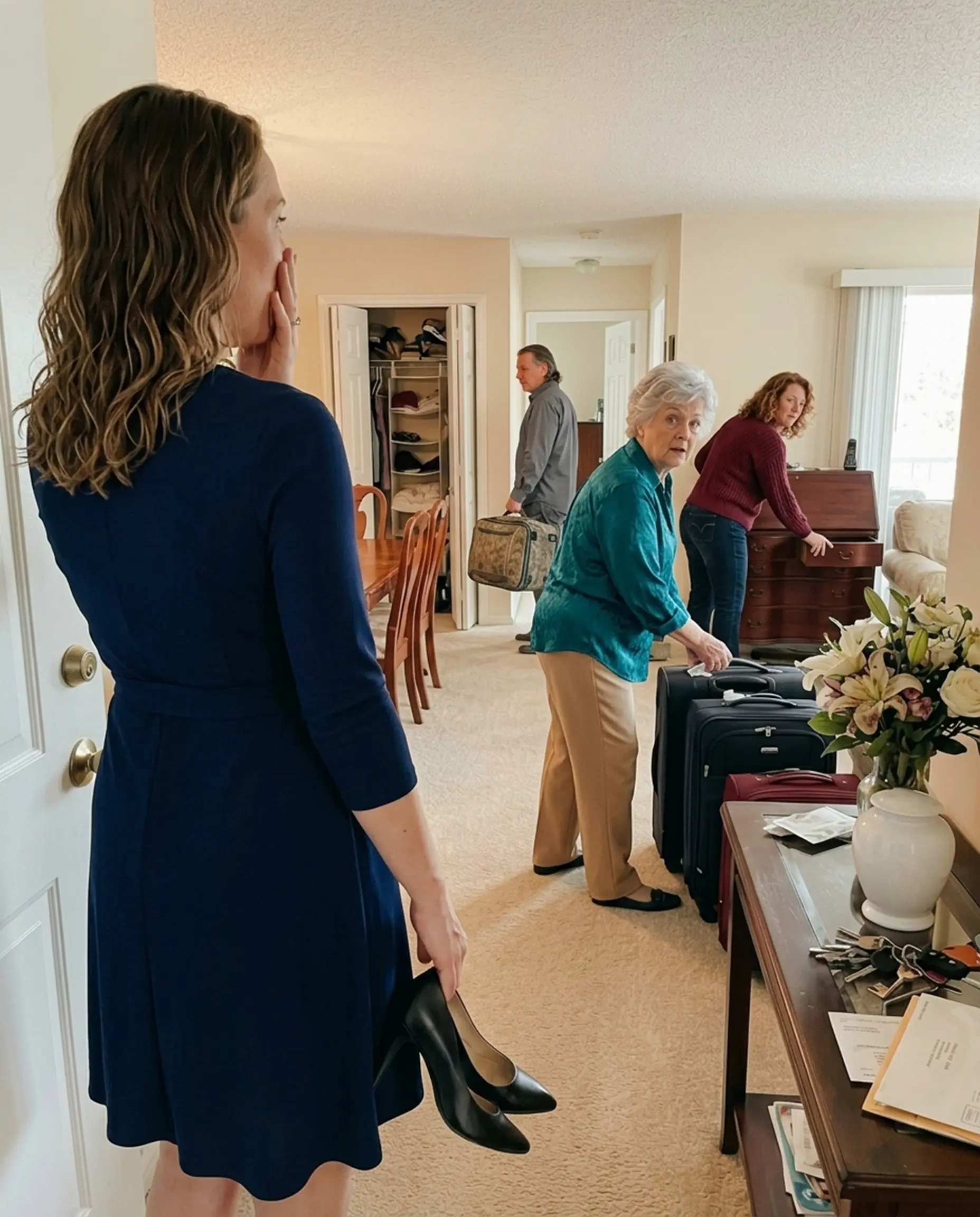
The total at the bottom of the fifth page was forty-eight thousand dollars, and none of the entries showed a single payment of return.
I realized then that Bradley had kept this ledger entirely to himself, never mentioning a single dollar of these loans during our evening talks on the balcony.
I had believed we had no secrets between us. I had believed our life was built on a quiet, shared simplicity, but this black book proved he had been fighting a private war against his own family for years without ever telling me.
I heard a floorboard creak in the hallway outside, and my breath caught in the quiet room.
I stood up, holding the heavy leather book against my ribs, and hurried into the kitchen.
Avery sliding the leather ledger under a stack of old magazines in the kitchen cupboard.
The gravel at Memorial Lutheran gritted under my shoes while the morning heat began to rise from the asphalt.
Marjorie stood by the passenger door of her rented sedan, her fingers tapping against the roof of the car. Her gray hair was pinned back in a tight, neat bun that seemed to pull the skin of her temples taut.
“These arrangements are yellow,” Marjorie said, her index finger tapping a steady rhythm on the painted metal. “Bradley always preferred white glads. It looks like a grocery store clearance.”
I twisted the plain gold band on my left ring finger, turning it twice before I answered.
“The florist did what I asked,” I said.
“The bill was sent to the estate address,” Marjorie said, her voice dropping into a lower register. “Four thousand dollars for a simple chapel service seems excessive. We must be careful with the remaining funds.”
“The funeral expenses are already paid,” I said.
Marjorie lifted her chin, her eyes scanning the low coquina stone wall of the church before they settled back on my face.
“Who currently holds the title to the Marine Street condo?” she asked.
She asked it in her sharp, clipped accent, as if she were inquiring about a dry cleaning receipt.
“It is settled,” I said, pausing between my words. “Bradley took care of it.”
“Bradley was a consultant, Avery, not an estate attorney. I need to see the deed.”
“The deed is where it belongs,” I said.
“If there is no formal will registered with the county, the property must be inventoried,” Marjorie said, her finger stopping its tap. “We cannot leave valuable real estate in limbo. It is my duty to my son to ensure his affairs are resolved correctly.”
“The affairs are resolved,” I said.
“When his father passed, we did not have these delays,” Marjorie said, her voice rising slightly. “Everything was handled within forty-eight hours because we worked as a family. I expect the same level of cooperation now.”
I looked at her, letting the silence stretch between us until she shifted her weight.
“We will need to verify that with the county clerk if you cannot produce the physical paper,” she said.
A young couple from the congregation walked past us, nodding their heads in quiet sympathy. Marjorie smiled at them, her expression instantly softening into the deep grief of a bereaved mother, then turned back to me with her eyes narrowed.
“We are his family,” she whispered. “We have a right to know what remains in his name.”
She did not wait for my response, turning on her heel to walk toward the heavy oak doors of the sanctuary.
Inside the church, the air was cool and smelled of damp stone and beeswax.
I sat in the side chapel during the prelude, trying to find a moment of quiet before the pews filled.
Declan found me there, his heavy steps echoing on the tile floor as he slid into the wooden pew beside me. He smelled strongly of pine cologne, and his slicked-back hair caught the blue light from the stained-glass window.
“I can help you audit Bradley’s old consulting firm,” Declan said, leaning in close.
His voice was too loud for the small chapel.
He ran a hand through his hair and gave a forced, barking laugh.
“A widow shouldn’t have to wade through old tax forms and client ledgers,” he said. “I can take all those boxes off your hands this afternoon.”
“No,” I said, my voice flat. “The business is closed.”
“Well, closed doesn’t mean the records are gone,” he said, laughing again. “He kept his real work separate from his name. Everything was under Bradley Rowan Consulting, wasn’t it?”
I looked at him, keeping my expression entirely still.
“He always kept his real work separate from his name,” I said.
“Exactly,” Declan said, nodding quickly. “Which means there are accounts under Rowan that the local banks don’t even have listed under his social security number yet. I just need the login details or the ledger from his desk. It saves everyone a lot of legal trouble.”
“The files are not available,” I said.
“I know he had that client in Jacksonville,” Declan said, his voice dropping to a harsh whisper. “The one who paid in cash for the asset searches. There has to be a physical record of those payments in the study.”
“The business papers are in order,” I said.
“He had the classic Mercedes too,” Declan said, shifting closer. “The one in the garage downstairs. Is the title for that in the desk as well? I could take it for a spin, make sure the battery doesn’t die on you.”
“The car is registered,” I said.
I did not answer him further, keeping my eyes fixed on the altar.
Declan pulled his phone from his pocket, aiming the camera at the printed program and obituary resting on the small table by the chapel entrance. He snapped three rapid photos, his thumb clicking against the screen.
“Just keeping a record,” he whispered.
He stood up and slid his phone into his jacket pocket, his eyes darting toward the main aisle where the first guests were arriving.
The reception hall after the service was filled with the low murmur of voices and the scent of hot chicory coffee.
I stood near the long table, holding a small plate with a single piece of pound cake that I had no intention of eating.
Fiona approached me from the side, her breathy whispers arriving before she did.
“Are the monthly condo dues fully paid?” she asked, her hands rapidly folding and unfolding a paper napkin. “The six hundred dollars. Is it clear through October fifteenth?”
I took a slow breath, letting the silence stretch between us.
“Bradley handled the household accounts,” I said.
“Because if there is a pending balance, it affects the valuation,” Fiona whispered, her fingers tearing a small strip from the edge of the napkin. “The estate cannot carry liabilities into the winter.”
“The condo is not for sale,” I said.
“We have to look at the numbers, Avery,” she said, her voice rising slightly before she hushed herself. “The association dues are high. Six hundred dollars a month is a lot for a single woman to carry on a fixed income.”
“I am fine,” I said.
“And the furniture, of course,” Fiona whispered, her eyes shifting around the room. “The leather wingback chairs in the study were his father’s. We should probably move those out before the humidity ruins the leather.”
“The condo has central air,” I said.
“The silver tea set on the dining room sideboard too,” she whispered, ignoring me. “The one with the rose pattern on the handles. That belonged to his great-aunt. It really should go to someone who has family dinners.”
“I use it,” I said.
“For one person? It seems like a waste of polishing,” she said, pulling a cheap plastic pen from her purse and beginning to write figures on the torn paper. “October fifteenth is the deadline for the transition. We need to make sure everything is inventoried by then.”
I set my plate down on the table and walked away without answering her, leaving her scribbling on the napkin.
The sun had dipped below the horizon by the time I drove to Cathedral Place, leaving the sky a bruised purple.
Elena met me in the gravel parking lot behind her quiet office, her face pale in the twilight.
She adjusted her silver watch strap, her eyes scanning the quiet street before she spoke.
“Marjorie has already made inquiries with two local real estate agents on Bay Street,” Elena said.
My hand went to my ring finger, twisting the gold band.
“She asked about the market value of the Marine Street condo,” Elena continued, her voice measured and legalistic. “She wants to know how quickly it can be listed.”
“It is not her home,” I said.
“They do not love information, Avery, they love access,” Elena said, her voice dropping lower. “And they are moving quickly because of the transition deadline on October fifteenth.”
“What did Marjorie sign after Bradley’s father passed away?” I asked, the question rising from the memory of the old ledger.
Elena shook her head slightly. “We are still gathering those records from the bank.”
“I active-tested the small camera lenses Bradley put in the study bookshelves last week,” I said. “The ones hidden behind the leather-bound books.”
“Good,” Elena said. “Keep them running. If they enter that room, we need every second on tape.”