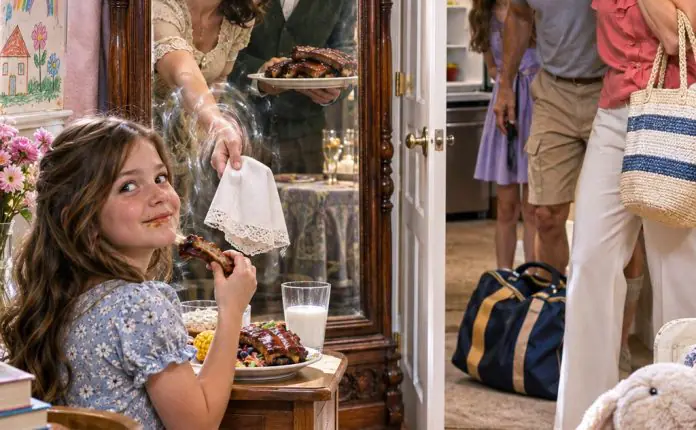
The following morning, my father unlocked my bedroom and pushed a broom through the doorway.
“Clean up that plate before somebody cuts a foot.”
I was sitting on the bed with my legs pulled beneath me.
The bandage around my ankle was still clean.
Mirror Mom had left a small tube of ointment beside my pillow, along with a folded washcloth and a fresh pair of socks.
Dad noticed the bandage.
“Where did you get that?”
I looked at him.
“Someone helped me.”
His mouth tightened.
“We're not starting that again.”
He pushed the broom farther inside.
“Get dressed. And don't leave broken glass lying around.”
“It isn't glass.”
“What?”
“The plate. It's broken pottery.”
He stared at me.
I hadn't meant to correct him.
For a moment, I thought he might strike me again.
Instead, he pointed toward the floor.
“Clean it.”
Then he walked away.
I waited until his footsteps faded before getting down from the bed.
The largest pieces were easy to collect.
The tiny fragments had scattered beneath the dresser and along the wall.
I used the broom carefully, keeping my injured ankle off the floor whenever possible.
When I finally finished, I carried the pieces to the trash can.
Mom appeared in the hallway holding a breakfast tray.
A pancake shaped like a bear sat on a white plate.
Strawberries formed its ears. A dusting of powdered sugar made its face look snowy.
My stomach growled.
“Is that for breakfast?”
Mom looked down at the tray.
“Yes.”
I reached toward the plate.
She shifted it away.
“For Claire.”
I stopped.
“Oh.”
“She's had a difficult few days.”
I looked toward the staircase.
“So have I.”
Mom closed her eyes.
“Nora, please. Not this morning.”
I wanted to tell her about the three nights in our empty house.
About the storm.
About sitting beside the telephone waiting for her to call.
But she was already moving down the hallway.
Claire followed several steps behind.
She had her pink doll tucked under one arm and was wearing the same shell clip from the beach.
When she reached my doorway, she stopped.
Mom continued toward the dining room.
Claire looked down the hall.
Then she reached onto the tray, took a strawberry, and rolled it across the wooden floor toward me.
It stopped beside my foot.
I looked up.
My sister was watching me.
Her expression wasn't one I recognized.
She moved her lips.
No sound came out.
Then the doll made a soft electronic chirp.
“Sorry.”
I stared.
Claire's fingers tightened around the toy.
Mom called her from downstairs.
Claire turned and hurried after her.
I picked up the strawberry.
It was still cold.
I ate it slowly, trying to decide whether my sister had meant to give me food or whether she had simply wanted to see me pick something up from the floor.
That distinction mattered in our house.
Over the years, I had learned to interpret Claire's behavior through my parents' explanations.
If she walked away from me, it meant I had overwhelmed her.
If she cried when I entered a room, it meant my presence upset her.
If she dropped something while I stood nearby, Dad said I had distracted her.
I had no idea what Claire thought about any of it.
She rarely spoke aloud.
Sometimes she made small sounds or whispered so quietly that I couldn't distinguish words.
Most of her communication came through gestures, written pictures, and her doll's recorded phrases.
Our parents treated that doll almost like a medical instrument.
It was never allowed to be left in the car or forgotten at school.
When its batteries ran low, Dad replaced them immediately.
When it made noise during dinner, nobody told Claire to turn it off.
I wasn't allowed to use a toy at the table.
I wondered, for the first time, whether Claire had chosen that arrangement.
Or whether it had been chosen for her.
By lunchtime, Mom announced that a doctor was coming.
“Someone who can help you understand what's happening,” she said.
I was sitting at the kitchen table, trying to spread peanut butter on bread without tearing it.
“What's happening?”
“The stories about the mirror. The things you say you see.”
I set down the knife.
“You mean the people who fed me?”
Mom glanced toward the living room.
“Lower your voice.”
“Why?”
“Because Claire doesn't need another upsetting conversation.”
I looked at my sister.
She was sitting on the carpet arranging wooden rings by size.
Her doll rested beside her knee.
Claire didn't look upset.
She looked interested.
“Will the doctor believe me?” I asked.
Mom straightened the bread bag.
“That's not what doctors are for.”
It was an answer I remembered for years.
I had assumed doctors were supposed to find out what was wrong and help.
Mom seemed to think they were supposed to decide which person had caused the trouble.
The visitor arrived shortly after two.
Her name was Dr. Elaine Mercer.
She wore dark trousers, a pale blue blouse, and a cardigan with pockets large enough to hold a notebook.
Her hair was streaked with silver.
Unlike the other adults who came to our house, she didn't begin by asking how Claire was doing.
She looked at me.
“Hello, Nora. May I sit with you?”
I glanced at Mom.
Mom nodded.
We went upstairs.
Dr. Mercer noticed my bandaged ankle almost immediately.
“What happened there?”
“I stepped on a piece of a plate.”
“Was it already broken?”
I hesitated.
“Dad dropped it.”
Dr. Mercer didn't write anything at first.
“Did you get help cleaning the injury?”
I looked toward the mirror.
“Yes.”
“Who helped you?”
“The lady who lives over there.”
She followed my gaze.
“Would you tell me about her?”
I described the yellow room.
The apron.
The soup.
The man who helped with arithmetic.
I told her their faces were difficult to see, but their voices were clear.
Dr. Mercer listened without interrupting.
When I finished, she asked something surprising.
“Before these visitors appeared, what were you doing?”
“Waiting.”
“For what?”
“My family.”
“Were you expecting someone to come back that night?”
I shook my head.
“Mom said Sunday.”
“Did anyone stay with you?”
“No.”
She looked at the door.
“Did you have a way to leave the house?”
“I tried.”
“Did you have enough food?”
I thought about the granola bar and the almost empty peanut butter jar.
“Not until the lady came.”
Dr. Mercer made a note.
Then she opened a canvas bag.
Inside were wooden blocks in different colors.
“Would you build me a house?”
I liked building things.
I arranged blue blocks into a rectangle, added a roof, and made three spaces inside.
Dr. Mercer watched.
“Who lives there?”
“Mom, Dad, and Claire.”
“And you?”
I looked at the remaining blocks.
Then I built a second house.
It was smaller but had yellow walls.
I put myself inside with two taller blocks.
“Who are those people?”
“My other mommy and daddy.”
Dr. Mercer studied the houses.
“Why do you need two?”
I moved a block slightly.
“Because the blue one is crowded.”
She looked at the enormous empty space around it.
“Could you make it bigger?”
“Probably.”
“Would you like to?”
I shook my head.
“Why not?”
I thought carefully.
“Because the people in that house already know where everyone belongs.”
Her pencil stopped moving.
I wondered whether I had answered incorrectly.
But she didn't correct me.
Instead, she asked whether the people in the yellow house were frightening.
“No.”
“Even though you can't see their faces clearly?”
“They brought me dinner.”
“Does that make them safe?”
I considered this.
At seven, I didn't know that food alone couldn't prove someone's intentions.
I only knew how I had felt when a stranger reached through impossible glass with something warm to eat.
“They asked if I wanted it,” I said.
Dr. Mercer looked at me for a long moment.
Then she gently moved the yellow house closer to the blue one.
“What would you like the people in both houses to know about you?”
I stared at the blocks.
Finally, I answered.
“That I get hungry too.”
Dr. Mercer lowered her eyes.
She was quiet long enough that I began to worry she was angry.
Then she asked permission to look at my ankle.
She checked the bandage and found the clean edges of the scratch.
“Whoever wrapped this did a careful job.”
I felt a little proud.
Before she left the bedroom, she examined the mirror.
She touched its wooden frame and studied the ordinary reflection.
Nothing happened.
The glass showed the two of us.
Dr. Mercer didn't say the woman was imaginary.
She didn't say she was real either.
Instead, she asked whether I would be comfortable waiting upstairs while she spoke to my parents.
I agreed.
I sat on the top stair and listened.
Mom sounded irritated.
“She has never behaved like this before.”
Dr. Mercer asked how long they had been away.
Dad answered.
“Friday morning until Sunday afternoon.”
“And Nora remained here without supervision?”
There was a pause.
Mom said Claire had required urgent attention.
Dr. Mercer asked whom they had arranged to care for me.
Nobody answered.
Then Dad said the house had been secure.
I heard Dr. Mercer's voice sharpen.
“A locked house is not supervision.”
Dad protested that I hadn't been hurt.
She asked whether he knew that before returning.
He didn't answer.
Mom began talking about Claire's condition and how difficult raising two children had become.
Dr. Mercer interrupted.
“Mrs. Bennett, I understand that caring for a child with additional needs can be demanding. That does not reduce your responsibility to your other child.”
It was the first time I had heard an adult speak those words in our living room.
I pressed my cheek against the stair railing.
Mom said they hadn't intended to leave me behind.
Dr. Mercer asked why they hadn't returned once they realized what had happened.
Dad said they couldn't interrupt Claire's trip.
There was a long silence.
Then Dr. Mercer said she would be documenting her concerns and contacting the appropriate child protection services.
My heart began to beat faster.
I knew almost nothing about child protection.
I had heard my parents discuss social workers in the same tone they used for tax audits and dangerous neighborhoods.
I wondered if Dr. Mercer was going to take me away.
Part of me hoped she would.
Another part was terrified that Dad would be angry if I left.
When she came upstairs, she found me sitting beside my bedroom door.
“Were you listening?”
I nodded.
She sat beside me.
“Thank you for telling me what happened.”
“Am I in trouble?”
“No.”
“Is Dad?”
She considered her answer.
“Adults may have to answer difficult questions about their decisions.”
I looked at her notebook.
“Will they be angry?”
“Possibly.”
“Because I told you?”
“Because they don't want to hear what they need to hear.”
She took a business card from her pocket.
It had her name and telephone number printed beneath the address of her office.
She wrote another number on the back.
“If you ever feel unsafe, give this to a teacher, police officer, or another adult you trust. Ask them to contact me.”
I folded the card carefully.
“Can I show it to the lady in the mirror?”
A faint smile crossed her face.
“You can keep it wherever you feel it will be safe.”
I tucked it beneath the lining of my backpack.
Downstairs, Claire was waiting near the front door.
As Dr. Mercer approached, my sister stepped forward and held out her doll.
Mom brightened.
“Claire wants to show you her favorite toy.”
The doctor accepted it.
It was a soft pink doll with embroidered eyes, a plastic voice box, and a battery compartment beneath its dress.
Dr. Mercer pressed the speaker.
A cheerful greeting played.
Then the doll announced that it loved Mommy.
Mom smiled.
“She's very attached to it.”
Dr. Mercer turned the toy over.
“Does it record sound as well?”
Dad answered before Mom could.
“Only simple phrases. Nothing complicated.”
Claire moved closer.
She touched the little panel on the doll's back.
Then she pointed toward Dr. Mercer's notebook.
The doctor followed her gesture.
“Would you like to show me something else?”
Claire nodded quickly.
Mom reached for the doll.
“She's tired. We shouldn't overwhelm her.”
Claire resisted.
Her face reddened, and she made a frustrated sound.
Mom pulled the toy away.
“Enough, darling.”
Claire's eyes filled with tears.
Dad said the appointment had already gone on too long.
Dr. Mercer watched the exchange.
Then she said she would be returning soon.
Mom didn't look pleased.
After the doctor left, Dad complained about outsiders interfering in family matters.
Mom agreed that Dr. Mercer had misunderstood everything.
I stood near the stairs, holding my backpack.
Neither parent asked what I had told her.
That frightened me more than if they had shouted.
That evening, I brought my math workbook to the mirror.
The yellow room appeared shortly after sunset.
The man was sitting at a desk with his sleeves rolled up.
When he saw me, he closed a book.
“How did your day go?”
I told him about the wooden houses.
He listened carefully.
Then I told him about Claire and the doll.
His attention sharpened.
“Does she always keep it with her?”
“Almost.”
“Even when she sleeps?”
“Yes.”
“Has she had it a long time?”
“As long as I remember.”
He exchanged a glance with the woman.
It was the first time I had seen either of them look truly worried.
“Could you tell us what the doll looks like underneath?” he asked.
I described the fabric dress, the plastic back, and the little opening Claire sometimes touched.
“Does it have a red light?”
I thought for a moment.
“Sometimes.”
The woman came closer.
“Nora, has your sister ever tried to give that doll to another adult?”
I remembered what had happened with Dr. Mercer.
“Yes.”
“Did your mother allow it?”
“No.”
She looked at the man again.
“What does it mean?” I asked.
The man hesitated.
“We think your sister may be trying to tell someone something.”
“But Claire doesn't talk.”
He folded his hands.
“Not speaking is different from having nothing to say.”
I sat with that idea.
All my life, I had been told that Claire's silence was my fault.
I asked him whether that was true.
He looked startled.
“Why would it be your fault?”
“Mom says she changed when I was born.”
He shook his head.
“Having a baby sister doesn't cause autism.”
I watched his face carefully.
“Are you sure?”
“Completely.”
“Then why is Claire like that?”
“Children can have many reasons for communicating differently. Some are born with neurological differences. Some become quiet when they're frightened. Sometimes several things are happening at once.”
He paused.
“Whatever Claire is experiencing, she deserves care. And so do you.”
I looked down at my workbook.
“Dad says the doctors cost a lot of money.”
“That isn't a debt either of you owes him.”
I wanted to believe that.
But believing something different from Dad felt like breaking a rule I didn't know how to name.
The woman asked whether I could spend a little time with Claire the following day.
“Why?”
“Because she may trust you more than you realize.”
I almost laughed.
Claire barely looked at me most days.
She was forever being led away to quiet rooms, appointments, and carefully scheduled activities.
Mom said my voice upset her.
Dad said I needed to respect her boundaries.
Yet I remembered the strawberry rolling across the hallway.
And the tiny sound from the doll.
Sorry.
I promised to try.
Before I could ask another question, the woman looked over my shoulder.
Her expression changed.
I turned.
Claire stood inside my bedroom.
I hadn't heard her enter.
She was holding the pink doll close to her chest.
The mirror had begun to brighten.
For one strange instant, I could see everything reflected behind me.
My bed.
The dresser.
The crooked lamp.
The doll in Claire's arms.
But not Claire.
Her place was an empty space in the reflected room.
The doll appeared to be floating beside my door.
A tiny red light blinked beneath its dress.
The man on the other side stood slowly.
“Nora, can you ask Claire whether we may examine her doll?”
I looked at my sister.
“Can I borrow her for a minute?”
Claire shook her head.
“I'll give her back.”
She tightened her arms.
I stepped closer.
“There's something inside it, isn't there?”
Claire looked at me sharply.
The red light continued blinking.
She touched the back of the doll.
I held out my hand.
For a moment, she seemed ready to give it to me.
Then the doll crackled.
A woman's voice came through its speaker.
Not the bright recorded voice that said good morning.
My mother's voice.
Sharp.
Angry.
“Don't touch me.”
Claire dropped the doll.
The words stopped.
We looked at each other.
Downstairs, a chair scraped against the floor.
Dad called Mom's name.
Claire snatched up the toy, pulled open the little panel behind its dress, and removed something.
She moved with astonishing speed.
Then she grabbed my wrist and pulled me into the closet.
I had barely closed the door when Dad entered my bedroom.
“Where are those girls?”
Mom was behind him.
“Did you hear the doll?”
“Yes.”
“Was it recording?”
“I don't know.”
“You said you checked it.”
“I did.”
There was a silence.
Then Mom whispered, “What if she kept something?”
My breath caught.
Beside me, Claire held the doll against her stomach.
Her hands were shaking.
I could feel her shoulder pressing against mine.
Dad came closer.
I saw the shadow of his shoes beneath the closet door.
“Claire?” he called.
His voice was suddenly gentle.
“Sweetheart, where are you?”
Claire's fingers closed around my wrist.
Then a sharp cracking sound came from the room.
Dad swore.
He moved away from the closet.
I opened the door a fraction.
A long fracture ran diagonally across my mirror.
Silver light glimmered briefly inside it.
Dad approached.
He reached toward the glass.
I rushed out.
“Don't touch it!”
He turned.
“Where did you come from?”
“Closet.”
“What were you doing in there?”
I glanced at Claire, who stepped out behind me.
“Playing.”
Dad looked at her.
His face relaxed.
He would have accused me of hiding something if I had been alone.
With Claire beside me, he seemed willing to believe that it was a game.
He examined the mirror again.
“That's going outside tomorrow.”
“No!”
“I'm tired of hearing about this thing.”
I looked at the crack.
It was slowly fading.
By the time Dad turned back, it had nearly disappeared.
He didn't notice.
At dinner, he announced that the mirror would be removed the next morning.
Mom agreed.
“It's making Nora's imagination worse.”
I stared at my plate.
Claire sat beside me, holding the doll beneath the table.
A small movement caught my eye.
She had opened its battery panel again.
Something tiny and dark was hidden beneath her thumb.
I looked away before Dad noticed.
“Can I keep the mirror?” I asked.
“No,” he said.
“It's mine.”
“It's in my house.”
I looked at Claire's doll.
“Then shouldn't Claire have to give up her toy too?”
Mom set down her fork.
“Absolutely not.”
“Why?”
“Because it helps your sister.”
“The mirror helps me.”
Mom sighed.
“That's different.”
“How?”
“The doll is part of Claire's treatment.”
“The mirror brought me dinner.”
Dad struck the table with his palm.
“We're not discussing imaginary people at dinner.”
I felt myself shrinking beneath his voice.
Then I remembered the woman cleaning my ankle.
The man drawing apples beside my math problems.
Dr. Mercer telling me I hadn't done anything wrong.
I looked at Mom.
“Why is it okay when something makes Claire feel safe, but wrong when something makes me feel safe?”
Mom's lips pressed together.
“Nora, your sister has a medical condition.”
“You always say that.”
“Because it's true.”
I glanced toward Claire.
Her spoon lay untouched.
She was staring at Mom.
I said quietly, “You never ask her what she thinks.”
Dad pushed his chair backward.
“That's enough.”
Claire suddenly lifted her hand and struck the table.
The sound made all of us turn.
She was trembling.
Mom reached toward her.
“Sweetheart?”
Claire pulled away.
Her mouth opened.
At first, only a small breath emerged.
Then she spoke in a thin, unsteady voice.
“I'm not.”
Mom froze.
Dad stopped moving.
I looked at my sister.
Claire swallowed, pressed the doll against her chest, and spoke again.
“I'm not sick.”
Mom's face changed.
She looked frightened in a way I had never seen before.
Not frightened for Claire.
Frightened of what Claire might say next.
END PART 2