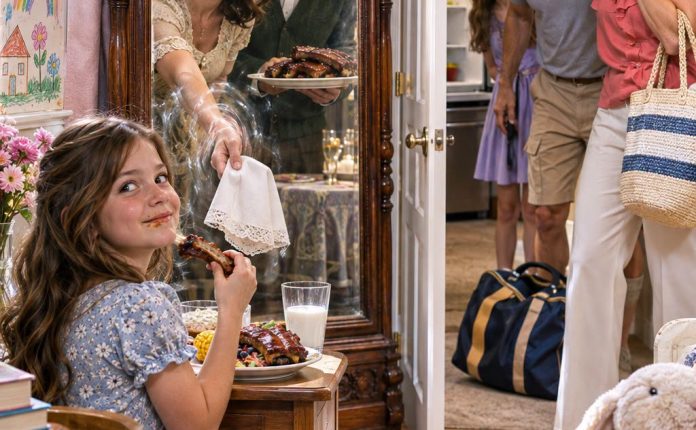
The first meal we ate in our new home was breakfast, even though it was nearly evening.
There were pancakes, scrambled eggs, sliced strawberries, and warm milk waiting on a wooden table beside a window overlooking the ocean.
For several minutes, Claire and I simply stood there.
Neither of us knew where to sit.
The woman pulled out two chairs.
“Anywhere you like.”
I looked toward the man.
“Which one is mine?”
“Whichever you choose.”
I selected the chair nearest the window.
Claire sat beside me.
The woman placed a plate in front of each of us.
I waited for somebody to remind me that Claire needed her food prepared differently or that I should be grateful for what remained after everyone else had eaten.
Nobody said anything.
I took a strawberry.
Then another.
The man passed me the syrup.
“Would you like some?”
I nodded.
He poured a little into a small dish beside my plate.
Claire watched him.
Then she spoke.
“Can I have more?”
He handed her the bottle.
“Of course.”
She looked startled.
He didn't praise her for speaking.
He didn't call anyone into the room to witness it.
He simply gave her what she had asked for.
I didn't understand how important that small moment was until years later.
In our old house, every word Claire spoke had been treated as evidence of something.
A symptom.
A breakthrough.
A crisis.
An opportunity for adults to discuss her.
In the yellow house, she could ask for syrup and receive syrup.
Nothing more was required.
After dinner, the woman showed us upstairs.
The hallway was painted a soft cream color.
There were three bedrooms, a bathroom with a deep white tub, and a narrow window overlooking a garden.
She opened the first bedroom.
Yellow curtains framed the window.
A quilt lay folded at the foot of the bed.
On the dresser sat the tiny pink seashell she had shown me through the mirror.
I stared at it.
“You kept it.”
“Of course.”
“Can I touch it?”
She picked it up and placed it in my hand.
It was smooth and cool.
When I held it against my ear, I heard a faint melody.
Not the sound of ordinary ocean waves.
Something softer.
A tune I couldn't recognize.
I smiled.
The woman watched me.
“Do you like it?”
I nodded.
Then I asked the question I had been carrying since we arrived.
“What should I call you?”
She glanced toward the man.
“Well, our last name is Ellis.”
I considered that.
“Mrs. Ellis?”
“You may.”
“Or Mirror Mom?”
She laughed gently.
“If that's what feels right.”
I looked down at the shell.
“Could I call you Mom?”
Her expression softened.
“You can, if you want to.”
I ran into her arms.
She held me until I was ready to let go.
Claire stood in the doorway watching us.
The woman opened her other arm.
My sister hesitated.
Then she joined us.
Later, the man showed Claire a bedroom across the hallway.
It had pale green walls and a large bookshelf.
Claire touched the door handle.
“Does it lock?”
“Only from your side, for privacy.”
She looked up sharply.
“Not from outside?”
“No.”
“What if I get angry?”
“You're allowed to be angry.”
“What if I slam it?”
“We'll ask you not to damage the door. We won't lock you inside.”
Claire thought about that.
“What if I don't want to talk?”
“Then we'll give you time.”
She looked at me.
“Can I sleep with Nora tonight?”
I nodded before anyone else could answer.
The man smiled.
“Then we'll bring another pillow.”
That first night, we lay side by side beneath my yellow quilt.
The ocean was audible through the open window.
The sound made my stomach tighten.
For three days, I had heard the ocean through a telephone while my family refused to come home.
Now it was outside my bedroom, and nobody had left me behind.
Claire noticed I was awake.
“Nora?”
“Yeah?”
“Are you mad at me?”
I turned toward her.
“Why?”
“Because they always blamed you.”
I was quiet.
She rubbed the edge of the blanket between her fingers.
“I heard them. I knew.”
“You were scared.”
“So were you.”
I thought about that.
Claire was only nine.
She had spent years believing it was her responsibility to protect me by keeping our parents occupied.
I was seven.
Neither of us had known how to change what was happening.
I reached for her hand beneath the blanket.
“We don't have to protect each other from them anymore.”
She began crying.
I put my arm around her.
We stayed that way until she fell asleep.
A little later, the mirror on the opposite wall began glowing.
I sat up.
Inside it stood Dr. Mercer.
She was in my old bedroom, examining Claire's doll.
A police officer stood beside her.
The doctor pressed the recording switch.
I heard my sister's voice.
She had told Dr. Mercer that we were together and safe.
The officer looked confused.
He asked whether someone had forced us to make the recording.
Dr. Mercer shook her head.
Then she noticed something on the doll's back.
She opened the battery compartment and examined it.
The small memory card she had taken earlier was already being preserved as evidence, but the doll had recorded one final message.
Our message.
She listened again.
Then she looked toward the empty bed.
I pressed my hand against the mirror.
“I'm okay,” I whispered.
Dr. Mercer couldn't hear me.
But she stayed beside the bed for a long time.
I watched until the glass became dark.
The following weeks were strange.
We learned that the yellow house stood in a small coastal town.
There were other houses, a grocery store, a library, a school, and roads that led inland toward wooded hills.
The world beyond the mirror wasn't an endless dream.
It had ordinary weather.
People went to work.
Cars broke down.
Children complained about homework.
The man taught us to ride bicycles along a quiet lane overlooking the water.
The woman showed us how to make bread.
She sometimes burned the bottom.
When that happened, she scraped it with a knife and laughed at herself.
I remember being astonished that an adult could make a mistake without looking for someone else to blame.
We began using the last name Ellis.
At school, we became Nora and Claire Ellis.
Our new parents explained that our old names weren't something to be ashamed of.
They simply wanted to give us a life where strangers wouldn't ask questions we weren't ready to answer.
I worried that changing our names made us dishonest.
Dad sat beside me on the porch.
“Does your new name change what happened to you?”
“No.”
“Does it change who your sister is?”
“No.”
“Then it's only a name.”
I considered that.
“Can I still remember Grandma Ruth?”
“Of course.”
“Will she think I died?”
He looked toward the ocean.
“I don't know what she'll be told.”
I lowered my eyes.
He continued.
“But the mirror has shown us people from your old world before. It may do so again.”
I wanted to ask when.
He seemed to know.
“I can't promise a date.”
That was another thing I learned about my new parents.
They rarely promised what they couldn't control.
But when they promised something they could do, they did it.
The mirror showed us the investigation in fragments.
Police searched our old house.
They questioned neighbors and examined the strange circumstances surrounding our disappearance.
Dr. Mercer gave a detailed account of her visit.
The recordings from Claire's doll revealed years of arguments, threats, and conversations our parents had never intended anyone else to hear.
One recording captured Mom and Dad discussing the lake incident and agreeing that Claire must never tell anyone what had happened.
Another revealed how casually they had discussed leaving me alone during the beach trip.
The police were disturbed by what they heard.
The recordings helped establish that our home had been unsafe.
But they could not explain where we had gone.
Nor could they explain why our parents had vanished.
Security cameras showed the family car arriving Sunday afternoon.
Dr. Mercer and Dr. Hale had seen Mom and Dad shortly before the police were called.
Nobody had seen them leave afterward.
Their belongings remained in the house.
There was no evidence of travel.
Our disappearance became a local mystery.
For a little while, television reporters gathered outside the property.
I saw one broadcast through the mirror.
A photograph of Claire and me appeared beside a picture of our parents.
The reporter described us as a missing family.
Claire turned away.
“I don't want to watch.”
Mom immediately darkened the mirror.
We didn't watch again for several weeks.
Instead, we learned to live.
That was harder than it sounded.
I woke during the night whenever the house became too quiet.
Sometimes I got out of bed and checked the kitchen to make sure there was food.
Once, Mom found me standing before the refrigerator at two in the morning.
She didn't scold me.
She opened the door.
“What would you like?”
“Nothing.”
“Are you hungry?”
I shook my head.
“Then let's just look.”
She stood beside me while I examined the shelves.
Milk.
Eggs.
Cheese.
Fruit.
Leftover soup.
The refrigerator was full.
I closed the door.
She walked me upstairs without asking me to explain.
Claire had difficulties of her own.
She sometimes stopped speaking for hours.
Certain noises still made her cover her ears.
She disliked people touching her unexpectedly.
Our new parents arranged for her to receive support from professionals who took time to understand both her developmental needs and the trauma she had experienced.
Nobody demanded that she speak to prove she was getting better.
When she wanted to communicate with a pencil and notebook, she did.
When she wanted silence, she had it.
And when she wanted to talk, somebody listened.
One afternoon, about six months after we arrived, I borrowed a sweater from Claire's room.
I didn't ask permission.
She became furious.
She shouted that I had no right to take her things.
Then she slammed her bedroom door.
I stood in the hallway, waiting.
In our old house, Dad would have come upstairs.
He would have demanded an explanation, assigned blame, and punished whichever child he considered responsible.
I expected shouting.
Instead, Mom knocked gently.
“Claire, would you like to talk?”
“No.”
“All right. I'll be downstairs.”
She walked away.
I stared after her.
Twenty minutes later, Claire opened her door.
She found me sitting on the floor outside.
“Why are you there?”
“I thought you were going to get in trouble.”
She looked confused.
“For being mad?”
I nodded.
Claire sat beside me.
We stayed quiet for a moment.
Then I handed back the sweater.
“Sorry.”
She accepted it.
“Ask next time.”
“I will.”
We went downstairs together.
Nobody had to win.
Nobody had to be humiliated.
It was an ordinary disagreement between sisters.
At the time, that seemed almost miraculous.
My eighth birthday arrived in spring.
I had forgotten the date until Mom appeared carrying a cake.
Eight candles stood in a circle around the top.
Claire had helped decorate it with tiny sugar flowers.
Dad held a camera.
“Would you like us to sing?” Mom asked.
I looked at Claire automatically.
For years, birthdays in our old house had been quiet because our parents said singing upset her.
Claire rolled her eyes.
“Nora, it's your birthday.”
I hesitated.
“Are you sure?”
She nodded.
So they sang.
I cried before they reached the last line.
Mom put down the cake and held me.
She didn't tell me to stop.
She waited.
When I finally blew out the candles, everyone applauded.
Later, I opened my presents.
The final box contained a small velvet pouch.
Inside was a polished pink seashell attached to a delicate silver chain.
The same one I had first seen through the mirror.
Mom helped fasten it around my neck.
I touched the shell.
“You remembered.”
She looked surprised.
“Why wouldn't I?”
I couldn't answer.
I had spent so many years preparing to be forgotten that being remembered felt almost impossible.
That evening, the mirror showed something new.
Grandma Ruth stood in my old bedroom.
Her silver hair was pinned back.
She wore the dark blue cardigan she always put on when visiting us.
Dr. Mercer stood beside her.
Grandma was holding a photograph of Claire and me.
“I don't know whether you can hear me,” she said.
I stepped toward the glass.
She continued.
“I hope you're together. Wherever you are.”
Her voice trembled.
“I hope somebody is taking care of you.”
Claire appeared beside me.
She took my hand.
Grandma pressed her palm against the mirror.
I lifted mine.
Our hands seemed to meet.
The surface warmed.
Grandma gasped.
“Nora?”
I looked at Claire.
She nodded.
“Grandma?”
My voice sounded faint.
But Grandma heard it.
She began crying.
Dr. Mercer hurried toward the glass.
For several seconds, nobody knew what to say.
Then Grandma asked whether we were alive.
“Yes,” I answered.
“Both of you?”
Claire stepped forward.
“We're together.”
Grandma covered her mouth.
Dr. Mercer sat on the edge of my old bed.
Her face had gone pale.
I had never seen her look so completely astonished.
“Claire,” she whispered, “is that really you?”
“Yes.”
She closed her eyes briefly.
Then she asked whether we were safe.
I looked over my shoulder.
Mom and Dad were standing a few feet away.
Neither tried to answer for us.
“Yes,” I said.
Grandma wanted us to come back.
I could hear it in her voice.
But she didn't ask immediately.
Instead, she said something I would remember all my life.
“If you're safe where you are, please don't leave just because I miss you.”
Claire began crying.
I touched the mirror.
“We miss you too.”
Grandma nodded.
“I know.”
Dr. Mercer asked whether we could meet again.
We didn't know.
The mirror opened and closed according to rules nobody fully understood.
But the connection had finally happened.
Before the image faded, Grandma told us that she believed we hadn't run away because we were bad children.
She believed we had been trying to survive.
I looked toward Dr. Mercer.
“Did you believe us?”
She nodded.
“I believed that you were frightened and needed protection. I still do.”
The image disappeared.
I sat on the floor for a long time.
Claire stayed beside me.
Neither of us spoke.
We had not returned to our old world.
But someone there knew we were alive.
And someone had believed us.
The years that followed were not free of difficulties.
I struggled with loud voices.
Claire still disliked unexpected changes.
Sometimes we argued.
Sometimes we hurt each other's feelings.
We learned that living in a safe home didn't mean never being upset.
It meant problems could be solved without somebody being abandoned.
Claire began playing the cello when she was fifteen.
The instrument suited her.
She liked the weight of it against her body and the way a single note could fill a room without requiring words.
At seventeen, she considered studying psychology.
Later, she chose music therapy.
She wanted to work with children who found it difficult to communicate.
She was never especially talkative.
That was fine.
Her silence no longer belonged to fear.
It belonged to her.
I became interested in emergency medicine.
I volunteered with a community first-aid program as a teenager.
Later, I studied nursing before deciding to continue into medical training.
I wasn't trying to repair my childhood.
I simply liked the work.
I liked being useful when somebody needed help.
And I understood the importance of arriving when someone called.
When I was sixteen, the mirror showed our first parents again.
They were still inside the reflected blue bedroom.
Time had changed them.
Dad's hair had grown long.
Mom's face looked older than I remembered.
They sat on opposite sides of the room.
A small tray of food rested near the door.
There was enough to keep them alive.
But little more.
The room seemed to contain the same meager provisions they had considered sufficient for me during the beach trip.
I felt sick looking at it.
Claire stood beside me.
Mom approached the glass.
She held up a sheet of paper.
It contained an apology.
She lowered it.
Then she raised another.
She wanted to come home.
I looked at Claire.
“What do you think?”
My sister studied our mother's face.
“I don't know what home means to her anymore.”
Dad appeared behind Mom.
He began shouting.
We couldn't hear the words.
Mom pushed him away and held up the apology again.
For years, I had imagined that hearing my parents say they were sorry would fix something inside me.
Now, with the words in front of me, I felt almost nothing.
Not happiness.
Not revenge.
Mostly distance.
I remembered the seven-year-old girl who had waited beside the telephone.
She had wanted her parents to come home.
She had wanted them to choose her.
But I wasn't that little girl anymore.
I had people who loved me.
I had a sister who could laugh without checking whether an adult approved.
I had a bedroom with a door nobody locked from the outside.
I looked at Mom's apology.
Then I turned away.
Claire followed.
We didn't ask the mirror to open.
Over the following years, Grandma Ruth remained part of our lives whenever the glass allowed it.
Sometimes she appeared with Dr. Mercer.
Sometimes she came alone.
She told us about birthdays, family news, and the garden she tended behind her house.
She never demanded that we return.
When I graduated from school, she saw me wearing my graduation gown through the mirror.
She cried so hard that Claire teased her about needing a handkerchief.
Grandma laughed.
“I've missed a lot, haven't I?”
I touched the glass.
“You're here now.”
She nodded.
“Yes, sweetheart. I am.”
Several years later, Grandma died peacefully.
Dr. Mercer told us.
Claire and I mourned her together.
We had not been able to spend as much time with her as we wanted.
But we knew she had loved us without trying to possess us.
That mattered.
By the time I completed medical residency, Claire and I were adults with lives of our own.
She worked with children and young people through music.
I worked in emergency medicine.
Our parents, the Ellises, still lived in the yellow house overlooking the ocean.
We visited often.
We sometimes stayed overnight.
On holidays, Claire brought desserts she insisted were better than anything Dad could make.
He pretended to be offended.
Mom pretended to take his side.
I usually ate both desserts.
The house was filled with ordinary family disagreements and laughter.
Nobody counted what one daughter received to make sure the other received less.
Nobody used one child's struggles as a reason to neglect another.
We had grown into women who could disagree, leave a room, return, apologize, and begin again.
On the twentieth anniversary of the beach trip, Claire came to visit me.
We spent the morning walking along the shore.
The weather was cool.
A strong wind lifted sand against our shoes.
For years, I had disliked beaches.
The sound of waves reminded me of Mom's voice on the telephone.
Eventually, Claire and I had decided we wouldn't let one terrible weekend claim the ocean forever.
So we went swimming.
We collected shells.
We ate seafood at little restaurants along the coast.
We learned to enjoy the water without pretending we had forgotten what happened.
That afternoon, we visited Mom and Dad.
A pie was cooling on the kitchen counter.
Dad had already cut a piece.
Mom complained that he never waited for dessert.
Claire laughed.
I watched them argue over the missing slice and felt an unexpected warmth.
Then I went upstairs.
The old mirror stood in the hallway.
Its surface had been ordinary for months.
I approached it.
Claire followed a few minutes later carrying two cups of coffee.
“I thought I'd find you here.”
I accepted one.
We stood side by side.
The glass began to darken.
Then the blue bedroom appeared.
Mom stood near the window.
Her hair was completely gray.
Dad sat against the wall.
He looked much older than the man I remembered.
For a moment, neither noticed us.
Then Mom turned.
She approached the glass slowly.
“Nora?”
Her voice was faint.
The mirror had changed over the years.
Sometimes it allowed sound to pass.
Sometimes it didn't.
Today, we could hear her.
“Hello,” I said.
Mom began crying.
Dad rose unsteadily.
He approached beside her.
Claire held her coffee without taking a sip.
Mom looked from one of us to the other.
“You've grown up.”
“Yes,” Claire answered.
Mom nodded.
She wiped her face.
For a while, nobody spoke.
Then Dad lowered his eyes.
“We owe you an apology.”
I waited.
He looked at me.
“Especially you, Nora.”
I felt Claire's hand touch my arm.
Dad continued.
“I blamed you for things that were never your responsibility.”
He spoke slowly.
“I blamed you when Claire needed attention. I blamed Claire when I didn't want to deal with you. I blamed your mother whenever I lost control.”
He swallowed.
“I made excuses for everything I did.”
Mom looked toward him.
Then she turned back to us.
“We told ourselves we were overwhelmed.”
Claire's expression remained still.
Mom continued.
“We were overwhelmed sometimes. But we used that explanation to justify choices we should never have made.”
I listened.
The words were different from the apologies I had imagined as a child.
They weren't dramatic.
They didn't include promises about becoming a happy family again.
They were specific.
Mom looked at Claire.
“We should have listened when you were frightened.”
Claire nodded once.
Mom's voice shook.
“We should never have left you in that car.”
My sister looked down.
Then Mom turned toward me.
“And we should never have left you alone in that house.”
I remembered the empty refrigerator.
The chair beneath the deadbolt.
The telephone.
The storm.
The mirror.
“You didn't just forget me,” I said.
Mom closed her eyes.
“I know.”
“You knew I was there.”
“Yes.”
“You answered the phone.”
She nodded.
“You heard me ask you to come home.”
Tears ran down her face.
“Yes.”
I looked at Dad.
“And you decided that locking the doors meant I was safe.”
He lowered his head.
“I did.”
For years, I had carried those facts.
Now they were being acknowledged by the people who had caused them.
I expected to feel triumphant.
Instead, I felt tired.
Claire spoke.
“You made us feel responsible for each other because neither of you wanted to be responsible for both of us.”
Mom covered her mouth.
Dad nodded.
“That's true.”
Claire's voice remained steady.
“I spent years believing I had to be the difficult child so Nora could be the easy one.”
She looked at him.
“And you still hurt her.”
Dad began crying.
I had never seen him cry before.
Once, that might have frightened me.
Now I understood that his feelings didn't require me to abandon my own.
Mom pressed her hand against the glass.
“Can you forgive us?”
Claire looked at me.
I shook my head.
“I'm not ready to give you that.”
Mom closed her eyes.
Claire spoke more firmly.
“Neither am I.”
Dad wiped his face.
Mom nodded slowly.
“All right.”
I was surprised by her answer.
She didn't argue.
She didn't tell us that we owed her forgiveness because she was our mother.
She didn't accuse us of cruelty.
She simply accepted what we said.
Perhaps years of living with consequences had taught her something.
Perhaps she had finally understood that regret didn't create a right to another person's forgiveness.
I stepped closer.
“Do you know what I wanted when I was little?”
Mom shook her head.
“I wanted you to notice me.”
Her face crumpled.
“Not just when I did something wrong. Not when Claire was asleep or you needed an extra pair of hands.”
I looked at her.
“I wanted you to come back because I was your daughter.”
Mom began crying again.
I waited.
Then she whispered, “You deserved that.”
I nodded.
“Yes.”
The word felt strange.
For so long, I had wanted someone else to decide whether I deserved to be cared for.
Now I didn't need permission to know the answer.
Dad approached the glass.
“Are you happy?”
I thought about the life we had built.
About Claire playing the cello in a sunlit room.
About Mom teaching us to make bread.
About Dad standing in the driveway to wave goodbye whenever we visited.
About patients who went home after frightening nights in the emergency department.
About birthdays, ordinary arguments, and the steady accumulation of days when nobody disappeared.
“Yes,” I said.
Mom smiled through her tears.
“I'm glad.”
Claire looked toward the hallway behind us.
Downstairs, our other Dad was complaining about someone stealing the last piece of pie.
Our other Mom laughed.
The sound traveled upstairs.
Mom and Dad inside the mirror heard it.
For several seconds, all four adults seemed to occupy the same impossible moment.
Then Claire asked a question.
“What happens to you now?”
Dad looked around the blue room.
“We don't know.”
Mom lowered her eyes.
“We've been here a long time.”
I studied their faces.
There was no pleasure in seeing them trapped.
Whatever the mirror had done, it had forced them to live with the consequences of choices they once considered insignificant.
I didn't know whether that punishment would ever end.
I didn't know who controlled it.
But I knew one thing.
Claire and I were not responsible for rescuing them.
I touched the wooden frame.
“I hope you keep telling the truth.”
Mom nodded.
“We will.”
“And if a frightened child ever appears in a mirror near you,” I continued, “don't make them explain why they deserve help.”
Claire stepped closer.
“Listen first.”
Dad nodded slowly.
Mom pressed her palm against the glass.
“We understand.”
The image began to fade.
Mom looked at me one last time.
“I love you, Nora.”
I didn't know whether she did.
Perhaps she did, in the limited and damaging way she had once understood love.
Perhaps she had learned something better too late.
I didn't need to decide.
“Goodbye, Mom.”
Claire lifted her hand.
“Goodbye.”
The blue room disappeared.
Our reflections returned.
Two adult women stood in the hallway.
Claire looked at me.
“How do you feel?”
I considered the question.
“Like I finally finished a conversation I started when I was seven.”
She smiled faintly.
“That's a long conversation.”
“It was.”
We went downstairs.
Mom was cutting the pie into new slices because Dad had apparently ruined the first attempt.
Claire immediately complained that his portions were uneven.
Dad told her she was welcome to take over.
She did.
I sat at the kitchen table and listened to them bicker.
Nobody asked what had happened upstairs.
Nobody demanded to know whether I still loved them.
They trusted me to decide what I wanted to share.
That evening, I drove home along the coastal road.
The sun was setting.
A thin band of orange light stretched across the ocean.
I rolled down the window and let the salt air enter the car.
For the first time in years, I thought about the little girl who had packed a purple backpack for a trip she never took.
I wished I could tell her that she would see the ocean someday.
That she would learn to swim.
That she would grow up with a sister who loved her.
That the yellow room behind the mirror would become a home.
But perhaps she already knew.
Perhaps that was why she had taken the woman's hand.
The following morning, I woke early.
I made coffee and opened the kitchen window.
A breeze moved through the curtains.
The house was quiet.
I had a full day ahead of me at the hospital.
As I passed the hallway, something caught my eye.
A mirror hung near the coat rack.
It was an ordinary antique mirror with a narrow wooden frame.
I had owned it for years.
But this morning, its reflection was wrong.
My hallway had disappeared.
Beyond the glass was a small, unfamiliar room.
The walls were plain.
A narrow bed stood against one side.
A little boy sat on the floor, hugging his knees.
He couldn't have been more than six.
His hair was untidy.
His cheeks were wet.
Behind him stood a closed door.
A heavy lock was fixed to the outside.
I stopped.
The boy looked up.
For a moment, we stared at each other.
Then he raised one hand.
I remembered the first time I had seen a strange woman through my bedroom mirror.
The uncertainty.
The hunger.
The fear of trusting someone who might disappear.
I placed my coffee on the hallway table.
Then I crouched in front of the glass.
“Hello,” I said.
The boy moved closer.
His lips trembled.
“Can you see me?”
“Yes.”
He wiped his face with his sleeve.
“Are you going to tell me I'm bad?”
The question hurt more than I expected.
I thought of my father standing in the doorway.
My mother walking away.
The empty refrigerator.
The woman with flour on her sleeve.
And a warm bowl of soup passing through a mirror when I needed it most.
“No,” I said gently.
The boy looked toward the locked door.
“Are you real?”
I smiled.
“My name is Nora.”
He pressed his palm against the glass.
I lifted mine.
Our hands met.
The surface grew warm.
Then I asked him the same question that had once changed my life.
“Sweetheart, have you had anything to eat?”
He shook his head.
I looked toward my kitchen.
There was soup in the refrigerator.
Bread on the counter.
Fresh fruit in a bowl.
More than enough.
I stood.
“I'm going to bring you something.”
The boy watched me.
“Will you come back?”
I looked at him.
And this time, the answer was easy.
“Yes,” I said. “I'm coming back.”
THE END
Disclaimer: This story is fictional and written for entertainment. Any resemblance to actual people or events is coincidental.
END PART 5
Disclaimer: This fictional story was created with AI assistance for entertainment. Names, characters, dialogue, and events are fictional. Any resemblance to actual people or events is coincidental.