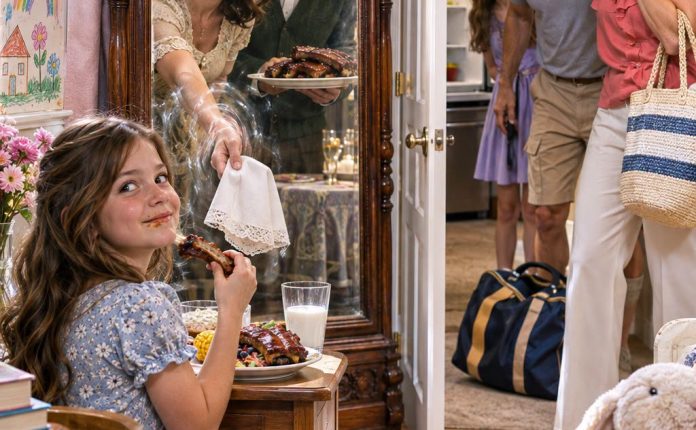
When my mother returned from the beach and found me eating barbecue ribs in my bedroom, she didn't ask whether I had been frightened.
She asked who had fed me.
I was seven years old, sitting on a faded rug with a ceramic dinner plate balanced across my knees. Barbecue sauce had dried between two fingers, and a little mound of mashed potatoes remained beside three green beans.
Mom stood in the doorway with the exhausted expression she usually wore after spending too much time with me.
Behind her, my father, Michael Bennett, stopped so abruptly that the suitcase he was dragging bumped into his ankle.
My nine-year-old sister, Claire, appeared between them.
Her cheeks were pink from the sun. Someone had fastened a seashell clip into her hair, and she was holding her familiar pink doll against her chest.
All three wore blue aquarium wristbands.
I looked down at my own bare wrist.
“Nora,” Mom said, “where did that dinner come from?”
“Somebody cooked it for me.”
My father's eyes traveled around the room.
“Somebody entered this house?”
I nodded.
“Who?”
I pointed toward the full-length mirror beside my closet.
“The family who lives over there.”
Neither parent answered.
Then Dad took a step toward me.
And I knew that, whatever happened next, they were going to be angrier about the food than they had ever been about leaving me alone.
Three days earlier, I had believed we were all going to the beach together.
On Thursday evening, I packed my clothes in a little purple backpack that Grandma Ruth had given me for my sixth birthday.
Two shirts, shorts, underwear, my toothbrush, and a plastic comb fit inside. I even packed the pink bunny hair clip I wore for special occasions.
I wanted to be ready before anyone asked.
Our family didn't travel often.
Claire found unfamiliar places difficult, or at least that was what my parents said. She disliked crowded restaurants, sudden noises, and sleeping in bedrooms she didn't recognize.
Whenever we discussed vacations, Dad talked about planning around her needs.
I understood that.
What I didn't understand was why planning around Claire usually meant forgetting that I had needs too.
At dinner, Mom brought Claire a separate plate with her favorite pasta arranged in three neat portions.
I received leftover chicken and some carrots.
Claire sat silently, rubbing the fabric ear of her therapy doll between her fingers. The toy had a small speaker concealed beneath its dress and could play cheerful recorded phrases when pressed.
Mom leaned close to her.
“Tomorrow we'll see the ocean. Remember the pictures?”
Claire looked at the table.
“You can bring your doll. Your special pillow too.”
I held up my backpack.
“Can I bring my sand bucket?”
Dad glanced at me.
“We don't need to haul unnecessary junk.”
“It's small.”
“Nora.”
That was the tone that ended conversations.
I lowered the backpack beneath my chair.
For most of my childhood, I had been told that Claire's difficulties began when I was born.
Before that, according to Mom, my sister had been a lively toddler who talked constantly and loved strangers.
Then I arrived.
Claire stopped speaking.
Doctors became part of our routine. There were appointments, special toys, careful schedules, and conversations that always ended when I entered the room.
Mom called Claire's condition severe autism.
Dad called it the reason our family could never have a normal life.
Sometimes he said it more plainly.
“You changed everything when you came along.”
I didn't know whether that was something a baby could do.
But I believed him because children often believe the adults who explain the world to them.
That night, I laid my shoes beside my bed and went to sleep imagining the ocean.
I had seen it only in photographs.
I wanted to know whether the sand really felt warm after sunset and whether seashells sounded like waves when you pressed them against your ear.
Just before dawn, an engine started outside.
At first, I thought Dad was moving the car.
Then I heard the gravel crunch beneath the tires.
I sat up.
My room was gray with early morning light.
“Mom?”
No answer.
I pulled on my slippers and hurried downstairs.
The house was quiet.
Both suitcases had disappeared from beside the front door.
Claire's pink pillow was missing from the couch.
I looked through the living room window.
Our driveway was empty.
For a few seconds, I assumed they had gone to buy breakfast.
Then I noticed the folded beach map Dad had left on the kitchen counter.
Underneath it sat a grocery receipt and a loaf of bread with hard edges.
The refrigerator was nearly empty.
Dad had thrown out the milk, leftovers, vegetables, and anything he thought might spoil while we were away.
There was one bottle of mustard, a small jar of pickles, and a container holding a few tablespoons of something I couldn't identify.
I took the house telephone from its cradle.
Mom's number was written on a card beside it.
She didn't answer.
I called again.
Nothing.
On my third attempt, she picked up.
“Nora? What is it?”
I could hear wind.
Then a high, laughing sound that I recognized as Claire's.
“Where are you?”
“We're at the coast.”
I looked through the window again.
“But we're supposed to go together.”
Mom hesitated.
“Your sister had a difficult evening. When she finally agreed to get into the car, we decided not to delay.”
“You left?”
“We'll discuss this when we return.”
“When are you coming home?”
“Sunday afternoon.”
It was Friday morning.
I counted the days on my fingers.
“But I'm still here.”
“I know.”
“The door is locked.”
“Then don't go outside.”
I stood beside the kitchen counter, looking at the dry bread.
“There's no breakfast.”
“Nora, I'm sure you can find something.”
I opened the refrigerator again, although I knew what was inside.
“Can you come get me?”
Behind her, somebody called her name.
Mom lowered her voice.
“Claire has been looking forward to this trip. Please don't make everything difficult.”
“I'm scared.”
She sighed.
“Stay inside. Don't touch the stove. We'll be home before you know it.”
The call ended.
For a while, I held the receiver against my ear, listening to the dial tone.
I thought she might call back.
She didn't.
I found a few crackers in the pantry, but they tasted stale. I scraped peanut butter from the bottom of an almost empty jar and ate half a granola bar from my school bag.
Then I tried to leave.
The front door had a deadbolt I could reach by standing on a chair.
I turned it.
The door moved slightly, then stopped against the chain my parents had fastened high above my head.
I tried standing on the chair again.
My fingertips brushed the chain, but I couldn't lift it.
The back door was locked.
The kitchen windows had been painted shut years earlier.
I pulled on one so hard that the metal catch scraped my thumb.
Nothing moved.
I could see our neighbor's driveway across the yard.
If someone had been outside, I might have called to them.
But the street was almost empty that morning.
I considered breaking a window.
Then I remembered Dad getting angry when I accidentally cracked a drinking glass.
I pictured what he might do if I broke a bedroom window.
I put the chair back where I had found it.
At seven, I was more afraid of being punished for damaging the house than I was of being trapped inside it.
I spent Friday afternoon in the living room.
I watched cartoons until the television stopped holding my attention. I counted the stripes in the wallpaper. I tried calling Dad, but his phone went directly to voicemail.
Once, I dialed Grandma Ruth's number.
It was written on the same card as Mom's.
I stopped before the call connected.
Dad had told me Grandma worried too much and that we shouldn't upset her with little family problems.
I didn't know whether this counted as little.
I hung up.
By evening, my stomach hurt.
A storm rolled over the neighborhood, turning the windows dark before sunset.
Rain knocked against the gutters.
Every few minutes, I thought I heard a car pulling into the driveway.
I ran to the window repeatedly.
Nobody came.
That night, I ate the remaining granola bar and drank a glass of water.
I carried my backpack upstairs and placed it beside the bed.
Some part of me still wanted to be ready in case Mom changed her mind.
Around eleven, thunder shook the house.
I pulled the blanket over my head.
I was crying quietly when I heard a sound near the closet.
It wasn't a knock.
It sounded like water moving inside a drinking glass.
I looked toward the mirror.
At first, I saw only my bedroom reflected in the darkness.
Then something shifted.
The blue blanket on my bed became a yellow quilt.
The cracked shade on my lamp was replaced by a warm amber light.
A doorway appeared in the reflection where my bedroom wall should have been.
I sat very still.
Someone walked past that doorway.
“Hello?”
The figure returned.
It was a woman.
She wore a pale apron printed with tiny flowers, and her dark hair was gathered loosely behind her head.
I couldn't see her features clearly.
It was as though a thin layer of mist hung between us.
She stopped when she saw me.
For a moment, she looked so concerned that I thought I had done something wrong.
Then she asked whether I had eaten.
I shook my head.
Her gaze went to the empty plate beside my bed.
“Stay there,” she said.
I heard dishes moving somewhere beyond the reflected doorway.
A few minutes later, she returned carrying a bowl.
She pressed her hand against the glass.
Instead of stopping, her fingers passed through.
I scrambled backward until my shoulders hit the bed.
The woman waited.
“It's chicken soup,” she said. “You don't have to take it if you don't want it.”
Steam rose from the bowl.
I smelled thyme and warm broth.
My stomach made an embarrassing noise.
The woman smiled.
“Perhaps just a little?”
I crawled forward.
She handed me the bowl and a spoon.
I tasted it carefully.
Then I ate until there was nothing left.
She remained beside the mirror, watching without hurrying me.
When I finished, she asked my name.
“Nora Bennett.”
“That's a lovely name.”
“What's yours?”
She considered the question.
“You can call me whatever feels comfortable.”
I looked at her apron.
“Are you somebody's mommy?”
“Yes.”
“Where's your kid?”
Her expression changed slightly.
“She's been a long time finding us.”
I didn't understand.
I put down the spoon.
“Are you a ghost?”
She laughed softly.
“No, sweetheart.”
“Then how did you get inside my mirror?”
“It's a doorway sometimes.”
“Can you come out?”
“Partway.”
“Can I come in?”
Her smile disappeared.
“Not tonight.”
I looked at the yellow bed behind her.
“Why?”
“Because there are choices you shouldn't have to make while you're frightened and hungry.”
It was a strange answer.
Most adults told me what I could or couldn't do without explaining their reasons.
This woman seemed to think my feelings mattered to the decision.
Before leaving, she brought me a glass of milk.
Then she sat on the other side of the glass until I stopped shaking.
I fell asleep with the bowl beside my pillow.
In the morning, I wondered if I had dreamed everything.
Then I saw the spoon.
It was silver, with a tiny flower engraved near its handle.
We didn't own spoons like that.
I washed it in the bathroom sink and hid it in my backpack.
Saturday morning passed slowly.
I tried calling Mom again, but she didn't answer.
Around noon, she sent a short message asking whether everything was all right.
I wrote that I wanted her to come home.
Her reply arrived nearly an hour later.
Be good. We're busy with Claire.
I stared at those words until the phone screen went dark.
That evening, the mirror brightened earlier than before.
The woman returned, this time with a man.
He had broad shoulders, silver beginning at his temples, and an old watch with a scratched leather strap.
Like the woman, his face was difficult to see clearly.
He carried a tray with scrambled eggs, toast, fruit, and a small glass of orange juice.
“Breakfast for dinner,” he announced.
I thought that was wonderful.
While I ate, he asked what I enjoyed at school.
“Reading,” I said. “Sometimes math.”
“Sometimes?”
“Only when the numbers behave.”
He smiled.
Then he asked whether I wanted help with my summer workbook.
We sat on opposite sides of the mirror, completing addition problems together.
Whenever I made a mistake, he drew crooked apples beside the equation until I understood.
He never raised his voice.
Once, I answered a problem incorrectly three times.
I held my pencil so tightly that my fingers hurt.
He noticed.
“Is there somewhere else you need to be?”
I shook my head.
“Is someone going to be angry if this takes longer?”
I looked down.
He waited.
Finally, I whispered, “Dad doesn't like when I get things wrong.”
The man set his pencil aside.
“Then he's missing an important part of teaching.”
I didn't ask what part.
He showed me.
We worked on the problem again.
When I solved it, he gave me a little salute, as though I had completed something difficult and important.
Later, the woman brought warm water and a clean towel.
She helped me wash my hair and found a fresh pair of pajamas in a cupboard that somehow seemed connected to my room.
They were yellow.
I had never owned yellow pajamas.
But they fit.
That night, I asked whether they had children.
The woman looked toward the man.
“We've been waiting for someone,” she said.
“Who?”
“Someone who needs us.”
I considered that.
“My mommy needs Claire.”
The man's expression grew serious.
“And what does Nora need?”
No adult had asked me that before.
I thought carefully.
“A sandwich tomorrow.”
The woman turned away for a moment.
When she looked back, she was smiling, although her eyes appeared wet.
“Then tomorrow,” she promised, “you'll have more than a sandwich.”
Sunday morning, she brought pancakes.
She cut strawberries into small pieces and placed them around the edges of my plate.
The man asked whether I wanted to learn a card game.
I said yes.
We played until I stopped checking the driveway every few minutes.
At lunchtime, the woman prepared barbecue ribs.
She said vegetables were important too, and she laughed when I tried to negotiate for extra potatoes instead.
She also showed me a tiny pink seashell sitting on the dresser behind her.
It had a delicate spiral and a polished surface.
“When you can come visit,” she said, “I'll show you something special about this.”
I pressed my fingers against the glass.
“Does it really come from the ocean?”
“Yes.”
“Can I hear it?”
“Not yet. But I promise you'll get the chance.”
I was still eating when I heard our car.
My heart leaped.
For a few seconds, I was happy.
Maybe Mom would hug me.
Maybe Dad would apologize.
Maybe Claire would show me photographs of the beach, and we could all pretend that Friday morning had been an unfortunate mistake.
The woman watched my face change.
“Your family is back,” she said.
I nodded.
“Will you tell them about us?” she asked.
“Of course.”
She looked as though she wanted to say something.
Instead, she reached through the mirror and wiped a drop of sauce from my chin.
“Remember,” she said, “you haven't done anything wrong by being hungry.”
Then the yellow room faded.
My parents came upstairs.
Mom saw the food.
Dad demanded to know who had entered the house.
Claire stood behind them holding her doll.
I told the truth.
I pointed toward the mirror.
Dad approached it.
“This is ridiculous.”
I placed my hand against the glass.
“Please. They're right there.”
Nothing happened.
The reflection showed my bedroom exactly as it was.
Except Claire was missing.
I turned to check.
She stood near the door, one hand twisting the doll's dress.
I looked back.
Mom's reflection was there.
Dad's reflection was there.
Mine was there.
Claire's place remained empty.
I tried to explain.
Dad seized the plate from my lap.
It hit the floor hard enough to send pieces beneath the dresser.
A shard scratched my ankle.
I cried out.
Mom immediately pulled Claire away from the noise.
Dad accused me of inventing visitors because I resented the attention my sister received.
He talked about doctors, money, exhaustion, and everything our family had supposedly suffered since my birth.
I stood barefoot beside the broken plate.
When I tried to tell him again that someone had fed me, his hand struck my cheek.
The impact startled me more than the pain.
For a moment, the room seemed to tilt.
Mom didn't rush toward me.
She was checking Claire, whose doll had made a frightened electronic sound.
“Michael,” Mom said sharply, “you've upset her.”
Dad looked at Claire.
His expression softened.
Then he turned back to me.
“Clean this mess up.”
I bent toward the broken pieces.
He stopped me.
“Actually, leave it. You can think about what you've done.”
He led me toward the bed.
The door shut.
A heavy metal lock turned on the outside.
I heard his footsteps move away.
Downstairs, suitcases opened.
Water ran through the bathroom pipes.
Somebody turned on the television.
I sat with my back against the mattress and pressed a towel against my ankle.
My cheek throbbed.
The room smelled of barbecue sauce and broken ceramic.
At eleven fifty-seven, the ceiling light flickered.
I stood up.
“Are you there?”
The mirror darkened.
Then the yellow bedroom appeared.
The woman was already waiting.
She looked at my face.
Her expression tightened.
“What happened?”
I told her.
Not everything.
Only that Dad hadn't believed me and I had made him angry.
She stepped through the glass far enough to kneel beside me.
Her hand was warm against my cheek.
“Anger doesn't give anyone permission to hurt you.”
I looked at the floor.
“Maybe I shouldn't have told him.”
“You weren't wrong to tell the truth.”
She cleaned the scratch on my ankle and wrapped it with a soft bandage.
Then she asked something that made my stomach tighten.
“Nora, do you remember the shopping mall?”
I looked up.
“What shopping mall?”
“The one where you were left alone when you were four.”
I hadn't thought about that night in a long time.
But suddenly I remembered.
The public restroom.
The bright lights that went dark one section at a time.
The way my little shoes had sounded on the tile.
Mom had gone to look for Claire's missing doll while Dad spoke to mall security.
Somehow, nobody had realized that I was still in the restroom when the building closed.
I remembered knocking on the stall door and calling for help.
I remembered the cold floor beneath my legs.
I remembered looking into the restroom mirror and seeing a man's face appear behind my reflection.
A kind face.
A voice asking whether I needed someone.
Hours later, a security guard found me.
My parents returned frightened and furious.
Mom cried and promised it would never happen again.
Dad told everyone I had wandered off.
But I hadn't.
I had simply been forgotten.
I looked at the woman kneeling beside me.
“That was you?”
“Someone from our home came to you.”
“Why?”
“Because you were alone.”
I stared at the mirror.
Beyond it, the man stood in the yellow room, watching us with a sadness I couldn't understand.
The woman took my hands.
“Some children find us when the people responsible for them stop keeping them safe.”
I felt my throat tighten.
“Will you always come?”
“As long as we can.”
“Even if Dad gets angry?”
“Yes.”
“Even if Mom says I'm lying?”
“Yes.”
I hesitated.
“What if they leave me again?”
The woman glanced toward the locked door.
Then she looked back at me.
“There have been two times when they left you without protection. The mall was the first. The beach was the second.”
I counted on my fingers.
“Does something happen after three?”
She drew me close enough that I could hear her heartbeat.
“After the third time, sweetheart, you may finally be given a choice.”
I pulled back.
“What choice?”
She looked past me toward the darkened hallway.
“The choice of where you truly belong.”
END PART 1