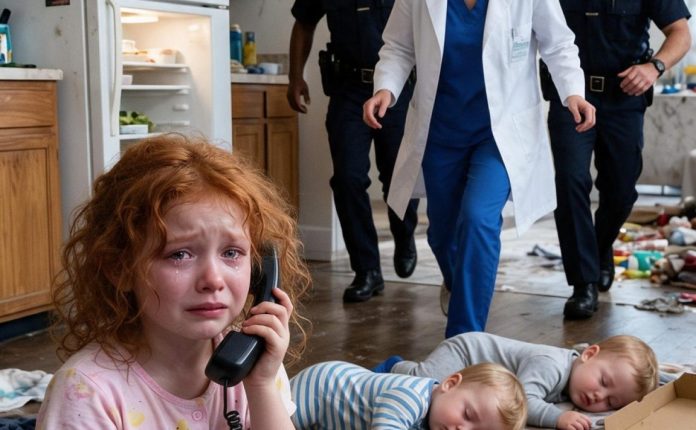
Wren was asleep when I returned to her room.
A nurse had placed a blanket over her legs. One of her hands rested beside a paper cup, and the other held the green washcloth she had carried from Grant's apartment.
I sat carefully on the edge of the chair.
My daughter looked smaller than she had on Tuesday.
For eight years, I had watched her grow into herself. She had gone from a baby who refused to sleep without music to a curious little girl who asked why the moon sometimes appeared during the day.
She loved drawing birds. She disliked the seams inside socks. She believed her younger brothers understood everything she said, even when their only response was delighted babbling.
Now there were shadows beneath her eyes.
I reached over to move a strand of hair from her forehead.
She woke immediately.
“Mom?”
“I'm here.”
“Did I sleep too long?”
“No, sweetheart.”
“Are the babies okay?”
“The doctors are helping them. They're still very sick, but they've responded to treatment.”
She thought about that.
“Can I see them?”
“When the doctors say it's okay.”
She looked at the cup.
“Am I allowed to drink the water?”
The question caught me off guard.
“Of course you are.”
She picked it up with both hands.
Then she stopped.
“Should I save some for Theo?”
I turned away for a moment.
Wren had been hungry and frightened for days, yet she was still thinking about what her brothers might need.
“There's enough water here for everyone,” I said.
She drank slowly.
Afterward, she asked whether she had done something wrong by leaving the apartment with the paramedics.
“Daddy told me nobody was supposed to take us anywhere.”
“Your father wasn't there to keep you safe. The paramedics came because you needed help.”
“He said you'd get in trouble if I called.”
“Wren, look at me.”
She lifted her eyes.
“Nobody can punish you for asking for help when someone's sick. You understand?”
She nodded, but I could see that she wanted more than an answer.
She wanted certainty.
Grant had spent months telling her that courts decided where children belonged and that adults could get into trouble for breaking rules.
To a child who had watched her parents argue over pickup times and legal documents, those warnings sounded powerful.
He had taken her understanding of authority and turned it into fear.
I could not undo that in one conversation.
A hospital social worker named Hannah Blake joined us after Wren had eaten a little soup.
Hannah was middle-aged, with reading glasses hanging from a cord around her neck. She spoke gently but directly, without the exaggerated sweetness adults sometimes use with frightened children.
“Wren, I heard you've had a difficult week.”
My daughter looked at me.
“You can tell her anything you remember,” I said.
Hannah asked where Wren slept, what food she had eaten, and whether she knew how to reach an adult.
Wren answered slowly.
She explained that Tuesday night had seemed normal.
Grant ordered pizza, watched television with them, and helped put the twins to bed.
The next morning, he woke before sunrise.
Wren had heard wheels rolling across the floor.
When she went into the hallway, he was standing beside the front door with his suitcase.
“He told me I was the boss while he was gone,” she said.
Hannah kept her voice neutral.
“What did that mean?”
“He said I knew where everything was.”
“Did he tell you when he'd come back?”
“He said before we needed anything.”
“And did he tell you another grownup would be there?”
Wren nodded.
“A lady was coming with dinner. She was supposed to change the babies too.”
“Did you know her name?”
“No.”
“Had you met her?”
“No.”
“Did she come?”
Wren looked down.
“I listened all the time.”
The social worker waited.
Wren rubbed the edge of her washcloth between her fingers.
“Daddy said she would knock three times. I thought I heard knocking once, but it was somebody in the hall.”
“Did you open the door?”
“No. He said not to.”
Hannah wrote something in her notebook.
“What happened when you needed more food?”
“I found the crackers.”
“Anything else?”
“Bread. Two bananas. There was yogurt, but it got warm and smelled bad.”
“Did you try calling your father?”
Wren nodded.
“His phone made a message sound. I left one.”
“What did you say?”
“I said we needed diapers.”
“Did he call back?”
She shook her head.
“What about your mother?”
Wren went quiet.
She stared at her hands for so long that I wondered whether she would answer.
Finally, she whispered, “I wasn't supposed to.”
Hannah leaned forward slightly.
“Who told you that?”
“Daddy.”
“What did he say?”
Wren's voice became almost inaudible.
“He said Mom always tries to take us away. If I called her, the judge might believe I didn't want to stay with him. Then they might put us somewhere else.”
My chest tightened.
Hannah glanced at me, then returned her attention to Wren.
“Calling your mother was a brave thing to do. I'm very glad you did it.”
Wren looked surprised.
“Even though Daddy said no?”
“Even then.”
Hannah let the silence settle.
Then she asked a question I had not considered.
“How did you know when to call?”
Wren held up the washcloth.
“I used to cover the microwave clock because it was too bright when the babies slept near the kitchen. Then the lights stopped working, and I couldn't see the numbers anymore.”
She frowned.
“I think that was Wednesday. Or Thursday. I don't know.”
I understood what she had tried to tell me earlier.
The darkness, the heat, and the long hours had become mixed together in her memory.
She had not been watching a clock.
She had been waiting for someone to arrive.
When the twins became less responsive, she finally took her emergency phone from her backpack.
“I was scared the battery would be gone,” she said.
“Did you try it before?”
“I turned it on once, but Daddy had told me not to use it. I was saving it.”
Hannah asked where the phone was now.
“In my bag.”
“That's helpful. We may want to look at it later, with your mom.”
Wren looked at me.
“Can I still keep it?”
I covered her hand with mine.
“Yes. And when you're home, we'll make sure it's always charged.”
The interview ended when Wren began rubbing her eyes.
Hannah thanked her and promised she could rest.
In the hallway, the social worker spoke privately with me.
“She's showing signs of significant stress,” Hannah said. “We're going to recommend follow-up support after discharge.”
“Will she be all right?”
“Children can recover remarkably well when they feel safe and have consistent support. But she may have sleep problems, guilt, or fear of separation. Don't expect her to feel normal the moment she's home.”
I nodded.
I already knew that bringing my children out of the apartment would not erase what had happened inside it.
The next morning, Saturday, Dr. Sato met me outside the pediatric unit.
Theo had become more responsive overnight. Miles was improving too, although he remained under close observation.
Both boys required continued treatment and monitoring.
For the first time since Friday, I felt something inside me loosen.
Not relief exactly.
A little space to breathe.
I walked into Theo's room.
He was lying beneath a pale blue blanket with a monitor attached near his chest.
When I touched his hand, his fingers curled weakly around mine.
“Hi, baby,” I whispered.
He opened his eyes.
Only for a moment.
But he looked toward my voice.
I bent over the bed and began crying.
A nurse brought me tissues without saying anything.
Twenty minutes later, Miles opened his eyes too.
His gaze was unfocused, and he still seemed terribly tired.
But when I brushed his cheek, he turned slightly toward my hand.
I had never been so grateful for such a small movement.
Dr. Sato reminded me that improvement did not mean the danger had completely passed.
The twins still needed careful monitoring.
I understood.
I also understood that I could finally imagine them leaving the hospital alive.
That possibility had felt impossibly distant the evening before.
At ten that morning, Detective Vega returned.
She found me in a family waiting room with a cup of coffee I had forgotten to drink.
“We've confirmed that Grant flew out of Milwaukee Wednesday morning,” she said.
“Where did he go?”
“Scottsdale, Arizona.”
“Why?”
“We're still documenting that.”
She explained that Grant had checked into a resort Wednesday afternoon.
The reservation was for three nights.
His departure was scheduled for Saturday.
I thought about the boys lying in that dark apartment.
While Wren counted crackers, their father had been sleeping in a hotel hundreds of miles away.
“Was this for work?” I asked.
“That's what we're trying to establish.”
“Have you spoken with him?”
“We've made contact.”
I straightened.
“He answered you?”
“Yes.”
“What did he say?”
Detective Vega pulled out a chair.
“He says he arranged childcare before leaving.”
I stared at her.
“There wasn't anyone there.”
“We know.”
“He left an eight-year-old with two babies.”
“That's consistent with what we've established so far.”
I pressed my fingers against my forehead.
“Then how can he say he arranged childcare?”
“He claims a caregiver was scheduled to arrive Wednesday morning.”
“Who?”
“He gave us a first name and the name of a booking service.”
I waited.
“We're checking the service records.”
I looked toward the hallway, where a nurse was pushing a cart of medical supplies.
“Do you believe him?”
The detective's expression remained careful.
“My job is to determine what happened, including what he knew and when he knew it.”
It was not the answer I wanted.
But it was the right one.
I had spent years arguing with Grant about what he intended, what he meant, and what he believed other people should have understood.
For once, intentions were not enough.
There were records.
There were timestamps.
There were children in hospital beds.
I wanted the truth to be something he could not talk his way around.
Detective Vega asked whether Grant had ever used childcare booking services before.
I told her that during our marriage, he sometimes arranged babysitters through an agency, usually for business dinners.
I had always insisted on meeting anyone who cared for the children.
Grant considered that unnecessary.
He preferred arrangements that required little effort.
“Do you know the caregiver he mentioned?” she asked.
“No.”
I gave her the names of the two sitters we had previously used.
Neither matched the first name he had provided.
Before leaving, Detective Vega asked for permission to examine Wren's emergency phone and copy relevant call information.
I agreed.
The phone was in her backpack, exactly where she said it would be.
Its battery was nearly empty.
There were several attempted calls to Grant's number and one voicemail.
The final outgoing call was to me.
Seeing the call list made my stomach turn.
My daughter had tried to reach an adult.
She had not simply waited quietly.
She had reached for help and been ignored.
Detective Vega documented the information and returned the phone.
“Keep it somewhere safe,” she said.
I placed it in my handbag.
A little later, my own phone rang.
Grant's mother.
Joan Whitaker had never liked me.
During the marriage, she believed I should overlook her son's spending and support his professional ambitions without complaint.
After the divorce, she accused me of being inflexible whenever I requested that Grant follow the parenting schedule.
I answered because she was the children's grandmother and might have information.
“Elena, what on earth is going on?”
“Joan, the children are in the hospital.”
“I know that. Grant called me.”
“He left them alone.”
There was silence.
Then she said, “He told me he'd made arrangements.”
“He left Wren to care for two infants for days. They're seriously ill.”
“You don't need to exaggerate.”
I looked through the glass window toward Theo's room.
“I have not exaggerated a single thing.”
“Grant says you took the children during his custody time.”
“Ambulances took them to the hospital because they were dangerously dehydrated.”
“I'm sure there are two sides.”
I felt a hot pressure behind my eyes.
“There are three children, Joan. All three needed medical care. That's the part you should be concerned about.”
She sighed.
“You know how hard he's been working. Sometimes things go wrong.”
I almost laughed.
Not because anything was funny.
Because the sentence was so inadequate.
Sometimes things go wrong.
A train arrives late.
A restaurant loses a reservation.
A package gets delivered to the wrong address.
Two babies do not become critically ill because their father has a difficult week.
“Do you know where Grant is?” I asked.
“On a business trip.”
“Did you know he was leaving Wednesday?”
“He mentioned an important opportunity.”
“Did you know he was leaving the children behind?”
No answer.
“Joan?”
“I assumed he'd arranged someone.”
“Who?”
“I don't know.”
I waited.
She did not offer a name.
Finally, she said, “You should try to keep this private. The children don't need a family scandal.”
I ended the call.
For years, privacy had meant keeping Grant's behavior from people who might question it.
I was finished protecting his reputation at the expense of our children's safety.
At noon, I met an attorney named Natalie Price.
A friend from the clinic had recommended her after learning what happened.
Natalie specialized in family law and child protection matters.
She arrived carrying a legal pad, wearing practical shoes, and speaking with the brisk calm of someone accustomed to difficult emergencies.
She had already reviewed the custody agreement I emailed.
“First,” she said, “we need to make sure the children cannot be removed from the hospital without appropriate authorization.”
“Can he come here and take them?”
“The hospital is aware of the safety concerns, and child protective services is involved. We're going to seek emergency court restrictions as quickly as possible.”
“What about his lawyer's letter?”
Natalie read it.
Then she read it again.
“Have you replied?”
“No.”
“Good.”
She placed it on the table.
“This letter assumes the children were removed from a safe custodial environment. That isn't what happened.”
“His lawyer wants them returned after discharge.”
“His lawyer appears to be relying on information Grant provided.”
I rubbed my temples.
“What happens if he lies in court?”
“We present the evidence. We don't build our case around proving that he's a bad person. We establish what happened to the children, the decisions he made, and the risks that remain.”
I looked at her.
“What if he convinces everyone this was a misunderstanding?”
Natalie did not rush to reassure me.
Instead, she pointed to the hospital paperwork.
“Doctors can document their conditions. The building can document the utility records. The airline can document his travel. Your daughter's call records and the old photograph are evidence. An explanation has to account for all of that.”
For the first time, I understood that I did not need to win another argument with Grant.
I needed to let the facts speak.
Natalie began preparing an emergency motion for temporary sole custody and restrictions on Grant's contact until the court could examine the circumstances.
She also contacted his attorney, Marianne Collier.
Marianne had sent the compliance letter on Friday.
Within an hour, she called Natalie back.
I was sitting across from my attorney when the call came through.
Natalie put it on speaker with Marianne's agreement.
“Ms. Price,” Marianne began, “I understand there's been a serious medical incident involving the children.”
“Yes.”
“Mr. Whitaker indicated that Ms. Elena Whitaker had removed them from his residence without authorization.”
“The children were transported by ambulance after being found without adult supervision.”
There was a long silence.
Marianne asked, “How long were they unattended?”
Natalie gave her the known timeline.
Wednesday morning until Friday afternoon.
Two infants.
One eight-year-old.
No confirmed caregiver.
Electricity disconnected during that period.
Marianne exhaled.
“That is not the information I was given.”
Natalie remained professional.
“I suggest you speak with your client before making further demands.”
“I intend to.”
The call ended.
I stared at the phone.
“Do you think she'll stop representing him?”
“That's her decision.”
“Could she force us to send the children back?”
“No attorney can make that decision by sending an email. We'll pursue the necessary court protection.”
Natalie gathered her papers.
“There's one more thing I want you to understand. A parent's embarrassment isn't an emergency. A child's safety is. We're going to keep those two issues separate.”
I carried that sentence with me for the rest of the day.
At three, Detective Vega called.
The childcare booking service had responded to investigators.
Grant had made an inquiry for a caregiver to supervise three children beginning Wednesday morning.
The booking required confirmation and payment before anyone would be assigned.
He had received a reminder Monday.
He had not completed the payment.
The request expired Tuesday afternoon.
I sat down on the edge of the hospital bed.
“He knew?”
“We have evidence that the booking was canceled,” Detective Vega said. “He received notification through the service.”
“And he still left?”
“He boarded his flight Wednesday morning.”
Wren's voice returned to me.
A lady was coming.
She was supposed to bring our dinners.
Grant had told her help was coming even though the booking had already expired.
The detective continued.
“We're obtaining the message records and confirming whether he made any other arrangements.”
I looked toward Miles, who was sleeping beneath his blanket.
“What happens now?”
“We'll continue the investigation. There may be grounds for criminal charges, but I won't speculate before the evidence is complete.”
After we ended the call, I sat beside Miles for a long time.
At four, Wren was finally allowed a brief supervised visit with her brothers.
She entered the room holding a drawing.
It showed three small figures sitting beneath a large yellow sun.
One figure had a pink dress.
Two had blue shirts.
“That's us,” she explained.
I smiled.
“I can see that.”
She approached Miles's bed carefully.
“Hi, Miles.”
He turned his head slightly.
Wren covered her mouth.
“He heard me.”
“Yes, honey. I think he did.”
She leaned closer.
“I'm sorry I couldn't make your bottle right.”
I put my hand on her shoulder.
“You don't need to apologize to him.”
“But he was hungry.”
“So were you.”
She looked at me.
“I thought if I ate the crackers, there wouldn't be enough.”
I knelt until our eyes were level.
“Wren, I need you to remember something. When adults don't provide what children need, the children are not responsible for fixing it.”
She listened without speaking.
“You kept your brothers company. You tried to comfort them. And when you realized they needed help, you called me. That was enough.”
She looked back at Miles.
“I still wish I'd called sooner.”
“So do I,” I whispered.
It was the first time I admitted the truth of my own regret.
Not because I blamed her.
Because I wished someone had reached them sooner.
A nurse helped Wren settle beside Theo's bed for a few minutes.
She sang the soft little song she had learned in kindergarten.
Theo watched her with sleepy eyes.
His fingers moved against the blanket.
For a moment, we were simply a family in a hospital room.
Then my phone vibrated.
A message from Natalie.
Grant had contacted his attorney again.
He was flying back to Milwaukee.
According to Marianne, he maintained that someone else was responsible for the childcare failure.
And he intended to contest my request for sole custody.
I read the message twice.
There was more.
He had claimed that I knew about his trip.
He said I had agreed to collect the children Wednesday morning.
I stared at those words.
We had never discussed such an arrangement.
Not once.
Then another message arrived from Natalie.
She had asked Grant's attorney to produce the communication showing my supposed agreement.
Grant claimed he had it in writing.
I looked down at Wren, who was gently singing to her brothers.
Her father had already lied about their safety.
Now he was preparing to claim I had known they were alone.
I walked into the hallway and called Natalie.
“He's going to say I abandoned them, isn't he?”
“He may try,” she answered.
“I never agreed to anything.”
“Then we document that.”
“What if he produces something?”
“We examine it carefully.”
I stood beside a window overlooking the hospital parking lot.
Below, parents were helping children into cars, adjusting coats, fastening seat belts.
Ordinary moments.
Things I had taken for granted.
“There's no agreement,” I said.
Natalie's voice was steady.
“Then we find out what he's trying to pass off as one.”
END PART 2