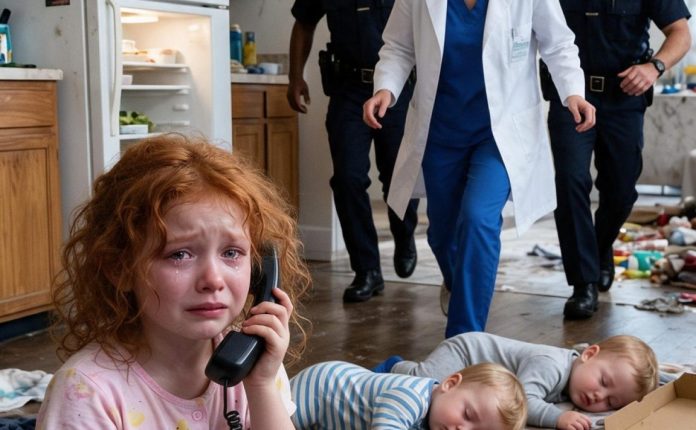
The first thing Wren asked when I told her about the court's decision was whether she could sleep in her own bed.
We were sitting beside the window in the hospital's family lounge. She wore the pale yellow sweater Leanne had brought her, and her hair was pulled into a loose braid.
“Yes, sweetheart,” I answered. “When the doctors say everyone is ready, we're going home.”
“All of us?”
“All four of us.”
She considered that.
“Is Daddy coming?”
“No.”
“Not even for dinner?”
“Not right now.”
She looked down at her sleeves.
“Did the judge get mad at me?”
I moved my chair closer.
“No. The judge understood that you needed grownups to take care of you.”
“Did you show her my notebook?”
“Yes.”
“Was my writing okay?”
I smiled, although my eyes were burning.
“Your writing was very clear.”
She nodded thoughtfully.
Then she asked, “Did she know I shared the banana?”
I reached for her hand.
“Yes, Wren. She understood you were trying to help your brothers.”
My daughter breathed out slowly.
It was the sound of a child who had been holding on to a terrible worry.
That evening, she slept for nearly ten uninterrupted hours.
I sat beside her for a long time, watching her face relax.
I had expected the court order to make me feel that the worst was over.
But the legal decision had only established where my children would live and how their father could contact them.
It could not erase their hunger.
It could not remove the memories of the dark apartment.
It could not give Wren back the days she had spent trying to be an adult.
Those things would require time.
And I was beginning to understand that healing would not follow the tidy schedule I wanted.
On Tuesday afternoon, Dr. Sato told me the twins were continuing to improve.
Their hydration and circulation had stabilized, and their blood tests were moving toward safer levels.
They were beginning to tolerate feeding under the medical team's supervision.
Both still required observation, but the doctor believed they could recover without lasting physical damage from the episode.
I held that possibility close.
“What should I watch for after discharge?” I asked.
He reviewed the follow-up plan carefully.
There would be pediatric appointments.
Growth and feeding assessments.
Monitoring for any continuing complications.
He reminded me that the boys might be more irritable or unsettled after their hospitalization.
“Don't be surprised if they need more reassurance than usual,” he said.
I nodded.
They were babies.
They did not understand court orders, police reports, or canceled childcare reservations.
They understood warmth.
Food.
Familiar voices.
Hands that picked them up when they cried.
For several days, those things had been unreliable.
I intended to make them ordinary again.
On Wednesday morning, Miles was discharged.
Theo followed later that afternoon.
A nurse helped me organize the medication instructions and follow-up appointments.
I signed the final paperwork with hands that were finally steady.
Wren stood beside the stroller, carefully inspecting her brothers.
“Can they wear their blue hats?”
“If they want to.”
“They're too little to say.”
“Then you can help me choose.”
She smiled.
It was a small, familiar smile.
The kind I had missed.
As we passed the hospital entrance, Wren stopped.
“Mom?”
“Yes?”
“Are you sure we can leave?”
I showed her the discharge papers.
“The doctors said we're ready.”
She looked toward the parking lot.
“And nobody will take us back to Daddy's apartment?”
I knelt beside her.
“No, sweetheart. We're going to our house.”
She stared at me.
Then she wrapped both arms around my neck.
I held her while people walked around us.
I did not hurry her.
For the first time in days, nobody was waiting for Wren to make an emergency decision.
She could stand there and be a child.
When we reached home, my sister Claire was waiting.
She had taken leave from her job to clean the house, wash the children's bedding, and fill the refrigerator.
She did not decorate the living room with balloons or make a celebration out of their return.
She knew the children needed quiet.
Instead, she placed fresh flowers on the kitchen table and made sure every night-light worked.
Wren went directly to the refrigerator.
She opened it.
Then she closed it.
A minute later, she opened it again.
I watched from the kitchen doorway.
“Looking for something?”
She shook her head.
“Just checking.”
I walked over.
The shelves held milk, yogurt, fruit, vegetables, eggs, and small containers of food Claire had prepared.
“There's plenty here,” I said.
Wren nodded.
Then she asked, “Will it still be here tomorrow?”
I felt my throat tighten.
“Yes.”
“What about Friday?”
“Yes.”
“And if the power goes off?”
I crouched beside her.
“If that happens, we'll find safe food somewhere else. We can go to Aunt Claire's house or the store. You won't have to figure it out by yourself.”
She looked at the refrigerator again.
Then she asked whether she could have a banana.
I took one from the fruit bowl.
She broke it in half.
“Can I save this part for Theo?”
I placed the other half beside her.
“Your brothers have their own food. You can eat your whole banana.”
She hesitated.
Then she took a bite.
That night, Wren refused to sleep in her bedroom.
She wanted to stay on the floor beside the twins.
I offered to bring her mattress into my room temporarily.
She agreed, but only after checking that both cribs were close enough for her to see.
At two in the morning, she woke crying.
She thought Miles had stopped breathing.
I checked him, found him sleeping normally, and sat beside her until she calmed down.
At four, she woke again.
This time, she wanted to know whether the refrigerator was still working.
I took her downstairs.
We stood together in the quiet kitchen.
The little interior light came on when I opened the door.
Wren stared at it.
“See?” I said softly.
She nodded.
“Can we leave the kitchen light on?”
“Yes.”
“Every night?”
“For as long as you need.”
We went back upstairs.
She fell asleep with one hand holding the edge of my blanket.
The next morning, I called the child therapist recommended by the hospital.
I made the first appointment available.
I also arranged follow-up care for the twins.
My supervisor at the clinic approved an extended leave.
I had worried about asking.
But when I explained the situation, she interrupted me gently.
“Elena, your children need you right now. We'll work out the schedule.”
For years, I had believed that being strong meant managing everything without asking for assistance.
I had worked extra shifts, stretched our budget, and tried to make up for every disappointment the children experienced after the divorce.
Now I began accepting help.
Claire came on Tuesdays.
Leanne visited on Thursdays.
A trusted neighbor checked in when I needed to take one child to an appointment.
I stopped apologizing whenever someone offered to carry groceries or fold laundry.
The practical details mattered more than I had expected.
Wren needed to know there were adults who came when they said they would.
When Claire promised to arrive at three, she arrived at three.
When Leanne said she would bring soup, she brought soup.
When I told Wren I would return from the pharmacy in twenty minutes, I made sure I did.
Gradually, those ordinary promises began to repair something that had been damaged.
Not immediately.
Not completely.
But enough for Wren to notice.
Three weeks after we came home, she asked if she could attend her friend's birthday party.
I said yes.
She looked surprised.
“Will you stay?”
“If you'd like me to.”
She thought about it.
“Maybe just until they bring out the cake.”
We went together.
For the first half hour, she remained close to me.
Then another little girl asked her to join a game.
Wren looked back.
I smiled.
She ran toward her friends.
I sat on a folding chair near the wall and watched her laugh.
It was the first time since the emergency that I had heard her laugh without checking whether her brothers were nearby.
I went home that afternoon with tears in my eyes.
They were different tears.
Meanwhile, the investigation into Grant continued.
Detective Vega contacted me occasionally to confirm information or request documentation.
She never promised an outcome.
She explained what had been established and what remained under review.
The childcare records were especially important.
Grant had attempted to book someone.
But the booking had never been confirmed.
He had received notice that no caregiver was assigned.
He had left anyway.
Investigators also examined his travel arrangements, communication records, and statements to family members.
The evidence showed that the Scottsdale trip had not been an unavoidable work emergency.
Grant had lost his sales position shortly before collecting the children.
He was trying to secure a new business opportunity through contacts attending a private executive retreat.
He had booked the resort before confirming care for the children.
He had also been preparing to leave his apartment because he could no longer afford the rent.
The utility disconnection was part of that plan.
Those details explained why he was so determined to travel.
They did not excuse leaving three children alone.
He had wanted to preserve the appearance of being financially successful and capable of managing his family.
Instead of admitting that his childcare arrangement had failed, he boarded the plane and kept making excuses.
When Wren tried to call, he did not respond.
When I asked about the children, he sent an old photograph.
When Leanne asked where they were, he claimed I had collected them.
And when the emergency became impossible to hide, he accused me of violating the custody arrangement.
His explanations had not merely failed to protect the children.
They had delayed the moment anyone realized they needed help.
That was the truth I had been trying to understand.
There had been no mysterious stranger who kidnapped him.
No medical emergency that prevented him from returning.
No confirmed caregiver who abandoned an assignment.
Grant had known the arrangement was unresolved.
He chose to travel anyway.
Then he lied because admitting what he had done would expose the failure he was trying so desperately to conceal.
Months later, he entered a plea to criminal charges arising from the neglect of the children.
The court imposed a custodial sentence followed by supervision and conditions intended to address his conduct.
The family court proceedings continued separately.
After reviewing the investigation, the medical evidence, and the children's needs, the court entered a longer-term order placing the children in my care and maintaining strict restrictions on Grant's contact.
Any future changes would require additional review and consideration of their safety.
I attended the relevant hearings, but I did not bring Wren.
She did not need to see her father in a courtroom again.
She did not need to listen to adults debate whether her suffering had been serious enough.
The evidence had already established what happened.
I wanted her childhood to become something more than a collection of exhibits.
The criminal case received some local attention, but I declined interviews.
I did not publish photographs of the children or describe their medical treatment online.
When someone suggested that sharing the story publicly might help people understand what Grant had done, I explained that my children did not owe strangers the details of their worst experience.
The truth belonged in the appropriate records.
Their recovery belonged to them.
Joan called several times during those months.
At first, I did not answer.
Eventually, she sent a letter.
It was handwritten on cream-colored stationery.
Elena,
I have spent a great deal of time thinking about what happened.
When you told me the children were in the hospital, I accused you of exaggerating.
I defended Grant before asking whether the children were safe.
I was wrong.
I don't expect you to trust me simply because I am their grandmother.
I only want you to know that I understand why you could not accept what I said.
I hope the children continue to recover.
Joan.
I read it twice.
Then I placed it in a drawer.
I did not throw it away.
I also did not immediately invite her back into the children's lives.
Trust required more than a letter.
Joan had spent years protecting Grant from consequences.
Whether she could become a dependable grandmother was something she would have to demonstrate through consistent behavior.
I allowed the appropriate professionals to help determine what contact might be suitable.
I had learned not to confuse someone's desire to be forgiven with a child's need to feel secure.
Leanne remained part of our lives.
She visited regularly, helped Wren with reading, and attended the twins' first follow-up developmental assessments.
One afternoon, while the boys were napping, she stood with me in the kitchen.
“I still can't believe he did it,” she said.
I looked at her.
“I know.”
“I keep thinking about what I would have done if he'd called.”
“You probably would have gone straight there.”
“Yes.”
She looked down.
“I wish he'd trusted me enough to ask.”
I rinsed a plate.
“It wasn't about trusting you, Leanne.”
“What do you mean?”
“He didn't want anyone to know his plan was falling apart. Asking for help would have meant admitting he couldn't manage.”
Leanne considered that.
Then she nodded.
“That sounds like Grant.”
We stood quietly for a moment.
Finally, she said, “I'm glad Wren called you.”
“So am I.”
I glanced toward the living room, where Wren's drawing supplies were spread across the coffee table.
“She saved their lives,” Leanne said.
I nodded.
“She helped get them to safety.”
Then I added, “But I never want her to feel that keeping them alive was her responsibility.”
Leanne understood.
We had both seen how quickly adults could turn a child's extraordinary effort into an expectation.
Wren deserved praise for asking for help.
She did not deserve the burden of believing she had been responsible for everything that followed.
Her therapist helped us work through that distinction.
During one session, Wren drew two pictures.
In the first, a little girl stood beside two babies inside a dark room.
In the second, the same children sat at a kitchen table with their mother.
The therapist asked Wren what was different.
“The first girl has to do everything,” Wren answered.
“And the second?”
Wren smiled faintly.
“The second girl gets breakfast.”
When the therapist told me about the conversation afterward, I cried in my car.
I had spent months worrying about how to explain responsibility, fear, and safety.
My daughter had described what she needed in one sentence.
She wanted breakfast.
She wanted someone else to know when the milk was running low.
She wanted to sleep without listening for a stranger at the door.
She wanted to be eight years old.
I could give her those things.
And I did.
Our routines became predictable.
Breakfast at seven.
School on weekdays.
A short walk after dinner when the weather was pleasant.
Baths, stories, and bedtime songs.
The twins gradually regained their strength.
Theo returned to crawling from one end of the living room to the other, usually chasing anything with wheels.
Miles developed a habit of laughing whenever someone sneezed.
Both began gaining weight steadily under their pediatrician's care.
Their doctors continued monitoring their progress.
Wren started sleeping in her own room again.
At first, she wanted the door open.
Then she wanted the hall light on.
Eventually, she asked whether we could turn the light off because it was keeping her awake.
I almost cried when she said it.
She was beginning to feel safe in the dark again.
Not every day was easy.
There were mornings when she became anxious because the twins refused breakfast.
There were nights when a loud noise woke her.
Sometimes she asked the same question three or four times because she needed to hear the answer again.
I learned to respond patiently.
When she worried about food, we checked the pantry together.
When she worried about someone leaving, I explained where I was going and when I would return.
When she worried about her father, I reminded her that adults and the court were responsible for making decisions about contact.
I never asked her to pretend she was no longer afraid.
One evening, several months after the rescue, she came into my room carrying the old green washcloth.
I recognized it immediately.
The fabric was faded and thin.
A small tear had opened near one corner.
“Mom, can we throw this away?”
I sat up.
“Of course. Is that what you want?”
She nodded.
“I used to think I needed it.”
“What for?”
“To help the babies sleep.”
She looked at the cloth.
“But they have blankets now.”
“Yes, they do.”
“And they don't have to sleep on towels.”
“No.”
She held it for a moment longer.
Then she placed it in the wastebasket beside my desk.
She did not cry.
She simply went back to her bedroom.
I sat there looking at the basket.
During the rescue, that washcloth had seemed like evidence of everything that had gone wrong.
To Wren, it had been a tool.
Something she could use when almost everything else was beyond her control.
Now she no longer needed it.
I left it where she had placed it.
The next morning, she asked me to help braid her hair.
I sat on the edge of her bed and separated the strands.
“Too tight?” I asked.
“No.”
She watched me in the mirror.
“Mom?”
“Yes?”
“Do you think Daddy loves us?”
I stopped for a moment.
There was no easy answer.
I did not want to lie.
I also did not want to make my daughter feel unlovable because of what her father had done.
“I think your father has feelings for you and your brothers,” I said carefully. “But love is also about what people do. Parents have to make safe choices and take care of their children.”
She considered that.
“He didn't take care of us.”
“No, he didn't.”
“Was it because we were too much work?”
I placed the braid against her shoulder.
“No, Wren. You and your brothers were not too much work. He failed to do what he was responsible for doing.”
She looked at herself in the mirror.
“Will he ever be better?”
“I hope he learns to make better choices. But that's his responsibility, not yours.”
She nodded slowly.
Then she asked whether we could use the purple hair elastic.
I smiled.
“Of course.”
We finished the braid.
She went downstairs to eat breakfast.
I followed her, feeling grateful that she had asked the question instead of keeping it hidden.
One Saturday the following spring, Claire came over for breakfast.
The twins were old enough to sit in their highchairs and argue loudly over which spoon belonged to whom.
Wren had decided we should make pancakes.
She stood on a small step stool beside me, stirring batter in a bowl.
“Not too fast,” I reminded her.
“I know.”
She added a little cinnamon.
Then she looked at me.
“Can we make extra?”
“Sure. How many?”
“Enough for Aunt Claire too.”
“That's easy.”
She glanced at the fruit bowl.
“And can we put bananas on top?”
I smiled.
“We can.”
She mashed one banana with a fork while I warmed the skillet.
The kitchen smelled of butter and cinnamon.
Sunlight fell across the table.
Theo banged his spoon.
Miles laughed.
Claire poured coffee.
It was an ordinary Saturday morning.
And that made it extraordinary to me.
When the first pancakes were ready, I placed one on Wren's plate.
She reached for her fork.
Then she hesitated.
I recognized the movement.
For months, she had struggled to eat before making sure her brothers had enough.
I waited.
She looked toward their highchairs.
“They have theirs?”
“Yes.”
“And Aunt Claire?”
“She has hers.”
“And you?”
“Mine's coming.”
Wren nodded.
Then she cut a piece of pancake and took a bite.
She did not save it.
She did not divide it into three portions.
She did not ask whether there would be enough food tomorrow.
She simply ate.
Across the table, Theo dropped a piece of banana onto the floor.
Miles immediately tried to imitate him.
Claire laughed.
I reached for a cloth.
Wren looked at her brothers and shook her head.
“You two are messy.”
“Very messy,” I agreed.
She grinned.
Then she went back to her breakfast.
I watched my children sitting together in the sunlight.
There were still appointments ahead.
There would be questions about their father as they grew older.
There would be moments when the memories returned, and days when progress felt slower than I wanted.
I knew that.
But I also knew something I had not fully understood before.
Our family did not need a perfect ending to have a safe beginning again.
The children needed adults who kept promises.
They needed food they could count on.
They needed rooms where the lights worked, doors they knew would open, and people who answered when they called.
Most of all, they needed to understand that childhood was not a responsibility they had to earn by being useful.
That morning, Wren finished her pancake and asked for another.
I reached for the plate.
“Of course, sweetheart.”
She smiled.
“Can I have extra bananas?”
I placed a few slices beside her pancake.
“There you go.”
She picked up her fork.
Outside, the neighborhood was waking.
A dog barked somewhere down the street.
A delivery truck stopped at the corner.
Inside, the twins were laughing, Claire was telling a story, and Wren was asking whether we could visit the library later.
Nobody was frightened of the refrigerator becoming empty.
Nobody was waiting for a stranger who might never arrive.
Nobody was counting the hours until someone came home.
For the first time in a very long while, the only thing my daughter had to worry about was whether there would be enough cinnamon for another batch of pancakes.
And there was.
END PART 5
Disclaimer: This fictional story was created with AI assistance for entertainment. Names, characters, dialogue, and events are fictional. Any resemblance to actual people or events is coincidental.