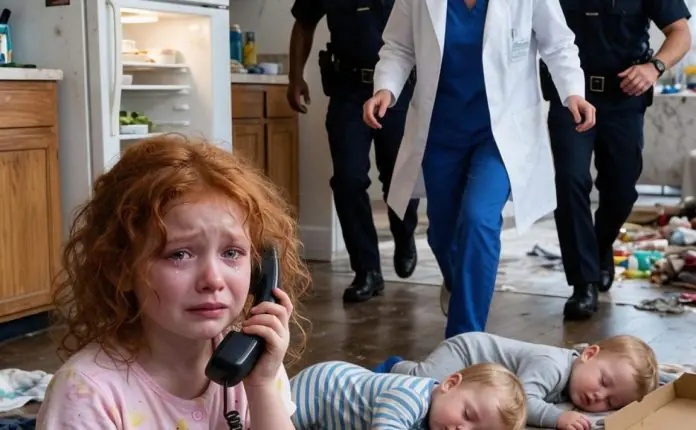
“Mom, Theo and Miles won't wake up.”
Those seven words came through my phone while I stood in the frozen-food aisle of a Milwaukee grocery store. The carton of milk in my hand slipped against my palm.
“Wren, honey, what do you mean they won't wake up?”
“I tried touching their cheeks. I called their names. Theo moved a little before, but now he won't.”
My daughter was eight years old. Her brothers were thirteen-month-old twins. They were supposed to be spending four nights with their father, my ex-husband, Grant Whitaker.
I put the milk on the nearest shelf.
“Where's Daddy?”
There was a pause long enough for me to hear a television playing somewhere behind her.
“He isn't here.”
“Where did he go?”
“He said somebody would come.”
I pushed my shopping cart aside, barely noticing when it bumped a display of cereal boxes.
“Sweetheart, tell me exactly what happened.”
Her breathing turned uneven.
“We haven't had a real meal since Tuesday. I gave the babies the bananas, but there wasn't anything else. And now they won't open their eyes.”
I looked at my watch.
Friday. 4:20 p.m.
The last time I had seen my children was Tuesday evening.
I was thirty-four years old, a medical billing supervisor at a neighborhood health clinic, and a mother who had spent the previous eighteen months learning how to raise three children after a difficult divorce.
I knew what dehydration could do to a baby. I also knew that young children could become critically ill much faster than adults.
But knowing those things did not prepare me to hear my own daughter describe her brothers lying motionless on an apartment floor.
“Wren, I'm calling an ambulance. Stay on the phone with me.”
“Please don't be angry.”
“I'm not angry with you.”
“Daddy said you'd be angry if I called.”
I closed my eyes for half a second.
“Your father was wrong. You did exactly what you were supposed to do.”
I hurried toward the store entrance while contacting emergency services on my second phone line.
I gave the dispatcher Grant's building address, the apartment number, the children's ages, and everything Wren had told me.
The dispatcher asked whether the twins were breathing.
I relayed the question.
Wren began crying again.
“Theo is breathing, but it's tiny. I can't tell with Miles.”
The dispatcher told me emergency responders were on their way and advised Wren to follow their instructions while remaining connected.
I ran through the parking lot with my keys clenched so tightly that the metal edges dug into my hand.
The drive usually took eighteen minutes.
That afternoon, it felt endless.
Grant lived in a renovated warehouse building near the Milwaukee River. He had moved there shortly after our divorce, choosing an apartment with exposed brick, enormous windows, and rent that exceeded what he had once paid toward our family mortgage.
When we were married, appearances mattered enormously to Grant.
He wanted the right car outside the right restaurant. He wanted expensive watches, attractive photographs, and colleagues who believed every business conversation ended with his success.
He was less interested in the ordinary expenses that made a household function.
During our marriage, I paid the daycare deposits while he financed a new vehicle. I bought winter boots for Wren while he spent hundreds on dinners with clients.
He would smile and tell me I worried too much about money.
After our separation, he became particularly concerned with how other people perceived his parenting.
He insisted on substantial parenting time during mediation, arguing that our children needed an equally involved father.
I agreed that they needed their father.
I also remembered how often he had treated childcare as something that simply happened around him.
The custody arrangement was finalized that spring.
Grant received scheduled overnight visits, with plans to expand them as the twins grew older.
At every exchange, he reminded me that he had rights.
I reminded him that rights came with responsibilities.
On Tuesday evening, I met him outside the neighborhood library.
Wren wore her pink sneakers and carried a little backpack containing her favorite chapter book. The twins sat in their stroller, one pulling at the other's sleeve.
I had packed formula, bottles, diapers, medication, spare clothes, and a printed schedule.
Grant arrived nearly fifteen minutes late.
His blue shirt looked freshly pressed. His hair was carefully styled, and a leather overnight bag lay across the back seat of his car.
“Are you traveling?” I asked.
“Work stuff.”
“During your parenting time?”
“It's a bag, Elena. People carry bags.”
I held out the feeding instructions.
“Theo's been waking earlier lately. He wants breakfast before seven. Miles has been refusing the new formula, so I packed the brand he tolerates.”
Grant glanced at the paper without taking it.
“I remember how to feed my own sons.”
“I'm sure you do. I'm telling you what's been working.”
He looked toward another parent leaving the library and lowered his voice.
“Can we not do this in front of everyone?”
There was nobody close enough to hear.
I placed the paper inside the diaper bag.
Wren stood beside us, twisting the strap of her backpack.
“Can I call you tomorrow, Mom?”
“Of course.”
Grant opened the rear passenger door.
“Come on, sweetheart. We're going to have a fun week.”
Wren climbed into the car but kept looking at me.
I bent down to kiss her forehead.
“Remember where your emergency phone is?”
She nodded.
It was an older smartphone I had given her after the divorce, with a prepaid calling plan and only a few approved contacts. She was not supposed to use it for games. It existed so she could reach me if she needed help.
Grant disliked it.
He called it unnecessary and accused me of encouraging Wren to monitor him.
But I insisted she keep it.
That Tuesday evening, I checked that it was fully charged before slipping it into the inside pocket of her backpack.
I watched Grant drive away.
I had a strange feeling as Wren's face disappeared behind the window, but nothing concrete enough to act upon.
I thought she was simply unhappy about leaving home.
I would spend many nights afterward remembering that moment.
On Wednesday morning, I sent Grant a message asking whether everyone had slept well.
He did not answer until after lunch.
The photograph showed Theo and Miles sitting on a yellow blanket in the living room. Both appeared happy, with toys scattered around them.
Everyone's good. Stop worrying.
I replied with a heart and asked whether Wren could call.
No answer.
On Thursday, I tried again.
Grant responded shortly before dinner.
They're fine. Enjoying themselves. Please respect my parenting time.
I had grown accustomed to his irritation whenever I asked ordinary questions.
I did not like it, but I also did not want every exchange to become another argument recorded by our lawyers.
So I waited.
Until Friday afternoon, when my daughter's frightened voice reached me through the grocery-store freezer aisle.
As I drove toward Grant's apartment, I asked Wren what food remained.
“There's bread, but it tastes funny now.”
“Don't eat anything that smells strange.”
“Okay.”
“Have you had water?”
“Yes. From the sink.”
“Good. Keep talking to me.”
“Mom?”
“I'm here.”
“I tried to make the boys happy.”
I gripped the steering wheel.
She told me she had sung their bedtime songs, changed their clothes, and cleaned their faces with a washcloth.
She had used the last clean diapers the previous day.
Afterward, she spread towels beneath them because she did not know what else to do.
She explained this in the careful manner of a child trying to prove she had followed instructions.
Then she said something I could barely understand.
“I gave them the last banana yesterday. I didn't eat any because they were crying.”
I pulled into the building's parking lot.
Two emergency vehicles stood near the entrance.
I ran inside.
The lobby smelled of lemon cleaner, and the floor beneath my shoes was polished concrete.
A paramedic was speaking into a radio near the elevator.
“Third floor?” I asked.
He nodded and hurried ahead of me.
At Grant's door, another paramedic stood beside Mrs. Norwood, the building caretaker.
She was a woman in her sixties with close-cropped gray hair and a ring of keys hanging from her wrist.
“She's inside,” Mrs. Norwood said. “I can hear the little girl.”
Wren had released the lower lock, but the upper bolt was jammed.
Mrs. Norwood tried the maintenance key while a paramedic pushed against the door.
I heard my daughter crying on the other side.
“Mommy?”
“I'm right here!”
A moment later, the bolt shifted.
The door opened.
The heat struck me first.
Then the smell.
The apartment was dark, although daylight still filtered through the edges of the blinds.
Something had spoiled in the kitchen.
A bowl sat on the counter with dried cereal stuck to its sides. Small pieces of bread were scattered across the table.
Near the living-room window, several towels covered the floor.
My daughter stood barefoot beside them.
Her cheeks looked hollow, and the skin around her lips was dry.
She held a faded green washcloth.
“Mommy, I couldn't get them to drink.”
I reached for her, but the paramedics were already moving toward the boys.
Theo lay on his side.
Miles was beside him, his small hand resting against the edge of a quilt.
Neither looked toward us.
A paramedic knelt and checked Theo.
The other lifted Miles carefully, calling out observations to his colleague.
I could hear medical instructions, the sound of equipment opening, and Mrs. Norwood asking whether she should bring the elevator upstairs.
But Wren's voice was the only thing I understood clearly.
“Please don't step on the towels. I made them for the babies.”
I pulled her against me.
“You did your best.”
She shook her head.
“They still got sick.”
“The ambulance is here now.”
“I tried everything.”
I held her face between my hands.
“Wren, listen to me. Your job was never to take care of two babies alone.”
Her expression crumpled.
“Daddy said I was the big sister.”
I wanted to tell her what I thought of that statement.
Instead, I said, “Being a big sister doesn't mean being their parent.”
The paramedics carried the boys out.
I followed with Wren.
A neighbor held open the elevator and offered my daughter a coat. Wren looked at the woman as though she did not understand why anyone was being kind to her.
Outside, the evening air felt cool against my damp face.
The twins were placed in separate ambulance care spaces, where the responders continued treatment and monitoring.
Wren and I rode with them.
She leaned against me, exhausted but unwilling to close her eyes.
“Will they wake up?”
“Doctors are going to help them.”
“Promise?”
I could not give her a promise I did not know I could keep.
So I kissed her hair.
“I promise we're staying with them.”
At the hospital, the twins were taken directly into emergency treatment.
A nurse guided Wren to a separate examination room.
I had to choose where to stand.
The boys needed doctors.
My daughter needed me.
For a moment, I stood in the hallway unable to move.
A nurse named Caroline noticed.
“Your daughter is safe with me,” she said. “Go speak to the physician. I'll bring her to you when we're ready.”
I looked through the open doorway.
Wren was sitting on an examination bed, staring at her bare feet.
“Stay where I can find you,” she whispered.
“I will.”
I had never before heard my daughter sound so afraid of being left behind.
Dr. Sato, the emergency physician, spoke to me after the initial treatment began.
Both twins were severely dehydrated.
Their circulation had been affected, and their blood tests showed serious disturbances that required close monitoring.
They were receiving carefully controlled fluids and ongoing assessment.
“Are they going to survive?” I asked.
Dr. Sato studied my face.
“We're treating both of them aggressively. They've shown an initial response, which is encouraging. But they're very ill, and we need to watch them closely.”
I looked toward the treatment room.
Theo's tiny arm was secured beside him.
Miles had a monitor attached to his chest.
“Can I touch them?”
“Briefly, yes.”
I placed two fingers against Miles's hand.
His skin was warm.
I had spent the drive imagining the worst. That small warmth felt like something I could hold on to.
I whispered his name.
He did not respond.
I tried again.
Nothing.
Behind me, a nurse adjusted a monitor.
“His body is working very hard right now,” she said gently.
I stepped back so the team could continue.
Within the hour, a hospital social worker arrived.
She asked about our custody arrangement, Grant's address, and the last time I had spoken with him.
I showed her the text messages.
She listened closely.
“Did you have any reason to believe he had left the children unattended?”
“No.”
“Has this happened before?”
“Not like this.”
I hated the uncertainty in my answer.
Grant had forgotten pickups. He had returned Wren late and once sent the twins home without enough diapers.
He had dismissed medical instructions and argued about money.
But I had never imagined he would leave three children alone for days.
I called him again.
Voicemail.
I sent a message.
The children are in the emergency department. Call immediately.
No reply.
When the hospital asked for the father's contact information, I gave them everything I had.
His phone number.
His business email.
His mother's number.
The name of his last employer.
I wanted someone to find him.
I also wanted him to explain how an eight-year-old girl had been left to keep two infants alive.
Shortly after seven, Detective Marisol Vega arrived.
She was a quiet woman with dark hair pulled into a low bun and a habit of letting people finish their sentences.
She introduced herself, confirmed the children's conditions with the medical team, and sat beside me in a small consultation room.
“I know you're exhausted,” she said. “We'll keep this as straightforward as possible.”
She asked when I had last seen the children.
Tuesday.
When Grant had been expected to return them.
Saturday evening.
Whether he had mentioned leaving town.
No.
Whether anyone else had been authorized to care for them.
Not to my knowledge.
When I finished, she asked about the messages Grant had sent during the week.
I handed her my phone.
She scrolled carefully.
Then she stopped at Wednesday's photograph.
“Is this his apartment?”
“Yes.”
“Do you recognize anything about the picture?”
I leaned forward.
The twins were sitting on the yellow blanket.
There was a stuffed elephant between them.
A small birthday card stood against a lamp in the background.
The card had a gold ribbon tied around it.
I recognized it immediately.
Wren had received it from my sister on her birthday six weeks earlier.
I opened my photo gallery.
There was the same picture.
Taken on Wren's birthday.
Same blanket.
Same toys.
Same card.
Same angle of sunlight.
Grant had sent me an old photograph as if it had been taken Wednesday.
Detective Vega checked the timestamps and asked whether I had retained the original files.
“Yes.”
“Please don't delete anything.”
I stared at the photograph.
He had not merely ignored my messages.
He had made an effort to convince me the children were safe without showing me anything current.
“Why would he do that?”
The detective did not speculate.
“We need to establish where he was.”
Someone knocked.
Mrs. Norwood appeared with a thin folder held against her chest.
She looked uncomfortable.
“I brought the maintenance records,” she said.
Detective Vega invited her inside.
The caretaker placed several pages on the table.
One showed the apartment's electricity service had stopped Wednesday afternoon at 2:14.
Another listed a pending change in occupancy status.
“His unit was scheduled to be vacant,” Mrs. Norwood explained. “We sent him a notice asking whether that was correct.”
I stared at her.
“Vacant?”
“He told the office he was moving his belongings out.”
“When?”
“Wednesday.”
I thought about the warm apartment, the spoiled food, and Wren sitting beside her brothers in the dark.
“Did the building turn off his electricity?”
“The utility provider processed a disconnection request. According to the record, it was submitted Monday.”
Monday.
Before Grant collected the children.
He had known the apartment would lose power while they were staying there.
Detective Vega asked Mrs. Norwood for the account records and copies of all building notices.
The caretaker nodded.
Then she hesitated.
“There's something else.”
She turned to the last page.
A note from the building's front desk showed that Grant had been seen leaving Wednesday morning with a suitcase.
He had told the attendant he would be away for several days.
The attendant had assumed the apartment was empty.
I leaned back in my chair.
Grant had scheduled the electricity to end.
He had left town.
And he had sent me an old photograph to make everything appear normal.
My phone vibrated.
For one foolish second, I thought he was finally calling.
Instead, I saw an email from his attorney.
URGENT CUSTODY COMPLIANCE.
The letter claimed I had interfered with Grant's scheduled visitation and demanded that I return the children to their father after their medical discharge.
I read it twice.
Then I turned the screen toward Detective Vega.
She scanned the message.
Her expression tightened.
“Mrs. Whitaker, did your former husband tell his attorney that his children had been left alone?”
“No.”
“Then we need to find out what he told her.”
My hands had stopped shaking.
I could still hear the hospital monitors through the doorway.
Somewhere down the corridor, Wren was asking a nurse when she could see her brothers.
I looked at the old birthday photograph on my phone.
Grant had tried to make a picture from six weeks earlier stand in for the children who needed him that afternoon.
I placed my phone on the table.
“Then let's find out,” I said.
END PART 1