PART 6: Rachel Kept Her Distance While David Slowly Learned to Visit Without Needing Anything
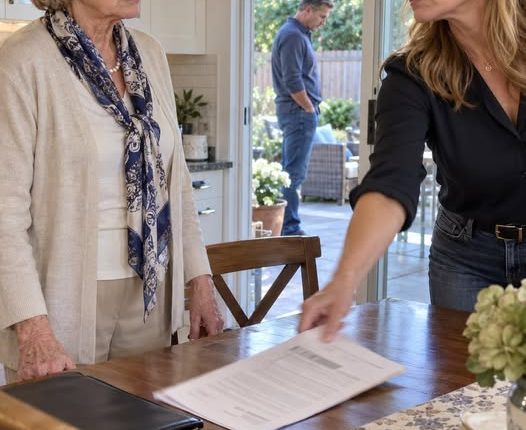
Rachel did not come to see the new kitchen.
I was not surprised.
David mentioned once that she thought the renovation was excessive. Brenda apparently had similar opinions, though no one told me exactly what she said.
I did not ask.
There was a period in my life when knowing someone disapproved of me would have sent me searching for information. I would have wanted the exact wording so I could decide whether the criticism was fair, unfair, exaggerated, or something I could repair.
I no longer had that urge.
Rachel could dislike my countertops.
Brenda could find my boundaries rude.
Neither opinion changed the locks.
That was enough.
I still saw Leo and Mia regularly.
The difference was that visits now appeared on my calendar before the children appeared on my porch.
David might call on Wednesday and ask whether I wanted to have them Saturday afternoon. Sometimes I said yes. Sometimes I had other plans.
Once, Rachel texted me herself.
“Would you be available next Friday from four until eight?”
I checked my calendar.
I was free.
“Yes.”
Her reply came quickly.
“Thank you.”
That was all.
No assumption.
No explanation that she was already late.
No statement that retirement meant I had nothing else to do.
When Friday came, she brought the children at four exactly. Their overnight bags did not appear because nobody had secretly expanded four hours into a weekend.
She picked them up at eight.
It was almost boring.
I found the boring part wonderful.
Leo and I made popcorn and watched a nature documentary. Mia sat beside me coloring while explaining the personal history of every crayon in the box. When David and Rachel arrived, I had enjoyed the evening.
I was not counting the minutes until they left.
The difference was choice.
Rachel remained polite but distant.
She never apologized for taking the mixer.
She never apologized for arriving with the children without asking.
She certainly never apologized for handing me those dinner plates.
For a while, that bothered me.
I imagined several versions of the conversation we might have.
In one, she admitted that she had treated me unfairly.
In another, she acknowledged how differently she treated Brenda.
In the most satisfying version, she recognized that the grocery money, free childcare, furniture help, and endless Sunday labor had become things she expected rather than appreciated.
That conversation never happened.
Eventually, I realized I did not need it.
An apology might have made me feel vindicated.
Changed access made me safe.
Rachel could still believe I had overreacted.
She could tell Brenda that I had become selfish.
She could privately resent every boundary I set.
But she could no longer enter my house without permission.
She could not plan my afternoons.
She could not put my money into her household budget.
She could not leave dirty dishes in my hands and walk away unless I chose to stand there holding them.
That was more useful than an apology.
David changed more noticeably.
At first, his calls had been cautious.
He seemed afraid that any request would trigger another discussion about boundaries.
Over time, the awkwardness faded.
Sometimes he called because he needed something.
More often, he began calling just to talk.
That had not happened much before.
One Tuesday evening, he called while I was watering the ferns I had bought the morning Rachel tried to drop off the children.
“Did you see the game last night?” he asked.
“What game?”
He groaned.
“Never mind.”
I laughed.
We talked for fifteen minutes anyway.
Another day, he sent me a photograph of Leo holding a model airplane he had assembled.
No request underneath.
No favor hidden in the next sentence.
Just a picture.
Those ordinary contacts affected me more than grand gestures would have.
Our relationship became smaller in practical terms.
I was no longer involved in every problem.
I no longer knew whether Rachel needed groceries or which household appliance was malfunctioning.
I did not know their monthly budget.
That distance might once have frightened me.
Instead, it felt healthy.
I was his mother.
I did not need to be his household operations department.
As my Arizona trip approached, Susan and I met several times to plan.
She had been my friend for years and possessed the kind of energy that made every trip sound slightly more adventurous than it probably was.
“We need sunrise at the red rocks,” she said one afternoon over coffee.
“I assume sunrise happens at an unreasonable hour.”
“Extremely.”
“Good. Retirement was becoming too comfortable.”
She laughed.
We planned our route, booked rooms, and argued cheerfully about how many camera lenses either of us truly needed.
The week before we left, David stopped by.
This time he called first.
That still made me smile.
He came into the kitchen carrying a bag from a bakery.
“I brought muffins.”
“Now I know you want something.”
He laughed.
“I don’t.”
“Suspicious.”
We sat at the island.
He asked about the trip.
I showed him the route Susan had mapped.
He looked genuinely interested.
“You’ll be driving all that?”
“Susan will do some.”
“Have you checked the weather?”
“Yes, David.”
“And you have roadside assistance?”
I raised an eyebrow.
He stopped.
“Sorry.”
“You sound like me.”
“That’s terrifying.”
I laughed.
Then he became more serious.
“I really am glad you’re going.”
I looked at him.
He meant it.
“Thank you.”
He tore a muffin in half.
“I think I got too used to you being around.”
The words were quiet.
I waited.
“If something happened, I called you.”
“I noticed.”
“If we needed someone, I called you.”
“Yes.”
“If money got tight…”
“You called me.”
He nodded.
“I don’t think I realized how much of our life was built around the assumption that you’d fix whatever part didn’t work.”
I felt no satisfaction hearing it.
Mostly sadness.
“I helped build that assumption.”
“You helped us.”
“Too much.”
David considered that.
“Maybe.”
“No maybe.”
That made him smile.
Then he looked around the kitchen.
“You seem happier.”
I traced one finger along the edge of my coffee cup.
“I am.”
“Was helping us really making you that unhappy?”
The question deserved care.
“No.”
He looked confused.
“I liked helping you. I still do.”
“Then what changed?”
“Helping stopped feeling voluntary.”
He nodded slowly.
There was no need to say more.
Susan and I flew to Arizona in late summer.
The first morning, my alarm went off while the sky outside the hotel was still black. I regretted every decision that had led me there until we reached the overlook.
Then the sun began touching the red rock.
The landscape changed color by the minute.
Deep rust became orange.
Orange became gold.
Shadows pulled away from cliffs.
I lifted my camera.
For nearly an hour, I thought about nothing else.
No grocery envelopes.
No dishes.
No family schedule.
No one else’s needs.
Just light.
Later, Susan and I ate pie at a roadside café outside Sedona. The pie was terrible.
She insisted hers was acceptable.
“It tastes like refrigerated cardboard.”
“You’re dramatic.”
“I know.”
I started laughing.
The word dramatic reminded me of nothing specific and everything at once.
The locks.
The dinner.
Thanksgiving.
The SUV request.
How dramatic my boundaries had seemed to people who preferred me without them.
That afternoon, we stopped along a trail lined with cactus.
Susan aimed her camera at one particularly crooked plant.
“That one looks offended.”
“It looks dignified.”
“It looks judgmental.”
We spent several minutes debating the emotional personality of a cactus.
I laughed until my stomach hurt.
That evening, back at the hotel, I sent David several photographs.
One showed the sunrise.
Another showed Susan pretending to negotiate with the cactus.
A third showed me standing beneath an enormous Arizona sky.
His reply came a few minutes later.
“Looks incredible, Mom. Have fun.”
That was the entire message.
I stared at it.
Nothing followed.
No question about when I returned.
No childcare request.
No reminder that Rachel needed something.
Three simple words.
Have fun.
I set down the phone and looked through the hotel window.
The message felt ordinary.
That was precisely why I loved it.
END PART 6