PART 3: My Son Came to Defend His Wife and Finally Heard What I Was Saying
David arrived that evening looking tired before he even sat down.
He took his usual place on my sofa, leaned forward with his elbows on his knees, and rubbed the back of his neck.
I remained in the chair opposite him.
For several seconds, neither of us spoke.
Finally he sighed.
“Rachel is furious.”
“I assumed she would be.”
“She says you locked her out.”
“I changed the locks on my house.”
“To her, that’s basically the same thing.”
“It isn’t.”
David looked at me.
“And you wouldn’t let her wash the blankets.”
“That’s correct.”
“And now there’s the grocery money.”
“Yes.”
He leaned back and studied me as if searching for some familiar weakness that would make the conversation easier.
“Mom, you’re making everything really hard.”
Something about the sentence settled me.
“I think it feels hard because you and Rachel are doing more things yourselves.”
His brow tightened.
“That isn’t fair.”
“Which part?”
“You’ve always helped us.”
“I know.”
“So what happened?”
I folded my hands in my lap.
“Last Sunday happened.”
David shook his head immediately.
“Mom, that was dishes.”
“No. The dishes were simply where I finally noticed everything else.”
His eyes dropped.
I continued.
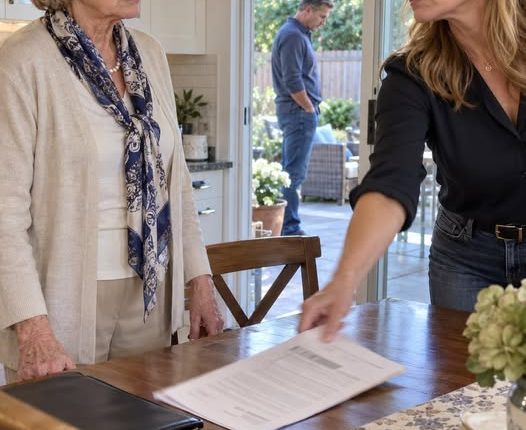
“For a year, I’ve been arriving early. I cook. I clean. I watch the children. I run errands when Rachel forgets things. I pay for dinners. I buy groceries. Then her mother arrives and is treated like an honored guest while I finish whatever work remains.”
“Brenda has back problems.”
“I know.”
“That’s why Rachel doesn’t ask her to do much.”
“I’m not asking Brenda to wash dishes.”
“Then what are you saying?”
“I’m saying I’m not required to wash them either.”
David became quiet.
I could see discomfort moving across his face.
“You never said anything.”
“That does not make the arrangement respectful.”
“How were we supposed to know?”
I almost answered sharply.
Then I stopped.
That was a fair question in one narrow sense.
I had trained everyone around me to expect compliance.
But there had also been signs any adult could have noticed.
“You could have looked,” I said.
He frowned.
“At what?”
“At me.”
The room went silent.
I softened my voice.
“The grocery money started because you were unemployed.”
“I remember.”
“You’ve had a steady job for years.”
He nodded.
“I kept sending it because I wanted to help. Somewhere along the way, you stopped seeing it as help.”
David looked toward the floor.
I continued.
“Babysitting was the same. At first, you asked. Now Rachel appears with the children and tells me what time she’ll be back.”
“She shouldn’t do that.”
“No.”
“And the mixer?”
He winced.
“She shouldn’t have taken it.”
“No.”
He rubbed his face.
“I told her that.”
“Good.”
“But changing every lock?”
“The key existed for emergencies. She used it because she wanted kitchen equipment.”
“She wasn’t stealing it.”
“I never said she was.”
“Then—”
“David, entering someone’s house without permission does not become acceptable because you intend to return whatever you take.”
That ended the argument.
He sat still for almost a minute.
The wall clock seemed unusually loud.
Finally, he looked at me.
“It feels like you’re punishing us.”
“I’m not.”
“You stopped the money. You changed the locks. You wouldn’t keep the kids.”
“I’m stopping things I no longer want to continue.”
“That feels like punishment from this side.”
I nodded.
“I believe you.”
He seemed surprised.
Then I said, “But if your household works only because I don’t have boundaries, that isn’t a reason for me to remain without them.”
David looked away.
The sentence seemed to land somewhere he could not immediately dismiss.
I leaned forward.
“I love you.”
He looked back.
“I love Rachel. I adore Leo and Mia. None of that gives your household ownership of my time, my money, or my house.”
He exhaled slowly.
“I never thought of it like ownership.”
“Neither did I.”
That was the truth.
For years, I thought I was choosing each individual favor.
Maybe I had been.
But hundreds of small choices had built an arrangement nobody questioned anymore.
David was quiet again.
Then his expression changed as though he had just remembered something.
“Thanksgiving is next month.”
“Yes.”
“Rachel’s parents are coming.”
“I know.”
“We usually do it here.”
“I’m aware.”
He hesitated.
“Are you still hosting?”
“Yes.”
Relief moved across his face.
Then I added, “But it will be different this year.”
The relief disappeared.
“How different?”
I smiled.
“You’ll see.”
A week later, I sent a message to everyone attending Thanksgiving.
I kept it simple.
I would prepare the turkey.
I would make a large garden salad.
Rachel and Brenda could divide the remaining dishes between them.
Potatoes.
Stuffing.
Cranberry sauce.
Dessert.
Anything else they wanted.
David responded with a thumbs-up.
Brenda did not reply.
Rachel said nothing.
Normally, silence would have made me anxious.
I would have followed up.
Are you okay?
Did you see my message?
What do you want me to make just in case?
Instead, I left the phone alone.
That was harder than changing the locks.
I had spent most of my adult life preventing other people’s discomfort before they experienced it.
If nobody answered, I filled the gap.
If somebody forgot food, I made extra.
If plans were unclear, I solved them.
If someone was unhappy, I immediately tried to improve the situation.
This time, I decided adults were allowed to experience the consequences of their own silence.
The day before Thanksgiving, my kitchen felt almost suspiciously calm.
Normally, every surface would have been covered.
I would have had potatoes boiling, bread drying for stuffing, cranberry sauce cooling, pies on racks, and a handwritten schedule designed to make everything reach the table at the same time.
Instead, I seasoned the turkey.
I washed salad greens.
I set the table.
Then I made tea and read a novel for nearly two hours.
Several times, I felt the urge to make mashed potatoes.
Just in case.
I did not.
Then stuffing.
I had all the ingredients.
I did not.
I even checked the pantry and saw a can of cranberry sauce.
I left it there.
Nobody had asked me to rescue dinner.
Thanksgiving afternoon arrived cold and bright.
I lit candles before two and adjusted the place settings.
The turkey smelled wonderful.
The salad was ready in a large bowl.
At exactly two, David’s sedan pulled into the driveway.
Brenda’s SUV followed behind him.
I walked toward the front hall.
Rachel came in first with Mia.
Brenda followed wearing a fur-trimmed coat.
David was carrying one bottle of inexpensive wine.
Leo came through last.
I looked behind them.
No casserole dishes.
No pie carrier.
No potatoes.
No stuffing.
Nothing.
Rachel watched my face.
Then she smiled.
“Oh, Patricia, I’m so sorry.”
I said nothing.
“Work has been completely insane.”
Brenda nodded with grave sympathy.
“And my oven has been acting terribly.”
Rachel touched my arm.
“We simply couldn’t get everything done.”
I looked at the six adults’ and children’s empty hands.
Then Rachel added the sentence she had clearly expected to solve everything.
“But we knew you’d make your usual spread.”
There it was.
They had not forgotten.
They had decided I would rescue them.
I stepped aside.
“Dinner’s ready.”
Rachel smiled, apparently satisfied.
She walked toward the dining room.
Then stopped.
David nearly walked into her back.
The table looked beautiful.
Candles.
Good china.
Water glasses.
A carved turkey.
One large bowl of salad.
Nothing else.
Rachel slowly turned toward me.
“Where are the potatoes?”
“I didn’t make any.”
“Stuffing?”
“No.”
“Cranberry sauce?”
“No.”
Brenda frowned.
“You’re hosting Thanksgiving.”
“Yes.”
Rachel’s face reddened.
“What are the children supposed to eat?”
I looked toward the table.
“Turkey and salad.”
She stared at me.
David looked deeply uncomfortable.
“You usually make backups,” he said quietly.
“I used to.”
Brenda placed her purse on a chair.
“This is absurd.”
“No,” I said. “This is exactly the meal I said I would provide.”
Rachel looked at the table again.
Then she reached for her phone.
“Fine. I’ll order Chinese.”
“That’s certainly an option.”
She started tapping the screen.
“But you’ll need to eat it at your house.”
Her thumb stopped.
“What?”
“I don’t want takeout containers covering my Thanksgiving table.”
The silence that followed felt almost peaceful.
Rachel stared at me as though she had finally understood that the woman who used to automatically repair every inconvenience was no longer available for that role.
Then David reached for his coat.
END PART 3