PART 5: My New Kitchen Forced David to See What My Boundaries Were Building
The renovation began on a Tuesday morning with the sound of cabinet doors being unscrewed from hinges.
I stood near the dining room holding coffee while the contractor and his crew carried pieces of my old kitchen toward the front door. Dust rose in pale clouds where cabinets had been mounted for decades. The room looked suddenly unfamiliar, stripped back to walls, pipes, and the outline of everything that had once been permanent.
I expected to feel nervous.
Instead, I felt lighter.
For years, whenever I considered spending serious money on myself, another need appeared first. David needed help during a difficult month. The children needed camp deposits. Someone needed school clothes. Rachel found furniture that was slightly outside their budget. There was always a perfectly reasonable reason to wait.
Now the reason I had waited was walking out my front door in pieces.
The contractor asked whether I still wanted the farmhouse sink centered beneath the window.
“Yes.”
“The quartz you chose is arriving Friday.”
“Perfect.”
He nodded and returned to work.
I carried my coffee into the living room.
My house was loud, dusty, and inconvenient.
I loved it.
About a week later, David stopped by without calling.
That used to irritate me less than it did now, but when I opened the door he was standing alone and holding two coffees from a café near his office.
“Peace offering?” he asked.
“For what?”
“I don’t know yet.”
I smiled and let him inside.
He took three steps toward the kitchen and stopped.
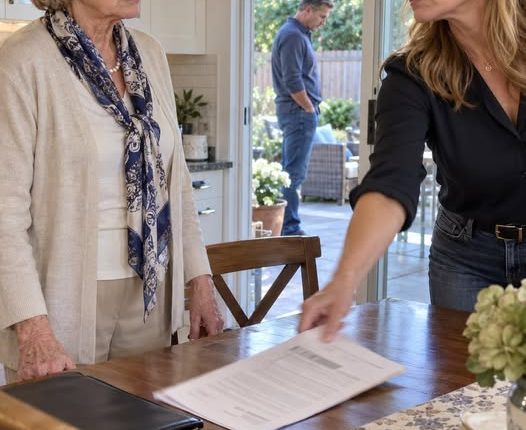
Half the cabinets were gone. Tile samples covered the dining table. A worker was measuring a section of wall while another spread protective covering over the floor.
David looked around.
“What happened?”
“I’m remodeling.”
“The entire kitchen?”
“Most of it.”
He walked closer to the doorway.
“You never said anything.”
“I didn’t know I needed approval.”
His head turned toward me quickly.
“I didn’t mean it like that.”
“I know.”
That was true.
Months earlier, I would have heard judgment in the question and immediately started defending the decision. I might have shown him estimates, explained my savings, or reassured him that the project was affordable.
Now I simply took the coffee he had brought.
David studied the drawings lying on the table.
“These counters are quartz?”
“Yes.”
“And that sink?”
“A farmhouse sink.”
He whistled softly.
“That must cost a fortune.”
“It costs less when I stop subsidizing another household.”
The words came out before I decided whether to soften them.
David looked down at his coffee.
“Fair.”
No argument.
That alone showed how much had changed.
He walked through the plans with me after that. He liked the cabinet color and thought the lighting choice would make the room brighter. For ten minutes, we talked like two adults discussing a renovation instead of mother and son negotiating what I was allowed to spend.
Then his expression shifted.
I recognized it immediately.
There was a request coming.
“Rachel wanted me to ask you something.”
I waited.
“She’s thinking about replacing her SUV.”
“All right.”
“She found one she likes.”
I said nothing.
David rubbed his thumb along the cardboard sleeve around his cup.
“The financing isn’t great.”
I already knew where the sentence was heading.
“She wondered whether you might co-sign.”
“No.”
The answer was out before he finished shifting his weight.
David nodded.
“Yeah.”
I blinked.
“That’s it?”
“I figured you’d say no.”
“Then why ask?”
He gave me a tired smile.
“Because if I didn’t, she would ask why I never brought it up.”
I almost laughed.
“That sounds like a conversation between you and your wife.”
“It is.”
“And just to be completely clear, David, that answer won’t change.”
“I know.”
He glanced toward the unfinished kitchen.
“I actually told her you’d probably say that.”
“How did she take it?”
He hesitated.
“Not well.”
I leaned against the dining-room chair.
“Is she angry with me?”
“She thinks you’ve become…”
He stopped.
“Difficult?”
“That wasn’t the word.”
“Selfish?”
He grimaced.
“That was closer.”
I nodded.
Months earlier, hearing that would have stayed with me all day.
Now it landed and passed.
Rachel was allowed to dislike my decision.
She was not entitled to change it.
“I hope she finds financing that works for her,” I said.
David looked relieved that I was not turning the conversation into another confrontation.
He finished his coffee, asked a few more questions about the renovation, and left.
I stood near the front window watching him drive away.
For the first time, he had delivered someone else’s request without acting as though my refusal created a crisis.
That mattered.
The kitchen took four weeks.
For most of that month, I washed dishes in the laundry sink and kept a coffee maker on a folding table in the dining room. There was dust in places dust had no logical reason to reach. I ate sandwiches, soup, and far too much restaurant food.
But every few days, another piece of the room came together.
Cabinets appeared.
Then counters.
Then the deep white sink.
New lights brightened the space in a way I had not expected.
When the final hardware was installed, the contractor walked through everything with me and asked whether I was satisfied.
I stood in the middle of the finished kitchen.
Sunlight fell across the pale quartz.
The cabinets closed evenly.
The sink was deep enough to hold my largest roasting pan without turning it sideways.
My stand mixer sat in one corner of the counter.
Exactly where I had placed it.
Behind locks only I controlled.
“It’s perfect,” I said.
After the crew left, I did something ridiculous.
I stood there alone for nearly fifteen minutes touching things.
I opened cabinet doors.
Closed drawers.
Ran water into the sink.
Wiped an already clean countertop.
There was something almost embarrassing about how much pleasure the room gave me.
Then the doorbell rang.
I checked the window.
David stood outside holding a small bouquet wrapped in clear plastic.
No children.
No laundry basket.
No envelope request.
No emergency.
Just flowers.
I opened the door.
“Hi, Mom.”
“Hello.”
He held the bouquet out.
“These are for the kitchen.”
I took them.
“They’ll improve the structural integrity.”
“That was my thought.”
I laughed and let him inside.
He walked into the kitchen slowly.
“Wow.”
I set the flowers on the island.
“You like it?”
“It looks incredible.”
He opened one cabinet.
Then another.
“You really changed everything.”
“Almost.”
His eyes moved to the stand mixer.
He noticed it.
Neither of us mentioned how it had once disappeared.
I put the flowers in a vase while he sat at the island.
Then I made coffee.
For the next hour, nothing happened.
That became important.
David told me about work. One of his colleagues was leaving. Leo had developed an obsession with building model airplanes. Mia wanted to start dance lessons because a friend at school had begun taking them.
I told him about the photography class I had signed up for.
He looked surprised.
“You’re doing photography now?”
“I always liked it.”
“I remember Dad buying you that camera.”
I smiled.
“Yes.”
For years after my husband died, the camera had stayed in a closet. Taking photographs alone felt strange. Then, during the workshop, I discovered that looking through the lens made me pay attention to things I had stopped noticing.
Light on old buildings.
Birds along the river.
Reflections in windows.
Ordinary things.
My instructor had mentioned a photography trip to Arizona later that summer.
“I’m going with Susan,” I told David.
He looked up.
“Arizona?”
“Sedona and a few places nearby.”
“For how long?”
“A week.”
“That sounds great.”
The answer surprised me.
Not because David had ever forbidden me from traveling.
Because his first reaction was not concern about whether I would be available while I was gone.
There was no immediate question about childcare.
No reminder of a birthday.
No hint that I should check someone else’s schedule.
Just enthusiasm.
“I’m glad,” he said.
I poured more coffee.
“You are?”
“Yeah.”
He looked around my kitchen again.
“I think you should do things for yourself.”
Something tightened unexpectedly in my throat.
I turned toward the sink so he would not notice.
“That’s the plan.”
When David left, he hugged me at the door.
No request followed.
No financial question.
No favor slipped into the goodbye.
I returned to the kitchen with the empty coffee cups.
There were two.
His and mine.
I washed them in my new farmhouse sink.
It took less than a minute.
Then I dried my hands.
Months earlier, drying my hands had been the beginning of a rupture.
This time, standing in my own kitchen with flowers on the counter and an Arizona trip on my calendar, it felt like something else.
Evidence.
I had not destroyed my relationship with my son by changing the rules.
I had simply made room for a relationship that was no longer built around what I provided.
END PART 5