I slid the papers back across the table, along with his silver pen.
Thomas did not move for a long moment. Then, the warmth vanished from his eyes, leaving them as hard and grey as river stones. He picked up the pen and slid it back into his pocket with a sharp click.
“You are being incredibly foolish,” he said, his voice cold and flat. “You are choosing a boundary dispute over a direct offer of assistance from your lender.”
“You did not offer assistance,” I said, standing up and holding the kitchen chair. “You offered to take away my only defense.”
He gathered the blue papers, tapping them against the wooden table to align the edges, and stuffed them back into his leather folder. He stood up, his chair scraping loudly against the linoleum.
“We tried to work with you,” Thomas said, looking down at me. “But you have chosen to listen to an old town attorney who does not understand modern banking. The bank will not make another offer.”
I walked him to the front door, my hand resting on the wooden frame as he stepped out onto the porch. The heat hit us both again, thick and suffocating.
“I would like you to leave my property, Mr. Kelly,” I said.
He walked down the porch steps and stopped on the gravel driveway, turning back to face me with his folder tucked tightly under his arm.
“You just sealed your own eviction,” he said.
Thomas slammed his leather folder shut and walked briskly to his car.
The grey light of six in the morning was barely pushing through the thin cotton curtains of my bedroom when the sound woke me.
It was not the sharp, metallic rattle of the daily freight train that usually shook the windowpanes at four in the afternoon.
Instead, it was a low, rhythmic murmur of male voices out on the gravel driveway, their tones hushed and urgent.
I lay still for a moment under the heavy patchwork quilt, my hand resting against the curve of my stomach where the baby was quiet and still.
The air in the room had turned surprisingly cool overnight, a sudden break in the stifling August humidity that had hung over the valley for weeks.
The wooden floorboards felt like slabs of cold creek stone beneath my bare feet as I finally swung my legs out of bed.
A soft, deliberate double knock sounded at the front door, the wood vibrating slightly through the quiet of the small bungalow.
I pulled my faded blue chenille robe from the brass hook behind the door, wrapping it tightly around my waist.
I tied the heavy belt twice to secure it over my pregnancy, my fingers cold and clumsy in the dim light.
The wooden screen door outside was swollen from the weeks of damp heat, but the inner door felt solid under my palm as I reached the entryway.
Through the textured yellow glass of the door’s oval pane, I could see the dark, square outline of a man standing on the porch.
I turned the deadbolt and pulled the heavy door inward, the hinges letting out a dry, high-pitched squeak that echoed down the narrow hallway.
Sheriff Robert Gentry stood on the top concrete step, his tan uniform pressed and neat.
His face looked lined with a deep, grey exhaustion that went far beyond the early hour.
He was holding his campaign hat in both hands, slowly running his thumb along the stitched edge of the brown leather band.
“Nora,” he said, his voice carrying that slow, comforting Midwestern drawl that had quieted many disturbances in this county over the years.
“I am sorry to disturb you before the sun is fully up, dear,” he added, looking down at his boots.
“Sheriff,” I said, my hand instinctively moving to the small of my back to rub the dull, aching pressure that had started there three weeks ago.
“Is there something wrong next door?” I asked, my heart catching on the silence of the morning.
He looked up, his eyes meeting mine with a quiet gravity that made my throat go dry.
“May I step inside for a brief moment?” he asked.
I stepped back into the living room, leaving the door wide to let the pale morning light spill onto the worn carpet.
The room was cool, the sudden draft from the porch carrying the scent of damp earth and river fog from the valley below.
Robert Gentry entered with a quiet, careful step, his heavy utility belt creaking slightly with each movement.
He did not sit in the armchair I pointed toward, choosing instead to stand near the edge of the small dining table.
My yellowed mortgage notices and the bright red-bordered envelopes still lay in a neat, stressful stack right where I had left them.
“I just came from next door,” the sheriff said, his voice dropping into a quiet, reverent tone.
“Clara’s niece, Martha, called the station about forty minutes ago when she went in to drop off the morning groceries,” he said.
He paused, his eyes resting on the stack of mail on my table before returning to my face.
“Clara passed away in her sleep last night, Nora,” he said, the words falling heavily into the quiet of the room.
“The county doctor has already been there, and he says her heart simply ran out of time.”
I sat down slowly on the edge of the sofa, my hands dropping into my lap as the room seemed to tilt.
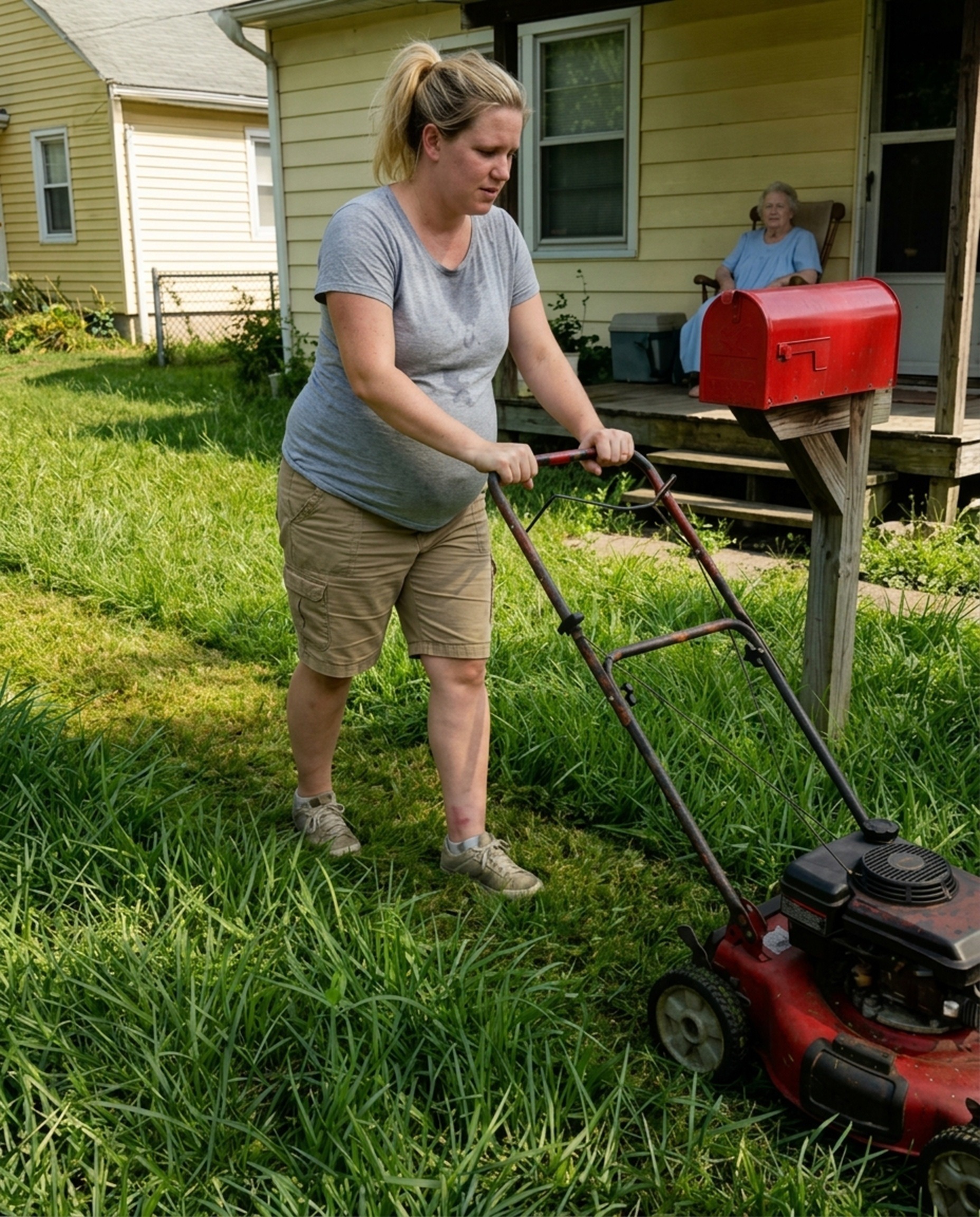
The image of Clara on Tuesday afternoon, pale and gasping for breath as she pulled at the starter cord of that ancient green mower, flashed through my mind.
“She was out there in the heat,” I whispered, looking toward the window that faced her empty driveway.
“She was trying to do the yard herself, and I didn’t even realize how sick she was.”
“You couldn’t have known,” Gentry said, resting his thumbs on his leather utility belt, his face showing the compassion that made him so respected in Oakhaven.
“Clara had been dealing with congestive heart failure for over a year now, but she was a proud woman.”
“She didn’t want this town watching her fade away, and she certainly didn’t want people worrying over her,” he added.
The small details of our last conversation on her porch came back to me, her trembling fingers holding the lemonade tray, her quiet insistence that some storms must be weathered with quiet help.
She had been settling her affairs right under my nose, preparing for the end while I was busy hiding my own financial ruin from her out of foolish pride.
“Martha found her ledger on the desk,” the sheriff continued, his drawl softening even further.
“But there was something else, Nora, and that is the real reason I came over here before the funeral home arrived.”
I looked up, my hand rubbing my lower back again as the baby shifted slightly inside me, a gentle reminder of the world that was still turning.
“What is it?” I asked, my voice barely louder than a whisper.