On the writing desk in the corner, the old ledger and the yellow legal pad still sat under the dim light of the desk lamp. I looked at the numbers I had written there just days ago, the columns of figures that had seemed like an impossible wall.
The number seven thousand four hundred twenty dollars was circled in red ink at the top of the page. I reached out and drew a single clean line through it with a black pen, then closed the pad.
The relief was a quiet thing, settling into my shoulders with a slow, steady weight. But as the minutes ticked by, the silence of the house began to feel heavier, empty of the comforting knowledge that Clara was just a few yards away.
I looked at the telephone on the side table, half expecting it to ring with another cold demand from Thomas Kelly at Oak Valley Bank. The black plastic sat quiet and still, its screen dark in the shade of the room.
I touched my stomach, feeling the round curve beneath my linen shirt. The baby was quiet, resting in the stillness of the afternoon as if she too were waiting for the storm to fully pass.
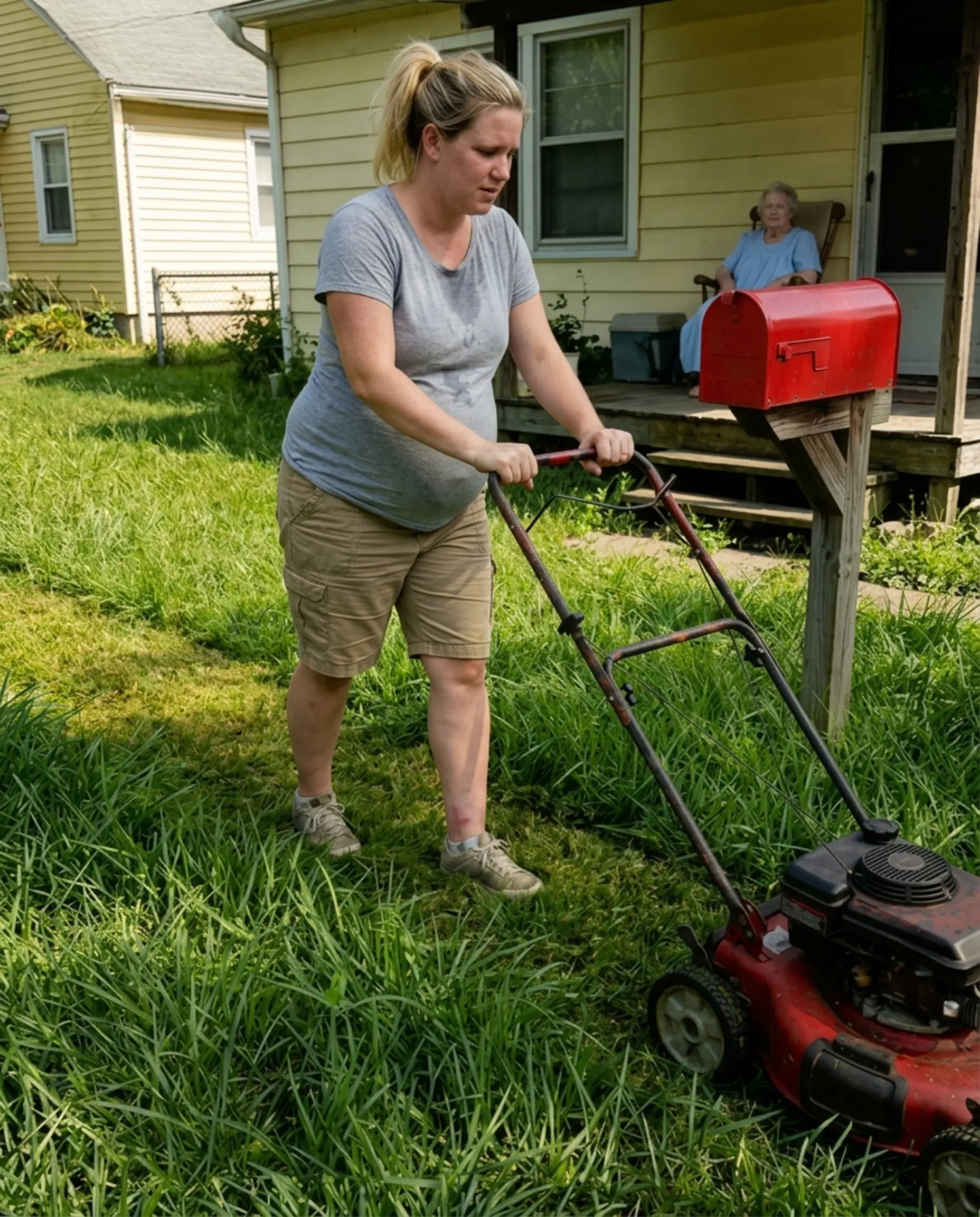
I thought of Clara pulling the starter cord on that heavy lawnmower, her face pale under her straw hat as she struggled in the heat. She had known her own heart was failing, yet her primary concern had been the grass that grew between our homes.
She had spent her remaining strength ensuring that my home would be safe before her own light went out.
At four o’clock, the daily freight train passed through the valley, its low rumble vibrating through the floorboards of the living room. I listened to the steady rhythm of the steel wheels, a sound that had marked the passage of my days in this valley for as long as I could remember.
When the sound finally faded into the distance, the house felt even quieter than before, the silence stretching from the kitchen to the empty nursery upstairs.
I stood up and walked to the window, pulling the curtain back just enough to look out at the driveway. The gravel was dry, dusty from the weeks without rain, holding the heat of the day.
I decided to go outside, unable to remain in the stillness of the living room any longer.
The air in the front yard had begun to shift, the stifling humidity of the afternoon giving way to a lighter breeze from the west. I walked down the porch steps and stood near the property line, looking at the two lawns.
The grass on Clara’s side was neat and even, the green blades standing straight in the sunlight. It looked cared for, a testament to the work we had done together under the August sun.
I walked toward the boundary line, my shoes sinking slightly into the soft earth. The property dispute that the bank had tried to use against me was gone, resolved by a simple survey and the quiet generosity of a neighbor who had seen my need.
I realized then that Clara’s gift was not just the money that had saved my home. It was the reminder that we are not meant to weather the storms of this life in isolation, hiding our struggles behind locked doors.
She had reached across the property line when I was too proud and too frightened to ask for help, offering a glass of lemonade and a hand to hold.
I stood there for a long time, looking at the quiet street and the houses that lined it. The sun was beginning to touch the tops of the maple trees, casting long, cool shadows across the grass.
A yellow butterfly, the same one I had seen from Clara’s porch, fluttered near the boundary line before disappearing into the shadow of the hedge.
A car turned onto the street, its tires humming against the asphalt as it slowed down near the corner.
I did not turn to look, keeping my eyes on the quiet green of Clara’s yard.
I placed my hand flat against my stomach, feeling a gentle kick of agreement from my baby.
The morning sun filtered through the mature maple trees, casting long, quiet shadows across the gravel driveway. The street was still, free of the delivery trucks and county cars that had occupied it over the last six weeks.
I sat on the top step of the porch, holding the thick cream envelope in both hands. The heavy bank documents and the stamped mortgage release were safely stored in the metal file box inside, but Clara’s handwritten letter remained in the envelope.
The ink was slightly faded, written in her small, precise cursive. She had penned it on her kitchen table only hours before her heart finally gave out.
“A home is not just four walls to keep out the wind, dear heart,” the letter read. “It is where we gather the strength to face the next morning.”
I folded the paper carefully along its original creases and slid it back into the cream paper.
A large orange moving truck turned the corner at ten past ten, its brakes squealing slightly as it slowed down. It backed into Clara’s driveway, the engine roaring before it died with a loud hiss of air.
A young woman with her dark hair pulled back in a messy bun climbed down from the passenger side, wiping her forehead with the back of her wrist. She looked at the two-story house, then at the stack of cardboard boxes visible through the open back of the truck.
I went inside, took a cold bottle of water from the refrigerator, and walked across the grass boundary line.
“The August humidity doesn’t make moving any easier,” I said, holding out the bottle.
The young woman turned, startled for a second, before her face softened into a grateful smile. She took the water, her fingers cool against mine.
“Thank you,” she said, twisting the plastic cap off. “I’m Megan. My uncle said Oakhaven was quiet, but I didn’t realize the air would feel like warm soup.”
“It gets better by September,” I said. “I’m Nora. If you need a place to store a few of those smaller boxes while you clear the rooms, my porch is dry.”
Megan looked back at the truck, then down at her keys. “I might take you up on that. The landlord said the house was empty, but there are still a few old pieces of furniture in the parlor.”
“Clara’s family left those for the estate sale,” I said. “They are good people. They wanted to make sure the right person ended up here.”
We stood by the rear bumper of the truck, watching the driver lift the first heavy wooden dresser onto the ramp.
“The yard looks like it grows an inch a day,” Megan said, gesturing to the thick blades of grass around the porch steps. “I don’t even own a rake yet.”
I reached into my pocket and felt the cold, notched shape of the brass key Clara had given me.
“Follow me,” I said, leading her toward the small wooden structure at the back of Clara’s property.
The padlock on the shed door was stiff, but the brass key turned with a solid, familiar click. I pulled the door open, letting the smell of dry earth and old oil drift out into the humid air.
The green lawnmower sat in the center of the small room, its loose blue gas cap catching a sliver of sunlight from the dusty window.
“This belonged to Clara,” I said, pointing to the handle. “I bought it from her estate last week. It has a little rattle, but it starts on the second pull.”
Megan leaned against the doorframe, looking at the neat rows of hand tools hanging on the pegboard. “I wouldn’t even know how to gas it up.”
“I can show you,” I said. “The fuel can is right behind the door. You’re welcome to use any of this whenever you need.”
“That’s incredibly kind of you, Nora,” Megan said, her voice dropping to a quieter, softer tone. “I was worried about moving to a place where I didn’t know a soul.”
I placed the brass key in her hand, wrapping her fingers around the metal.
“Let me know if you ever need a hand with that yard,” I said.
She squeezed the key, her shoulders dropping as she let out a long, slow breath.
I walked back to my own side of the lawn, the grass soft under my sneakers. The heat was still heavy, but the air felt clearer now, stripped of the pressure that had kept my shoulders tight for months.
By eleven o’clock, the sun was directly overhead, baking the wooden steps of my porch.
I carried the wicker bassinet out from the living room, setting it down gently in the shade of the blue porch overhang.
My baby daughter lay inside, her small fingers curling and uncurlying against the yellow flannel blanket. She had arrived exactly two weeks after the bank manager signed the mortgage release, healthy and quiet, as if she knew the house was finally safe.
I sat in the wicker rocker beside her, letting the gentle back-and-forth motion soothe the remaining ache in my lower back.
My financial ledger was no longer a source of secret terror. With the house secure, I had found a steady, part-time bookkeeping job for a local lumber yard, working from the kitchen table while the baby slept.
Clara’s relatives had offered me several pieces of her furniture before the estate sale, including the grand mahogany clock that had kept time in her parlor for fifty years. I had thanked them, but asked instead for her yellow straw sun hat, which now hung on the peg by my front door.
The anger I had carried toward the bank and the cold face of Thomas Kelly had simply faded away, replaced by the daily, practical rhythms of caring for my daughter. There was no room left in the bungalow for bitterness.
Megan was back in her driveway now, carrying a stack of empty cardboard boxes toward the paper recycling bin. She waved, her face bright in the midday light.
I waved back, then looked down at the bassinet.
My daughter opened her eyes, dark and clear, reflecting the green of the maple leaves above us.
I reached down and let her tiny hand wrap around my index finger, her grip surprisingly warm and firm.
“We are home, little one, and we are going to be just fine.”
The END.