“We need to find out the starting bid,” Nate said.
I looked out the window at the traffic on High Street. “I am going to ask Gail.”
“She knows the system,” Nate said, rubbing his temple. “But if you get involved in this, Walter will find out.”
I stared at the dark coffee in my cup, watching the reflection of the overhead light move on the surface. “He does not have to know anything until the deed changes hands.”
Nate picked up his truck keys, the metal clinking in the quiet booth. “That is a dangerous game to play with a man who has nothing left to lose.”
I smoothed the edges of the printed auction notice on the table, my thumb tracing the black borders.
I folded the printed auction notice and slipped it into my front pocket before walking into the Star Diner on Keowee Street. The smell of burnt grease and cheap coffee hit me as soon as the door swung closed behind me.
Bob Henderson, who had lived three doors down from my father on Piedmont Road for twenty years, sat in the corner booth with a mug of black coffee. He looked older than he had six years ago, his hair completely white and his knuckles swollen from arthritis.
“You look like your mother, Leo,” Bob said, sliding his plate of toast to the side. “I saw your truck outside. Didn’t think you ever came back to Dayton.”
“Just passing through,” I said, sitting down opposite him. “How is the old neighborhood?”
Bob took a slow sip of his coffee and looked out the window at the gray street. “Your father is still there. But he doesn’t talk to anyone. The mailbox has been overflowing for three weeks.”
“I heard about the bank notices,” I said.
“They posted the sheriff’s sale warning on his front door last Tuesday,” Bob said. “He came out with a crowbar, ripped the paper off the wood, and threw it in the street. He tells everyone who passes by that the bank made a mistake.”
“The auction is set for October twelfth,” I said.
Bob leaned forward, his voice dropping. “He won’t leave, Leo. He sits on that porch with the lights off, watching the road. The sheriff will have to carry him out of there.”
I rubbed the small scar on my left palm, feeling the rough edge of the skin. “Does he have any money left?”
“Not a dime,” Bob said. “He tried to borrow five hundred dollars from me to pay his electric bill last month. I had to tell him no.”
I stood up and left a five-dollar bill on the table. “Thanks for the coffee, Bob.”
“He’s still your father,” Bob said to my back.
I did not answer him. I walked out to my Ford truck and started the engine, the familiar rumble vibrating through the steering wheel.
By three in the afternoon, I was back in Columbus, standing in the drafty concrete warehouse where Gail Vance stored her surplus drywall and framing timber. Gail was counting brass hinges on a metal rack, her small leather notebook open on a wooden crate.
“The Dayton market is heating up,” Gail said without looking up from her list. “I was looking at the county tax lists this morning.”
“Did you see Piedmont Road?” I asked.
Gail clicked her brass pen and turned to face me. “I did. But you have competition, Leo. A firm out of Cincinnati called Vanguard Holdings is bidding on every single distressed property in that zip code.”
“They want the whole block,” I said.
“They want the land,” Gail said. “They buy them, knock them down, and build cheap duplexes. They have a representative at every county auction with fifty thousand dollars in certified checks.”
“I have some money saved,” I said.
Gail looked at me for a long moment, her eyes quiet and direct. “You have twenty-four thousand dollars in your business account, Leo. I know because I paid you twelve of it last week.”
“It is enough to start,” I said.
“The opening bid on a tax foreclosure is based on the back taxes and the bank judgments,” Gail said. “If Vanguard wants that house, they will push the price past your limit in thirty seconds.”
“I have to try,” I said.
“You built a good business here in six years,” Gail said, tapping her notebook against her palm. “If you pull that cash out now, you won’t have enough to buy materials for the high school renovation next month. You will be right back where you started.”
“I know the risk,” I said.
“Then you need to know the minimum,” Gail said. “Call the county treasurer tomorrow. Find out the exact starting number.”
I left the warehouse and drove to Nate Miller’s garage on the south side of town. Nate was working under the hood of a rusty Buick, his hands black with oil and his face streaked with grease.
“Your father called my cell phone twice today,” Nate said, wiping his fingers on a rag. “He asked if I knew where you were.”
“What did you tell him?” I asked.
“I told him I hadn’t seen you since the day we left,” Nate said. “But he didn’t believe me. He sounded tired, Leo. Really tired.”
“The house goes to auction on the twelfth,” I said.
Nate stopped wiping his hands and looked at me, his fingers tapping against the metal fender of the Buick. “You are thinking about buying it, aren’t you?”
“I have twenty-four thousand dollars in the bank,” I said.
“That is your life, Leo,” Nate said, his voice rising. “You worked sixty-hour weeks for six years to get that money. You slept on my cousin’s floor, you wore thrift store boots, you ate soup out of a can.”
“I can earn it again,” I said.
“If you buy that house, you can never go home again,” Nate said. “If Walter finds out his own son bought his mortgage out from under him, he will hate you until the day he dies.”
“He already hates me,” I said.
“No, he doesn’t,” Nate said. “He’s proud and he’s stupid, but he’s your father. If you do this, you are turning him into your tenant.”
“It is better than the bank throwing him on the street,” I said.
“He won’t see it that way,” Nate said. “He will see it as a boy trying to play king of the mountain.”
I did not argue with him. I drove back to Dayton in the dark, parking my truck three blocks away from Piedmont Road under a broken street light.
The autumn air was crisp and smelled of dry leaves. I walked down the gravel alley behind the houses, my boots silent on the dirt, until I reached the back of our old property.
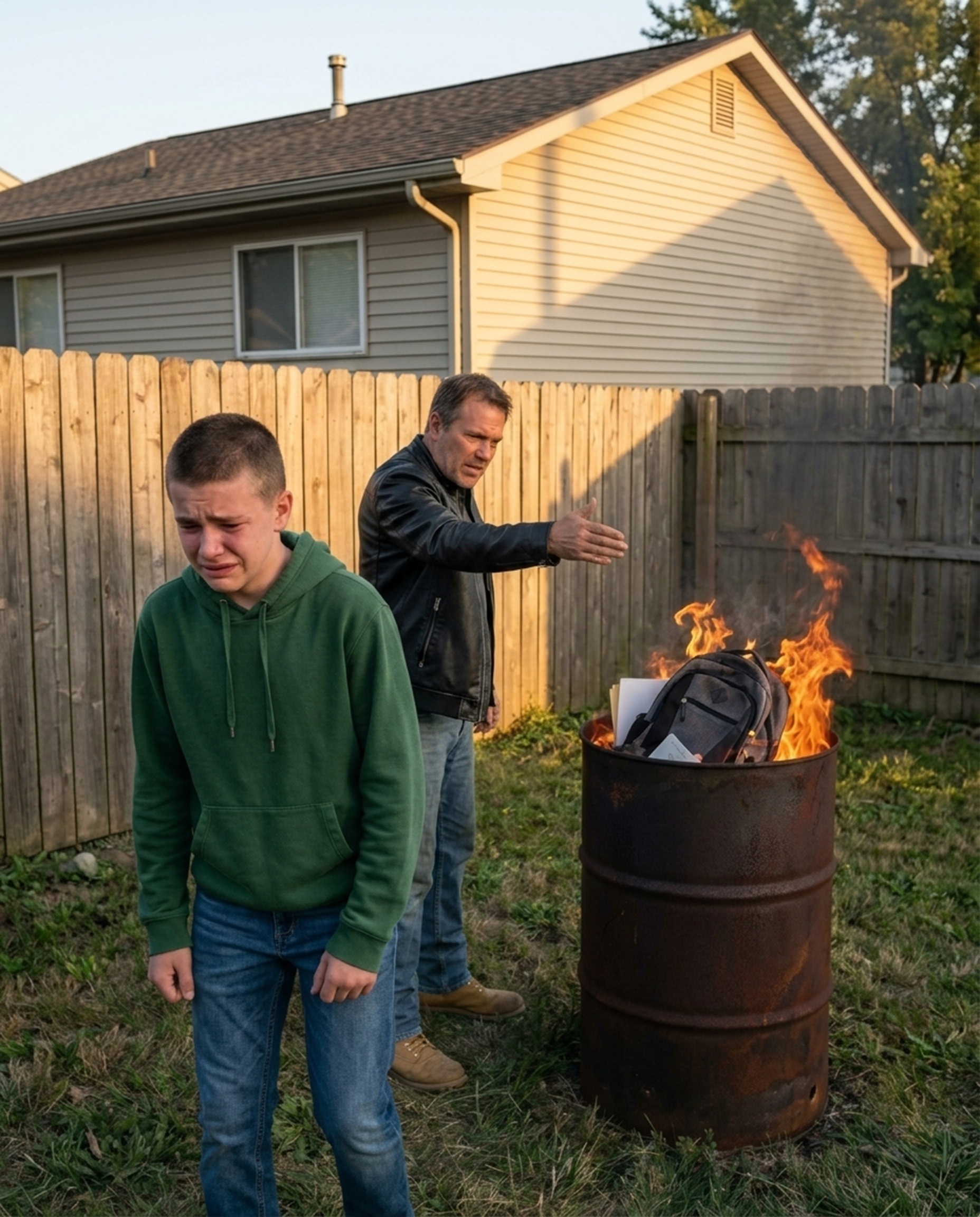
The rusted metal barrel where my father had burned my clothes six years ago still sat near the wooden fence, half-filled with rainwater and dead leaves. The garage door was hanging off one hinge, its white paint peeling away in long strips.
I looked through the gap in the fence toward the house.
The kitchen window was dark, but a single yellow bulb burned above the back porch. My father sat in the old metal lawn chair, his arms crossed tightly over his chest, a blue ceramic mug resting on his knee.
He looked smaller than I remembered. His shoulders were curved forward, and his chest did not look as broad as it used to when he stood in the kitchen and yelled at me.
He did not move for ten minutes. He just stared at the dark grass of the yard, his fingers occasionally tapping against the side of the mug.
I reached into my pocket and pulled out my phone. I logged into my bank app and looked at the blue screen.
The balance read twenty-four thousand one hundred and twelve dollars.
I folded the paper and slid it into my front shirt pocket.
Gail Vance looked up from her leather-bound notebook, her brass pen poised over a column of figures. The morning sun through her office window caught the dust in the air.
“That is nearly every dollar to your name, Leo,” she said.
“Twenty-two thousand is for the bank draft,” I said. “The rest stays in the account for fuel and materials.”
She tapped the brass pen against her thumb, looking at the layout of the Piedmont Road house I had sketched on a scrap of drywall paper.
“The Piedmont Road house is a residential auction in Montgomery County,” she said. “You are going up against people who do this for a living. They do not care about the address or the shingles or who built the porch.”
“I know the address,” I said.
“Arthur Vance is my brother-in-law’s cousin,” she said, leaning back in her chair. “He buys three or four of these distressed properties a month. He knows the sheriff’s deputies by their first names, and he knows exactly how much a kitchen remodel costs down to the dozen screws.”
“He does not know what I have in my pocket,” I said.
“The county requires cashier’s checks,” Gail said, tracing a line on her desk with the brass pen. “They do not take personal checks or promises. If you bid twenty-two thousand and one dollar, and you only have twenty-two thousand, they will throw your bid out and bar you from the room for a year. You need to be exact.”
“I am bidding exactly what I have, and not a dollar more,” I said.
She looked at me for several seconds without speaking. Her face was lined with the kind of fatigue that comes from twenty years of fighting with subcontractors and city inspectors.
“My father lost our first warehouse because he could not walk away from a bad bid,” she said, her voice turning quiet. “He kept throwing good money after bad because his name was on the sign. Do not let your name make your decisions for you.”
“My name is not on that house,” I said. “Not yet.”
She reached into her desk drawer and pulled out a manila envelope.
“Take the truck with the magnetic signs,” she said, sliding the envelope across the laminate desk. “Let them see the Hayes Restoration logo on the door when you pull into the lot. It makes you look like a business, not a kid with a pocket full of cash who is buying his childhood bedroom back.”
“What is this?” I asked, touching the corner of the thick paper.
“The certified tax assessment for that parcel,” Gail said. “It shows the outstanding county utility liens. If Arthur starts bidding, let him see you looking at that paper. He will think you found a major structural issue in the public records.”
I took the envelope and stood up.
“Thank you, Gail,” I said.
“Do not thank me yet,” she said, opening her notebook again. “If you lose your savings, I lose my best framing subcontractor. Get out of here and go to the bank.”
The bank lobby on Broad Street was quiet at two in the afternoon. A single teller sat behind the counter, her fingers tapping a rhythm on her keyboard that reminded me of Nate Miller when he was waiting for a light to change.
I sat at a mahogany desk across from a man named Dave, whose name tag read Loan Officer. He had a stack of gray ledger sheets in front of him and a blue pen held between his index fingers.