“Who are the other two men?” I asked.
“Two laborers from the union hall,” she said. “But you are the lead. I pay eighteen dollars an hour for the lead contractor.”
“I need to buy some framing jacks,” I said. “And some level lines.”
“I don’t advance cash for tools,” she said. “That is why you are a subcontractor.”
I looked at the yellow folder. Inside was a contract with my name typed at the top, Hayes Restoration. Seeing those words on the paper made the room feel very quiet.
“The materials will be delivered to the site by noon,” Gail said.
“I will need to buy a three-foot level,” I said. “And a hand saw.”
“There is a hardware store three blocks down,” she said. “They have what you need.”
I took the brass pen she offered and signed my name at the bottom of the page.
My used Ford truck sat idling at the curb of Piedmont Road, the magnetic signs on the door panels still smelling of fresh vinyl.
I had three men working under me in Columbus now, framing out a duplex on Gail Vance’s account, but the drive back to Dayton always felt like slipping into a smaller coat.
Walter was on the front porch with a rusty three-inch brush and a can of cheap white latex paint that was already running down his wrist.
His shoulder hitched every time he reached for the header.
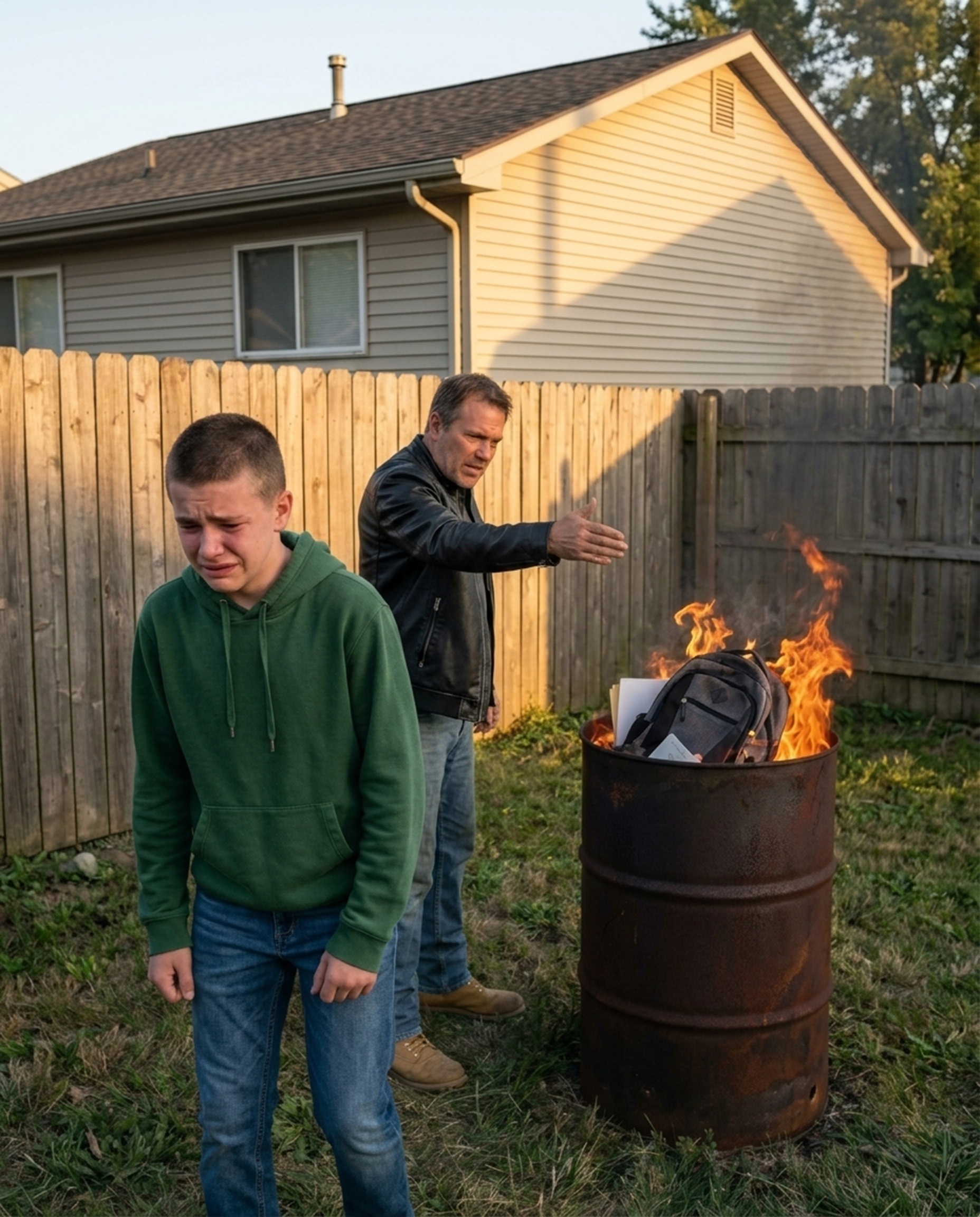
I clicked the door open and stepped onto the dry grass of the lawn where the metal burn barrel used to sit.
He did not drop the brush, but he stopped painting and crossed his arms tightly over his chest, leaving a smear of white on his gray work shirt.
“You took your time,” Walter said, his voice carrying across the yard.
He walked down the three wooden steps, his boots heavy on the pine, and reached into a red cooler sitting by the garden hose.
He pulled out a can of orange soda and held it out.
“I knew you would come back,” he said.
The metal on the can was covered in melting frost.
I did not take it.
“I have to be back in Columbus by eight,” I said, rubbing the small scar on my left palm.
“Columbus is a temporary stop,” he said, setting the soda on the porch railing with a wet thud.
“The work is steady,” I said.
“A man does not build a reputation in a city that does not know his grandfather,” he said.
He wiped his hand on his thigh, leaving another streak of white paint on his trousers.
“We have four roofs lined up for the autumn,” Walter said, turning back toward the house.
“Get your gloves from the tool shed,” he said. “We need to stop by the hardware store before they close at five.”
I looked at the peeling paint on the porch rail and didn’t move.
“I have my own tools in the truck,” I said.
“Then get them,” he said. “We are wasting daylight.”
The counter at the Dayton hardware store still smelled of linseed oil and dry sweep.
Old Mr. Gable behind the register nodded to my father, then looked at me with a quick squint before going back to his ledger.
“Get those six bundles of cedar shakes from the back dock, Leo,” Walter said, pointing a thick finger toward the loading bay.
“My back is acting up from the porch header,” he said.
The dock worker was already wheeling the cart out, his boots clicking on the concrete.
“I do not work for Hayes Construction anymore, Walter,” I said, keeping my voice low so Gable wouldn’t hear.
Walter turned on me, his chest expanding as he crossed his arms again.
“You are standing in my town, using my gas to get around,” he said.
“Load the truck,” he said.
“I drove my own truck here,” I said. “I paid four thousand dollars for it.”
The dock worker stopped five feet away, looking between us before setting the brake on his cart.
Walter did not look at the worker.
He kept his eyes on mine, his jaw tight.
“A boy who runs away does not get to dictate terms to the man who gave him his first hammer,” he said.
“The hammer was my mother’s,” I said.
He did not answer.
He turned his back to me and pulled a crumpled wad of bills from his pocket, counting out forty-three dollars to pay for the shakes.
It was the exact amount of cash I had in my pocket the night I left for Columbus.
“Put it on the account, Gable,” Walter said, shoving the cash back into his pocket.
“Account is frozen, Walter,” the old man behind the counter said, his pen pausing on the page.
“Manager says cash only until the spring balance is cleared,” Gable said.
Walter did not blink.
He laid two twenties and three ones on the wood, his knuckles turning white as he pressed them down.
“We will settle the rest on Monday,” Walter said.
The old man did not touch the money.
“The manager is off on Mondays, Walter,” Gable said.
We drove back to Piedmont Road in separate trucks, the distance between our bumpers exactly twenty feet.
We sat in the kitchen while the evening light turned the yellow wallpaper gray.
There was no coffee in the pot, and the sink was piled with white plates that had dried grease along the rims.
My old brass key to the front door was heavy in my front pocket, rubbing against my thigh every time I shifted on the vinyl chair.
I had never taken it off my ring, even when I was sleeping on Otis’s floor.
“I am offering you a full partnership,” Walter said, his voice loud enough to rattle the plastic salt shaker on the table.
“Fifty-fifty split on every contract from here to the county line,” he said.
“You do not have the contracts, Walter,” I said.
“We have the name,” he said, leaning forward until I could smell the stale tobacco on his shirt.
“Hayes and Son,” he said. “It is what people expect to see on the side of the trucks.”
He reached into his breast pocket and pulled out a clean sheet of notebook paper with three hand-drawn lines for signatures.
“You belong here working under my name,” he said.
I looked at the paper.
The handwriting was his, but the ink was shaky at the edges, like he had written it while riding in a moving vehicle.
“I have my own crew in Columbus,” I said.
“Gail Vance is giving us another three houses next month,” I said.
“She is a speculator,” Walter said, waving his hand as if clearing smoke from the air.
“She will drop you the minute the interest rates tick up,” he said. “Family stays.”
“You burned my boots, Walter,” I said.
“I was teaching you a lesson about loyalty,” he said, his face darkening in the twilight.
“And you learned it,” he said. “You are sitting in my kitchen.”
He pushed the paper closer to my side of the table, his thumb leaving a faint smudge of white paint on the white sheet.
“Sign it, and we will go down to the bank on Monday to update the signature cards,” he said.