She reached into her large canvas tote bag and pulled out a thick manila envelope, the edges creased from being carried around in her purse.
“Jenna is a legal resident here,” Elaine said, her fingers digging into the paper. “She has every right to be inside.”
She slid a stack of official papers out of the envelope and held them inches from my face. They were change of address confirmation letters from the United States Postal Service, printed with Jenna’s name and my Oak Street address.
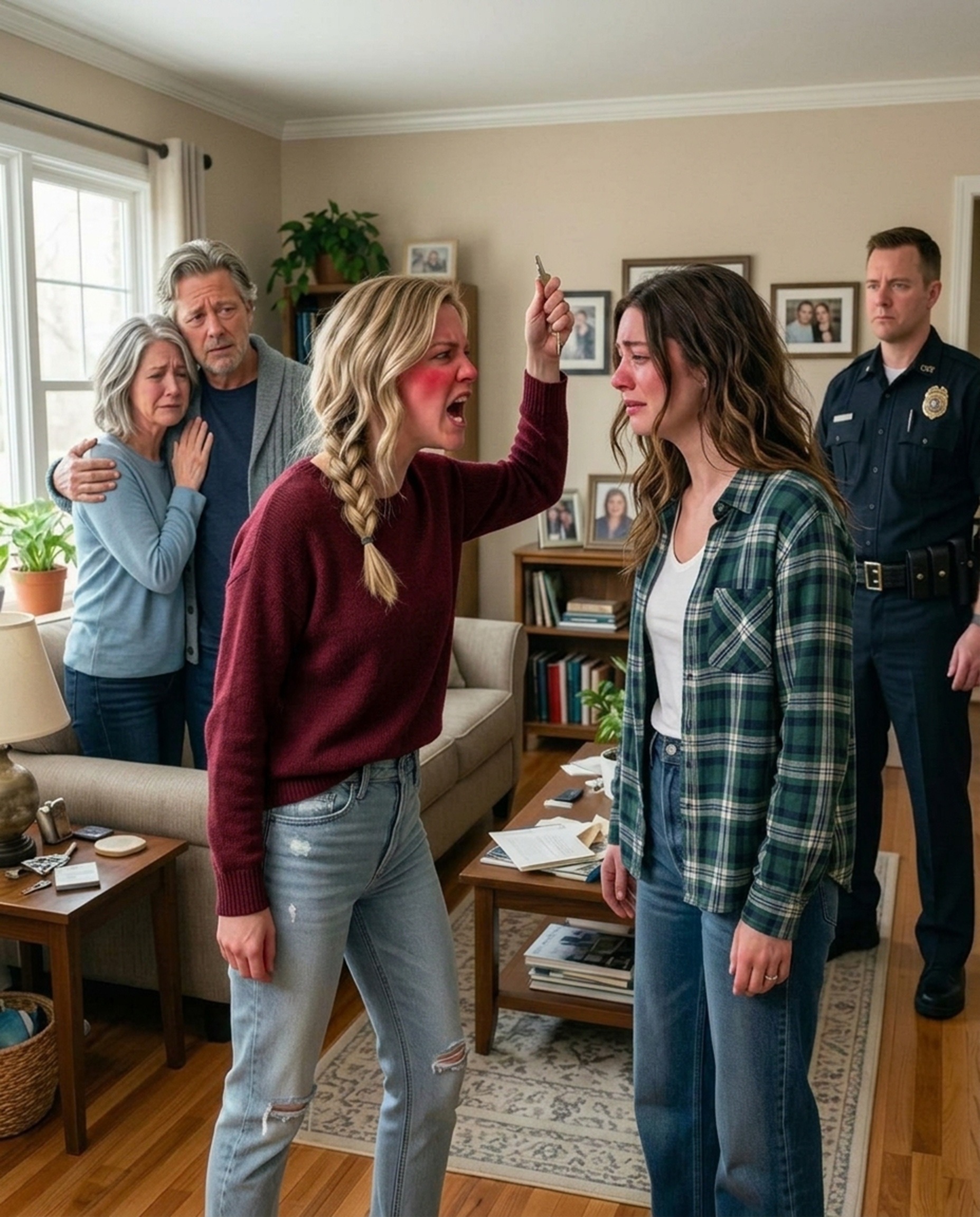
The postmark on the top envelope was dated three weeks ago, long before Jenna had even mentioned her lease ending.
“She registered her residency with the federal government,” Elaine said, her voice shaking with a sharp, defensive triumph. “You cannot simply throw her out on the street.”
“A mailing address does not grant a tenancy, Mom,” I said, keeping my voice level. “I did not sign a lease, and I did not give her permission to move her things into my guest room.”
“She is your sister,” Elaine said, her voice rising again as she stepped closer. “Where is she supposed to go when her lease ends in three days?”
“She has until the end of the month on her own lease,” I said, pointing toward the street. “And she can find her own apartment, just like I did.”
Jenna let out a sharp, high-pitched laugh from the bottom step. “With what money, Lauren? You know what the rents are downtown right now.”
“That is not my problem to solve,” I said.
Elaine reached for her phone, her fingers tapping the screen with rapid, angry strokes. “We will see what your father has to say about this.”
“Dad is already down the street,” I said, pointing toward the corner.
Elaine paused, her thumb hovering over the screen, but she did not turn around to look.
I did not wait for her to make the call. I reached into my pocket, pulled out my own phone, and dialed the local sheriff’s dispatch number.
The wait took twenty-two minutes. Elaine and Jenna sat on the top step of the porch, whispered arguments passing between them while Jenna stared at her sneakers and twisted her hair.
I stood near the black mailbox at the edge of the driveway, keeping my distance and watching the quiet street.
Two blocks down, parked beneath a large sweetgum tree, a blue sedan sat idling. Robert was sitting behind the wheel, his face barely visible behind the glare on the windshield as he watched the house.
Elaine did not look down the street, keeping her back turned to the road, entirely unaware that her husband was waiting in the shadows.
A white patrol car rounded the corner and slowed, its tires crunching on the fallen leaves before it pulled up to the curb.
Two deputies stepped out of the vehicle, their heavy utility belts squeaking with every step they took toward my driveway.
“Afternoon, ladies,” the older deputy said, looking between Elaine, Jenna, and me. “We received a call about a residential dispute.”
“My daughter has locked us out of the house,” Elaine said, stepping forward with her bracelets rattling. “My younger daughter lives here, and we have the government paperwork to prove it.”
She thrust the postal confirmation letters toward the officer’s chest.
I opened my folder and handed the deputy my certified copy of the property deed, the recent utility bills in my name, and the official trespass warning notice Arthur had prepared.
The deputy took both sets of papers, walking over to the hood of the patrol car to lay them out in the afternoon sunlight.
The younger deputy stood near the edge of the grass, his arms crossed over his chest as his eyes scanned the porch and the front door.
Down the street, the brake lights of the blue sedan flared red, then went dark again as Robert watched from the distance.
The older deputy spent several minutes reading through the documents, his thumb tracing the blue ink on my deed. He looked up, his eyes moving from Elaine to Jenna.
“This deed lists Lauren as the sole owner of the property,” the deputy said, handing my documents back to me.
“But the post office papers,” Elaine said, her voice rising an octave. “She has her mail sent here. That makes it her legal home.”
“A postal form does not establish a right to occupy a property against the owner’s will, ma’am,” the deputy said. “There is no signed lease, and the owner has not accepted any rent.”
He turned to Jenna, who was twisting her hair so tightly her finger looked purple.
“The paperwork is clear, ma’am, you have to leave this property,” the deputy said.
“This is ridiculous,” Jenna said, her voice cracking as she looked at Elaine. “You told me she couldn’t do this.”
“We will go to a hotel,” Elaine said, her hand reaching out to touch Jenna’s shoulder. “We will let the lawyers handle this tomorrow.”
“The owner has requested a formal trespass warning,” the deputy said, writing on a small notepad. “If you return to this address without written permission, you will be subject to arrest.”
Elaine stared at me, her eyes wide and dark with a cold, quiet anger that felt heavier than any shout.
“You are doing this to your own sister,” Elaine said, her voice dropping to a whisper. “I hope you are happy with yourself.”
“I am protecting my home, Mom,” I said.
The younger deputy gestured toward the front door. “We will supervise while you retrieve your personal belongings from the house, ma’am. Please keep it to the essentials.”
I unlocked the front door using the keypad, standing aside as Jenna and the younger deputy walked into the hallway.
The smell of fresh paint still lingered in the air, mixed now with the crisp autumn breeze.
Elaine stayed on the driveway, her phone pressed to her ear as she walked in small, agitated circles. She was arguing with someone, her hand gesturing wildly toward the sweetgum tree down the street.
Ten minutes later, Jenna emerged from the front door carrying two large cardboard boxes, her winter coats draped over her arm.
Her silver keys clinked against the cardboard as she walked down the steps.
The older deputy followed her closely, his boots thudding against the concrete.
Jenna did not look at me as she passed. She kept her head down, her breath coming in shallow, ragged gaps as she headed toward the curb.
Elaine walked beside her, carrying a smaller box of shoes, her heels clicking against the asphalt.
The blue sedan down the street began to roll slowly toward my house, its engine humming in the quiet afternoon.
Jenna carried her cardboard boxes down the driveway under the watchful eyes of the deputies.
David lifted his side of the heavy cream-colored sofa, his knuckles turning white as he gripped the underside of the frame. I took the opposite arm, lifting with my legs the way the movers always recommended, and we slowly slid the oak legs back into the deep, square indentations they had made in the rug weeks ago.
The living room felt cavernous now that the cardboard boxes were gone, though a faint scent of pine cleaner still lingered near the baseboards where Jenna had tried to clean up her mess before the deputies arrived.
“It is exactly where it belongs,” David said, wiping his palms on his jeans. “Do you want me to help you move the sideboard next?”
“No, the sideboard is fine where it is,” I said. My voice sounded thin to my own ears, like a recording played from another room.
David folded his arms across his chest and looked at the bare spot on the wall where Jenna had hung her cheap plastic mirror. “Did your mother call you last night?”
“Three times,” I said, rubbing the silver wristwatch on my left wrist with my thumb. “I did not answer any of the calls.”
David walked over to the front window and pointed down toward the curb where the mail carrier was currently slipping a small stack of envelopes into my metal mailbox. “You need to check that before you go to Arthur’s office.”
“I already checked the online portal,” I said, setting a yellow legal pad on the kitchen counter. “The post office confirmed that Jenna’s address correction has been processed, and her mail will no longer be routed to this house.”
“Good,” David said, picking up his car keys from the counter. “Let Arthur handle the rest of the paperwork today.”
The law office of Arthur, my real estate and estate planning attorney, was located in a quiet suburban strip mall on the edge of town, its brick facade partially hidden by overgrown oaks. Inside, the office smelled of old paper and leather bindings, a dry, comforting scent that had not changed since my first consultation.
Arthur sat behind his wide mahogany desk, tapping his heavy fountain pen on a yellow legal pad while he reviewed three separate folders.
“The utility bills you brought me yesterday were essential, Lauren,” Arthur said, his voice slow and deliberate. “By showing the electric and water accounts have been in your name alone since the closing date, we established a clear, uninterrupted record of sole occupancy for your legal protection documents.”
“Does that mean the trespass notice is fully binding?” I asked.
“It is,” Arthur said, sliding a thick document with a blue backing paper toward me. “And it allowed me to draft these updated estate documents with absolute clarity regarding who has access to your assets.”
I took the heavy fountain pen from his hand and signed my name on the bottom line of the new will, my signature looking small and sharp against the clean white page. Under the emergency contact section, where my mother’s name had been written for ten years, David’s name now sat in black ink.
Arthur took the papers back, checking each page with a brief nod, and then he reached across the desk and gently patted my hand. “You did the correct thing, Lauren, even if it does not feel like it today.”
“I know,” I said, but my chest felt tight, as if the air in the room had suddenly grown heavy.