He put his glasses back on, adjusting them behind his ears before looking at me. His eyes were small and watery behind the thick lenses, carrying that familiar look of quiet guilt he always wore when he was caught enabling Jenna.
“I will make it up to you,” he said, stepping closer and putting his hands into his pockets. “I will pay for your lawn care. Three months, the premium service from that local company on Wake Forest Road. They will do the mowing, the edging, and the pine straw in the flowerbeds.”
“I do not require three months of lawn care, Father,” I said, my fingers finding the edge of my silver wristwatch and rubbing the metal. “I require my spare key back, and I require an explanation for why you violated my trust.”
“I helped you move all those heavy boxes, Lauren,” he muttered, turning back to the sink and turning the faucet on. “I carried that solid wood dining chair all the way from the truck myself. I was just trying to help.”
“Helping me move does not buy the right to duplicate my keys.”
“It is forty-five dollars a week, Lauren,” he said, stepping back toward the refrigerator and avoiding my gaze. “That is real money. It will save you the trouble of dealing with the yard while you are busy at the office. You have a lot on your plate with the new house.”
I did not answer him. I stood near the pantry, watching him shift his weight from one foot to the other.
He watched me for a moment, his chest rising and falling in a heavy breath that he cut short when he saw my face.
“Three months,” he repeated, his voice dropping to a grunt. “I will call the lawn service tomorrow morning. They do a real nice job with the edges. You will not have to lift a finger.”
“Do not call them,” I said.
I turned toward the back door, the weight of the house key in my own pocket feeling like a cold stone. I let the screen door click shut behind me, the sound sharp in the quiet kitchen.
By Monday morning, the sunlight in my kitchen felt thin and pale, barely reaching the edge of the granite island. The smell of freshly painted drywall was still heavy in the air, mixing with the scent of the dark roast coffee David had brought with him. He had stopped by my office downtown first, but when I told him about the weekend, he insisted we review the digital video feed immediately at the house.
David sat at the counter with his laptop open, a half-empty mug sitting on a paper napkin. He was wearing his gray wool sweater, his arms folded tightly across his chest as he stared at the screen.
“You need to look at this,” he said, not looking up from the screen.
I stood behind him, leaning over his shoulder to watch the grainy, high-definition playback from the new front porch camera. The green light on the application interface flickered as the media player buffered the file from the previous day.
The timestamp in the corner read Sunday afternoon, three o’clock, right when I had been sitting in my mother’s living room listening to her promises of peace.
On the screen, my mother walked up my front steps. She was wearing her yellow cardigan, and under her left arm, she carried a thick, heavy manila envelope.
She did not ring the bell. Instead, she stood close to the front door, her head tilted as if she were listening for sounds inside my house.
“Did she try the handle?” I asked, my voice barely above a whisper.
“Watch,” David said, pointing a finger at the screen.
Elaine did not reach for the gold-plated brass lock. She slid the large manila envelope into the brass mail slot, pushing it until it cleared the flap and vanished inside the house.
“Why would she slide a package through the mail slot if Jenna was already inside?” David asked, turning his head to look at me.
“I do not know,” I said. “I did not see any envelope on the entryway table when I came home last night. The blue ceramic dish was completely empty.”
“She must have given it directly to Jenna,” David said, his brow furrowing as he paused the video. “Or Jenna was waiting right behind the door to take it. What kind of documents come in an envelope that size?”
“Tax forms, maybe,” I said, though my stomach felt tight. “Or lease agreements.”
“Look at her hand,” David said, pointing to the screen. “She is holding it like it is a legal document. She did not want you to find it. If she did, she would have left it on the kitchen island.”
“Why would she hide mail from me in my own house?” I asked.
“Because it is not your mail,” David said. He stood up, folding his arms tightly. “Your sister was already inside, and your mother was delivering something she did not want you to see. You need to get those locks changed, Lauren.”
I rubbed my silver wristwatch with my thumb, the metal cool against my skin.
“I am going to ask her,” I said.
“She is not going to tell you the truth, Lauren,” David said, leaning back against the kitchen counter. “They are playing a team game here, and you are still trying to play by the rules. You need to realize they do not care about your rules.”
The air on Tuesday afternoon carried the first real chill of autumn, blowing dry oak leaves across the wooden steps of my porch. I was sitting on the wooden steps when my mother’s blue sedan pulled into the driveway, her tires crunching on the gravel.
She climbed out of the car carrying a glass dish covered in aluminum foil, her gold bracelets clinking as she closed the door with her hip.
“I made your favorite,” she said, walking up the walkway with a bright, wide smile. “Peach cobbler, still warm from the oven. I thought we could have a nice, quiet talk.”
“Thank you, Mom,” I said, remaining where I was.
She set the dish on the small wicker table next to the porch swing and smoothed her floral apron.
“It is a beautiful afternoon, is it not?” she asked, looking up at the eaves of the house.
Her eyes lingered on the small black dome of the security camera mounted above the doorframe.
“I noticed you put up some new lights,” she said, her voice dropping into that soft, maternal tone.
“Those are cameras, Mom,” I said.
“Oh, well, they certainly look very modern,” she said, adjusting her gold bracelets with a sharp, nervous gesture. “Jenna mentioned she had trouble getting the side door to open yesterday. She said she felt quite uncomfortable with those black things watching her.”
“The cameras are there for my security,” I said, my voice remaining precise. “They are not meant to make unauthorized visitors comfortable.”
“I only brought this cobbler because I know how stressed you have been,” she said, her voice soft and wounded. “We only want what is best for both of our girls, Lauren. You know that, do you not?”
“I know what you want, Mom,” I said, keeping my hands clasped tightly.
“Well, she was saying she felt a little nervous with them,” Elaine said, leaning closer and touching my arm. “What is the code for the application, sweetie? Just so we can turn them off when we are coming and going. It would make things much easier for everyone.”
“I am not sharing the code, Mom,” I said.
Elaine’s warm smile froze as I declined to share the camera security code.
Jenna did not look up from her phone when I stepped into the guest bedroom. She was sitting on the edge of the mattress, her ankles crossed over one of my cardboard packing boxes, a half-empty bottle of soda resting on the windowsill.
“You need to gather your things and leave, Jenna,” I said, keeping my voice level.
She spun a strand of dark hair around her index finger, her eyes darting toward the closet where three of her winter coats already hung. “I told you, Lauren, I am staying here until I find a place that fits my budget.”
“This is not a boarding house,” I said. “You entered my home without my permission, and you do not have a lease.”
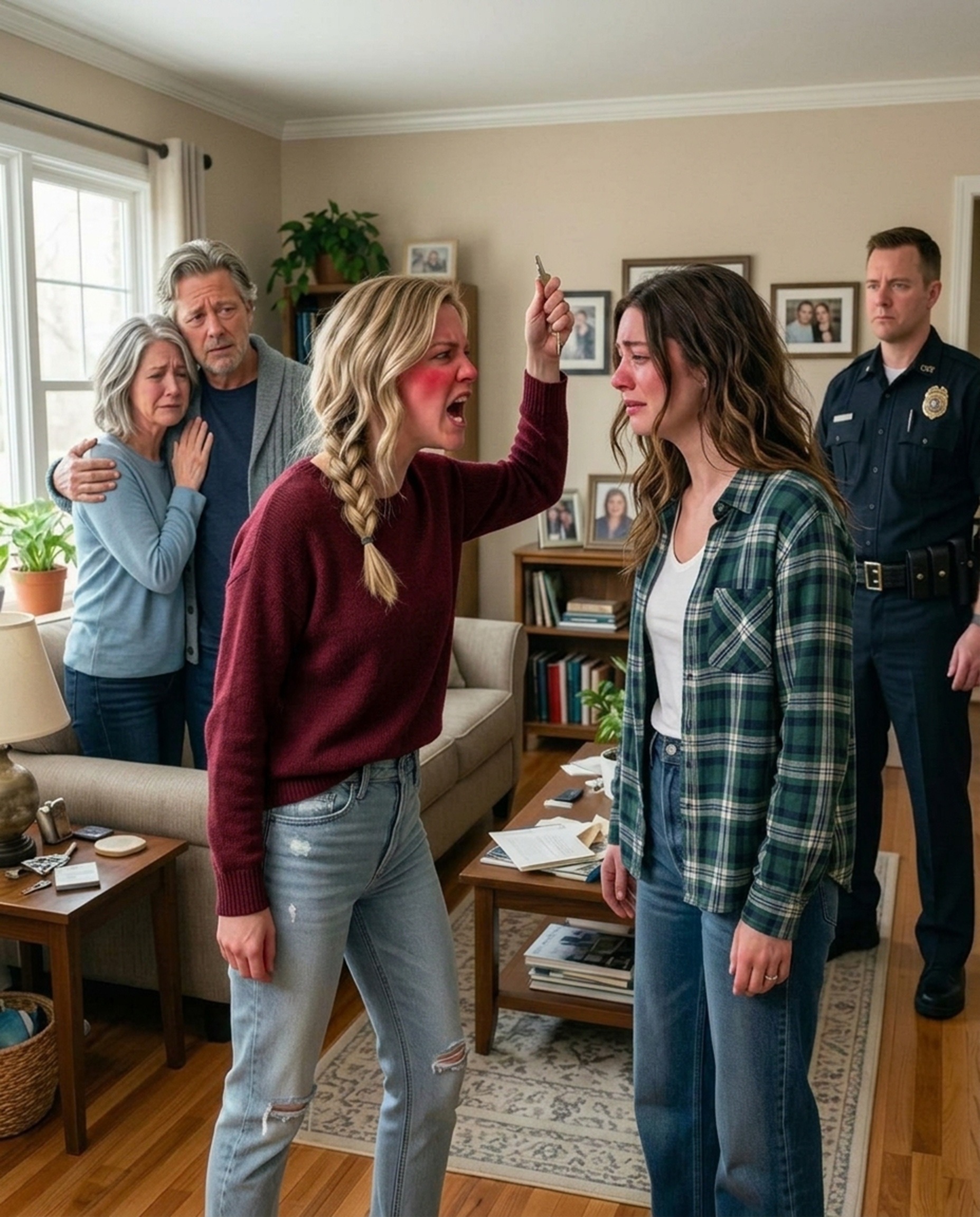
Jenna reached into her jeans pocket and pulled out a heavy brass key, letting it dangle from her index finger by a small silver ring. “I do have permission.”
The metal glinted under the overhead light, its jagged teeth matching the exact lock on my front door. It was the duplicate of the heavy brass key I thought was still sitting safely on the blue ceramic jewelry dish downstairs.
“Where did you get that?” I asked.
“Dad gave it to me,” she said, tossing the key onto the mattress between us. “He said you had plenty of room.”
I picked up the key, its cool weight familiar and terrifying in my hand. “Dad does not own this house.”
“He helped you buy it,” she lied, her voice rising to that rapid, high-pitched defensive register she used whenever she felt cornered. “He spent his whole weekend lifting your heavy boxes.”
“Lifting boxes does not give him the right to hand out keys to my property,” I said.
The sound of heavy work boots on the front porch stairs interrupted us before Jenna could reply.
Robert, my father, stepped through the front door, carrying a small plastic bag from the hardware store. He stopped in the hallway, his face instantly tightening when he saw me standing near the stairs with the brass key in my palm.
“Lauren,” he said, clearing his throat and shifting his weight from one foot to the other. “I did not expect you back from the office so early.”
“Why does Jenna have a copy of my house key, Dad?” I asked, my thumb automatically rubbing the silver watch on my wrist.
He pulled his glasses off by the frame and began cleaning them on the hem of his flannel shirt, refusing to meet my eyes. “She needed a place to go, Lauren. Her lease is up in October, and she has nowhere else to turn.”
“You stole my spare key,” I said, the words tasting like copper in my mouth.
“I did not steal anything,” he muttered, adjusting his wire rims back onto his nose. “I helped you move. I carried your heavy green toolbox out to the garage so you would not strain your back.”
The memory of that hot Saturday morning in August flashed back, sharp and clear. He had insisted on taking the heavy metal toolbox down the stairs himself, staying in the garage for nearly twenty minutes while I unpacked the kitchen boxes.