“What about your mother?” David asked. “She will not take this quietly.”
“She does not have a key,” I said. “Only Jenna and my father do. Once the locks are changed, they cannot get back inside.”
“And the utility bills?” David asked, pointing to a stack of mail on the counter. “Did Arthur ask for those?”
“He did,” I said. “He told me to bring the water and electric bills from the last three months.”
David nodded once, his face serious. “Then you need to call Arthur before his office closes for the weekend.”
Arthur’s office in the suburban strip mall smelled of old paper and leather bindings. He sat behind his mahogany desk, tapping his heavy gold fountain pen against a stack of white documents. Outside, the autumn wind rustled the dry oak leaves against the windowpane.
“This is a formal trespass warning notice, Lauren,” Arthur said, his voice slow and deliberate. “It is a standard instrument, but it has teeth.”
He slid the papers across the desk toward me. My name was printed in bold at the top as the sole owner of the property on Oak Street. Jenna’s name was typed below it.
“Once you sign this,” Arthur said, “I will have it delivered to the sheriff’s office. They will dispatch deputies to deliver it physically to your sister.”
“Does she have to sign it?” I asked, my pen hovering over the signature line.
“No,” Arthur said, tapping the pen once more. “The deputies will log the service. From that moment, her presence in your home is a misdemeanor. If she refuses to leave, they will remove her.”
“My parents will be there,” I said. “My mother has been staying there during the day while I am at work.”
“The notice applies only to Jenna,” Arthur replied. “But the deputies will secure the entire premises. If your parents interfere, they can be cited as well.”
I signed my name on the bottom line, the ink drying dark and thick.
Arthur took the document back and blotted it. He looked at me over his gold-rimmed glasses. “Bring me your recent utility bills tomorrow morning, Lauren. The gas, the water, and the electric.”
“Why do you need the utility bills?” I asked.
“Just bring them,” Arthur said, sliding the papers into a blue folder. “We need every piece of paper that proves you are the only person who maintains that household.”
“They are on my kitchen counter,” I said. “I can bring them by first thing in the morning.”
“Good,” Arthur said. “The courthouse opens at nine. You will need to file the certified deed documents with the clerk before you bring the bills to me.”
I stood up, my shoulder bag heavy on my arm. The legal machinery was moving now, and there was no way to stop it without looking weak.
“Thank you, Arthur,” I said.
“Be home on Thursday afternoon,” he said. “That is when the deputies will execute the order.”
The county courthouse downtown was crowded with people waiting for traffic court, but the register of deeds office on the second floor was quiet. A ceiling fan hummed overhead, stirring the warm air.
I had to pass through the security metal detector at the entrance, placing my keys and my phone in a grey plastic bin. The guard looked at my briefcase but did not open it.
The clerk behind the counter was a woman in her fifties with grey hair held back by a plastic clip. She took my certified copy of the deed and scanned the barcode.
“You are requesting a certified copy of the active title, correct?” she asked, her fingers hovering over the keyboard.
“Yes,” I said. “And the tax administration printout showing my name as the sole taxpayer.”
She clicked her mouse three times. The printer behind her began to hum, spitting out three pages of white paper with a raised state seal on the bottom.
“That will be twenty-four dollars,” she said.
I handed her my credit card. The transaction cleared with a soft beep.
“Is this for a boundary dispute?” the clerk asked, stamping the top page with blue ink.
“A domestic issue,” I said.
She handed me the documents in a legal-sized paper sleeve. “Make sure you keep these in a dry place. If the police need to verify ownership, the original stamp is what they look for.”
I tucked the sleeve into my briefcase. When I walked out into the bright Raleigh morning, the wind through the oaks felt cooler than it had the day before.
I had the deed, I had the utility bills, and I had Arthur’s signed notice. The only thing left was the physical perimeter of the house.
The locksmith’s white van was parked in my driveway by eight o’clock on Wednesday morning. A magnetic sign on the door read Capital Lock and Key.
Jenna’s silver sedan was gone, likely because she was out meeting our mother for breakfast to discuss their next move.
The locksmith was a young man with a tool belt that jingled with brass blanks as he walked up the porch steps. He looked at the existing gold-plated deadbolts.
“These are standard builder-grade locks,” he said, touching the keyway with a small pick. “A simple bump key could open these in five seconds.”
“I want the electronic smart locks,” I said, pointing to the boxes I had purchased. “The ones that require a digital code or an authorized phone application.”
“It takes about twenty minutes per door,” he said. “I will rekey the deadbolts first, then install the keypad units.”
I stood in the driveway, watching him work on the front door. The smell of freshly cut metal drifted through the screen.
Every brass key my father had copied was about to become a useless piece of scrap metal.
“That will be three hundred dollars total for the three doors,” the locksmith said when he finished the back door.
I handed him three one-hundred-dollar bills. My wallet felt lighter, but my grip on my own life felt tighter than it had in weeks.
“Try the code,” he said, pointing to the sleek black keypad on the front door.
I entered the six-digit sequence I had programmed.
The motor inside the door whined softly, and then came the sharp click of the brand new electronic smart lock engaging.
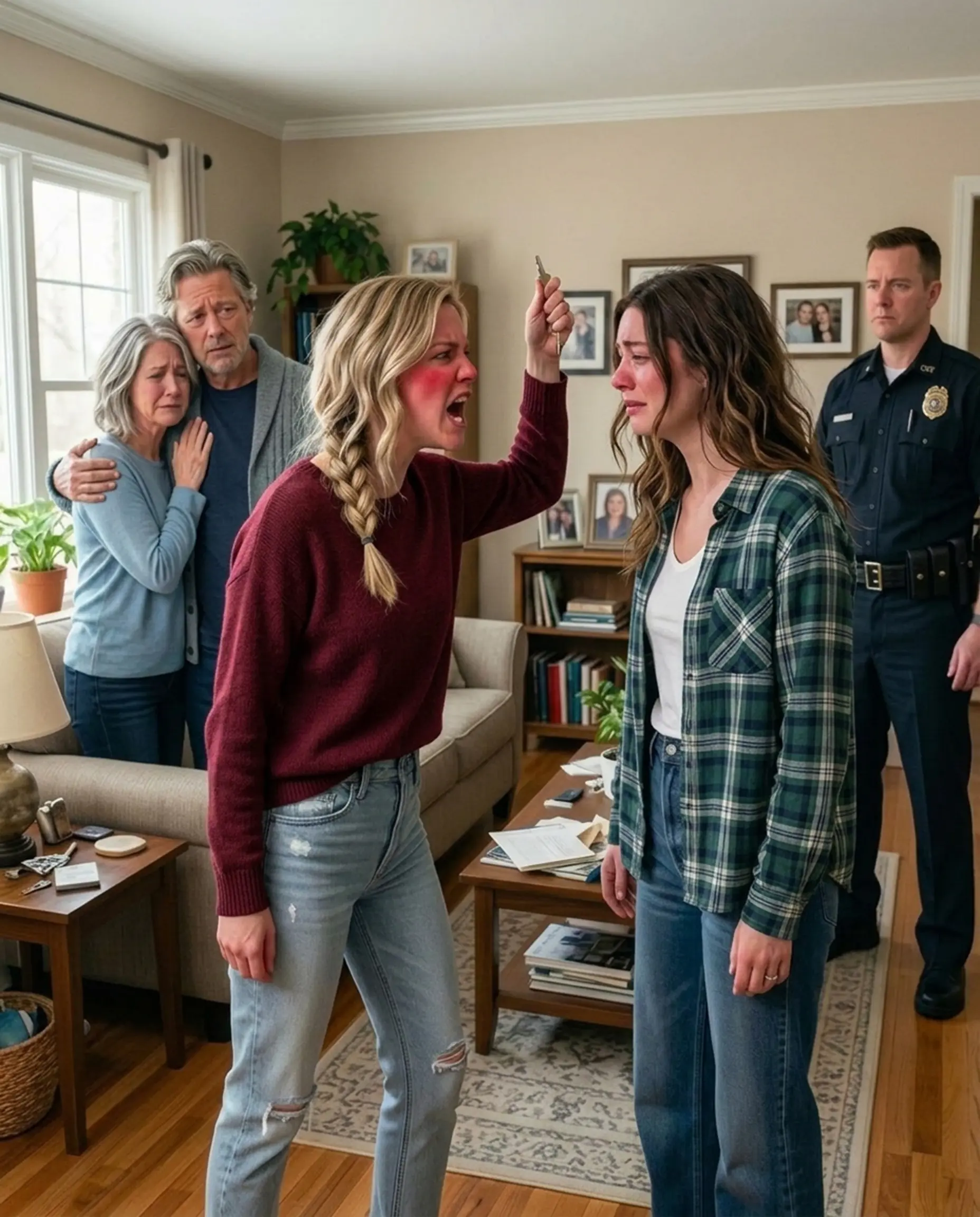
I stood in the entryway on Thursday afternoon, adjusting the blue ceramic jewelry dish on the console table so it sat exactly in the center of the wood grain. The dish was completely empty, stripped of the spare keys that had caused so much quiet damage over the last few weeks.
Through the narrow glass panes flanking the heavy front door, a shadow blocked the pale autumn light. Jenna stood on the porch with her silver key ring in her hand, her shoulder bag slipping off her arm as she reached for the lock.
She slid her copied brass key into the new lock. She turned it to the right, then back to the left, her eyebrows drawing together as the cold metal refused to budge.
She pulled the key out, inspected the teeth, and shoved it back into the keyhole with more force. The smart lock remained silent, its black face showing no response to her efforts.
Jenna rattled the brass thumbpiece, her knuckles turning white as she banged her palm against the dark wood of the door.
“Lauren, open this door,” she called out, her voice rising in pitch as she leaned against the frame.
I did not move from the hallway rug, my hand resting on my silver wristwatch, my thumb slowly rubbing the smooth metal of the bezel. In my other hand, I held the thick cardboard folder Arthur had prepared for me, my fingers hooked over the metal clasp.
She tried the key one more time, twisting a strand of hair around her index finger with her left hand while her right hand strained against the hardware.
“I know you are in there,” she shouted, her face pressing close to the glass pane. “My key is not working.”
I took a slow breath and watched her through the glass, noting the sudden panic in her eyes before another sound drew my attention to the driveway.
A car door slammed near the curb.
Elaine marched up the concrete walkway, her heavy gold bracelets clinking together like dry leaves. She did not look at the flowerbeds or the lawn, her focus locked entirely on the front porch where Jenna stood.
“What did you do to the door?” Elaine asked, her voice carrying across the yard before she even reached the steps.
“I changed the locks,” I said, opening the door just wide enough to step through onto the porch, pulling it firmly shut behind me.
The Raleigh wind was cool, blowing dry brown oak leaves across the porch steps. I stood on the top step, holding the cardboard folder against my ribs like a shield.
“You have no right to lock your sister out of her own home,” Elaine said, her face flushing red under her makeup as she reached the bottom step.
“This is not her home, Mom,” I said, my voice flat and precise. “This is my house, and she entered it without my permission using a key she had no right to possess.”
“We took care of this weeks ago, Lauren,” Elaine said, her voice dropping into that patronizing, maternal tone she used when she wanted to settle a family dispute.