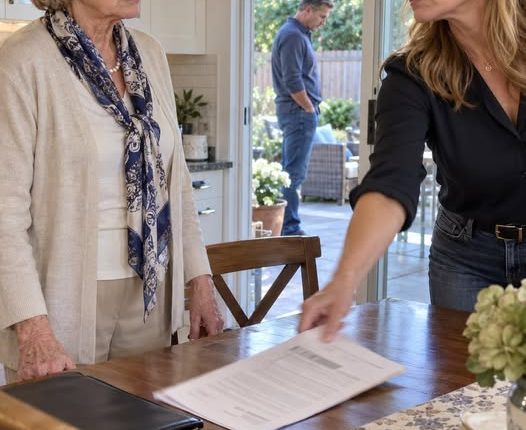
My daughter-in-law shoved greasy plates at me and said, “Could you finish these? My mother prefers her wine chilled.” My son poured Brenda a glass while I stood by the sink like hired help. I quietly dried my hands, put on my coat, and left without washing a single dish.
PART 1: One Stack of Dinner Plates Made Me See What I Had Become
The sound that finally changed everything was not shouting.
It was the soft clink of wine glasses from my son’s living room while I stood under the bright kitchen light holding a stack of greasy dinner plates against my chest.
Rachel, my daughter-in-law, had handed them to me without really stopping. She was already turning toward the living room when she explained that her mother wanted another glass of chilled wine and she needed to entertain.
I caught the plates automatically.
That was the part that bothered me most afterward.
My hands accepted them before my mind had even considered whether I wanted to.
Through the wide doorway, I could see my son David beside the sofa pouring white wine for Rachel’s mother, Brenda. She sat comfortably against the leather cushions in a cream sweater, silver-blond hair arranged perfectly around her face. Rachel joined them a moment later, and the three of them laughed about something I could not hear.
I looked at the sofa.
Six months earlier, I had helped pay for it.
Rachel had called from the furniture showroom because the model she loved cost more than they had budgeted. She sounded embarrassed when she asked if I could help with the difference. I had transferred the money that same afternoon.
David had hugged me later.
“You always come through, Mom.”
At the time, I had felt proud.
Standing in their kitchen with dirty plates warming my forearms, those words sounded considerably less flattering.
Sunday dinners had changed so gradually that I could not identify the exact week when I stopped being a guest.
At first, arriving early had been my idea. Rachel had two young children, dinner took work, and after my husband died I had more empty hours than I knew what to do with. Helping made the evenings easier for everyone, and being useful made the quiet in my own house feel less noticeable.
Then usefulness became routine.
Routine became expectation.
By the time I arrived at David and Rachel’s house on Sundays, there was usually already a list waiting for me.
Peel the potatoes.
Watch Leo and Mia.
Stir the gravy.
Set the table.
Find whichever toy had suddenly become essential to one of the children’s survival.
Pick up bread because Rachel had forgotten it.
None of those things seemed unreasonable by themselves.
That was why the arrangement lasted so long.
I loved my grandchildren. Leo was seven, endlessly curious, and incapable of telling a story without adding several unnecessary sound effects. Mia was five and had the serious concentration of a surgeon whenever she dressed one of her dolls.
Helping with them never felt like a burden when someone actually asked.
But asking had slowly disappeared.
Rachel’s mother never seemed to receive assignments.
Brenda usually arrived shortly before dinner carrying a bottle of wine or, sometimes, nothing at all. Rachel greeted her as though she had crossed an ocean rather than driven across town.
“Mom, sit down. You must be exhausted.”
I heard that exact sentence the Sunday everything changed.
At the time, I was standing a few feet away holding a hot roasting pan with oven mitts.
Nobody asked whether I was tired.
I noticed the difference.
Then, as usual, I explained it away.
Brenda lived farther away.
Her back bothered her.
She was older than Rachel.
She was a guest.
I managed to maintain those explanations for months before finally confronting the obvious problem.
I was supposed to be a guest too.
That Sunday, Rachel had texted me before noon saying she was overwhelmed.
I arrived at three-thirty carrying a spinach casserole I had prepared at home. Before dinner, I found one of Mia’s missing doll shoes, chopped vegetables, washed mixing bowls, helped Leo with a school project he had suddenly remembered, and set out napkins.
Rachel thanked me several times.
That was enough to keep the pattern feeling generous.
Brenda arrived around five-thirty.
Rachel kissed her on both cheeks and guided her directly to the living room.
“Sit down. I’ll get you something to drink.”
I was scraping browned sauce from the roasting pan.
Dinner itself was not openly unpleasant.
That almost made the evening worse.
There was no obvious insult I could point to later. Nobody called me names. Nobody told me I did not belong.
I simply seemed to disappear every time conversation moved in my direction.
I mentioned an exhibition opening at the art museum because I had been thinking about going.
Rachel immediately turned toward Brenda.
“Mom, you would love that. Remember that gallery we saw in Boston?”
My story vanished.
A few minutes later, I tried to tell David about a neighbor who had finally sold her house.
Leo interrupted with a question.
David answered him.
The conversation moved on.
I sat there smiling, cutting my chicken, and feeling strangely absent from a table where I had helped prepare half the food.
I was not angry yet.
Mostly, I felt foolish.
After dessert, Brenda carried her wine into the living room.
David followed her.
Rachel began stacking dishes.
For one hopeful second, I thought she intended to wash them.
Then she walked straight toward me.
She placed the first plate in my hands, added another, then another.
“Could you finish these, Patricia? My mother likes her wine cold, and I need to keep her company.”
She did not wait for my answer.
Her shoes clicked across the hardwood as she disappeared into the next room.
I stood motionless.
The sink was already filled with cloudy water from the pans I had washed earlier. Grease floated across the surface. A dinner roll had fallen apart beside a serving spoon, and a streak of gravy had dried along the counter.
Behind me, someone laughed.
I turned my head.
David was pouring Brenda another glass.
Rachel lowered herself onto the sofa.
No one looked toward the kitchen.
Something inside me became remarkably quiet.
There was no burst of rage.
No speech formed.
I did not imagine throwing plates or confronting anyone in front of the children.
Instead, one thought arrived with such clarity that I almost felt embarrassed for not seeing it sooner.
I was not being treated like David’s mother.
I was not even being treated like Rachel’s mother-in-law.
I was functioning as household staff who happened to bring birthday gifts and pay for furniture.
I looked at the dishes in my arms.
Then I placed them carefully on the counter.
One plate clicked against another.
No one came to investigate.
I took a paper towel from the roll, dried my hands slowly, and walked into the hallway.
My wool coat hung beside Rachel’s expensive winter parka.
I slipped it on.
I checked my purse for my wallet and keys.
The laughter continued.
Nobody asked where I was going.
That hurt.
For about three seconds.
Then it became useful information.
I opened the front door.
Cold air touched my face.
I stepped outside and closed the door quietly behind me.
The porch light cast a pale circle across the driveway. Brenda’s SUV occupied the closest parking space, so I had parked half a block away earlier.
I walked toward my car.
No footsteps followed me.
No one opened the door.
No one called my name.
By the time I reached the driver’s seat, my phone began vibrating.
I looked at the screen.
David.
I let it ring.
Rachel called next.
Then David again.
I started the car.
For the first Sunday in almost a year, the dirty dishes inside that house were no longer waiting for me.
I drove home smiling, not because I had punished anyone, but because I had finally left their responsibility where it belonged.
Behind me.
END PART 1