PART 5: The Ring Came Off When I Realized His Change Did Not Require My Return
Three months into our separation, Nathan and I left the diner separately.
He had not asked me to come home. That mattered more than I expected. For the first time since everything began, he had spoken about changing without attaching the work to a deadline for my forgiveness. I drove back to Mom’s house with both hands steady on the wheel, grieving the fact that the sentence I had wanted from him for months had arrived after I stopped trusting what came next.
The separation continued.
Nathan kept attending individual therapy. He stayed in financial counseling, paid down one credit card, sold the golf equipment he had once treated like part of his identity, and stopped making purchases that required explanations afterward. Carol’s house was repaired through insurance, contractor negotiations, and a payment plan Nathan helped her organize without asking me to open my savings.
I noticed every change.
I refused to turn any of them into a promise.
By the sixth month after Mom’s canceled flight, I had moved from her guest room into a small townhouse fifteen minutes from Fort Liberty. The place had beige walls, a narrow kitchen, a stubborn bathroom drawer, and a back patio facing a wooden privacy fence. Nothing about it was impressive.
I loved it.
Every bill that arrived there was mine to understand. Every purchase was mine to approve. If I opened the refrigerator and saw something missing, I knew exactly who had forgotten to buy it. The quiet felt different from the silence in my marriage. It did not contain suspicion.
Mom visited most Sundays.
She complained about my kitchen chairs, brought enough food for three families, and inspected my pantry as if Army officers routinely forgot how to feed themselves. I pretended to be irritated.
Nathan and I still met for practical reasons.
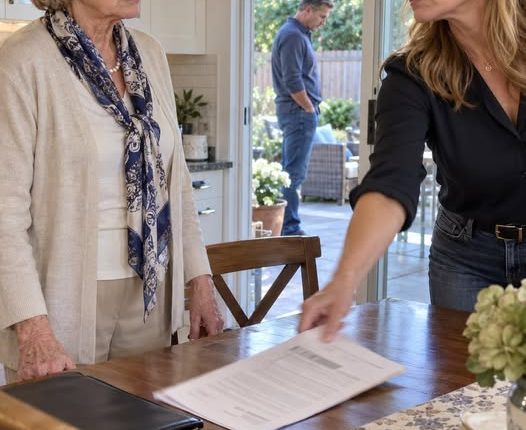
The old house had to be dealt with. Shared accounts needed separating. Insurance policies had to be rewritten. There were documents Denise wanted signed so that his undisclosed debts remained clearly assigned to him rather than drifting back toward our joint finances.
He still wore his wedding ring.
For four months, I wore mine too.
Taking it off felt absurdly difficult.
One Tuesday evening, I sat at the small dresser in my townhouse turning the band beneath the bedside lamp. I remembered our wedding. Our first apartment with the broken dishwasher. Christmas mornings. Long drives. The time Nathan slept in a hospital chair when I had emergency surgery. Terrible restaurants we still joked about years later.
Those memories were real.
So was everything that happened after them.
I finally slid the ring from my finger and placed it in a small wooden box.
The pale indentation around my skin remained.
For a long time, I stared at it.
Taking off the ring did not mean the marriage had been fake.
It meant the marriage could be real and still be over.
Nathan noticed at our next meeting.
We were sitting on a bench outside Denise’s office after signing paperwork that separated the last of several household obligations. His eyes went directly to my hand.
“You took it off.”
“Yes.”
He swallowed.
“Is that your answer?”
“Part of it.”
Nathan looked older than he had six months earlier. There was less tension in his face, but more awareness. The man who once defended every mistake before admitting it now spent longer thinking before he spoke.
“I’ve been trying not to ask you something.”
“What?”
“Whether there’s still a chance.”
A family crossed the parking lot in front of us. A little girl skipped between her parents, pulling on both their hands while they tried to keep her from stepping into a puddle.
I watched them until they passed.
“There is always a chance people can change,” I said.
Nathan looked at me.
“You already have.”
Hope appeared on his face so quickly that I almost stopped talking.
“But that doesn’t mean I want to restart our marriage.”
The hope disappeared.
He looked down at his hands.
“Why?”
There was no accusation in the question.
That made answering harder.
“Because every time I imagine coming home, I don’t feel relief.”
“What do you feel?”
“Responsible.”
He closed his eyes.
I continued.
“I imagine checking every statement. Wondering whether every quiet week means another account I haven’t found. Wondering whether every apology is real or whether you’re trying to keep me calm until something else gets fixed.”
“I wouldn’t do it again.”
“I believe you believe that.”
“That isn’t enough?”
“No.”
He rubbed his palms together.
“I don’t understand how you can say I’ve changed and still leave.”
I thought about Denise asking what I was trying to protect.
Then I answered.
“Because your change is not a debt I have to repay.”
Nathan looked at me.
“You are doing good work. Keep doing it. Pay what you owe. Go to therapy. Become somebody you respect.”
His eyes filled.
“But I don’t owe you reconciliation because you finally became honest.”
He turned away.
For several seconds, neither of us spoke.
Then he said quietly, “I thought forgiveness meant another chance.”
“I forgive you.”
Nathan looked back.
“I mean that.”
His face changed.
“I don’t want revenge. I don’t want your life ruined. I don’t want you carrying shame forever.”
“Then why divorce me?”
“Because forgiveness means I’m not carrying hatred.”
I took a breath.
“It does not mean I volunteer for the same marriage again.”
His eyes closed.
When he opened them, he nodded.
It was the saddest and most respectful thing he had done since Mom’s flight was canceled.
We filed the following month.
There was no dramatic courtroom battle.
No screaming over furniture.
No attempt to destroy each other financially.
We sold the house, paid legitimate joint obligations, divided what remained, and kept Nathan’s undisclosed personal debt assigned to him under the agreements Denise and our attorneys helped document.
Mom asked me one evening whether I was certain.
We were sitting on her porch while she watered a fern she had already watered that morning.
“Yes.”
“You still love him?”
“In a way.”
She nodded.
“That doesn’t surprise me.”
“I thought you’d tell me I was foolish.”
“Why?”
“Because of what he did.”
Mom set down the watering can.
“A person does not become entirely worthless because they failed you.”
I waited.
“But you don’t have to build your future around their potential.”
I smiled.
“You’ve been saving that one.”
“For eighty-one years.”
The divorce process moved forward quietly.
Nathan never tried to sabotage it.
He never used Carol to pressure me.
He never asked Colin to call.
That did not restore the marriage.
It did tell me his change might finally be about something larger than keeping me.
One afternoon, Denise sent me an update showing that another major balance had been paid down.
I looked at the numbers and felt proud of him.
Then I noticed something equally important.
I did not feel responsible for helping.
I could care about his progress without becoming part of the machinery producing it.
That was new.
Almost eleven months after the airport night, the court finalized our divorce.
Nathan and I walked out into the courthouse parking lot carrying separate folders.
Cold wind moved between the buildings.
He handed me one last document.
“So this is it.”
“Yes.”
He looked toward the pavement.
“I’m sorry, Rachel.”
“I know.”
“For all of it.”
“I know.”
“I wish I understood sooner.”
“So do I.”
We stood there in silence.
Then he said, “Your mom was never really the problem.”
“No.”
“I was.”
“You were part of it.”
A sad smile touched his face.
“Still protecting me from myself?”
“No.”
I shook my head.
“Just being accurate.”
That made him laugh quietly.
Before walking toward his car, he stopped.
“When you said okay that night, I thought I’d won the argument.”
I looked at him.
“I didn’t understand you had stopped arguing because something in you changed.”
He was right.
For years, I had believed silence meant surrender.
Now I understood it could also mean you were finished begging someone to value something they had already chosen to dismiss.
Nathan walked away.
I watched until he reached his car.
The grief came.
So did relief.
Then my phone rang.
Mom.
“Finished?”
“Yes.”
“How do you feel?”
I looked back at the courthouse.
“Like I finally put down something that wasn’t mine to carry.”
She was quiet.
Then she laughed softly.
“Good. Now come get lunch. I’m starving.”
I smiled.
“I’m coming.”
END PART 5