PART 5: The Fire Records Led Us to a Widow Whose Husband Had Warned Calder Before He Died
The formal ethics hearing was scheduled six weeks later.
Rachel called me the morning the date became official.
Her first instruction was simple.
“You will not share a waiting room with Adrian.”
“I wasn’t planning to.”
“You will not meet with Conrad privately.”
“Definitely not.”
“And if either of them attempts to contact you directly, you document it and send it to me.”
“I already do.”
Rachel paused.
“I know.”
She sounded tired.
So was I.
Adrian had last seen me crossing the Grand Ellison ballroom after placing my wedding ring on a waiter’s tray.
I intended to preserve that as his final image of me.
He disagreed.
Twice, he appeared outside my office building.
Security refused to let him upstairs.
The first time, he waited almost an hour before leaving.
The second time, he sent a message through reception.
Tell Elena I only need five minutes.
I gave the receptionist Rachel’s number.
Later that week, Adrian appeared near the lobby of my condo.
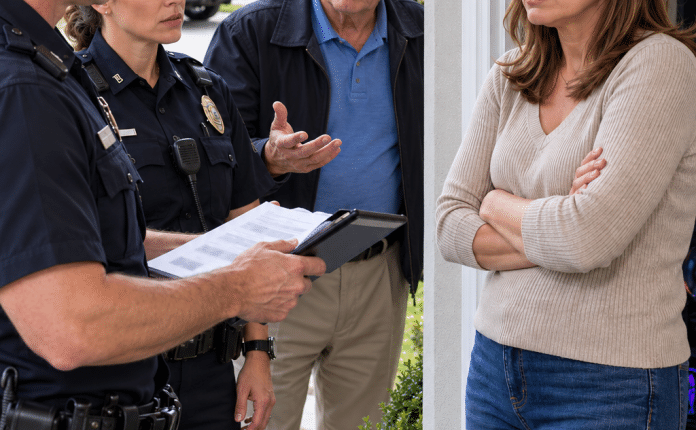
The property manager warned him that police would be called if he refused to leave.
He left.
Then came the handwritten letter.
Rachel received it first.
She asked whether I wanted to read it.
“No.”
“Good.”
That surprised me.
“Good?”
“There are admissions in it.”
“Then summarize them.”
She opened the envelope.
According to Adrian, he struck me because he panicked.
He claimed he had only recently learned the full extent of the Calder cover-up.
The wedding-morning payment, he said, had been authorized because Conrad pressured him.
“What else?”
Rachel’s expression flattened.
“He says you confronted him in the wrong place.”
I stared.
“What?”
“He says the situation escalated because guests were nearby.”
I laughed once.
Even Adrian’s confession needed a portion of the blame relocated.
“He hit me.”
“Yes.”
“Because I would not hand him evidence.”
“Yes.”
“And his explanation is that I should have chosen a more private hallway?”
“Essentially.”
I leaned back.
“That sounds like him.”
For all the records we had uncovered, part of me still struggled to reconcile the man in those documents with the Adrian who once spent an afternoon helping me move boxes.
That was the trap.
People assume cruelty erases every earlier kindness.
It does not.
Both can exist.
One does not excuse the other.
The hearing date approached.
Meanwhile, Tessa and I traveled to Wisconsin.
We had finally located the widow whose objections to the Calder fire investigation had disappeared from public attention.
Her name was Laura Bennett.
She lived outside Milwaukee in a narrow duplex with faded blue siding and a patch of lawn already turning brown at the edges.
Her teenage daughter was at school when we arrived.
Laura opened the door cautiously.
Her face changed when Tessa introduced us.
“You’re the lawyer from the wedding.”
I resisted the strange urge to apologize for being recognizable that way.
“Yes.”
Laura stepped aside.
“Come in.”
Her kitchen smelled of coffee and laundry detergent.
Medical bills sat beneath a ceramic fruit bowl.
Beside the back door was a row of work boots.
One pair was older than the others.
Clean now.
Unused.
I knew before she spoke whose they were.
“Samuel’s.”
She followed my gaze.
“My husband.”
We sat.
Laura did not waste time.
“The week before the fire, he called me from work.”
Her fingers tightened around her mug.
“He said the new section wasn’t ready.”
“What specifically?”
“Electrical problems.”
She looked toward the boots.
“Temporary wiring got hot enough that he could smell it.”
Tessa began taking notes.
“Anything else?”
“Alarm problems.”
My attention sharpened.
“What kind?”
“Failures.”
Laura looked at me.
“Samuel said some alarms weren’t communicating properly.”
“Did he report it?”
“Three times.”
She stood.
Opened a drawer.
Removed a folder.
The emails inside were printed.
Original timestamps still visible.
Samuel had warned supervisors.
Not once.
Three times.
Each message was marked resolved within hours.
“How?”
Laura laughed bitterly.
“I asked the same thing.”
She slid another document across the table.
The final inspection report.
Signed by Raymond Doyle.
Safe for operation.
I thought about Raymond’s cash-purchased house in Arizona.
Julian’s money trail.
Adrian sitting beside him in the conference-room photograph.
“What happened after the fire?”
Laura’s face hardened.
“A man came here.”
“From Vale?”
“He never said.”
“What did he want?”
She looked directly at me.
“He offered money.”
Tessa’s pen stopped.
“For what?”
“For me to sign a statement saying Samuel had ignored procedures.”
My stomach tightened.
“Did he?”
“No.”
“What happened after you refused?”
Laura counted slowly.
“My lawyer withdrew.”
One finger.
“Reporters stopped returning calls.”
Second.
“Then somebody sent photographs of my daughter walking home from school.”
Third.
Tessa went very still.
Laura saw her reaction.
“That part worked.”
“You stopped speaking publicly.”
“I stopped letting my daughter walk home.”
Her voice remained calm.
That made it worse.
“People told me to move on.”
She glanced again toward Samuel’s boots.
“They said fighting a company like Vale Dominion would destroy whatever was left of my family.”
“Why talk now?”
Laura’s eyes stayed on the boots.
“Because they counted on me getting tired.”
The answer stayed with me.
We copied Samuel’s emails with Laura’s permission.
Julian matched their dates against transfers through Silver Strand Procurement.
Each time a significant safety complaint was closed, money moved.
Consultants.
Inspectors.
Outside services.
The pattern had become mechanical.
Warning.
Payment.
Resolution.
Silence.
Then another warning.
I began understanding Vale Dominion differently.
This was not one disaster followed by a cover-up.
The cover-up was part of the operating system.
One week before the ethics hearing, Adrian’s criminal-defense lawyer sent a settlement proposal.
Rachel read it aloud in her conference room.
Adrian would not contest the annulment.
He would issue a carefully worded apology.
He would pay my legal fees.
In exchange, I would withdraw cooperation from the ethics inquiry and return every copy of Vale Dominion records.
I waited until Rachel finished.
“What happens to Elaine?”
“Not addressed.”
“Celia?”
“Not addressed.”
“Laura?”
“No.”
“Samuel Bennett?”
“No.”
“The second worker who died?”
“No.”
I looked through the conference-room window at traffic inching through an intersection.
A horn sounded repeatedly though the light remained red.
“Then no.”
Rachel nodded.
No surprise.
That afternoon, the annulment hearing went forward.
Adrian contested enough details to make the proceeding unpleasant but not enough to change the result.
Fraud.
Misconduct.
Evidence hidden before the marriage.
Forgery afterward.
The judge granted the annulment.
Adrian’s lawyers requested the order be sealed.
Denied.
I left through a side entrance.
No cameras.
No crowd.
No Adrian.
Mom waited in her car.
She took me to a diner.
Grilled cheese.
Tomato soup.
Ordinary food.
Ordinary table.
After we ordered, she smiled across at me.
“You’re officially Elena Hart again.”
“I never stopped being Elena Hart.”
Her smile softened.
“I know.”
The night before the ethics hearing, Tessa came to my condo carrying Julian’s latest report.
She did not remove her coat.
“What?”
She placed a page on the table.
“The official Calder report says the fire began at 2:13 a.m.”
“I know.”
“Elaine’s sensor records show the first alarm at 1:47.”
I stared.
“Twenty-six minutes.”
“Yes.”
“What happened?”
Tessa sat.
“Someone disabled the automatic emergency notification system.”
I stopped breathing.
“Remotely?”
“Yes.”
“From where?”
“Executive access.”
I already knew the answer I wanted it not to be.
“Conrad?”
Tessa shook her head.
The account belonged to Adrian.
The record showed activity four minutes after the first alarm.
For weeks, Adrian claimed he had only participated after the fire because Conrad pressured him.
The sensor data placed his executive credentials inside the emergency system before anyone officially reported flames.
And suddenly the slap at our wedding looked different.
Adrian had not struck me merely because I found his father’s secret.
He struck me because the page in my hand could lead directly to his own.
END PART 5