PART 3: Celia Vanished, Adrian Forged My Signature, and the Money Trail Led to a Paid Inspector
For four days, Celia Warren seemed to disappear.
Her apartment was empty.
Her car remained in the employee garage at the Grand Ellison.
Her phone went directly to voicemail.
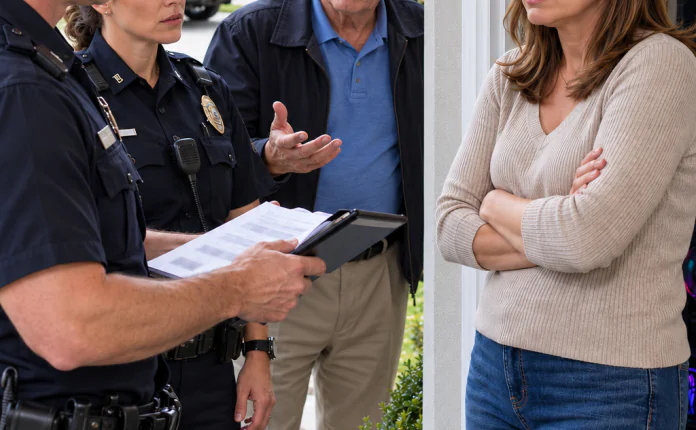
Police told us there was no evidence of foul play.
An adult could leave voluntarily.
They were correct.
Legally.
Nothing about it felt ordinary.
Tessa searched public records and old Calder employment information.
I focused on separating my life from Adrian.
I changed the locks at my condo.
Froze my credit.
Moved financial accounts.
Updated security questions.
Directed every future communication from Adrian or Vale Dominion through Rachel.
The wedding-night police report already contained more support than most assault cases ever received.
Witness statements.
Hotel footage.
Two camera angles.
Adrian’s lawyers still claimed the strike had been accidental.
The video made that difficult.
It showed him extending his hand first.
Demanding the page.
Me refusing.
Then his arm moving.
There was no collision.
No stumble.
No accident.
His public-relations team shifted strategies.
Photographs of me began appearing online.
Not wedding photographs.
Images from litigation.
Court steps.
Depositions.
Hearings.
Every picture showed me serious.
Focused.
Occasionally angry.
An anonymous source described me as “professionally combative.”
Another called me “obsessed with winning.”
I recognized the method.
I had spent years representing companies through ugly disputes.
Reputations are rarely dismantled with one large lie.
First, the aggressor becomes emotional.
Then the victim becomes calculating.
Eventually, the public is invited to decide everyone behaved badly.
I refused the invitation.
My entire public statement was three sentences.
“My marriage ended when Adrian Vale struck me. The incident was witnessed and recorded. All other matters will be addressed through proper legal channels.”
Then I stopped talking.
Privately, I did the opposite.
I hired Julian Mercer.
Forensic accountant.
Early forties.
Broad shoulders.
Cheap reading glasses.
Color-coded folders for everything.
I had worked with him on prior litigation.
Julian hated three things.
Speculation.
Dramatic language.
People who called accounting creative.
He studied the wedding document in silence for nearly an hour.
Tessa paced.
I drank coffee.
Finally, Julian removed his glasses.
“These companies are funnels.”
“Explain.”
“Vale money enters disguised as logistics, consulting, procurement.”
He pointed across the page.
“Then gets divided through smaller entities until tracing purpose becomes difficult.”
“Can you follow it?”
“If records exist.”
“And if they have been deleted?”
He put his glasses back on.
“Deleted records leave records.”
Two days later, he found the first major connection.
North Harbor Logistics had paid a private investigation firm after the Calder fire.
The firm contacted former employees.
Reviewed their social media.
Monitored public statements.
Offered several temporary relocation payments.
One recipient stood out.
Raymond Doyle.
Maintenance supervisor.
The man who signed the final electrical inspection report at Calder.
Three months after the warehouse fire, Raymond bought a house in Arizona.
Cash.
Julian leaned back.
“Either Mr. Doyle won a very private lottery…”
“Or someone paid him.”
“Yes.”
Tessa located him.
He refused to speak.
The same afternoon, Rachel called me into her office.
When I arrived, a document sat on the conference table.
“What is this?”
“A cohabitation agreement.”
I stared.
“Adrian and I never signed one.”
“I know.”
The document claimed otherwise.
According to its terms, six weeks before the wedding I had acknowledged all Vale business information as confidential corporate property.
I supposedly agreed to return any company material immediately upon request.
Another clause required every dispute involving the Vale family to be handled through private arbitration.
I read the signature.
My signature.
Almost.
The spacing was right.
The angle.
Even the forward lean in the E.
My stomach tightened.
Rachel watched.
“It looks good.”
“It is not.”
“How can you tell?”
I pointed to the final letter.
“When I sign Hart, the t ends with a tiny upward stroke.”
Rachel leaned closer.
“This one doesn’t.”
“No.”
I had done it since high school.
Without thinking.
The forged signature ended flat.
Rachel sent the file to both a handwriting specialist and a digital-forensics lab.
Forty-eight hours later, the results matched.
My signature had been copied from an older document.
Electronically inserted.
The metadata contained an even more damaging fact.
The file had been created the morning after the wedding.
Adrian’s lawyers withdrew it without explanation.
Rachel preserved the withdrawal.
“He is getting reckless.”
“Or scared.”
“Those often look similar.”
That night, at eleven thirty, someone knocked on my condo door.
I checked the security camera.
A woman stood outside in a gray coat.
Late fifties.
Rain flattened her hair.
She held a grocery box against her chest and kept looking toward the elevator.
I spoke through the intercom.
“Who are you?”
“My name is Elaine Porter.”
I did not recognize it.
“I worked for Calder Chemical.”
Every muscle in my body tightened.
“Why are you here?”
“Because Celia Warren told me to come if anything happened to her.”
I called Tessa.
Then Julian.
Neither complained about the hour.
I opened the door only after both were on their way.
Elaine entered with rain dripping from her coat.
She refused coffee.
Accepted water.
Held the glass with both hands because they would not stop trembling.
The grocery box contained canned soup.
Crackers.
Ordinary items.
Tessa arrived first.
Julian ten minutes later.
Elaine removed the food.
At the bottom of the box, beneath a cardboard divider, a flash drive had been taped flat.
She peeled it loose.
Placed it on my table.
“I supervised compliance records.”
“And Celia?”
“Executive correspondence.”
Elaine swallowed.
“After the fire, we were ordered to replace inspection files.”
I stared.
“Replace them?”
“New versions.”
“What happened to the originals?”
“Destroyed.”
“Who ordered it?”
Her eyes went toward the windows.
“Conrad Vale’s office.”
Tessa went completely still.
“What did Adrian know?”
Elaine looked down at her water.
“I don’t know everything.”
“That is not what I asked.”
“I know.”
She took a breath.
“But he attended a meeting before the Calder expansion opened.”
“What meeting?”
“The one where people raised concerns that ventilation and electrical work were unfinished.”
My stomach tightened.
Adrian had told me he had been in London that week.
Elaine plugged the drive into Julian’s secured laptop.
Folders appeared.
Emails.
Scans.
Photos.
She opened one image.
A conference room.
Wall calendar.
Four men around a table.
I saw Adrian immediately.
Beside him sat Raymond Doyle.
The maintenance supervisor who later signed the electrical inspection.
The man who bought a house in Arizona with cash.
On the whiteboard was the Calder expansion schedule.
Opening date circled.
Below it, handwritten words.
DELAYS COST MORE THAN SETTLEMENTS.
I recognized the handwriting.
Conrad.
I stared at Adrian’s face in the photograph.
He was not in London.
He was sitting beside the man who would later certify the warehouse as safe.
The shell companies no longer looked like something Adrian might have discovered after the fire.
He had been inside the decision-making room before it happened.
END PART 3