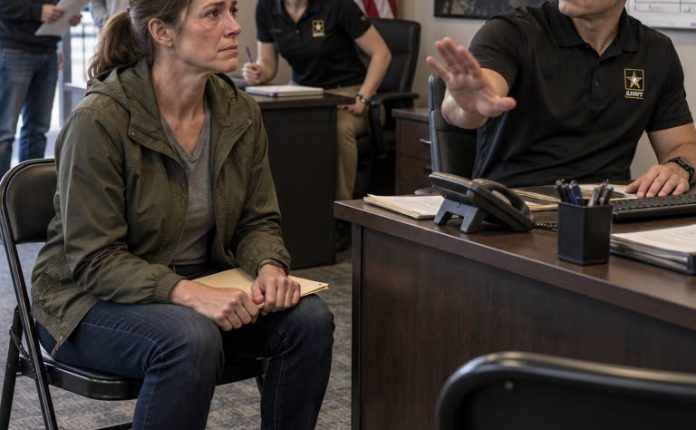
The folding chairs were the kind that could pinch your fingers if you closed them carelessly.
Twelve of them sat in three short rows inside a recruiting station wedged into a strip mall between a nail salon and a place that cashed checks. On Tuesday evenings, those chairs filled with young people waiting to leave for training.
By the fall of 2026, I was standing in front of them in my Army green service uniform while eleven future soldiers watched me as though I might know something worth writing down.
I did.
Just not what most of them thought.
Behind me, taped to the wall near the door, was a recruiting poster. The woman in the photograph wore the same uniform I did, her hair pulled into a regulation bun, chin level, eyes forward. Across her chest was a rack of ribbons. Near the top sat one small blue ribbon.
There was a line of white recruiting copy beneath her boots that I had not written and never would have chosen.
People walked past that poster on the sidewalk every day without slowing down.
The young people sitting in those folding chairs had walked past it too.
I knew the woman in the photograph.
For a long time, I could not say that without feeling my throat tighten.
Ten weeks before that Tuesday evening, I had walked through the same door wearing jeans, running shoes and an olive windbreaker.
The man behind the desk had told me to go home and cook.
That was where the real story began.
It had been a weekday morning in the summer, the kind of heat that rose off a parking lot before you had even crossed half of it. I carried a manila folder under one arm and had no intention of making an entrance.
I had recently moved to the area. One clerical line in my military records needed a wet signature and a station stamp. The folder also contained a volunteer application.
I wanted to help with the station’s future-soldier program—the group everyone casually called the pool. These were young men and women who had signed their contracts but had not yet shipped. Some waited weeks. Some waited months.
Waiting can do strange things to a nineteen-year-old who has just made the largest decision of their life.
I remembered.
That was why I went to the recruiting station instead of taking the records correction to a personnel office on post.
I wanted to meet the kids who were waiting.
The bell over the glass door gave a cheap little ring when I entered.
Nobody looked up immediately.
There were two desks.
At the farther one, a young sergeant was reading something on her computer while chewing the cap of a pen.
At the nearer desk, a staff sergeant had a phone trapped between his shoulder and ear. Behind him, a whiteboard was divided into rows of names, dates and numbers written in green and red marker.
He looked twenty-nine, maybe thirty. Fresh fade. Recruiter polo ironed flat. Jaw tight enough to show he had been carrying a monthly quota around in his head all morning.
Without looking at me, he held up one finger.
Wait.
I waited.
I have always been good at waiting.
He finished his call, lowered the receiver and looked at me the way people look at a delivery they were not expecting.
“Help you?”
It did not sound like a question.
I read the name embroidered on his shirt.
SUTTER.
“Staff Sergeant, I have a couple of things I need to drop off. It’ll take about two minutes.”
His eyes touched the folder under my arm.
That was all he needed.
In less than a second, he decided what kind of woman had walked into his station.
“Ma’am, if this is about your son, parents need appointments. Cards are by the door.”
“It isn’t about my son.”
“Your husband, then? If he’s trying to re-up, that’s another office. We handle new accessions here.”
“It isn’t about my husband.”
He smiled.
It was not an openly cruel smile.
That would almost have been easier.
It was casual.
Costless.
The smile of someone who believed he already knew enough.
“Look,” he said, leaning back, “I’ve got a ship date I need filled by Friday and two kids who won’t answer their phones. I don’t have time to walk somebody’s mom through a brochure.”
Then came the sentence.
“Go home and cook for your husband, sweetheart. We enlist fighters here.”
The young sergeant at the other desk stopped chewing her pen.
I had heard worse things in my career.
Much worse.
A recruiter in a strip mall saying something dismissive to a woman in a windbreaker did not come close to the hardest morning of my life.
Still, the sentence landed in a very particular place.
I keep a rule about my voice.
Once I raise it, the story changes.
People stop talking about what happened and start talking about how loudly I reacted.
So I kept my voice level.
I kept one hand steady on the folder.
“It’ll still take two minutes.”
Sutter had already started turning back toward his whiteboard.
He flicked his fingers toward the counter.
“Leave it. Somebody will get to it.”
I did not leave it.
Instead, I pulled out the folding chair across from his desk—the chair usually meant for a nervous seventeen-year-old or somebody’s worried mother.
I sat down.
I placed the folder across my knees.
Then I folded my hands over it.
Sutter looked at me.
Something moved across his face.
Not concern.
Just the irritation of a plan refusing to proceed according to schedule.
“Ma’am—”
“I’ll wait.”
Behind him, on the wall near the entrance, was the poster.
I could see it from the chair.
I did not look directly at it.
I did not need to.
I had known it was there before I ever opened the door.
In fact, I had seen it through the storefront glass from the parking lot.
For a few seconds outside, standing in the heat with the folder tucked against my side, I had considered turning around.
I could have driven to the personnel office, gotten the signature and gone home.
Nobody would have needed to have that particular morning.
But I stayed.
I told myself it was because I wanted to meet the pool.
That was true.
It simply was not the entire truth.
Some part of me wanted to find out whether I could stand in the same room as that photograph.
I had avoided copies of it for years.
Now it hung above a recruiter’s shoulder like ordinary wallpaper.
The morning answered a question I had not realized I was asking.
It just made me sit through an insult first.
The man across from me had already decided who was sitting in his chair.
He was wrong.
The distance between his assumption and the truth was the entire story.