Rank does not live on your clothes.
That is the first thing.
I wore jeans, running shoes and a windbreaker because I was off duty.
Nothing about me announced what I had spent the previous twenty-one years doing.
That was intentional.
When you are off duty and buying groceries or visiting a hardware store, you are allowed to be just another person standing in line.
Nobody owes the cashier a résumé.
And nobody should need one before receiving basic respect.
The second thing takes longer to learn.
Rank often lives in how long you can stay quiet.
The military teaches people how to give orders.
It takes years to understand how much leadership involves swallowing the urge to make every moment about your authority.
You swallow bad calls.
You swallow careless comments.
You swallow walking into a room and watching people assume somebody else is in charge.
If that happens often enough, you either become bitter or you learn to use the information people give you when they think you do not matter.
When people decide you are furniture, they relax.
They say honest things.
They reveal themselves.
Then, if the moment comes when you stop being furniture, you already understand the room.
I had enlisted at nineteen from a river town in Ohio where the choices seemed to be the plant, community college or the recruiter in another strip mall not all that different from Sutter’s.
I chose the recruiter.
Twenty-one years later, I was a sergeant first class, pay grade E-7.
I had reached it one board at a time in a career where a woman who performs well is still occasionally described as surprisingly good at her job.
Years earlier, I had walked into a planning session at headquarters.
A colonel I had never met looked up, handed me a stack of papers and asked me to make copies and start the coffee.
He was not trying to humiliate me.
That was what made it useful.
He had simply looked at me and placed me into a category.
Helps with the room.
I made the copies.
I started the coffee.
Then I sat at the table and delivered the briefing for the section he did not know belonged to me.
I watched him recalculate.
People imagine that moment feels satisfying.
Mostly, I felt tired.
There is a specific kind of exhaustion that comes from constantly having to earn the second look after someone has already spent the first one incorrectly.
If you are not careful, that exhaustion hardens.
Somewhere around my fifteenth year, I made myself a promise.
I was not going to let other people’s laziness about me become my own opinion of myself.
I would do the work.
The work could make the argument.
That approach takes longer than raising your voice.
It also wins more often.
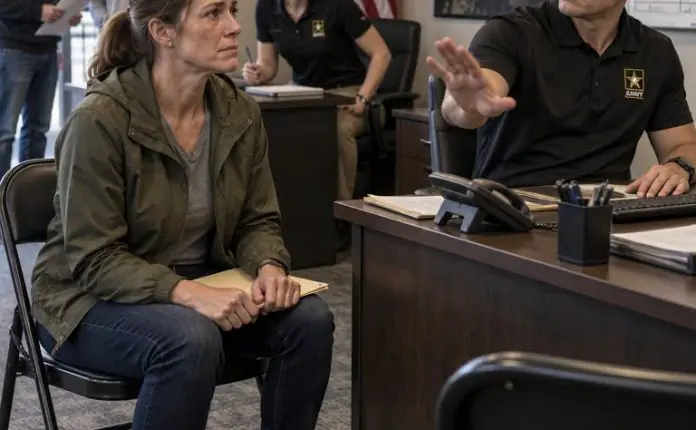
That was the woman sitting in Sutter’s folding chair.
Not somebody desperate for a young staff sergeant to understand that she mattered.
Somebody who had spent years learning that another person’s assumption was theirs to carry—right until the moment it became theirs to correct.
The folder on my knees contained exactly two things.
A boring records correction.
And a volunteer application.
I wanted to become a mentor for the pool.
Young people who have signed but not shipped live in a strange temporary country.
They have announced they are leaving, but they are still home.
Their friends have opinions.
Their parents have opinions.
Their partners have opinions.
Then the excitement fades and the practical worries show up.
Car payments.
Weight standards.
Cold feet.
Fear.
Half a recruiter’s job is keeping them warm until the bus arrives.
I remembered being nineteen and terrified while pretending I was not.
I wanted to tell them the part that helps.
That was the errand.
Nothing more.
I had not walked into the station to prove I was somebody.
I had come because I wanted to be useful.
So when Sutter told me to go home and cook, he was not only wrong about my identity.
He was standing between me and something I was trying to give away for free.
I sat in the folding chair.
The air conditioner hummed.
Sutter made calls.
I waited.
I had done harder waiting in worse chairs.
And the photograph behind him was not leaving.
Neither was I.