That was the moment I had been trying to prevent.
Not losing money.
Not losing property.
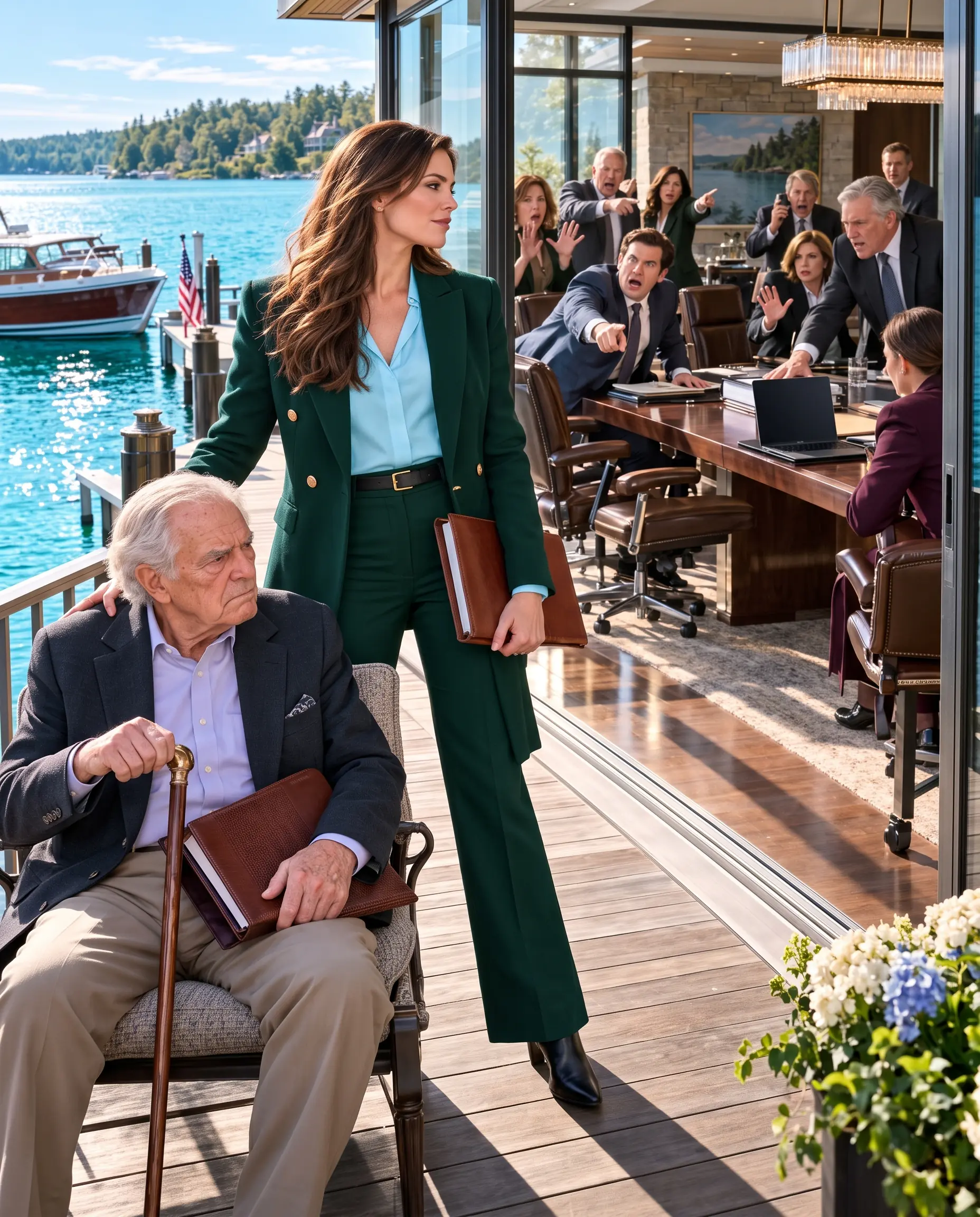
This.
The knowledge that someone he loved might have used his trust against him.
I walked toward him.
“I’m making sure nobody can sell anything unless it’s truly what you want and legally appropriate.”
He looked past me at Nolan.
“Nolan?”
My brother’s face changed.
For one second he looked twelve years old.
Then Grandpa asked the question that broke whatever remained between them.
“Why didn’t you just ask me?”
Nolan opened his mouth.
Nothing came out.
Grandpa nodded slowly, as though silence itself had answered him.
Then he turned and walked back toward the porch.
Nolan left that afternoon.
There was no dramatic screaming.
No slammed suitcase.
No final insult worth remembering.
Only tires crunching across wet gravel while Grandpa stood at the window and watched the rental SUV disappear through the trees.
Then he said, almost to himself, “Your grandmother would’ve been angry.”
I knew exactly what he meant.
But the court hearing was still months away.
And Nolan had signed a promise, not undergone a transformation.
I learned the difference three weeks later when Elena called and said, “Your brother has hired litigation counsel.”
### Part 5
Nolan fought the guardianship.
Not openly at first.
His lawyer requested medical records, questioned my financial motives, and argued that Grandpa’s fluctuating capacity meant the recently signed power of attorney should be respected.
I expected that.
What I didn’t expect was how painful it would be to read myself described in court documents as an “interested beneficiary with substantial emotional and financial incentives.”
Technically, it was true.
I was in Grandpa’s will.
I loved the cottage.
I would benefit someday if it remained valuable.
That was why I welcomed scrutiny.
The independent assessor interviewed Grandpa without me.
The trust officer reviewed his finances.
My own banking records were irrelevant but I volunteered anything necessary to demonstrate I had never taken money from him beyond reimbursements for groceries, household repairs, and expenses documented with receipts.
Elena asked me one afternoon, “You understand you don’t need to prove moral perfection?”
“I know.”
“You sound like you’re trying.”
“I need there to be no question.”
“There will always be questions.”
She was right.
Court does not produce perfect certainty.
It produces findings based on evidence.
Winter came.
Snow buried the dock.
Grandpa’s memory declined slowly enough that some weeks I convinced myself nothing had changed.
Then he would call me by my mother’s name.
Once he put the TV remote in the refrigerator.
Another time he woke at dawn, dressed for work at a job he had retired from twenty-two years earlier.
But he still knew the cottage.
That seemed to live somewhere deeper.
He could walk to the shed in darkness and find the exact drawer containing a specific wrench.
He remembered which window stuck in damp weather.
He could point through snow toward the shoreline and tell me where the lake bottom dropped suddenly from six feet to twenty.
And whenever the independent evaluator asked what he wanted done with the cottage, his answer stayed consistent.
“I want to live there as long as I safely can.”
That mattered.
Four months after Nolan’s visit, the court issued its decision.
I was appointed guardian of property, subject to professional oversight and annual accounting.
The court restricted the disputed power of attorney from further use and noted significant concerns regarding the circumstances in which Grandpa had signed it.
The interim preservation order became part of the ongoing structure protecting his assets.
No cottage sale without proper justification.
No unexplained transfers.
No quiet shortcuts.
I read the decision at my kitchen table with snow melting from my boots onto the floor.
I expected relief to feel bigger.
Instead, I made tea.
Then I cried for about five minutes.
Not because I had won.
Because this was now official.
Grandpa’s condition was serious enough that a court had entrusted another person with protecting his property.
There was no pretending anymore.
Nolan called that evening.
I watched his name glow on the screen before answering.
“Hello.”
“So it’s done.”
“Yes.”
“You got what you wanted.”
I closed my eyes.
“I wanted Grandpa to sign a proper POA two years ago while this was easier. I wanted you to visit because you loved him. I wanted none of this.”
“You always have an answer.”
“No. I have paperwork. There’s a difference.”
He was silent.
Then he said, “You made me look like a criminal.”
“I didn’t call you one.”
“You reported the bank incident.”
“The bank recorded the bank incident.”
“You know what I mean.”
“Yes.”
Another silence.
“I was trying to protect my family.”
“So was I.”
“Paige thinks I went too far.”
“That sounds like something you two should discuss.”
“You really don’t care what happens to us, do you?”
There was a time that question would have pulled me apart.
Now it only made me tired.
“I care about you, Nolan. That’s why this hurts.”
“Then withdraw some of this.”
“No.”
“Maren.”
“No.”
“You said the cottage stays in the family either way.”
“That isn’t the issue.”
“Then what is?”
“You still think consequences are something other people impose on you.”
His breathing changed.
I kept going.
“You had Grandpa sign something he didn’t understand. You tried to move money. You started preparing his home for sale after he told you he wanted to keep it. And now you want me to prove I love you by making those facts disappear.”
“I made a mistake.”
“You made a sequence of decisions.”
“So people don’t get forgiven?”
“Sometimes.”
He waited.
I knew what he wanted.
He wanted me to say eventually.
He wanted the emotional equivalent of an escape hatch.
I didn’t give him one.
“I’m not carrying hatred for you,” I said. “But I will never trust you with Grandpa’s finances again. I won’t pretend this was confusion. And I won’t apologize for stopping you.”
His voice became distant.
“So that’s it.”
“For this? Yes.”
He hung up.
We did not speak for almost six months.
I wish I could tell you the silence broke my heart every morning.
It didn’t.
At first, I missed him.
Then I realized I mostly missed the brother I kept imagining he might become.
The one who would eventually show up.
The one who would see Grandpa as a person before seeing the cottage as property.
The one who would call me and say, “I understand what I did.”
That brother did not exist simply because I wanted him to.
Late love does not erase timely betrayal.
An apology offered only after access is gone is not the same thing as character.
So I stopped waiting.
Spring arrived slowly.
The snow receded from the trees first, then the clearing, then the strip of grass beside the lake.
When I walked down to the dock one April morning, Grandpa was right.
The boards needed sealant.
He stood behind me wearing an old canvas jacket and said, “Told you.”
“You’ve been waiting six months to say that.”
“Longer.”
In May, we worked on it together.
I did most of the sanding.
Grandpa insisted on applying the first coat himself.
The afternoon was warm, and the lake smelled like wet earth and pine.
Every few minutes a loon called from somewhere beyond the point.
Grandpa worked slowly, moving his brush along each board with exaggerated concentration.
At one point he stopped.
“Your grandmother hated this job.”
“I thought she liked helping.”
“She liked telling me how badly I was doing it.”
“That sounds more believable.”
He laughed.
Then his face became distant.
“Is she coming later?”
My hand froze around the brush.
There are moments when dementia asks you to choose between truth and kindness.
The answer changes every time.
I looked at him.
He was calm.
Not frightened.
“No, Grandpa.”
He waited.
“Grandma died a long time ago.”
His eyes filled with a sadness so immediate it was as though I had told him for the first time.
“Oh.”
I hated the disease then.
Not dramatically.
Not poetically.
I hated it with the plain fury of someone watching a beloved person repeatedly lose the same thing.
I sat beside him.
After a while he nodded toward the water.
“She liked it here.”
“She loved it.”
“Good.”
Then he picked up the brush again.
That summer Nolan finally came back.
Alone.
He called first.
That was new.
“I’d like to see Grandpa.”
“You can.”
“I’m not asking about the cottage.”
“Good.”
He arrived on a Saturday morning carrying no folders, no wine, no laptop.
Grandpa recognized him instantly.
“Nolan!”
My brother hugged him for a long time.
I stood in the kitchen and let them have the afternoon.
They fished.
Nolan burned burgers.
Grandpa told the sunroom story twice.
Nolan listened both times.
After Grandpa went to bed, my brother found me on the porch.
“I’m sorry.”
I looked at the lake.
“For what?”
He winced.
“Do you really need me to list it?”
“Yes.”
He was quiet for a long time.
Then he did.
Not elegantly.
Not perfectly.
But specifically.
For pressuring Grandpa.
For using the POA.
For believing future inheritance gave him present authority.
For turning old resentment toward me into justification.
For preparing a sale he knew Grandpa didn’t want.
When he finished, he asked, “Do you forgive me?”
I considered lying.
It would have been easier.
“No.”
His face fell.
“I don’t hate you,” I said. “I hope you become someone I can have a relationship with again. But forgiveness isn’t a receipt you get because you finally admitted what happened.”
He nodded slowly.
“So what do I do?”
“Be better without requiring me to reward you for it.”
That hurt him.
I could see it.
But he nodded again.
Then he left the next morning.
We have a relationship now.
A limited one.
He calls Grandpa weekly.
He visits a few times a year.
I do not give him access to accounts, passwords, financial decisions, or anything else that requires trust he has not earned back.
Maybe someday I will trust him differently.
Not the way I did before.
Some things, once broken, should not be repaired to look exactly as they did.
The crack is information.
Grandpa turned eighty-two in June.
We had cake on the porch.
He still beats me at cribbage sometimes, although now I quietly correct the score when he forgets what he counted.
He still checks the dock.
He still tells strangers that he built the cottage himself until I remind him Grandma did half the work.
The guardianship reports are tedious.
Receipts.
Statements.
Forms.
Annual reviews.
I love every boring page.
Accountability was never the enemy.
Secrecy was.
People sometimes assume protecting someone means standing in a room and making a dramatic speech.
I learned differently.
Sometimes protection looks like documenting a missed payment.
Calling a doctor.
Saving an email.
Adding a trusted contact to a bank account years before you think you’ll need one.
Driving through November rain with a folder on the passenger seat.
Filing papers quietly while someone else is making plans they assume nobody can stop.
Then sitting across from the people who would have taken control, passing the potatoes, listening, waiting, and letting them reveal exactly what they intended.
Nolan thought his power came from Grandpa’s signature.
Mine came from patience.
Not because patience made me stronger than him.
Because patience gave me time to make sure the truth had somewhere official to land.
I don’t know what will happen to the cottage decades from now.
Maybe Nolan and I will eventually inherit it.
Maybe maintaining it will become impossible.
Maybe Grandpa’s care will one day genuinely require resources that make selling necessary.
If that day comes, I will sign whatever needs to be signed.
Not because the cottage matters more than Grandpa.
Because it never did.
That was the difference Nolan failed to understand.
The property was valuable because Grandpa’s life was inside it, not the other way around.
For now, the porch still catches the evening sun.
The old cabinet still refuses to shut properly.
The wood stove still smokes if I forget the damper.
And every spring, Grandpa asks whether the dock needs another coat of sealant.
I always tell him it can probably wait another year.
He always tells me I’m wrong.
Sometimes he remembers that we had a legal fight.
Most days he doesn’t.
I’m glad.
There are burdens he spent his whole life carrying for the rest of us.
Now there are some I can carry for him.
My brother once believed inheritance was something waiting at the end of another person’s life.
I know better.
The things that matter most are inherited long before anyone dies.
A way of showing up.
A refusal to take advantage of trust.
The discipline to do the right thing when nobody is applauding.
The willingness to protect someone without needing to own what belongs to them.
Grandpa gave me those things without ever putting them in his will.
And when Nolan flew across the country believing a piece of paper had made the cottage his to control, I didn’t have to scream, threaten him, or beg him to reconsider.
I simply opened a folder.
I showed him the court order.
And for once, the ground beneath my grandfather’s home was stronger than my brother’s entitlement.
It held.
So did I.
THE END!
Disclaimer: Our stories are inspired by real-life events but are carefully rewritten for entertainment. Any resemblance to actual people or situations is purely coincidental.