I Was On The Dock With Grandpa When The Email Arrived: “Your Brother Filed A Power Of Attorney.” I Smiled And Said, “Good Thing I Filed The Court Order Yesterday.” When He Sat Down At That Table…
### Part 1
My grandfather was asking me whether the dock needed another coat of sealant when my phone buzzed against the porch railing beside my coffee mug.
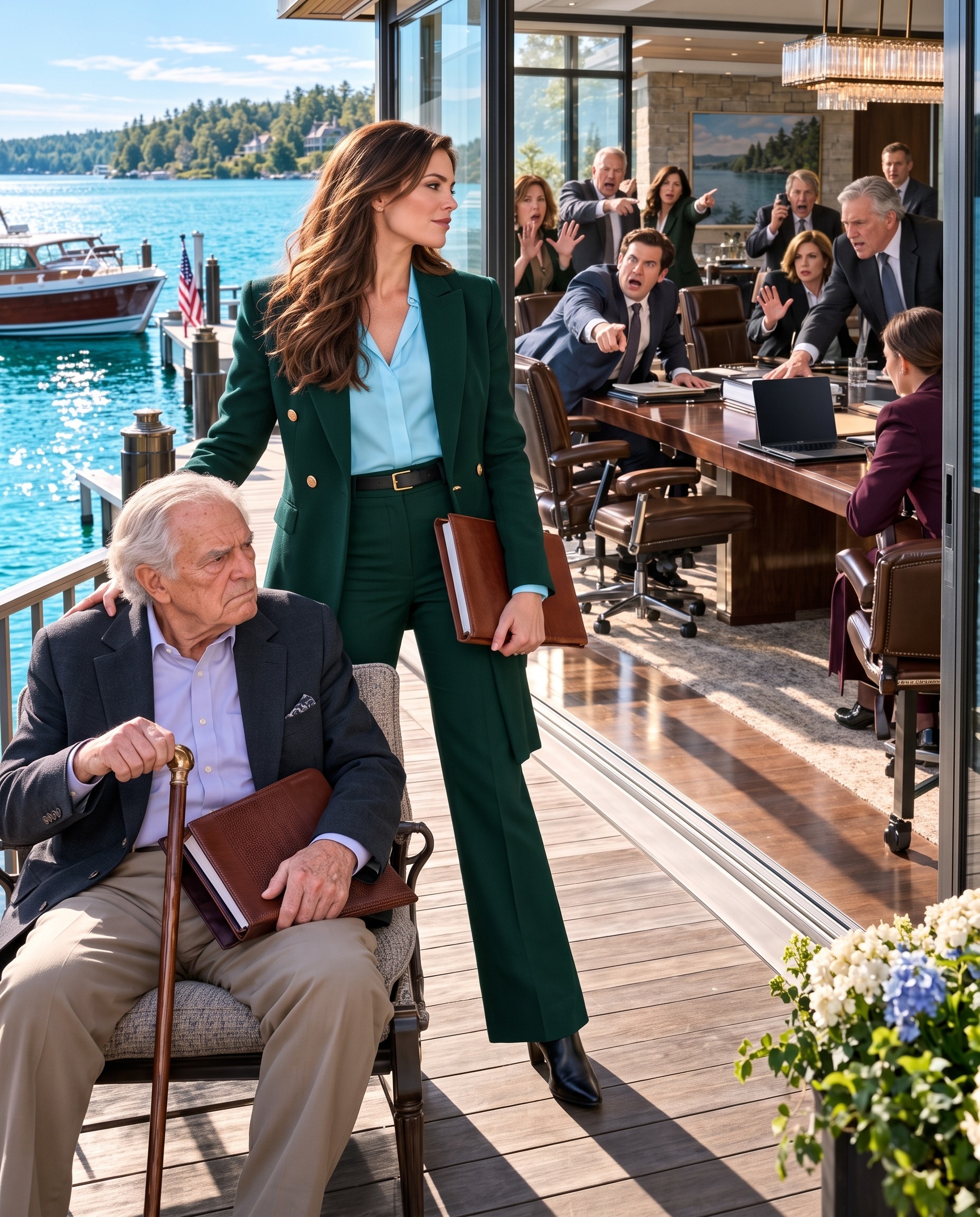
The sound was small, almost lost beneath the soft slap of lake water against the pilings and the rustle of dry maple leaves skittering across the boards, but when I glanced at the screen, something inside me tightened.
The email was from a Calgary law firm I had never heard of.
The subject line contained my grandfather’s full name.
Walter Bennett — Power of Attorney for Property.
I looked up.
Grandpa was leaning forward in his old cedar chair, squinting toward the dock as though the condition of those weathered boards were the most urgent problem in his life.
“That section by the ladder is going gray,” he said. “Should’ve done another coat in May.”
“It’ll survive until spring.”
“You said that last year.”
“And you were right last year too.”
He smiled, pleased with himself, then lifted his coffee with both hands.
I turned my phone facedown.
What I didn’t tell him was that I had spent the previous afternoon in a courthouse in Barrie signing papers designed to stop exactly what that email suggested was happening.
You need to understand the cottage before you can understand why I did that.
Grandpa built it in 1963 on a narrow strip of wooded land beside a lake north of Gravenhurst. At least, he always said he built it. Grandma used to roll her eyes and remind everyone that she had carried lumber, mixed concrete, painted walls, and slept in a tent for half that first summer.
The cottage had grown over the decades.
One bedroom became three. A screened porch became a heated sunroom. Grandpa added a stone chimney one year, a storage shed the next, then the long dock where my brother and I learned to swim.
It wasn’t fancy.
It was better than fancy.
The pine floorboards creaked in recognizable places. The cast-iron stove smoked if you forgot to open the damper properly. One kitchen cabinet never closed all the way because my grandmother had insisted Grandpa was measuring it wrong, and he had been too stubborn to admit she was right.
Every August when I was little, the entire place smelled like cedar, sunscreen, coffee, charcoal smoke, and whatever Grandma had simmering in the kitchen.
She made black bean soup even during the hottest week of summer because Grandpa loved it.
She died when I was sixteen.
After that, he preserved the cottage like a person protecting a language only he still spoke fluently.
Every October he drained the pipes and stacked the porch furniture. Every May he opened the shutters, checked the roof, tested the water pump, and walked the property line with a notebook in his shirt pocket.
He did it because this place had been theirs.
Maybe part of him believed it still was.
My name is Maren Bennett. I’m thirty-one, and I work as a financial planner at a credit union in Gravenhurst. I moved back four years ago, partly because of a job opening and partly because Grandpa had turned eighty and I was starting to notice things during our phone calls that worried me.
At first they were tiny.
He told the same fishing story twice within twenty minutes.
He called me from the grocery store because he couldn’t remember why he was there.
Once he drove home from town and left the milk in the passenger seat until morning.
Nothing dramatic.
Nothing that would have convinced a stranger something was wrong.
But I had watched my grandmother decline before she died, and I knew that sometimes the first warning isn’t forgetting a person’s name.
Sometimes it’s forgetting what you were doing while you’re still doing it.
Grandpa was still funny, stubborn, independent, and capable of beating me at cribbage more often than I liked admitting.
But the gaps were getting wider.
My brother, Nolan, knew that.
Nolan was nine years older than me and lived in Calgary with his wife, Paige, and their two kids. He had a large house, a successful consulting business, and the kind of life that looked polished in Christmas photos.
For years, I defended him whenever anyone suggested he should visit more.
“He’s busy.”
“The kids have school.”
“Flights are expensive.”
“He’ll make it next summer.”
Grandpa never criticized him.
That somehow made it worse.
Every June Nolan would promise to bring the kids to the cottage.
Every August Grandpa would clean the second bedroom anyway.
He would put fresh sheets on both twin beds and buy the cereal Nolan’s children liked.
Then some emergency would appear in Calgary.
A client meeting.
A soccer tournament.
A scheduling conflict.
Grandpa would say, “Next year, then.”
The hope always came back fresh.
That was the hardest part to watch.
Grandpa’s estate was valuable enough to attract attention, although he never lived as though it was.
The cottage and four acres were worth close to a million dollars. He had retirement investments, savings, and no debt. His will divided everything equally between Nolan and me, while specifically stating that the cottage should not be sold for several years after his death unless circumstances made keeping it impossible.
Grandpa wanted time.
Time for grief to settle.
Time for his great-grandchildren to know the lake.
Time for Nolan and me to decide whether the place could remain in the family.
What Grandpa didn’t have was a properly completed power of attorney for property and personal care.
I had tried to arrange it with him more than once.
He always delayed.
“I’m still here, aren’t I?”
“Yes.”
“I still know where my money is.”
“Yes.”
“Then why do we need lawyers involved?”
Because dementia doesn’t send you a calendar invitation, I wanted to say.
Instead, I told him there was no rush.
I regretted that later.
The previous winter, his family doctor documented moderate early-stage dementia and recommended a formal capacity assessment.
I went with Grandpa.
The evaluator was patient. She asked questions about bills, property, medical decisions, risks, and hypothetical situations involving money.
Grandpa did better than I feared.
Then she asked what he would do if a close family member brought him financial paperwork and told him signing it would make life easier.
Grandpa chuckled.
“I’d sign it if I trusted them.”
The evaluator glanced at me.
That answer stayed with me.
Her report said Grandpa retained significant independence but had become vulnerable to influence in complex financial matters, especially when information came from someone emotionally trusted.
He could still make many decisions.
But he increasingly relied on familiar people to tell him whether something was safe.
And Grandpa’s definition of family had always included one dangerous assumption.
Family didn’t lie to you.
Nolan’s calls became more frequent in September.
At first, I was relieved.
Then I noticed that Grandpa started mentioning specific financial subjects after those calls.
“Nolan thinks I should simplify the investments.”
Another evening he said, “Your brother asked who drafted my will.”
Then, while we were eating beef stew at the kitchen table, Grandpa said something that made me stop with my spoon halfway to my mouth.
“Nolan says he can take some of the weight off you.”
“What weight?”
“The finances. The cottage. Things like that.”
I put my spoon down.
“Did he say how?”
Grandpa frowned.
“He explained it.”
“But you don’t remember?”
The hurt that crossed his face made me immediately regret the question.
“I remember enough.”
“Okay.”
I smiled and changed the subject.
The next morning I called Nolan from my office parking lot.
“I heard you’ve been talking to Grandpa about helping with his finances.”
“Someone has to plan ahead.”
“I agree. I’ve been trying to get all of us into a meeting with Grandpa’s lawyer.”
“I’ve already got somebody working on it.”
I remember staring through my windshield at a delivery truck backing toward the grocery store.
“Already?”
“Yeah. Calgary firm. They handle estate planning.”
“Nolan, Grandpa lives in Ontario.”
“They have people who understand Ontario law.”
“What are they preparing?”
He sighed.
Not angrily.
That would have been easier.
He sounded like a patient older brother explaining something obvious to his irresponsible younger sister.
“A power of attorney. Basic stuff.”
“Grandpa needs independent advice before signing anything.”
“Maren, relax.”
“Don’t tell me to relax.”
“It’s paperwork.”
“If it gives you control over his property, it isn’t just paperwork.”
There was a short silence.
Then he said, “You’re too emotionally involved because you’re there every day.”
I almost laughed.
“You mean because I take him to appointments?”
“I mean you’ve convinced yourself proximity makes you the authority.”
“And you think living three thousand kilometers away makes you one?”
His voice cooled.
“I’m his grandson too.”
“I know.”
“Then start acting like it.”
He hung up.
That afternoon I took the folder I had been building for eighteen months and drove to Barrie.
Inside were copies of medical assessments, account records, dates of memory incidents, notes about Nolan’s calls, and a timeline I had never wanted to create.
The lawyer I met with, Elena Mercer, specialized in elder law and guardianship matters.
She read more quietly than anyone I had ever met.
After nearly an hour, she closed the folder.
“You’re worried your brother will get a power of attorney signed and use it to move assets.”
“Yes.”
“Do you believe your grandfather understands the extent of the authority he would be granting?”
“No.”
“Can you prove that?”
“I can prove he’s vulnerable. I can’t predict what he’ll say on one good afternoon.”
“That distinction matters.”
I nodded.
Elena explained that we could apply to the Ontario Superior Court for guardianship of property if the evidence supported it, but she warned me that filing an application did not magically erase every document Grandpa might sign afterward.
That mattered.
I didn’t need comforting legal fiction.
I needed something that would actually protect him.
So Elena prepared an urgent motion requesting temporary restrictions against major transfers, property dealings, and withdrawals until the court could review Grandpa’s capacity and the circumstances surrounding any new power of attorney.
“If the court grants interim relief,” she said, “any attempt to sell the cottage or drain accounts becomes much harder to hide and much harder to complete.”
“Can Nolan be notified?”
“Yes.”
“Not yet.”
Elena looked at me.
“I want evidence before he knows I’m watching.”
She held my gaze for a moment, then nodded.
The application was filed Thursday afternoon.
Three days later, on Sunday, a lawyer sent by Nolan arrived at the cottage.
I wasn’t there.
That bothered me more than almost anything else.
Grandpa told me Tuesday over eggs.
“Nolan sent a nice young fellow.”
My hand stopped over the coffee pot.
“What for?”
“Some forms.”
“What forms?”
He saw my face and immediately looked apologetic.
“I suppose I should’ve read them more carefully.”
I sat across from him.
“Do you remember what they were?”
“Bank things, maybe.”
“Did the lawyer explain that Nolan could control investments or the cottage?”
Grandpa rubbed his thumb across the edge of his plate.
“He said it would make things easier.”
“Did you have your own lawyer there?”
“No.”
“Did you ask to call me?”
Grandpa looked embarrassed.
“He said Nolan had already explained everything to you.”
For a second the refrigerator hum seemed unbearably loud.
That was the first lie I could prove.
I reached across the table and covered Grandpa’s hand.
“You didn’t do anything wrong.”
His eyes searched mine.
“I trusted him.”
“I know.”
That night, just before midnight, I found Grandpa standing in the kitchen doorway wearing his robe and slippers.
He looked frightened.
“Grandpa?”
He turned toward me quickly.
“Have you seen Ruth?”
Ruth was my grandmother.
She had been dead fifteen years.
“She was right here,” he insisted. “She’ll worry if she can’t find me.”
I sat with him at the kitchen table until the panic left his face.
After I got him back into bed, I stood alone in the hallway listening to the old clock tick.
Then I opened my laptop.
There was a new email from Elena.
The judge had reviewed our urgent motion.
A temporary court order had been issued.
No sale of the cottage.
No significant transfer of Grandpa’s funds.
No change of beneficiaries.
No use of any newly executed power of attorney for extraordinary transactions until further review.
I read the order twice.
Then my phone lit up with a message from Nolan.
Landing Friday morning. Paige and I are coming to sort out the cottage situation in person.
For the first time in months, I felt completely calm.
Because Nolan thought he was flying east to take control.
He had no idea a judge had already arrived before him.
### Part 2
Nolan showed up Friday wearing expensive boots that had never seen mud and carrying a bottle of wine Grandpa would never have bought for himself.
Paige came behind him with two shopping bags from an upscale grocery store, a cashmere coat draped over one arm, and the bright expression she used whenever she wanted a room to believe she was helping.
“Surprise.”
Grandpa lit up.
That hurt more than anger would have.
“Nolan?”
My brother crossed the porch in three strides and hugged him.
“Who else?”
Grandpa laughed, actually laughed, and for one ugly second I hated Nolan for being able to create that sound after staying away so long.
Then I hated myself for hating him.
Family is inconvenient like that.
Love doesn’t disappear just because someone disappoints you.
Sometimes it stays and makes the disappointment worse.
Paige kissed Grandpa’s cheek and immediately began unpacking ingredients in the kitchen.
“We thought we’d stay a few days and get everything organized.”
Everything.
I noticed the word.
“So this is a visit or a business trip?” I asked.
Nolan glanced at me.
“Can’t it be both?”
“It can be whatever you want to call it.”
Grandpa was already telling Paige where the soup pot lived.
I stepped outside before I said something that would make him feel caught in the middle.
The lake had gone steel-gray beneath the November sky.
Bare branches tapped the roof.
I could smell wood smoke from somewhere across the water.
My phone vibrated in my pocket.
Elena.
I walked down toward the dock before answering.
“The order has been formally entered,” she said. “Certified copies are ready.”
“Good.”
“There’s something else. The bank contacted my office.”
My stomach tightened.
“What happened?”
“Someone submitted the new power of attorney to your grandfather’s financial institution.”
“When?”
“This morning.”
I looked back toward the cottage.
Through the kitchen window, I could see Nolan laughing with Grandpa.
“What did they ask for?”
“A transfer authorization. It was described as advance payment for estate-planning and property-management expenses.”
“How much?”
Elena told me.
It wasn’t enough to destroy Grandpa.
It was enough to establish intent.
“Did the bank release it?”
“No. Your grandfather has a trusted-contact designation. The branch also flagged the request because of his age, recent account history, and the size and purpose of the transaction. They paused it.”
I closed my eyes.
Two years earlier, Grandpa had complained for twenty minutes when I persuaded him to add me as a trusted contact.
“Banks are too nosy.”
“That’s literally why this exists.”
“Nobody’s stealing from me.”
“I hope nobody ever tries.”
Standing beside the lake, I wished desperately that he had been right.
“What do we do?” I asked.
“We document it.”
“Do we confront him now?”
“No.”
That answer surprised me.
Elena continued, “Let him talk. If he believes he has authority, he may explain what he intends to do with it.”
I looked back at the cottage again.
“You want me to sit through dinner.”
“I want you not to interrupt someone who might explain his own plan.”
So I did.
That evening Paige made butternut squash soup with toasted bread and rosemary. The cottage smelled warm and almost painfully normal.
Grandpa told Nolan the story of building the sunroom in 1971.
I had heard it dozens of times.
That night he told it beautifully.
“And your grandmother said the wall was crooked,” he said.
“Was it?” Paige asked.
Grandpa looked offended.
“No.”
I smiled into my wine.
It absolutely was.
After dinner Nolan carried his glass into the living room.
“Actually, Grandpa, the addition is one of the things we should talk about.”
I leaned back.
There it was.
Nolan began gently.
Always gently.
That was his talent.
He explained property taxes, maintenance costs, future care needs, winter accessibility, market conditions.
Every sentence by itself sounded reasonable.
Together they formed a road leading exactly where he wanted.
“The cottage is worth a lot more now than when you built it,” he said.
Grandpa nodded slowly.
“That doesn’t mean much if I’m not selling it.”
“Of course.”
Nolan smiled.
“But someday you might need more support. Full-time care is expensive.”
“I have investments.”
“Sure. But you don’t want to burn through them if the cottage is sitting here mostly unused.”
I watched Grandpa’s brow furrow.
That was the moment I almost stopped it.
Almost.
Then Elena’s advice came back.
Let him talk.
Paige joined in.
“We’re not saying anything has to happen tomorrow.”
That was technically true.
“We’re just saying responsible families plan before there’s a crisis.”
“What kind of plan?” I asked.
Nolan’s eyes moved to me.
“A sale, eventually.”
Grandpa stiffened.
“No.”
The firmness surprised all of us.
Nolan recovered first.
“Not while you want to be here.”
“It belongs to the family.”
“It would still benefit the family.”
I watched his face.
There.
Not Grandpa.
The family.
A softer word for the people who expected to inherit.
I said, “Grandpa’s retirement fund can cover years of projected support.”
Paige looked at me.
“That assumes markets cooperate.”
“There are conservative options.”
“And you’re emotionally attached to the property,” Nolan said.
“So are you apparently, considering you flew across the country to discuss it.”
His mouth tightened.
Grandpa looked between us.
“I don’t want you two fighting.”
That sentence ended it.
I immediately stood.
“We’re not.”
Nolan stood too.
“We’re discussing.”
“No. We’re done tonight.”
Later, after Grandpa went to bed, Nolan cornered me near the wood stove.
“You’re making this harder than it needs to be.”
The fire had burned low. Orange light moved across his face.
“You lied to Grandpa’s lawyer.”
His expression didn’t change.
“What?”
“The man you sent here told Grandpa you’d already discussed the documents with me.”
“I don’t know exactly what he said.”
“Convenient.”
“He was there to witness signatures, Maren, not perform a theatrical production.”
“He was there because you knew Grandpa’s own lawyer would ask questions.”
“You have no idea what I know.”
“I know you already tried using the POA at the bank.”
That did it.
Only slightly.
A tiny shift in his eyes.
But I saw it.
Then he shrugged.
“Of course I did. That’s what a power of attorney is for.”
“The transfer was for estate-planning expenses.”
“Yes.”
“What expenses?”
“Legal fees. Valuation. Preliminary property work.”
“Property work?”
“Don’t play dumb.”
“I want to hear you say it.”
His patience finally cracked.
“The cottage has to be evaluated.”
“For sale.”
“At some point.”
“Grandpa just told you no.”
“He has dementia.”
The words fell between us.
I think he regretted saying them that plainly.
I lowered my voice.
“He has dementia when he disagrees with you, but enough capacity to sign away control when he agrees?”
Nolan looked toward the hallway.
“Keep your voice down.”
“I am.”
“You’re twisting things.”
“No, I think for the first time they’re becoming very straight.”
He rubbed his forehead.
“You know what your problem is? You’ve turned caring for him into your identity.”
I stared at him.
“You think because you moved here and handle his appointments, everything should go through you.”
“Everything concerning a vulnerable man’s property should go through someone who isn’t secretly preparing to sell it.”
“I’m protecting him.”
“From what?”
“From you treating this place like a museum.”
I laughed once, without humor.
“You came here twice in nine years.”
His jaw flexed.
“That doesn’t mean I don’t care.”
“No. But it tells me what you care enough to show up for.”
He stepped closer.
Not threatening.
Just angry enough to forget the polished version of himself.
“You’ve always done this.”
“Done what?”
“Acted morally superior because you choose the difficult option and then resent everyone who doesn’t.”