The forms had been submitted five days before Naomi moved into my house.
The officer turned the first page around and slid it across the desk.
“Would you like to explain why you signed this before entering the house?”
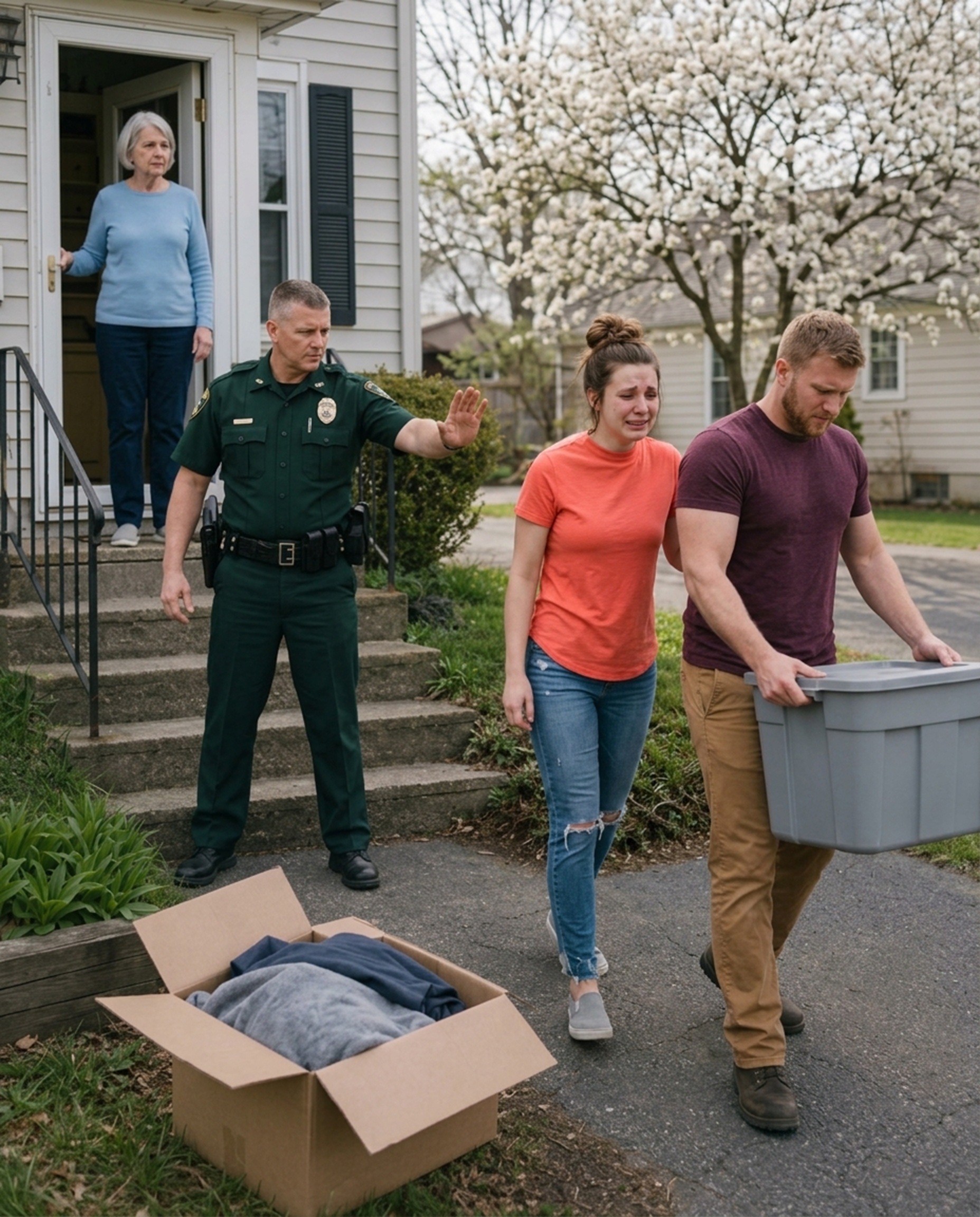
Naomi didn’t answer.
For the first time, she looked genuinely frightened.
Because the situation no longer looked like a family making a desperate decision in the middle of a housing crisis.
It looked planned.
That afternoon, I went home and began gathering every document connected to the cottage.
The deed.
Property-tax records.
Insurance paperwork.
Retirement-account statements.
Renovation receipts.
Every document that showed exactly how much time, money and effort I had invested in that house.
There was no mortgage.
No lease.
No estate agreement giving Naomi any rights.
No written permission allowing her to live there.
The cottage had passed to me through my mother’s estate.
It was mine.
Completely.
And the records made that unmistakably clear.
If the matter ever went further, there would be no confusion about who owned the property.
Naomi had no legal claim to it.
What disturbed me most wasn’t simply that she had entered my house.
It was the preparation.
She hadn’t just walked through the door one evening because she had nowhere else to sleep.
She had already begun creating a paper trail.
She had redirected mail.
She had used my address for her children’s school enrollment.
She had taken a key.
She had moved boxes.
She had begun turning my address into hers before I even knew she was planning to enter.
She wasn’t asking to stay.
She was preparing to establish that she already belonged there.
And that realization hurt more than the break-in itself.
I changed every lock.
I installed a new deadbolt.
I replaced every access code.
The unauthorized mail forwarding was reversed.
The school district rejected Naomi’s attempt to use my address.
I put the police paperwork beside the deed in a fireproof box.
Then I waited.
For weeks, Naomi called.
I didn’t answer.
She left messages.
Some were angry.
Some were emotional.
Some reminded me of everything I had done for her.
And that was the part that hurt the most.
Because I remembered.
I remembered the frightened eight-year-old arriving with a suitcase.
I remembered school lunches.
Parent-teacher conferences.
Emergency rooms.
Braces.
College tuition.
Graduation day.
I remembered the girl who once hugged me and said she didn’t know what she would have done without me.
I still don’t regret any of it.
Not one dollar.
Not one late-night drive.
Not one school event.
Not one sacrifice.
But I finally understood something I should have understood years earlier.
Helping someone does not give them ownership of your life.
Love does not make your home communal property.
Generosity is not a contract.
And being the person who rescued someone once does not mean you must rescue them forever.
One May morning, Mrs. Puit came over with a box of lemon shortbread.
We sat together on my porch.
The same porch Naomi had once measured with her eyes.
The same porch I had nearly lost to someone else’s assumption that my generosity would never end.
Sunlight moved slowly through the dogwoods.
For the first time since the night of the cameras, the cottage felt peaceful again.
I looked around.
The roof I had paid to replace.
The plumbing I had updated.
The kitchen I had renovated.
The insulation I had added.
The rooms I had carefully prepared for a quiet retirement.
All of it was still there.
Mine.
I thought about Naomi.
I thought about the little girl she had been.
And I thought about the woman she had become.
There was sadness in that realization.
But there was also clarity.
I had spent eleven years teaching Naomi that she would never be abandoned.
I had shown her that someone would always be there when she needed help.
Maybe I had simply forgotten to teach her the other half of that lesson:
That needing help does not mean you are entitled to take what belongs to someone else.
That family can open its heart without surrendering its boundaries.
And that sometimes, protecting the life you built requires saying no—even to the people you once would have done anything for.
Naomi had once needed me to open a door for her.
This time, she had decided the door belonged to her.
It didn’t.
It never had.
And as I sat on that porch with my neighbor, listening to the leaves move in the afternoon breeze, I finally understood the difference between generosity and surrender.
Generosity can create gratitude.
It does not create ownership.
Sometimes protecting what you built doesn’t require a dramatic confrontation.
Sometimes it begins with something much simpler.
Changing the locks.
And refusing to hand over the keys again.
The END.