The text arrived at 10:17 on a Tuesday night.
I was nearly two hundred miles away from home, staying with an old coworker in Asheville, North Carolina, when my phone lit up beside my bed.
The message was from Mrs. Puit, my neighbor back home in Tennessee.
It contained only six words:
“Lights on at your place. Someone’s inside.”
I sat upright immediately.
My reading glasses were still on my face, and a half-finished mug of chamomile tea was cooling on the nightstand.
I stared at the message for several seconds before typing back.
“Are you sure? Could it be the porch light?”
Her response came almost instantly.
“No. Living room. I can see movement through the window.”
My hands went completely still.
Two months earlier, I had installed four security cameras at the cottage my late mother had left me.
One faced the front door.
One covered the driveway.
And two were inside the house.
I opened the security app.
The living-room feed loaded.
And there she was.
My niece, Naomi.
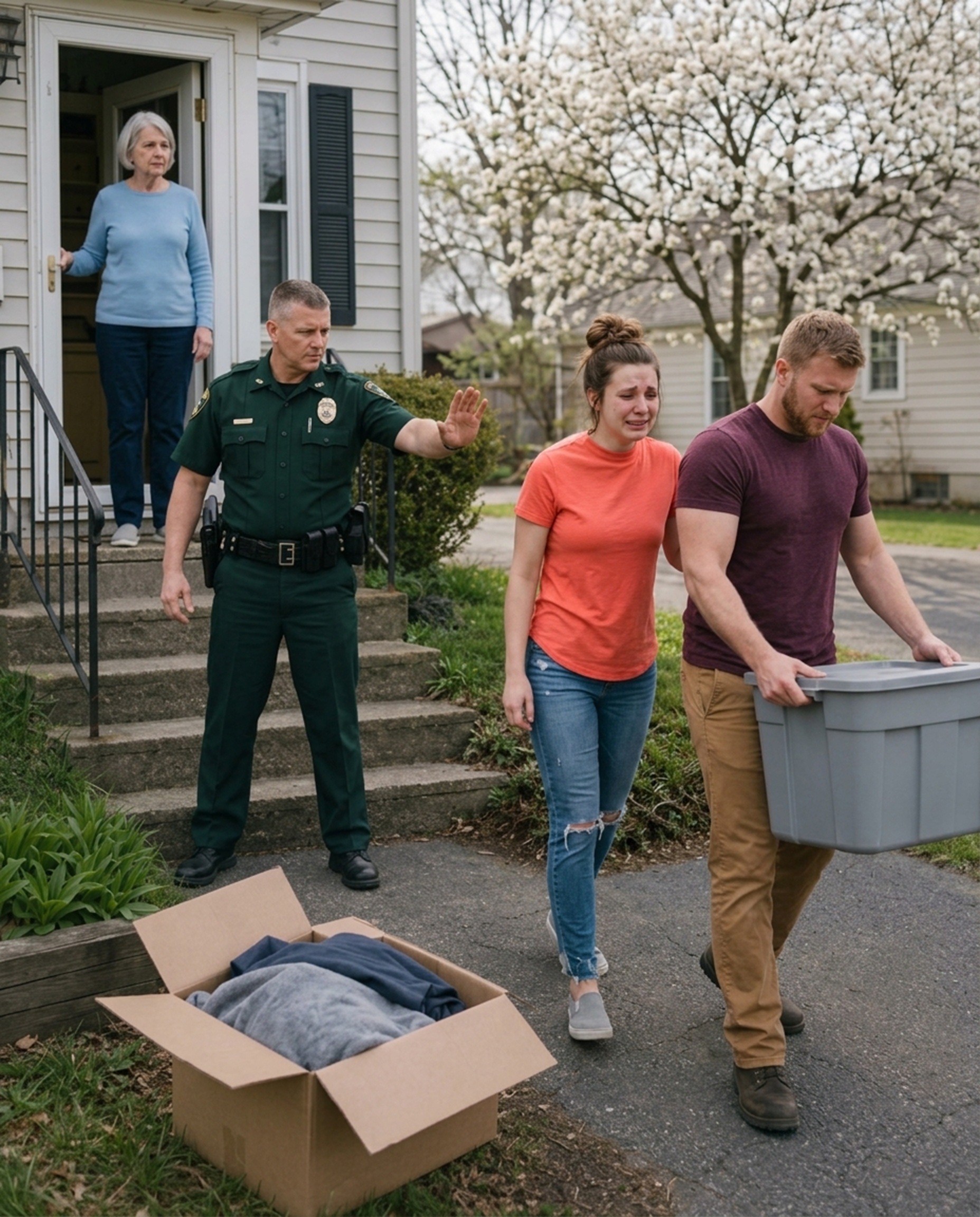
She was standing in the middle of my living room, pointing toward the hallway while her husband, Brent, carried a large plastic storage bin.
Boxes were stacked against my walls.
Two were already open.
Their children’s toys were scattered around my coffee table.
The children themselves were running from one room to another.
Brent disappeared down the hallway carrying what looked like bedding.
I watched for several seconds, unable to process what I was seeing.
Then the truth became impossible to ignore.
They weren’t visiting.
They weren’t staying for the weekend.
They weren’t there because of some emergency.
They were moving in.
Into my home.
The home I had spent years restoring for my retirement.
The home where I had imagined finally having peace.
And the woman directing the entire operation was the same girl I had spent eleven years raising.
Naomi was only eight years old when her parents’ marriage collapsed.
My brother came to me with a suitcase and a tired expression and asked whether she could stay with me “for a little while.”
That little while lasted eleven years.
I never complained.
I packed her lunches.
I helped with homework.
I attended parent-teacher conferences.
I sat through school concerts and school plays.
I was there for the ordinary things that children remember only when they’re older.
And I was there for the frightening things, too.
When Naomi suffered a dangerous allergic reaction in the school cafeteria, I was the one who drove her to the emergency room.
I remember gripping the steering wheel with one hand while reaching into the back seat with the other so she could hold my fingers.
I was terrified.
She was terrified.
But I stayed calm because she needed me to.
I paid for her braces using what remained of my late husband’s life insurance.
Later, when financial aid wasn’t enough, I withdrew money from my 403(b) to help cover three years of in-state college tuition.
I didn’t keep a running total.
I didn’t send her invoices.
She was my niece.
And, for many years, she felt like my daughter.
At her graduation, she hugged me tightly.
“I don’t know what I would’ve done without you,” she whispered.
I believed her.
And I never regretted helping her.
But somewhere along the way, something changed.
Naomi began to treat my love as though it came with permanent rights.
Not just to my time.
Not just to my attention.
But to the things I owned.
The first warning came during Christmas dinner the year before.
I had been talking about retirement from the county library system.
After 31 years of working, I was finally ready to slow down.
Naomi asked what I planned to do afterward.
So I told her.
I told her about the cottage my mother had left me in 2019.
I had spent three years turning it into the home I wanted for the rest of my life.
I replaced the roof.
Updated the plumbing.
Added insulation.
Renovated the kitchen.
Repaired things that had been neglected for years.
It wasn’t a mansion.
It was a quiet cottage surrounded by trees, with a porch overlooking the dogwoods.
When I talked about it, I could already picture myself there with a book and a cup of coffee.
“I’m going to live there,” I said.
Naomi exchanged a quick glance with Brent.
Then she looked back at me.
“That’s a lot of room for one person.”
“It’s a cottage,” I said.
“We need more space,” she replied.
I remember putting my fork down.
Naomi continued as though she were presenting a perfectly reasonable idea.
“Maybe we could share it. You could keep the main bedroom, and we’d take the other two.”
“No.”
She blinked.
I repeated myself.
“Naomi, I’m not giving up my retirement home.”
Brent smiled and called it “brainstorming.”
But he wasn’t brainstorming.
His eyes were moving around the room.
Measuring.
Calculating.
Looking at the bedrooms, the kitchen and the hallway as though he were already deciding where his family’s belongings would go.
That night, I made two quiet decisions.
I would finish the cottage.
And I would never give Naomi a key.
I kept both promises.
I moved without announcing it.
Only one trusted former coworker knew when I was finally ready.