The officer took Meadow downstairs while another officer secured the house.
Dennis was sitting at the kitchen table.
Serena stood beside him.
Neither spoke.
I walked toward them.
“Where is the ledger?”
Dennis looked at me.
“I don’t know.”
Serena closed her eyes.
Then she whispered:
“I do.”
Everyone turned toward her.
Dennis stood.
“Serena, don’t.”
She looked at him.
“You nearly killed her.”
His face fell.
“You helped me.”
“I know.”
“And you were there.”
“I know.”
“You knew what they wanted.”
“I know.”
She began crying.
“But I didn’t know Dennis would hurt Meadow.”
I looked at my sister.
“You brought them into my home.”
She nodded.
“Yes.”
“Why?”
Her voice broke.
“Because I was in debt.”
The room became silent.
“They threatened me,” she continued. “They said if I didn’t get the ledger, they’d destroy me. I thought it was just about money. I thought they wanted information about your father’s investigation.”
She looked at Meadow.
“Then everything changed.”
“What changed?”
Serena swallowed.
“They told me Meadow had seen too much.”
I felt something inside me go cold.
“You were going to let them hurt my daughter?”
“No.”
She shook her head desperately.
“I tried to stop them.”
Dennis laughed bitterly.
“You didn’t.”
“I called you.”
“You called me after they were already inside.”
I looked at Dennis.
“You knew they were coming?”
He nodded.
“I was supposed to hand over the ledger.”
“Why didn’t you?”
His eyes filled with tears.
“Because I couldn’t.”
I stared at him.
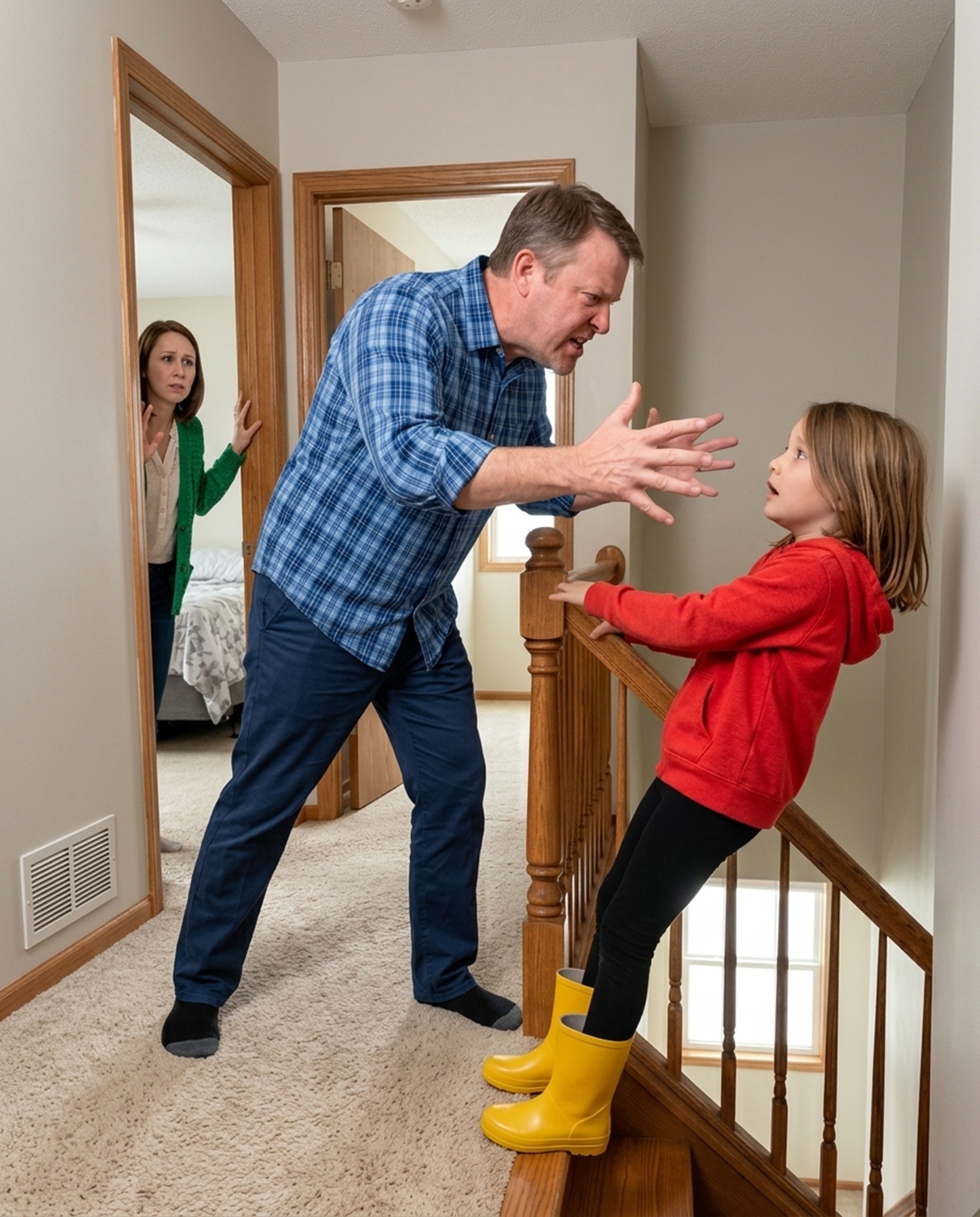
“You threw our daughter down the stairs.”
He lowered his head.
“I know.”
“No explanation changes that.”
“I know.”
“You betrayed me.”
“I know.”
“You destroyed our family.”
He whispered:
“I know.”
The police arrested both of them.
Serena cooperated.
Dennis eventually confessed.
But the mystery of the ledger remained.
Until Meadow spoke.
She was sitting in the living room wrapped in a blanket when she looked at the photograph of my father.
“Mom?”
“Yes?”
“Grandpa told me where it was.”
I stared at her.
“What do you mean?”
She pointed to the photograph.
“He told me once.”
“When?”
“Before he died.”
I felt my heart stop.
“You met Grandpa?”
She nodded.
“Once.”
I knelt beside her.
“What did he say?”
She whispered:
“He said that if anything bad ever happened, I should tell my mom to look where the horses sleep.”
My mind raced.
The old Hawthorne property.
The barn.
My father had built a false wall behind the hay storage area.
I remembered it suddenly.
When I was sixteen, he had told me never to open it.
We drove there before sunrise.
The police came with us.
Behind the old barn, beneath years of dust and hay, we found the hidden compartment.
Inside was a metal box.
The ledger was there.
So were photographs.
Names.
Bank records.
Military contracts.
Evidence proving that several powerful men in the county had been stealing money for decades.
And there was one final letter from my father.
I opened it with shaking hands.
This time, the handwriting was unmistakably his.
My little girl,
If you’re reading this, I failed to keep this secret buried.
But I need you to know something.
I never hid this because I didn’t trust you.
I hid it because I loved you.
You were always stronger than you believed.
I couldn’t continue.
I pressed the letter against my chest.
For the first time since Meadow had been hurt, I allowed myself to cry.
Not from fear.
From relief.
My father had known.
He had always known who I was.
A survivor.
A fighter.
His daughter.
The investigation that followed lasted months.
The men behind the scheme were arrested.
The evidence from my father’s ledger finally cleared his name.
His death, which had been dismissed as an accident, was officially reopened.
And this time, the truth won.
Dennis was convicted for assaulting Meadow and for his role in the conspiracy.
Serena received a reduced sentence after cooperating fully with investigators.
I never forgave either of them.
But I eventually stopped carrying them inside my heart.
That was another kind of freedom.
Meadow recovered slowly.
Her shoulder healed.
The bruises faded.
The nightmares took longer.
So did the fear.
But one evening, almost a year later, she came running into the barn wearing her purple rain boots.
“Mom!”
I turned from the horse I was examining.
“What?”
She held something behind her back.
“What have you got?”
She smiled.
“A surprise.”
She pulled out a new stuffed triceratops.
“General Pickles has a girlfriend.”
I laughed.
A real laugh.
The first one that didn’t hurt.
“What is her name?”
She thought seriously.
“Captain Pickles.”
I shook my head.
“That is terrible.”
“You’re just jealous.”
She ran away laughing.
I watched her go.
The sun was setting over the Nebraska fields.
Golden light spilled across the barn doors.
For years, I had believed strength meant never breaking.
I was wrong.
Strength was getting back up.
Strength was believing your child when the world wanted you to doubt her.
Strength was walking through your own front door after betrayal and refusing to become the person who hurt you.
And sometimes strength was simply sitting in a barn at sunset, listening to your daughter laugh.
Meadow came back and wrapped her arms around my waist.
“Mom?”
“Yes, sweetheart?”
“Are we okay now?”
I looked down at her.
At the missing tooth.
The healed shoulder.
The purple boots.
The little girl who had survived what no child should ever have survived.
I kissed the top of her head.
“Yes.”
She smiled.
“Forever?”
I held her tighter.
“Forever.”
Behind us, the old barn creaked softly in the evening wind.
My father’s photograph rested safely inside my home.
The ledger was finally in the hands of the people who could use it to finish what he had started.
The truth had come out.
The people who betrayed us had answered for it.
And my daughter was still here.
That was enough.
More than enough.
I had spent twenty years learning how to survive.
But that night, watching Meadow run through the golden grass, I finally learned something better.
How to live.
And when she turned around and shouted, “Mom, race you!”
I smiled.
Then I ran after her.
I ran toward the stairs.
“Mom!”
It was Meadow.
My daughter.
Alive.
Terrified.
But alive.
I took the stairs two at a time until the officer caught up with me.
“Mrs. Hawthorne, wait!”
I stopped at the landing.
The upstairs hallway was empty.
Meadow wasn’t there.
For one terrible second, I thought I had imagined her voice.
Then I heard it again.
“Mom?”
It was coming from my bedroom.
I pushed the door open.
Nothing.
The curtains moved in the cold night air.
My cedar chest sat open.
My father’s photograph lay on the floor.
Then I saw the closet door.
It was slightly open.
I reached for it.
“Mom!”
The voice came from inside.
I pulled the door open.
And there she was.
Meadow.
Curled beneath a pile of blankets.
Her face was pale, her arm still wrapped from the hospital, her purple rain boot missing from one foot.
I dropped to my knees.
“Oh, baby.”
She threw her good arm around my neck.
I held her so tightly I was afraid I might hurt her.
“I thought you were at the hospital,” I whispered.
“I was.”