My seven-year-old daughter found my husband and my sister in my bed, and he threw her down the stairs to keep her quiet. When the hospital called, my baby whispered, “Mom, I’m sorry,” then told me they were still home drinking whiskey—because the town’s perfect father and her favorite aunt thought I would shatter before I fought back.
The call came while I was stitching a border collie’s shoulder.
The room smelled like antiseptic, wet fur, and the faint copper edge of blood. My hands were steady around the needle when my phone lit up.
County General Hospital.
Something inside me went quiet before I answered.
“This is Victoria Hawthorne.”
The woman on the other end spoke carefully. “Mrs. Hawthorne, you need to come to the emergency room immediately. It’s your daughter.”
Meadow.
Seven years old. Missing one front tooth. Purple rain boots in every season. A stuffed triceratops named General Pickles tucked into bed every night.
I don’t remember taking off my gloves. I remember the snap of latex against my wrist and telling my assistant, “Cancel the rest of the day.”
Then I was gone.
At the hospital, the receptionist’s expression changed when I gave my name. A nurse holding a clipboard couldn’t quite meet my eyes.
“Mrs. Hawthorne, your daughter is in critical condition. The doctor will explain, but you should prepare yourself.”
Prepare yourself.
I had served twenty years in the military. Three tours. A Bronze Star sitting in a box in my closet. I knew how to keep my hands steady when panic could get people killed.
None of that prepared me to see my child in a hospital bed.
People in our small Nebraska town knew me as Doc Tori. They brought me their horses, calves, barn cats, and farm dogs. They knew blood didn’t scare me.
They didn’t know what calm had cost me.
The doctor walked me down the hall explaining what they knew: a reported fall down the stairs, imaging, a shoulder injury, observation, possible internal trauma. Meadow had arrived at 2:17 p.m.
Then I saw her.
She looked tiny beneath the hospital blankets. One arm was wrapped, one shoulder braced, and dark bruising marked her small body. Machines beeped beside her with the cruel steadiness of ordinary equipment doing an extraordinary job.
“Meadow?”
Her eyes opened.
“Mom,” she whispered. “I’m sorry.”
I leaned over her, afraid even to touch her too hard. “No, sweetheart. You do not apologize. Not to me. Not ever.”
Her eyes moved toward the door.
That was when I understood she wasn’t only hurt.
She was afraid someone might hear her.
“I saw Dad,” she whispered. “With Aunt Serena.”
My stomach went cold.
“In your bed.”
Dennis.
Serena.
My husband of nine years and my younger sister—the woman who had a spare key to my house, knew the alarm code, helped with Meadow when emergencies kept me late, and was loved by my daughter without hesitation.
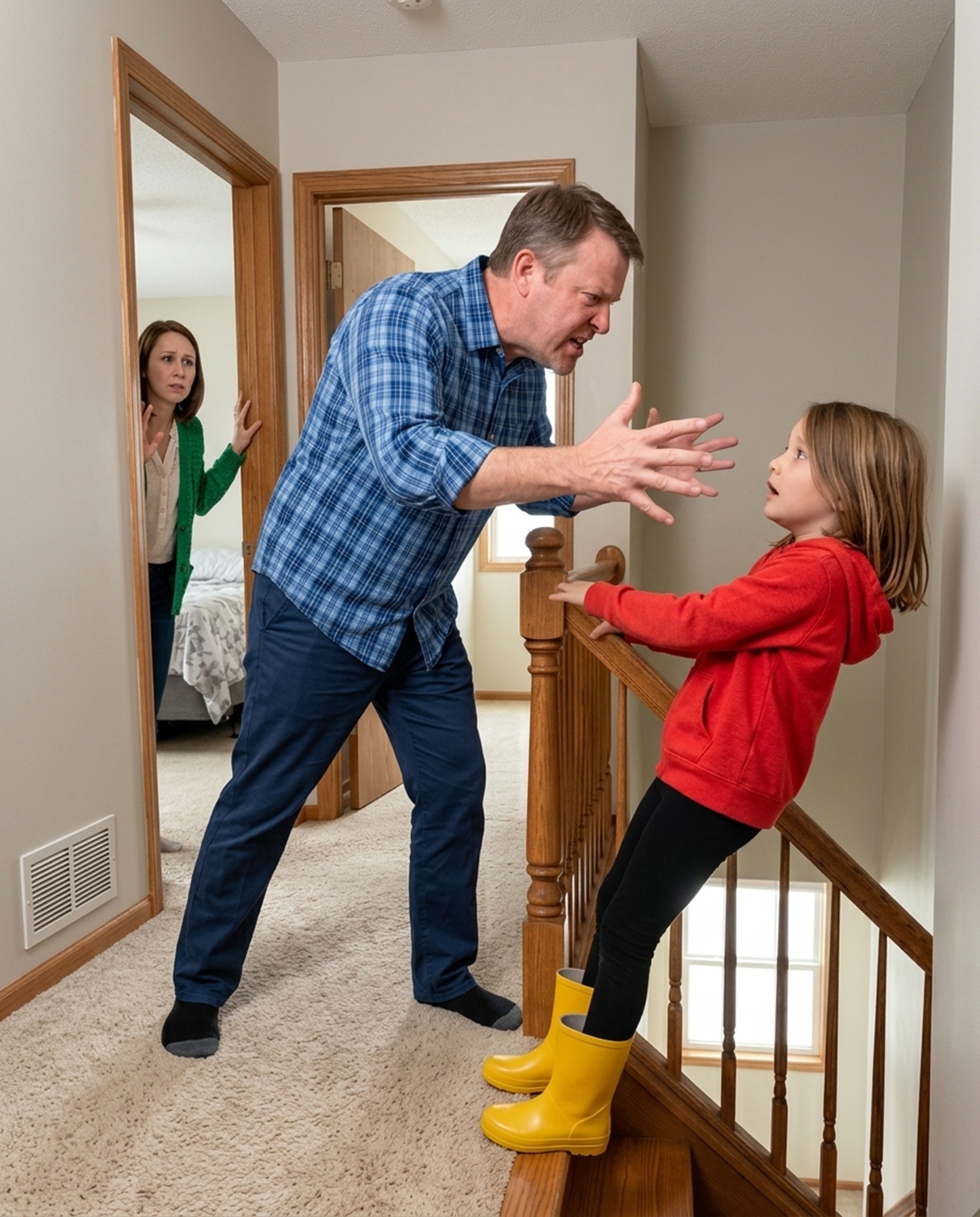
Meadow swallowed through the pain. “He got mad. He said I ruined everything. Then he threw me down the stairs.”
I went completely still.
“They told me to say I fell,” she continued. “Playing dress-up. Dad said nobody would believe me.”
“I believe you,” I said immediately.
Her eyes searched mine.
“I believe every word.”
Then she whispered the sentence that changed everything.
“They’re still there. In the kitchen. Drinking whiskey.”
Some anger burns.
Mine froze.
A nurse entered quietly and told me the police were waiting outside.
I kissed Meadow’s forehead. “Mommy is going to handle this.”
“Don’t let them be mad at me,” she whispered.
That nearly broke me.
“They do not get to be mad at you,” I told her. “They get to answer.”
Two officers waited near the nurses’ station. I gave them the facts without decoration: my daughter said her father hurt her after she found him with my sister. He told her to lie. Both adults were apparently still at my house drinking.
Then I gave them what could be checked.
The hospital had the intake form. Meadow arrived at 2:17 p.m. She told me what happened at 2:43 p.m. The doctor had documented her injuries.
And my house had cameras facing the stairwell and the back door.
The officer’s pen paused.
“I know where Dennis keeps the whiskey,” I said. “I know the back door sticks when it opens. If you want the truth before they have time to clean anything up, we need to go now.”
Twenty-six minutes later, three patrol cars rolled quietly into my gravel driveway with their lights off.
Through the kitchen window, I could see Dennis holding a glass of whiskey like this was an ordinary afternoon.
Serena sat in my chair, barefoot, laughing.
The lead officer walked onto the porch and knocked.
Dennis came to the door.
For the first time in nine years, my husband opened my front door and saw exactly who he had underestimated.
The knock came again.
Three hard raps against the front door.
Dennis froze.
For half a second, he simply stood there with the whiskey glass in his hand, staring toward the entryway as though he could will whoever was outside to disappear.
Serena stopped laughing. Her smile faded first.
Then the color left her face. “Who is that?” she whispered.
Dennis didn’t answer.
He set his glass on the kitchen counter.
I watched from the patrol car parked across the gravel drive, sitting beside the lead officer.
My hands were folded in my lap.
They were steady.
That surprised me.
Because inside that house were the two people I had trusted most in the world.
And neither of them knew that the woman they had spent years underestimating was sitting twenty yards away, watching them walk directly into the consequences of what they had done.
The officer knocked a third time.
“Dennis Hawthorne?”
A pause.
Then Dennis opened the door.
“Can I help you?”
His voice was smooth.
Polite.
Almost offended.
The town loved that voice.
Dennis had coached Little League for six years. He organized the annual Fourth of July parade. He donated lumber to the elementary school when the roof needed repairs.
People called him dependable.
A good father.
A good husband.
The kind of man who shook your hand firmly and remembered your children’s names.
The officer showed his badge.
“Sir, we need to speak with you about an incident involving your daughter.”
Dennis’s expression changed.
Only slightly.
But I saw it.
His jaw tightened.
His eyes flicked past the officer toward the driveway.
Looking for me.
He didn’t see me.
Not yet.
“My daughter?” he said.
“Yes.”
“What happened?”
The officer’s voice remained calm.
“We understand she was injured this afternoon.”
Dennis blinked.
Then came the performance.
“Oh, God.”
He put one hand against his chest.
“She fell down the stairs.”
Behind him, Serena appeared in the hallway.
Barefoot.
Still wearing the silk blouse she’d worn when I left for work that morning.
My blouse.
I had bought it for her birthday.
She saw the officers.
Then she saw Dennis.
Then she looked toward the windows.
Something in her face told me she was afraid.
Not for Meadow.
For herself.
The second officer stepped forward.
“Mr. Hawthorne, we’d like to ask you a few questions.”
“Of course.”
Dennis smiled.
That smile almost made me laugh.
Almost.
He thought this was still a conversation he could control.
He didn’t know that the hospital had already documented Meadow’s words.
He didn’t know that the officers knew about the cameras.
And he certainly didn’t know that I had spent twenty years learning that the most dangerous moment in any operation wasn’t when the shooting started.
It was the moment your opponent realized they had lost.
The officer looked past him.
“Is anyone else inside?”
Dennis hesitated.
“My sister-in-law.”
Serena’s head snapped toward him.
Sister-in-law.
Not Serena.
Not the woman who had been sleeping in my bed.
Just my sister-in-law.
The officer noticed the hesitation.
“So she’s here?”
“Yes.”
“Can we speak with her?”
Dennis stepped aside.
Serena came forward.
She had always been beautiful.
That was one of the things people noticed first.
Dark hair. Green eyes. A soft smile that made strangers trust her.
When we were children, she could cry and have our mother apologizing to her within thirty seconds.
I was the opposite.
I learned early that tears didn’t change anything.
So I learned not to waste them.
Serena looked at the officers.
“What happened to Meadow?”
Her voice cracked perfectly.
Dennis reached for her hand.
That was when the officer said:
“Your niece told hospital staff that she saw you and her father together in her mother’s bedroom.”
Serena went completely still.
Dennis’s fingers slipped from hers.
Nobody spoke.
The silence stretched.
Then Serena whispered:
“She was confused.”
I closed my eyes.
There it was.
The first lie.
Not that’s impossible.
Not I wasn’t there.
Not Dennis wasn’t with me.
Just—
She was confused.
The officer wrote something down.
“Confused about what?”
“She was hurt.”
Serena swallowed.
“She must have misunderstood what she saw.”
Dennis stepped in.
“She walked in at the wrong time.”
The officer looked up.
“What wrong time?”
Dennis didn’t answer.
His face had gone pale.
The officer’s partner stepped closer.
“Mr. Hawthorne, we need you to explain exactly what happened before Meadow fell.”
“She was playing upstairs.”
“She fell?”
“Yes.”
“By herself?”
“Yes.”
“Then why did she tell the hospital that you threw her?”
Dennis’s mouth opened.
Nothing came out.
From the patrol car, I watched his face collapse.
Not completely.
Just enough.
The mask had cracked.
And behind it was the man my daughter had seen.
The man who had pushed a seven-year-old child down a staircase because she had discovered something he wanted hidden.
Serena began crying.
Real tears this time.
“I never meant for any of this to happen.”
The officers turned toward her.
Dennis stared at her.
“Serena.”
She looked at him.
And for the first time, I saw fear between them.
Not love.
Not loyalty.
Fear.
The kind that comes when two people realize they may save themselves only by sacrificing each other.
The lead officer stepped outside.
He looked toward the patrol car.
Then he nodded.
That was my signal.
I opened the door.
Gravel crunched beneath my boots.
Dennis saw me.
His entire body stiffened.
“Victoria?”
I walked toward the porch.
He stared at me as though he were seeing a ghost.
Serena covered her mouth.
“No.”
I stopped at the bottom of the steps.
“Yes.”
Dennis’s eyes searched my face.
“Why are you here?”
I almost smiled.
“My daughter told me where you were.”
His face drained of color.
“You talked to her?”
“Yes.”
“That isn’t possible.”
“Why?”
He said nothing.
I climbed the steps.
Slowly.
One step.
Then another.
I stood directly in front of my husband.
For nine years, I had kissed that face.
Trusted that face.
Believed that face when it told me everything was fine.
Now I looked at it and saw a stranger.
“You should have checked the cameras, Dennis.”
His eyes flickered.
That was all I needed.
The officer noticed it too.
“What cameras?” Dennis asked.
I didn’t answer.
I looked beyond him into the kitchen.
My whiskey bottle sat open on the counter.
Two glasses.
One with lipstick along the rim.
One with Dennis’s fingerprints.
And on the floor beside the kitchen island was Meadow’s purple rain boot.
The officer followed my gaze.
He walked inside.
“Sir, don’t touch anything.”
Dennis immediately raised his hands.
“I haven’t touched anything.”
“Good.”
The officer’s eyes moved around the room.
Then he noticed something on the edge of the counter.
A small pink plastic bracelet.
Meadow’s bracelet.
I knew it instantly.
She had made it at school two weeks earlier.
She had told me it was a magic bracelet that would protect me from bad dreams.
I had laughed and worn it anyway.
Now it was sitting beside two whiskey glasses.
The officer carefully photographed it.
Dennis suddenly said, “She dropped that earlier.”
“Earlier when?”
He hesitated.
“I don’t remember.”
I did.
Because Meadow had been wearing it when I kissed her goodbye that morning.
The second officer looked at his watch.
“Mrs. Hawthorne, what time did you leave the house today?”
“7:18 a.m.”
“And you didn’t return?”
“No.”
“Anyone else have access to the house?”
I looked at Serena.
“My sister.”
Serena stared at the floor.
The officer turned to her.
“When did you arrive?”
She didn’t answer.
“Ms. Hawthorne?”
“About noon.”
Dennis looked at her sharply.
She immediately corrected herself.
“Maybe eleven-thirty.”
The officer wrote it down.
“What were you doing here?”
“I came to see Meadow.”
“She wasn’t here?”
Serena’s lips trembled.
“She was upstairs.”
I looked at her.
“No.”
Serena looked at me.
“She was.”
I shook my head.
“She was supposed to be at school until three.”
Serena stopped breathing.
The officer looked between us.
“What time did Meadow get home?”
Dennis answered.
“Two.”
The hospital records said she arrived at 2:17.
That meant seventeen minutes.
Seventeen minutes between whatever happened upstairs and the ambulance reaching the hospital.
The officer asked, “Who called 911?”
Silence.
I looked at Dennis.
Then Serena.
Neither answered.
The officer’s voice hardened.
“Who called 911?”
Finally, Dennis said:
“I did.”
I knew immediately that he was lying.
Because Meadow had told me nobody called.
She said Dennis carried her downstairs.
She said Serena told him to leave her there.
She said she cried for twelve minutes before someone across the road heard her.
And there was something else.
Something Meadow had whispered so softly that I almost missed it.
Mom, Aunt Serena took my phone.
My daughter’s phone.
It was still inside that house.
The officer asked Dennis where it was.
Dennis looked toward the hallway.
“I’m not sure.”
I pointed.
“Her bedroom.”
The officer went upstairs.
Dennis stepped toward me.
“Victoria, please.”
I held up my hand.
He stopped.
“Don’t.”
“I can explain.”
“You can explain it to the police.”
“You don’t understand.”
“I understand exactly enough.”
His face twisted.
“You’re destroying our family.”
I looked at him for several seconds.
“No, Dennis.”
My voice was quiet.
“You did that when you put your hands on our daughter.”
His eyes hardened.
For one dangerous second, the old Dennis disappeared completely.
“You don’t know what you’re talking about.”
“I know Meadow.”
“She was confused.”
“She was terrified.”
“She was hurt.”
“Because of you.”
His face changed.
“What?”
“You were supposed to protect her.”
I stepped closer.
“She trusted you.”
Dennis looked away.
That was the moment I knew.
He had no defense left.
Only excuses.
The officer came back downstairs holding Meadow’s phone inside an evidence bag.
“Found this beneath the upstairs bed.”
Dennis immediately said, “I didn’t put it there.”
Nobody had accused him.
The officer stared at him.
Neither did I.
But Dennis had just accused himself.
Then the officer’s radio crackled.
He listened.
His expression changed.
“Understood.”
He looked at me.
“Mrs. Hawthorne, we need to talk privately.”
My stomach tightened.
“What is it?”
He glanced toward Dennis and Serena.
Then back at me.
“The hospital just called.”
I felt the blood leave my face.
“Is Meadow worse?”
“No.”
He lowered his voice.
“She woke up fully.”
I exhaled.
Then he added:
“And she remembered something else.”
“What?”
The officer hesitated.
“She told the nurse there was another person in the house.”
I stared at him.
“Another person?”
“Yes.”
“Who?”
He shook his head.
“She doesn’t know his name.”
I looked toward the kitchen.
Dennis and Serena were both watching us.
Neither spoke.
The officer continued.
“She said the man was already inside when she came home.”
A cold feeling spread through me.
“Did she describe him?”
“Yes.”
“How?”
The officer looked at me carefully.
“She said he was wearing your old military jacket.”
I stopped breathing.
Because there was only one person in our town who had ever worn that jacket besides me.
My father.
And he had been dead for eleven years.
Then the officer asked the question that made the entire house feel suddenly unfamiliar.
“Mrs. Hawthorne…”
He lowered his voice.
“Do you have any idea who Meadow might have seen?”
The knock came again.
Three hard raps against the front door.
Dennis froze.
For half a second, he simply stood there with the whiskey glass in his hand, staring toward the entryway as though he could will whoever was outside to disappear.
Serena stopped laughing.
Her smile faded first.
Then the color left her face.
“Who is that?” she whispered.
Dennis didn’t answer.
He set his glass on the kitchen counter.
I watched from the patrol car parked across the gravel drive, sitting beside the lead officer. My hands were folded in my lap.
They were steady.
That surprised me.
Because inside that house were the two people I had trusted most in the world.
And neither of them knew that the woman they had spent years underestimating was sitting twenty yards away, watching them walk directly into the consequences of what they had done.
The officer knocked a third time.
“Dennis Hawthorne?”
A pause.
Then Dennis opened the door.
“Can I help you?”
His voice was smooth.
Polite.
Almost offended.
The town loved that voice.
Dennis had coached Little League for six years. He organized the annual Fourth of July parade. He donated lumber to the elementary school when the roof needed repairs.
People called him dependable.
A good father.
A good husband.
The kind of man who shook your hand firmly and remembered your children’s names.
The officer showed his badge.
“Sir, we need to speak with you about an incident involving your daughter.”
Dennis’s expression changed.
Only slightly.
But I saw it.
His jaw tightened.
His eyes flicked past the officer toward the driveway.
Looking for me.
He didn’t see me.
Not yet.
“My daughter?” he said.
“Yes.”
“What happened?”