The stack of small cotton t-shirts on the kitchen table had a damp, sour scent that the dryer had failed to lift. I folded a pair of Sam’s grass-stained socks and watched Dave struggle with a fitted sheet, his thumbs catching in the elastic corners. Outside, the Ohio wind was shaking the last dry maple leaves from the branches, throwing them against our kitchen window with a sound like dry fingernails. It was two o’clock on a Sunday afternoon, the hour when the coming dinner at his parents’ house always began to crowd into our small kitchen.
“She barely looked at him when we walked in last Sunday,” I said.
Dave did not look up from the sheet, his fingers working the cotton with careful, repetitive movements. “My mother has a lot on her mind, Clara. You know how she gets when the yard needs work before the first frost.”
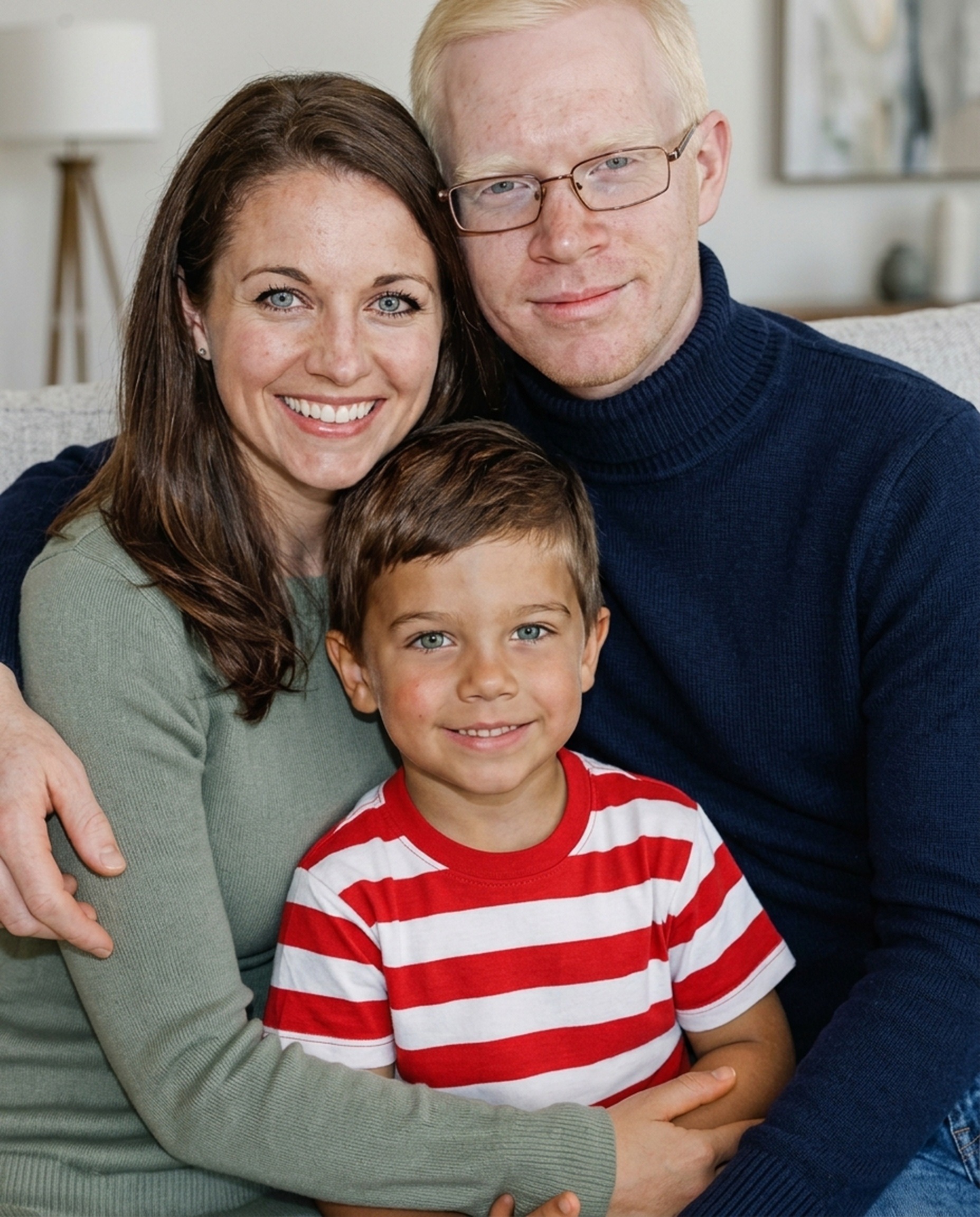
“It is not the yard,” I said, twisting my silver wedding band around my knuckle until the skin turned pink and pinched. “She looked at his face like she was trying to solve a puzzle she did not like. She does it every single time we sit down at her cherry wood table.”
Dave sighed, running his hand through his blond hair, leaving a few pale strands standing straight up. He was a high school chemistry teacher, used to explaining the clean, predictable formulas of the world, but his mother was an equation he had spent his whole life trying to avoid solving. “She is just quiet lately. Dad is having a hard month, and she is carrying most of that weight.”
“She is not quiet with you,” I said, smoothing down the collar of Sam’s green shirt. “Only with Sam. And with me. She acts like we are guests who stayed three days too long.”
Dave smoothed the folded sheet with his palms, lining up the corners with a precision that always reminded me of his classroom. “We are going over there in two hours, Clara. Let us just have a normal afternoon.”
“I want it to be normal,” I said, but the cold weight in my chest remained.
I picked up another shirt, my fingers tracing the faded print of a cartoon dinosaur on the chest. The rising resentment toward Patricia felt like a physical ache in my jaw, one I had to hide behind a flat, calm face every time we crossed town to the six-bedroom Tudor house she kept so clean.
“Just promise me you will say something if she starts in on his appearance again,” I said.
Dave picked up a stack of pillowcases and did not answer.
The drive to the north side of Oakhaven took less than ten minutes, but the silence in our small sedan made the trip feel much longer. Sam sat in his booster seat in the back, humming a song about a triceratops, completely unaware of the quiet battle in the front seat. He held a green crayon between his knuckles, his small fingers already smudged with the dark wax.
Inside the large Tudor house, the air smelled of lemon oil, beeswax, and dry upholstery. Patricia stood in the center of her living room, her posture as rigid as the high-backed chairs she had inherited from her family.
Sam immediately dropped to his knees on the patterned Persian rug, pulling a paper napkin from the side table. He began drawing on the thin paper, his green crayon making broad, jagged strokes.
Patricia walked over to him, her manicured nails tapping a steady, irritating rhythm against the polished cherry wood of the mantelpiece. Her eyes were narrowed, fixed on the back of our son’s head where his dark curls clustered near his collar.
“His hair is remarkably dark,” Patricia said, her voice sharp, precise, and clipped. “Neither you nor Dave had curls like that when you were five.”
“My father had dark curls,” I said, keeping my voice steady as I sat on the edge of the cream-colored sofa.
Patricia did not look at me, her gaze remaining fixed on Sam’s head. “He does not have the family nose, does he?”
Dave stepped into the room from the hallway, carrying a tray of ice water that his mother had asked him to fetch. “Whose nose, Mom?”
“Anyone’s,” Patricia said, her nails stopping their tap. “It is just an observation, David. One would expect some family resemblance to show through by now. Legacy is not just about a name.”
Sam looked up, holding his green crayon in the air, his face bright. “Look, Grandma. It is a stegosaurus.”
Patricia gave a brief, tight nod that did not reach her eyes. “Very nice, Sam. Do not get wax on the rug.”
I watched her hand drop to her side, her fingers still twitching slightly as if she wanted to scrub the drawing paper clean. The hostility felt personal, a direct current aimed at my presence in her family, and I turned my ring around my finger to keep from speaking.
“Where is Robert?” Dave asked, setting the tray down on the coffee table.
“In the backyard,” Patricia said, her voice dropping a fraction of an octave. “He is attempting to clear the leaves. He refuses to let the service do it, despite his condition.”
The backyard was thick with fallen maple leaves that smelled of damp earth and coming rain. Robert, the retired factory owner who had spent forty years running Oakhaven Manufacturing, stood near the edge of the brick patio, holding a wooden rake but not using it. His quiet baritone was gravelly and low, carrying over the rustle of the wind.
“The trees are dropping everything early this year,” Robert said, pulling a white handkerchief from his pocket to polish his reading glasses.
“I can help you finish the lawn, Robert,” I said, picking up the spare rake that leaned against the garage wall.
He put his glasses back on, his eyes looking tired and slightly yellowed behind the thick lenses. “Do not worry about the leaves, Clara. I wanted to talk to you out here while the others are busy inside.”
I stopped with the rake in my hand, watching the way his chest rose and fell with a shallow, heavy rhythm. “Is everything all right?”
“My doctor called yesterday morning,” Robert said, his voice dropping to a gravelly whisper that barely carried past the rosebushes. “The treatments are not doing what we hoped they would.”
The wooden handle of the rake felt cold and rough in my palms. “What are they saying, Robert?”
“They are saying we need to get things in order,” Robert said, looking toward the high windows of the Tudor house where Dave was visible through the kitchen glass, pouring more water. “I need to make some changes to the estate before the winter gets bad.”
“What kind of changes?” I asked, my heart shifting with a sudden, sharp unely ease.
Robert looked down at the leaves at his feet, his hand gripping the rake handle until his knuckles showed white. “Patricia has some ideas about how the manufacturing firm should be divided. Strong ideas about legacy and bloodlines.”
“She wants to protect the family,” I said, though the words tasted like copper in my mouth.
“She wants control, Clara,” Robert said softly, his voice cracking slightly on the last word. “And my time is growing short. I have to do what is right for everyone, but the pressure is constant.”
He turned back toward the house, his shoulders hunched against the October wind, leaving me standing on the damp grass with the rake still balanced in my hands.
By eight o’clock, we were back in our own kitchen, the quiet of our small house a sharp contrast to the cold tension of the Tudor estate. The sink was full of dinner plates, and the steam from the hot water rose into my face, dampening the loose hair at my temples.
“Your father told me his health is failing,” I said, sliding a soapy glass into the rinsing rack.
Dave stood next to me with a dish towel, his shoulders hunched. “He told me too, while you were packing up Sam’s toys. He says he feels tired all the time now.”
“He said Patricia wants to change the estate planning,” I said, turning to look at him, the water dripping from my fingers onto the linoleum. “Dave, she is going to try to exclude us. She is using any excuse she can find.”
“She is just worried about the future,” Dave said, his soft voice thin and defensive. “She wants to make sure everything is secure.”
“She keeps talking about Sam’s hair and his nose,” I said, my hand twisting my wedding band. “She is making remarks to the neighbors, too. I know she is. It is like she is trying to prove we do not belong.”
“She is just old-fashioned,” Dave said, but he ran his hand through his blond hair twice, his eyes fixed on the floor. “She wants to be sure of things.”
“Sure of what?” I asked, the soapy water growing cold around my wrists. “Sure that Sam is yours? She has no right to question that.”
Dave did not answer, his fingers tightening on the dry linen dish towel.
“She asked me about my old college friends last week,” I said. “She is trying to build a case against us. I can feel it.”
Dave looked at the small blue shirt of Sam’s sitting on the laundry basket near the table. “We just need to give her time, Clara. She is under a lot of stress with Dad. Let us not make this harder than it is.”
I watched Dave fold the small blue shirt in silence.
Dave set his calculator on the corner of the cherry wood table and rubbed his temples. He had three utility bills spread out between us, each one stapled to a small green receipt.
I handed him the water bill and watched him enter the figure into his spreadsheet. He always did the math twice, a habit from his years of teaching chemistry, but today his fingers kept slipping on the keys.
His phone buzzed on the wood, the screen lighting up with his mother name.
Dave answered on the second ring, his voice dropping into that quiet, careful register he reserved for Patricia. I sorted the remaining envelopes, sliding the bank statements to one side of the table while he listened.
“We just paid the insurance, Mom,” Dave said, leaning back in his chair. “No, Sam is fine. He is playing in the den.”
He went quiet for a long moment, his eyes fixing on the light fixture above our heads. He pulled a pencil from behind his ear and began tapping the eraser against his knuckles.
“I do not think that is how genetics works,” Dave said, his tone turning slightly defensive. “Clara has brown hair, and so does her father. It is not that unusual.”
I looked up from the electric bill, but Dave turned his shoulder away from me, shielding his face. He nodded twice at the empty wall.
“He is five, Mom,” he said, his voice dropping even lower. “Children change as they grow. I am sure my hair was not always this light.”
He listened for another minute, then muttered a quick goodbye and set the phone face down on the table.
“What did she want?” I asked.
“Nothing,” Dave said, running his hand through his blond hair. “She was just asking about Sam preschool pictures from last week. She thinks his hair is getting darker.”
He picked up his pencil again, but he did not return to the spreadsheet. He stared at the water bill as if the numbers had suddenly changed.
“She said none of the boys on their side of the family ever had hair that dark,” Dave said. “She was quite insistent about it.”
I took the pencil from his fingers and laid it flat on the paper.
“We are going to be late for the visit if we do not finish these bills,” I said.
By three in the afternoon, the autumn wind was shaking the maples along the driveway of the six-bedroom Tudor house. We walked up the brick path, Sam running ahead with a plastic dinosaur tucked under his arm.
Patricia opened the door before we could knock, her manicured nails tapping against the brass handle. She did not lean down to hug Sam, but her eyes lingered on his head as he slipped past her into the hallway.
I hung my wool coat on the brass peg, the heavy wool smelling slightly of rain. Patricia stood close beside me, her perfume dry and sharp like dried lavender.
She pointed to the silver-framed portrait hanging on the wallpaper, a professional photograph of Dave when he was five years old. In the picture, Dave had pale skin and white-blond hair that caught the studio lights.
“Look at that picture, Clara,” Patricia said, her voice clipped and even. “Dave was almost translucent at that age. The family line has always been exceptionally fair.”
“Sam has my father eyes, Patricia,” I said, keeping my voice steady as I smoothed my skirt.
“Eyes can be deceptive,” she said, her nails clicking against the frame of the portrait. “But the bone structure and the hair do not lie. Dave looked like a true member of this family from the day he was born.”
She turned and walked toward the kitchen, her heels clicking on the hardwood before I could answer.