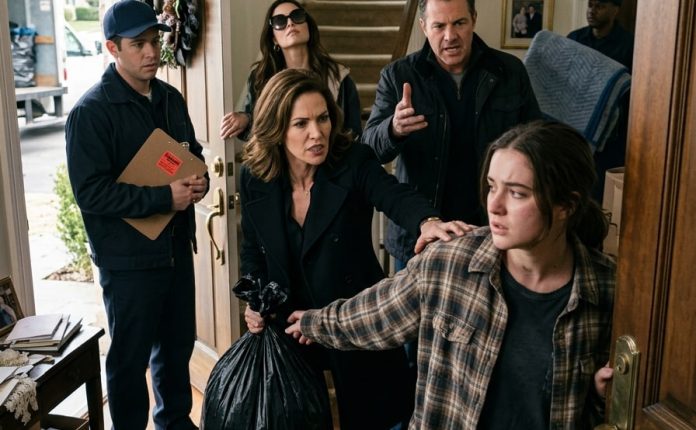
My mother handed me two garbage bags while the funeral wreath was still hanging on the door.
“Start with your clothes,” she said. “We need the upstairs cleared.”
Behind her, a moving truck shuddered at the curb. My father stood beside it with a clipboard, pointing toward the house as though he had spent the previous seventeen years paying its bills.
I held a cup of coffee in both hands.
It had gone cold before I remembered drinking any.
My sister climbed down from the passenger seat wearing sunglasses large enough to hide half her face. She stopped on the pavement, looked up at the windows, and smiled.
“I want the main bedroom.”
Yesterday, I had watched two cemetery workers lower my grandfather into the ground.
Today, my family had arrived to divide the rooms.
For a few seconds, I couldn’t fit those facts inside the same morning.
A length of ribbon stirred against the wreath. The florist had printed BELOVED FATHER AND GRANDFATHER in gold letters. My mother brushed it aside with her elbow as she came through the doorway.
“You look dreadful, Emily.”
I was wearing Grandpa’s flannel shirt over the clothes I had slept in. One cuff had a missing button. There was a thin crescent of soil beneath my thumbnail from the handful of earth I had dropped onto his coffin.
My father didn’t come close enough to notice.
“Upstairs first,” he told the movers. “We’ll deal with the study afterward.”
That caught my attention.
Not enough to make me speak.
Enough to make me remember.
Three weeks earlier, Grandpa had been standing at the kitchen sink, trying to rinse a plate while pretending he wasn’t leaning his full weight against the counter.
I had taken the plate.
He had objected on principle.
Then he had sat down without finishing the objection, which frightened me more than anything the hospital later told us.
Until that autumn, Walter Bennett had been the kind of man who treated illness as a scheduling inconvenience.
At seventy-eight, he still grew more tomatoes than two people could eat. He sharpened pencils with a pocketknife and kept the instruction manuals for appliances we no longer owned.
When our washing machine broke, he consulted a manual from 1996, announced that modern engineering had become unnecessarily dramatic, and called a repairman.
I loved him most in those ordinary moments.
I hadn’t known how much until ordinary things stopped happening.
No kettle whistling before six.
No radio murmuring the weather.
No familiar cough from the garden when I opened my bedroom window.
The house had become enormous in his absence.
Now my mother was standing inside it, telling me I occupied too much space.
“Did you hear me?”
She pushed the bags closer.
I took them because my hands had spent the last month accepting things people handed me: prescriptions, discharge papers, sympathy cards, a plastic sack containing the clothes Grandpa had worn to the hospital.
Brianna passed between us.
“Wow,” she said, looking around the foyer. “He really never changed anything.”
She wrinkled her nose.
The house smelled of lilies, damp wool, and the furniture polish Grandpa bought because his mother had used the same brand.
There was also, somewhere beneath it, the old trace of pipe tobacco.
He had quit when I was twelve.
I remembered him putting the pipe away after I brought home a school worksheet about smoking. He had read my frightened handwriting, folded the paper, and said he supposed the tomatoes would appreciate having him around a little longer.
My father looked toward the stairs.
“Brianna, check what you want to keep.”
She was already halfway up.
“Can I paint that bedroom? The wood is so dark.”
“Later,” Mom said.
Later.
They had brought a future with them.
They expected mine to fit into two bags.
I was five when they left me here.
I knew the age because Grandpa had written it on the back of the first photograph he took after I moved in. I was sitting on his back step, holding a mug of cocoa with both hands.
My mother said it would be one weekend.
My father carried my little overnight case to the porch. Brianna, who was eight, stayed in the car with a packet of crackers.
I remember thinking she was lucky.
She got to go with them.
Grandpa was still wearing his gardening gloves when Mom kissed the air beside his cheek.
“Sunday evening,” she told him.
Then she bent toward me.
“Be good. Don’t make trouble.”
I spent that first night on top of the quilt because I thought sleeping underneath it meant I had moved in.
On Sunday, Grandpa made a roast.
At six, he put my shoes beside the door.
At eight, he wrapped the leftovers.
At nine, I asked whether the car might have broken down.
He sat on the stairs beside me.
“Come have some warm milk.”
“Will I hear them if I’m in the kitchen?”
“I’ll hear.”
For a long time afterward, whenever a car slowed outside, I stood where he could see me.
He never told me to stop.
Eventually, he bought a small dresser from a charity shop and sanded a sticky drawer until it opened properly.
He didn’t say my parents weren’t coming.
He said I needed somewhere to put my socks.
That was how he raised me: by making room before asking whether I believed I deserved it.
He learned to braid my hair from a library book.
The first attempt looked like a rope that had survived an argument, but he photographed it anyway.
He put a folded towel on a dining chair so I could reach the table.
He attended school meetings carrying a notebook because he didn’t trust himself to remember every teacher’s name.
When forms asked for my father, I wrote Walter.
When children asked why my grandfather collected me, I learned to say, “He’s my person.”
There were difficult years.
I wasn’t the grateful child people sometimes imagined when they praised him.
At nine, I told him he was too old to understand anything.
At thirteen, I broke a plate because he wouldn’t let me attend a party without speaking to the parent hosting it.
At sixteen, I asked whether my mother would have stayed if I had been prettier.
He put down the dish towel.
Nothing in his face suggested he found the question ridiculous.
“Her leaving tells you about her,” he said. “You don’t have to spend your life making it tell you about yourself.”
I believed him for perhaps ten minutes.
Then he spent the next six years reminding me in a hundred less direct ways.
He saved the first payslip from my weekend job.
He brought soup when I studied late.
When I enrolled in the bookkeeping program at the community college, he made such an event of buying my calculator that the cashier asked whether I was beginning medical school.
I graduated in May.
He clapped too early.
I could hear him laughing at himself from the stage.
My mother snapped her fingers in front of my face.
“Emily. Focus.”
The foyer returned around me.
The truck engine. The wreath. Brianna’s footsteps above us.
“What am I packing for?” I asked.
Mom’s mouth tightened, as though I had asked something deliberately foolish.
“You can’t expect to stay here forever.”
“This is my home.”
“It was your grandfather’s home.”
I looked at my father.
He avoided my eyes and spoke to the mover carrying the clipboard.
“The tall chest in the front bedroom goes first.”
The mover glanced between us.
He was perhaps forty, with a navy cap and the tired, attentive expression of someone who had moved enough households to recognize an argument before it fully arrived.
“Do we have authorization from the property owner?”
“You’re talking to the family,” Dad said.
The mover didn’t advance.
I noticed a red sticker on the corner of his clipboard.
Beside the printer yesterday, while looking for the funeral home’s receipt, I had found a half-used sheet of those stickers.
Underneath it lay a photograph of the staircase.
I had turned it over, expecting the name of a repair company.
There was only a number written in blue ink.
I had put it down.
Yesterday, I had been trying to decide whether I could wash Grandpa’s pillowcase.
A photograph of the stairs hadn’t seemed important.
Now Dad shifted the clipboard beneath his arm.
“You’ll be paid for waiting,” he told the mover. “Give us a minute.”
My mother lowered her voice.
“You were Walter’s responsibility. He chose that. We didn’t interfere.”
Something scraped across the floor upstairs.
A drawer.
I could picture Brianna pulling it open.
Grandpa’s good shirts folded on the left. His socks rolled together because he considered matching them after washing an avoidable nuisance.
“Leave his things alone,” I called.
The scraping stopped.
My father looked sharply at me.
“Let’s not turn this into something ugly.”
I had not shouted.
I wondered what volume my grief would have to reach before he considered it inconvenient enough to acknowledge.
Mom held out her hand.
“Give me those.”
She took one bag, shook it open, and held the mouth wide.
The sound made me flinch.
“Clothes, toothbrush, that old quilt. We can come back for anything you forget.”
“I’m not packing Grandpa’s things.”
“Nobody asked you to.”
“You just told them to remove his dresser.”
“It’s furniture, Emily.”
Upstairs, Brianna called, “There’s a photo in here. Do you want it?”
I closed my eyes.
For one dangerous second, I wanted to scream until everyone left.
Then I heard Grandpa’s hospital voice.
Not loud.
Clear.
Four days before he died, he had waited until the nurse finished checking his blood pressure.
“Close the door, sweetheart.”
I had done it reluctantly.
The previous night, I had begun listening to his breathing whenever he fell asleep. A closed door felt like one more thing between us and help.
He motioned me closer.
“If your parents come to the house, don’t argue on the porch.”
I thought he had confused one decade with another.
“They’re not coming.”
“They may.”
“Why now?”
He looked toward the little cupboard where I kept his clean pajamas.
For a moment, his expression changed.
Weariness, perhaps.
Or anger he no longer had the energy to conceal.
“Let them say what they came to say.”
I didn’t like the sound of it.
“You want me to listen while they insult you?”
“You don’t have to keep anybody comfortable.”
His fingers closed around mine.
“Just don’t get drawn into a fight at the door. And don’t sign anything.”
“Grandpa—”
“Ruth knows.”
He stopped to catch his breath.
I reached for his water.
“Open my study,” he said when he could speak again. “You won’t have to handle it by yourself.”
I had thought there would be time to ask more.
There had been so many things I thought I could ask later.
Ruth Mercer called that same afternoon.
She had handled Grandpa’s legal matters for years, though I knew her chiefly as the woman who corrected him when he claimed a handshake was sufficient for every arrangement.
She asked where I was.
At the hospital.
Was anyone with me?
Grandpa.
Was I safe?
I said yes.
She asked again, differently.
“Is anyone pressuring you about the house?”
I glanced through the glass panel at Grandpa’s bed.
“No.”
“Call me if that changes.”
Now I understood the question differently.
My father stood beneath the kitchen doorway, one hand resting against the frame.
There were pencil marks beside his thumb.
Five years old. Seven. Ten.
Grandpa had measured me on my birthdays until I stopped growing, then insisted on checking at twenty because he said he didn’t trust me to remain the same height unsupervised.
Dad had never witnessed one of those measurements.
“The property should stay with Walter’s family,” he said.
I looked at the little W beside my tallest mark.
“I am his family.”
Mom sighed.
“No one’s denying you lived here.”
For seventeen years, I had imagined them explaining themselves.
Sometimes I pictured a hospital, a terrible misunderstanding, a lost letter.
Sometimes I pictured my mother crying because coming back had become harder with every year she stayed away.
I had even imagined being angry.
I had never imagined her reducing my childhood to proof of occupancy.
Brianna appeared at the top of the stairs.
She held a photograph against her hip.
Grandpa and me in the garden, a bundle of carrots between us.
I had been seven. My front teeth were missing.
“Where should I put this?”
“Back,” I said.
She looked at Mom.
It was a small movement.
A child checking whose instructions mattered.
Only she wasn’t a child anymore.
My father started toward the hallway.
“I’ll handle the office.”
I moved before he reached it.
“The study.”
“What?”
“He called it the study.”
Dad gave me a look of impatient disbelief.
“All right. The study.”
My mother followed us.
“Honestly, Emily. We’re trying to do this gently.”
The bags rustled in her hand.
She had taken back the second one without my noticing.
I reached the closed door.
Behind it, Ruth had been sorting papers since quarter past eight.
She had arrived carrying breakfast I hadn’t eaten and asked whether I wanted to sit with her.
I told her I needed a few minutes in the kitchen.
When the truck appeared, she had still been at the desk.
I hadn’t imagined Grandpa’s instructions would become necessary before the day had properly begun.
Dad’s voice sharpened.
“There’s nothing in there you need.”
He had sounded bored until then.
Now he sounded afraid.
My mother reached toward my shoulder.
The handle turned before she touched me.
Ruth opened the door.
She looked at Dad, then Mom, then the bags.
“Diane.”
Mom stopped.
One bag slipped to the floor.
She caught the other, lost her grip on that too, and stood staring as the black plastic settled around her shoes.
It wasn’t the sight of an attorney that frightened her.
I understood that before anyone spoke.
She recognized a particular problem.
Dad recovered first.
“I thought we were discussing matters Tuesday.”
“You left a message asking to do that,” Ruth said. “I didn’t accept.”
Brianna had come halfway down the stairs.
“Who’s this?”
“Walter’s attorney,” Mom said.
The words sounded scraped out of her.
Ruth looked past her.
“Please return that photograph to where you found it.”
Brianna hesitated, then turned around.
The mover appeared at the front door.
“Everything okay?”
“We’ll need you to wait outside,” Ruth told him. “Nothing is being removed.”
Dad lifted his chin.
“You don’t have authority to interfere with our arrangements.”
Ruth considered him for a moment.
“Paul, I suggest we establish whose arrangements these are.”
Outside, the engine shut off.
Silence spread through the house with surprising speed.
Mom bent for the bags.
“We know Emily’s upset. That’s why we’re here.”
Ruth waited.
“She hasn’t been coping. She gets confused.”
I stared at her.
“About what?”
“Sweetheart, this is exactly—”
“About what?”
Dad said my name.
A warning.
I recognized it without remembering when I had learned it.
Ruth moved slightly, placing herself beside me.
“Last Tuesday, Diane told my office you were receiving inpatient psychiatric treatment.”
The foyer seemed to tilt.
“I was with Grandpa.”
“I know.”
Mom folded the bags together.
“I said she was having difficulties.”
“You said she was hospitalized, unable to communicate, and dependent on you for decisions about her accommodation.”
“That’s not how I meant—”
“I made a note of the call.”
Dad looked toward the open front door.
The mover was still visible on the porch.
“Could we have some privacy?”
Ruth nodded toward the study.
“Emily first.”
I entered a room that had belonged to every ordinary evening of my life.
The green lamp stood at the left corner of the desk.
A peppermint tin sat beside the blotter.
Grandpa’s reading notebook lay open to a page containing three shopping items and the beginning of a sentence about the weather.
I almost turned around.
All morning, I had been able to pretend he might be elsewhere in the house.
Here, his unfinished handwriting made that impossible.
Ruth pulled out the chair beside the desk.
I sat.
Mom chose the visitor’s chair without asking.
Dad stayed standing.
Brianna remained near the doorway, empty-handed now.
A blue folder lay beneath Ruth’s legal pad.
Beside it sat an envelope addressed to me.
The handwriting on that was steadier.
Older.
“Before we discuss anything else,” Ruth said, “Emily, did you hire these movers?”
“No.”
“Have you agreed to leave?”
“No.”
“Have you authorized either parent to act for you?”
“No.”
Mom looked toward Dad.
He gave a small shake of his head.
Not an answer.
An instruction to keep quiet.
Ruth opened the folder.
“Walter established a revocable living trust seven years ago. He transferred this property into it at that time. I became successor trustee upon his death.”
Dad laughed once.
An unpleasant, empty sound.
“He never mentioned a trust.”
“He wasn’t required to discuss his planning with you.”
Mom leaned forward.
“I’m his daughter.”
“Yes.”
“So this is hardly some straightforward—”
“Your relationship to Walter doesn’t give you ownership of a property he transferred during his lifetime.”
Ruth took out a copy of a recorded deed.
She laid it where we could see the address.
Our address.
The one I had written on school forms, job applications, birthday invitations, and hospital admission paperwork.
“The house is a trust asset,” she continued. “Under the trust’s terms, it is to pass to Emily. The household contents are included, subject to a short list of personal gifts.”
I heard the mantel clock strike nine in the hall.
It struck twice before I realized I was counting.
Mom stared at the page.
Dad didn’t.
He was looking at the locked bottom drawer of Grandpa’s desk.
“Emily,” Ruth said, “you are not being evicted. You don’t need to pack anything.”
My hands began shaking.
Only then.
Not when the bags were against my chest.
Not when my mother called me someone else’s responsibility.
At those moments, I had been busy surviving the next sentence.
Now there was space for what had happened to reach me.
Brianna whispered, “He left her the whole house?”
Dad said, “There’ll be grounds to challenge this.”
“You’re free to obtain independent advice,” Ruth replied. “You are not free to take possession while you do.”
Mom touched the deed with one fingernail.
“When did he sign this?”
“Seven years ago.”
“But he was ill.”
“Not seven years ago.”
The room went quiet.
Ruth let the silence remain.
Then she took out a second document.
“More immediately, we need to discuss why a prospective buyer contacted my office on Thursday with what appeared to be Walter’s authorization to sell.”
Dad moved.
Not much.
Enough that his jacket brushed the doorframe.
Mom’s eyes closed.
I looked from one to the other.
“A buyer?”
Ruth turned the document toward me.
At the bottom was a signature that looked like Grandpa’s until I looked properly.
Too smooth.
Too evenly spaced.
And beneath it was a date from a week when he had barely been able to hold a cup.
My father reached for the paper.
Ruth covered it with her hand.
“The buyer says,” she continued, “that he has already paid you eight thousand dollars.”
END PART 1