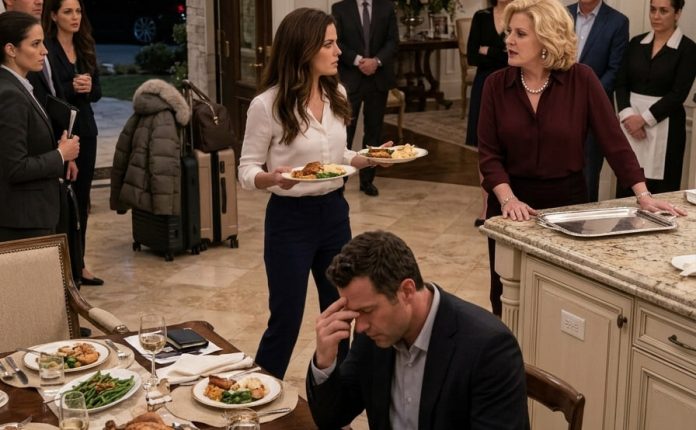
My son shut the door behind him before I reached the top step.
“Dad, you can’t come in right now.”
I stopped with one boot on the porch.
Through the dining room window, I could hear dishes being moved and a man laughing. The house smelled faintly of roasted chicken. Somebody had opened a window despite the heat.
“I’m dropping off the property papers,” I said.
Trent glanced at the white envelope in my hand, then at the street, as though another visitor might arrive and complicate things.
“Give them to me. I’ll look tonight.”
“I have a few things to explain.”
“We’ll call you.”
He used we when he wanted a decision to sound larger than himself.
I shifted the envelope under my arm. My jacket sleeve caught against the porch railing, leaving a little pale dust on the dark paint.
Trent noticed.
His face changed so slightly that a stranger might have missed it. I had watched that face grow from infancy. I knew the movement around his mouth when he was trying to conceal irritation.
“Madison’s parents are here,” he said.
“I heard someone inside.”
“They came up from Savannah.”
“Then I ought to say hello.”
His hand stayed on the doorknob.
“Please don’t.”
The porch was wide enough for three people to stand abreast. He had chosen the one place where I could not pass without making a point of it.
I looked at him properly then.
Pressed shirt. Clean sneakers. A watch I had never seen before. Behind his shoulder, an arrangement of white flowers stood on the hall table.
I had bought that table when his mother was alive. Madison had liked it, and I had given it to them when they moved in.
“What’s the problem, Trent?”
He looked down.
My boots were dusty from the roof we had finished across town. A tear in the canvas near my jacket pocket had been stitched with black thread because that was what I had found in the drawer.
“I’ve been working,” I said.
“I know.”
He rubbed the side of his jaw.
“They don’t need to see you like this.”
A car passed slowly. Somewhere down the block, a sprinkler clicked through its turning cycle.
I waited for him to correct himself.
He didn’t.
I was sixty-four that spring. My knees complained on ladders, and I no longer spent every day on a roof, but I still worked beside my crew when a job needed another pair of hands.
That afternoon, one of our men had gone home with a sick child. I had taken his place rather than let the rest finish late.
The dust on my boots came from a roof that would not leak when the next storm arrived.
I had never thought of it as something that required an apology.
“They have a certain impression,” Trent continued.
“Of me?”
“Of us.”
He spoke quietly, but there was impatience underneath it. He wanted me to understand without making him say anything uglier.
A voice carried through the window.
“You were smart to buy in here, Trent.”
Richard.
I recognized his deliberate way of speaking. At their wedding, he had delivered a toast without looking once at the notes in his pocket.
“Even when things soften, a neighborhood like this stays desirable.”
Evelyn said something I did not catch, then added, “And Madison has room for everything now. It’s lovely knowing you’ve provided that.”
Trent stopped rubbing his jaw.
I turned the envelope in my hand.
“What did you tell them about this house?”
“Dad.”
“What did you tell them?”
He leaned closer.
“This isn’t the time.”
I could see a corner of the dining table through the window. A blue serving bowl sat beside folded napkins. The room looked ordinary, comfortable, carefully prepared.
Nothing inside explained why its owner had to remain outside.
“They believe you bought it,” I said.
Trent looked toward the curtain.
“It was simpler.”
I had come to talk about insurance and an agreement. Now I was trying to understand when generosity had become an obstacle to my son’s reputation.
Five years earlier, he had sat at my kitchen table with a folder of apartment listings.
Madison had been beside him, counting the difference between their current rent and the cheapest place they could find near her job.
They were not destitute. They were tired.
Every attempt to save had been interrupted by something practical: a transmission, a medical bill, a deposit they could not recover from a previous landlord.
I knew that kind of arithmetic.
When Trent was small, I had worked out grocery money on the backs of envelopes. His mother, Nora, would circle the items we could postpone and leave the milk uncircled.
After she died, the same table became the place where I paid bills alone.
By the time Trent married, my roofing business had grown beyond the days when one broken truck could leave us stranded. I had bought two modest rental properties and, later, the house in Brentwood.
The previous tenants had moved away.
I had planned to repaint it and put it back on the market for rent.
Instead, I pushed the keys across the table.
“You can stay there while you get ahead.”
Madison had covered her mouth.
Trent had picked up the keys, set them down, then picked them up again.
“For how long?”
“A couple of years. We’ll review it.”
I had wanted the help to be clear enough that nobody felt uneasy.
Calder prepared a simple occupancy agreement. No rent. Utilities and routine yard care were theirs. Taxes, insurance, and significant repairs remained mine. The property stayed in my name.
We all signed.
Calder had asked Trent whether he understood the difference between permission to occupy and ownership.
Trent had said, “Absolutely.”
I remembered that answer on the porch.
“Did you forget what we signed?” I asked.
“Of course not.”
“Then why are they congratulating you for buying it?”
He breathed out through his nose.
“Because explaining every detail makes us sound like we haven’t accomplished anything.”
I looked at the lawn.
He and Madison had done a good job with it. The roses along the side fence were hers. The gravel bed beneath the dining room window had been his idea.
I had always been glad they felt at home.
Apparently, he had come to believe feeling at home entitled him to a different history.
“You could have told them we were helping you save.”
“Richard doesn’t understand things that way.”
“You’ve asked him?”
Trent’s mouth tightened.
The door shifted behind him. He pulled it firmly into the frame.
I thought of the years I had spent telling customers exactly what a repair would cost, even when the honest number meant losing a job. I had believed Trent understood why.
He had worked summers with me in high school.
He knew the difference between a roof that looked good from the street and one that would hold when rain reached the decking.
Now he was standing in front of the first kind.
“Does Madison know what they think?”
“She knows the situation.”
“Which situation?”
“Dad, you’re turning a small thing into a family issue.”
There it was: my objection had become the problem.
I let the envelope rest against my thigh.
For a moment, I was tempted to walk past him. I could have stepped into the dining room, introduced myself, and corrected the story over the chicken.
The temptation embarrassed me.
I did not want to become another man arranging a performance in that house.
Instead, I reached for my phone.
Trent’s eyes followed my hand.
“Who are you calling?”
“Calder.”
“Why?”
“Because I’m no longer comfortable leaving our arrangement as it is.”
His shoulder came away from the door.
That movement told me more than his words had.
He knew where the house belonged when it mattered.
“Let’s talk first.”
“We are talking.”
“Inside. Come inside.”
I looked at the opening he had finally made.
A few seconds earlier, my jacket had been unsuitable. Now there was apparently room at the table.
I scrolled to Calder Webb.
He had handled the Brentwood purchase, the rental agreements before Trent moved in, and the documents afterward. He was not a man who raised his voice or enjoyed dramatic gestures.
I trusted him for that.
When he answered, I kept my own voice level.
“I’m at the Brentwood property. I want the entire file reviewed, and I need you to prepare options for changing the present arrangement.”
Trent stepped forward.
“Dad, don’t do this here.”
I put up one hand.
“Check everything before we take any steps,” I told Calder. “I don’t want anything hurried.”
“All right,” he said.
He asked whether I still had the envelope.
“Yes.”
“Keep it with you for now. I’ll call in the morning.”
I agreed and ended the call.
Trent stood close enough that I could see a tiny nick beneath his chin where he had shaved.
It was such an ordinary detail. I would remember it later because nothing else about those minutes felt ordinary.
“You can’t just decide this because you’re angry.”
“I can decide I need to understand what’s happening in a house I own.”
“We’ve been here five years.”
“Yes.”
“You said we should make it our home.”
“I did.”
He waited, expecting that to settle something.
I moved around him and went down the steps.
Behind us, the door opened.
“Kent?”
Madison stood in the hall.
She wore an apron over a pale green dress. One hand held a dish towel twisted into a tight rope.
I had no wish to ask her questions in front of her guests, but I could not make myself smile.
“I’ll speak with you tomorrow.”
“What happened?”
“Ask Trent.”
That was sharper than I wanted it to be.
I stopped at the bottom of the path.
“I’m not asking you to take his word or mine,” I added. “We’ll sit down and look at the papers.”
Her eyes went to the envelope.
Trent followed me toward the truck.
The clean driveway made my old pickup look especially battered. There was a dent above the rear wheel from a gatepost I had misjudged twelve years earlier.
I had meant to fix it, then discovered it did not affect anything I needed the truck to do.
“Please,” Trent said. “You’re making them wonder what’s wrong.”
I opened the driver’s door.
“Then tell them.”
“They’ll think—”
He stopped.
I waited.
He did not finish.
Inside the cab, my tape measure had rolled against the cup holder. A folded supplier invoice lay on the passenger seat. The smell of warm canvas and old upholstery rose as I sat down.
Trent caught the door before I could close it.
“Come back in. I’ll explain.”
“Explain without me.”
“We can work this out.”
“I hope we can.”
For the first time, he seemed to hear something beyond irritation in my voice.
His hand dropped from the door.
I told him to enjoy his lunch because I could not think of anything else that would let me leave without saying too much.
Then I drove away.
At the corner, I glanced in the mirror.
He had not gone back inside.
Madison had come down the path and stood beside him.
I knew nothing then about the loan application, the money from Richard, or the copied signature.
I believed the worst thing I had discovered was that my son found me embarrassing.
That would have been difficult enough.
At home, I left the envelope on the kitchen table and went to the sink.
Roof dust made a gray ribbon in the water. I scrubbed the creases around my nails with the little brush Nora had bought years before she died.
Its handle was cracked.
I could have replaced it at any time.
I kept it because it still worked, and because her hand had once rested in the same place mine did.
My phone vibrated on the counter.
Trent.
I watched it until the screen went dark.
It rang again while I was drying my hands.
I was not ready to speak carefully. That was the only reason I did not answer.
Anger can make a man feel unusually clear while he is doing the least careful thinking of his life.
I had learned that on job sites, with contracts, and once or twice as a father.
I changed my clothes and made a sandwich.
While I ate, I opened the envelope.
The insurance summary sat on top. Beneath it was the proposed renewal Calder had prepared at my request.
It would have continued the rent-free arrangement for another year, with a scheduled discussion about their next steps.
I read the first page twice.
Until that afternoon, I had imagined we would sit in the Brentwood kitchen and talk about savings, mortgage rates, and whether they wanted to buy somewhere smaller.
I had even considered offering them a properly documented purchase on favorable terms when they were ready.
Considered.
Never promised.
The distinction seemed too small to matter in a trusting family.
I put the pages back.
Trent had once asked whether the house might be theirs someday.
We had been replacing a garden gate together, three summers earlier. He had held a hinge while I marked the screw holes.
“If we really like staying here, would you ever sell it to us?”
“We can talk when you’re ready.”
He had grinned.
I had added, “There’s a lot to work out before that.”
At the time, I thought he had heard both sentences.
Now I wondered how many people had heard only the first, enlarged into something I would not recognize.
Madison’s message arrived after six.
She said she was sorry the visit had become awkward and asked whether she could call.
I replied that we would talk after I spoke with Calder in the morning.
She sent back, All right.
No explanation.
No accusation.
I set the phone face down.
Outside my kitchen window, the neighbor’s grandson was trying to push a bicycle up the curb. His grandfather held the handlebars steady without doing the work for him.
I watched longer than I needed to.
It was easy to recognize good judgment in someone else’s yard.
I had helped Trent because I remembered how hard things could be. I had continued because he was my son, and because a monthly rent payment from him would not have changed my life very much.
I had not asked regularly how much they were saving.
Sometimes he said they were making progress.
Sometimes Madison mentioned another expense.
I did not want help to feel like supervision.
Yet I had allowed an arrangement meant to create room for independence to continue without asking whether independence was actually arriving.
That did not excuse what he had said on the porch.
It did give me something of my own to examine.
After dinner, I called the foreman on the job we had finished.
He told me the customer had walked outside during the cleanup and said the roof looked better than she had hoped.
“That’s good.”
“You all right, Kent?”
“Long afternoon.”
He offered to handle the next day’s deliveries.
I thanked him.
I did not tell him about Trent.
Some private hurts become more manageable when spoken aloud. Others are still too new to know what they are.
I went to the hall closet and hung up my jacket.
The dusty cuff left a faint mark on the shelf.
I wiped it with my thumb, then stopped.
I could clean the jacket. I could buy another one. I could drive a truck with glossy paint and arrive at every family lunch in a pressed shirt.
None of those things would explain why my son had needed me to be absent.
The next morning, I woke before the alarm.
For a few seconds, I had the pleasant blankness that comes before remembering.
Then I saw the envelope on the table.
I made coffee.
The first cup went cold while I read the old occupancy agreement from my own folder.
There were our signatures at the bottom.
Mine, Trent’s, Madison’s.
Five years earlier, Madison had asked whether they could hang shelves.
Calder had smiled and told her reasonable decorating was fine.
Trent had asked whether they could have a dog.
I had said yes.
Their questions had been about living there.
Nothing in that room had suggested they misunderstood who owned it.
At eight forty-five, Calder’s name appeared.
“I’ve completed the initial review,” he said.
He sounded as though he had chosen the sentence before calling.
“All right.”
“Have you signed an authorization for any borrowing connected to Brentwood?”
“No.”
“Have you agreed to guarantee a loan for Trent?”
“No.”
“Have you agreed to transfer the house?”
I held the cup away from my mouth.
“No, Calder.”
He paused.
“What did you find?”
“A title inquiry came into the property file last week. It was attached to a broker’s request to verify ownership and an authorization supposedly from you.”
“Supposedly?”
“I’m sending you what I have. I want you to look before we discuss it further.”
I asked whether anyone had put a claim against the house.
“Not that I’ve found. I’m confirming that directly. This appears to be an application that encountered a problem when the recorded ownership was checked.”
My shoulders loosened slightly.
Then tightened again.
“Trent applied?”
“Yes.”
“In his own name?”
“Yes.”
“Using my house?”
“The documents identify the address and present him as owner. The attached authorization appears intended to deal with the discrepancy.”
I put the cup down too close to the edge and moved it back.
Calder told me he was contacting the title company and broker. He would establish what had been submitted, what had been verified, and whether any funds had been advanced.
“I won’t call an application a completed loan until we have the facts,” he said.
I appreciated the distinction even as I hated needing it.
“What should I say to my son?”
“Ask for the records. Preserve what he brings. Let him explain in his own words.”
I found a receipt and wrote that down.
My handwriting looked unusually small.
Calder added, “And don’t sign anything someone brings over because they say it will fix this.”
“I won’t.”
“I know. I’m saying it anyway.”
After the call, I sat without moving.
The house was quiet enough for me to hear the coffee machine tick as it cooled.
Yesterday, my son had wanted to keep me outside because I might expose a lie.
This morning, I was beginning to understand that the lie might have needed paperwork to survive.
I opened Madison’s message.
Trent had told her there was a misunderstanding.
I asked them both to come at eleven, with anything involving the house or money borrowed against it.
Her reply came almost immediately.
Borrowed against it?
I did not know whether to feel relieved or alarmed.
Trent called before I could answer.
“What did Calder say?”
“I need you here.”
“There’s a way to explain this.”
“Then bring the explanation and the documents.”
He drew a breath.
“Dad, you have to understand the position I was in.”
“Does Richard know?”
The line went quiet.
Somewhere behind him, Madison said, “Trent, what money?”
He did not answer her while I was listening.
My email chimed.
Calder had sent three attachments.
I opened the owner declaration first.
There was my property address, typed neatly beneath Trent’s name.
I opened the authorization next.
A signature sat at the bottom.
At first glance, it was mine.
Then I enlarged it.
The final letter had a small interruption where the pen had skipped.
I knew that mark.
Three years earlier, I had signed an approval for replacement gutters at Brentwood while sitting on the tailgate of my truck. The paper had shifted over a groove in the metal, and my pen had broken contact.
Trent had kept a scanned copy because he was coordinating access for the contractor.
I had not seen that exact signature since.
Now it sat beneath words I had never read, authorizing something I had never agreed to do.
“Eleven,” I said into the phone.
I ended the call.
For several seconds, I could not bring myself to set the screen down.
The copied signature was so familiar that the rest of the page seemed even more foreign.
My son had not merely told people a different story about my house.
Someone had taken my name from a document about fixing it and placed it on a document about borrowing against it.
And at eleven, I would have to look across my kitchen table and ask him whether that someone was him.
END PART 1