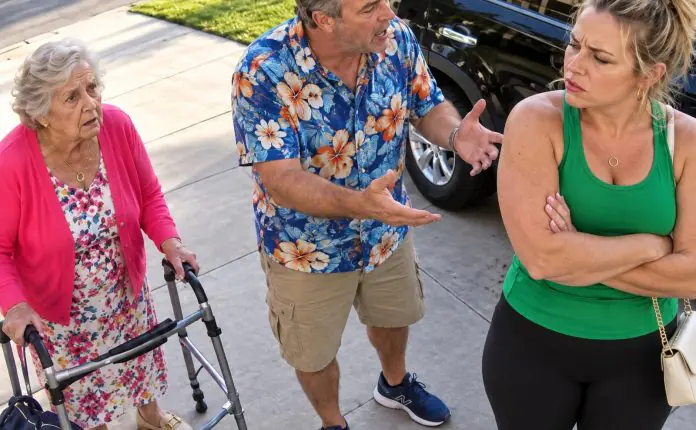
“You brought a document into my home that was already notarized with a false date. You had my private brokerage information without my permission, and then you convinced my son to sign an affidavit questioning my ability to manage my own life.”
Roman lowered his head.
Denise immediately pointed toward him. “He was worried about you too.”
“I was,” Roman said quietly. “But I didn’t know what she was doing.”
His voice cracked as he admitted he’d signed papers without reading them carefully because Denise had told him they were necessary to protect me. He’d also given her my financial statements because she claimed she needed them to understand which bills and accounts might require attention after Walter’s death.
“I thought I was helping you, Mom.”
I believed him.
That didn’t erase what he’d done, but there was a difference between being manipulated and deliberately trying to take control of me. Walter had understood that difference too, which was why his letter warned that one of our children might unknowingly help Denise.
Denise pushed her chair back.
“This is ridiculous. I’ll tell the grandchildren what’s happening here.”
“You may tell them whatever you want.”
“I’ll tell them you’re confused.”
I looked directly at her.
“Then Bennett can show them the trust, and Dr. Halloran can show them the results of the cognitive evaluation I completed this week.”
Her expression changed again.
I had arranged the examination after seeing the guardianship papers because I knew exactly what Denise might claim. The results confirmed that I was fully capable of understanding my finances and making my own legal decisions.
There would be no easy argument that grief or age had made me incompetent.
I picked up Walter’s old document.
“He kept this quiet because he wanted to protect his family, Denise. I intend to do the same.”
She stared at me.
“So you’re threatening me?”
“No.”
I slid the photocopy back into its envelope.
“I’m telling you to stop.”
For several seconds, nobody moved. Then I gave my sister-in-law the only instruction that mattered.
“Go home, Denise.”
Her face tightened, but she must have understood that the situation had changed. The elderly widow she expected to control was sitting beside an attorney with a recorded trust, medical proof of competence, photographs of suspicious documents, and evidence Walter had preserved for exactly this moment.
Denise gathered her papers.
She didn’t apologize.
She didn’t look at Roman.
She simply walked out of my house and closed the door behind her.
The silence she left behind felt enormous.
Roman remained seated across from me, staring at his hands. Janet and Charlie moved closer, but I kept my attention on my youngest son.
“Mom, I’m sorry.”
I could see the shame on his face.
“I should’ve read everything. I should’ve asked you before giving her anything.”
“Yes,” I said. “You should have.”
He looked up, surprised by my answer.
I reached across the table and took his hand.
“But you can learn from it.”
Roman’s eyes filled with tears.
Janet came around the table next. Only days earlier, she’d asked what I had done to make Walter leave me nothing; now she wrapped her arms around me and whispered an apology against my shoulder.
Charlie joined us.
For the first time since Walter died, I allowed myself to breathe without wondering what disaster was waiting behind the next door.
But later that evening, after everyone had gone home, I returned to Walter’s first letter.
There was one paragraph I hadn’t fully understood before.
Walter hadn’t created his plan merely because he distrusted Denise.
He had done it because he knew me.
If I told you what I suspected while I was alive, you would have tried to keep the family together. You would have given everyone another chance, Eleanor—even if doing so put your own future at risk.
I pressed my fingers against his handwriting.
After sixty-nine years, Walter had known exactly what I would do.
And that was why he’d decided the only way to protect me was to keep the truth from me until he was gone.
Part 5: What Walter Really Left Me
I sat alone at the dining room table long after my children had gone home, reading Walter’s letter again. The house felt different without him, yet for the first time since his death, I understood that his final months had contained far more than the quiet decline I’d witnessed from beside his bed.
Walter had known Denise might come after my independence.
He had also known I would never believe him if he’d warned me directly. I had spent my entire life trying to keep peace in the family, forgiving people quickly and assuming concern came from a good place, especially when it came from someone I loved.
That was why he hadn’t told me.
If Walter had accused Denise while he was alive, I would have defended her. I probably would have told him illness was making him suspicious, and if he’d warned me that Roman might unknowingly help her, I would have insisted our son would never do anything that could harm me.
Walter knew that.
After sixty-nine years of marriage, he knew me well enough to understand that my greatest strength could also become my weakness.
So he created a plan that required me to see the truth for myself.
The will everyone heard in Bennett’s office had never been Walter’s real protection for me. It was a decoy designed to convince Denise that I had been left vulnerable enough for her to step forward and offer control disguised as help.
And she had done exactly that.
Within a day, she’d arrived at my kitchen table with a predated power of attorney. She already possessed my private financial information, had convinced Roman to share documents with her, and was preparing a guardianship petition that could have allowed her to challenge my ability to control my own affairs.
Walter had predicted almost every step.
But he hadn’t left me defenseless.
Months before his health deteriorated, he’d created and funded a living trust naming me as sole trustee and beneficiary. He had obtained medical documentation proving his competence at the time, protected the arrangement from the kind of attack Denise might attempt, and placed the old family document with Bennett as a final safeguard.
For one terrible afternoon, I believed my husband had left me nothing.
In reality, he had spent his final months protecting everything we’d built together.
The realization didn’t make losing him easier.
If anything, it made me miss him more.
A few days later, Roman came to see me alone. He apologized again for sharing my statements and signing Denise’s affidavit without reading it carefully.
“I thought I was protecting you,” he said.
“I know.”
“I should’ve asked you what you wanted.”
“Yes,” I replied. “You should have.”
He lowered his head, but I reached across the table and squeezed his hand. I didn’t want my husband’s final act to become the beginning of another family fracture.
Roman had made a serious mistake.
He would have to live with that and earn back my trust, but I wasn’t going to lose my son because Denise had manipulated his fear.
Janet apologized too.
She admitted that when Bennett read the will, she’d immediately assumed Walter must have discovered something terrible about me. Her question—What did you do?—had hurt more than she realized.
“I should’ve trusted you, Mom.”
I nodded.
“That would have been nice.”
She laughed through her tears and hugged me.
Charlie, as usual, needed fewer words. He simply kissed my forehead and told me that whatever I decided to do next, he would follow my lead.
Denise didn’t return.
Bennett handled the remaining legal matters, and the guardianship petition disappeared before it could go anywhere. I remained in my home, managed my own finances, and continued making my own decisions exactly as I had before everyone suddenly decided ninety years old meant I needed permission to live my life.
One evening, I walked into the bedroom Walter and I had shared for decades.
His side of the closet still held several jackets I hadn’t been ready to move. Near the back was an old brown coat that reminded me of the ridiculous jacket he’d worn constantly when we first met in college.
I touched the sleeve and smiled.
“You stubborn old man,” I whispered.
For nearly seventy years, Walter had been my husband, my best friend, and occasionally the most frustrating person I’d ever known. Even at the end, he’d managed to construct an elaborate plan instead of simply telling me what he was worried about.
But now I understood why.
He wasn’t protecting money.
He was protecting my right to remain myself.
He knew grief would make me vulnerable, that my age would give other people an excuse to question my judgment, and that my instinct to trust family could be used against me. So he left behind something stronger than a traditional inheritance.
He left me control.
He left me evidence.
Most importantly, he trusted that once I saw the truth, I would know what to do with it.
I had spent nearly seven decades believing there were no secrets left between Walter and me. In the end, I discovered that he’d hidden one final plan from me, but it wasn’t the betrayal I’d feared when I first unfolded his letter.
Walter hadn’t left me nothing.
He had made everyone believe he had so the person waiting to take advantage of me would reveal herself.
Then he left me everything I needed to protect the life we’d built together.
At ninety years old, after sixty-nine years of marriage, I finally understood what my husband’s final gift truly was.
It wasn’t the house, the trust, or the money.
It was the certainty that even after he was gone, Walter still believed I was capable of standing on my own.