Part 3 — Thirty-Seven Guests Arrive At My Door
Thirty-seven conversations stopped at once.
I could see heads turning behind the tinted windows. The driver glanced back. My father looked from my mother to the house, and the color drained from his face so quickly that for a moment I wondered whether I was about to end up providing medical care at my own family confrontation. Mom remained halfway out of the bus.
“Oh my God.”
It was barely audible.
Then she looked at me.
“Mara.”
I folded my arms loosely.
“Hi, Mom.”
“What did you do?”
That sentence told me everything. Not how did you buy this? Not is this really Grandma’s house? What did you do?
“I bought a house,” I said. “You called me about it Tuesday.”
Behind her, people were beginning to recognize the property.
Most of the guests belonged to the same Baptist congregation where Grandma Evelyn had taught Sunday school for decades. Several were old enough to have drunk sweet tea in her living room. At least three had attended the Easter dinner when she publicly said the house should someday belong to me and Noah.
A small woman near the front pressed her face closer to the glass.
“That’s Evelyn’s place.”
A murmur moved down the aisle. My mother heard it. I watched her recover.
If Diane Ellison had one great talent, it was turning disaster into presentation. She descended the steps, adjusted her blouse, and smiled at everyone.
“Well,” she announced brightly, “isn’t this something? Mara went and brought Evelyn’s house back into the family.”
Into the family. Not bought for herself. Brought back into the family.
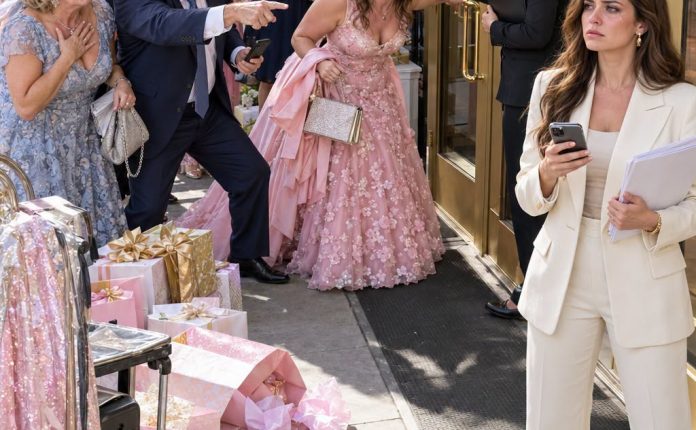
My father came off the bus behind her and immediately opened the luggage compartment. Two folding tables appeared. Then a large cooler.
Then cake boxes, decorations, paper plates, bags of gifts. And finally three suitcases. Noah saw them through the screen door.
“Mom.”
“I see them.”
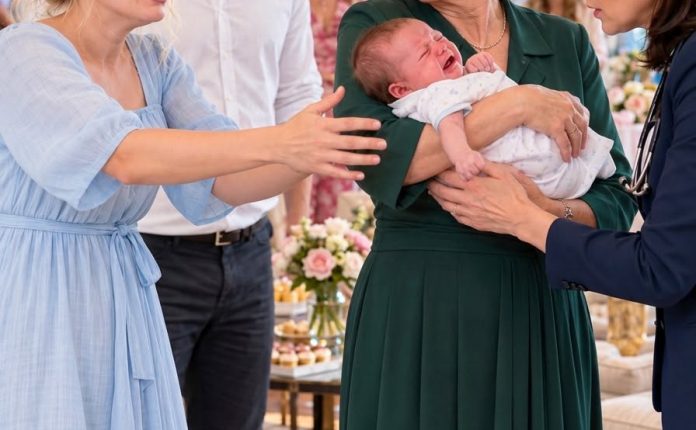
Behind the suitcases sat a boxed portable crib. Nobody brings luggage and a crib to a four-hour baby shower. My mother turned toward the guests.
“This is perfect, actually. A new generation coming home to Evelyn’s house. She would have loved it.”
I almost admired the speed of the lie. Almost.
The women began stepping off the bus, but nobody approached my gate. One of them, Mrs. Parker, whom I had known since childhood, looked from my mother to me.
“Did Mara know we were coming?”
Mom laughed.
“Oh, you know family. We don’t need formal invitations.”
Mrs. Parker’s expression didn’t change.
“That wasn’t what I asked.”
Mom ignored her and reached for my gate. My hand settled on the latch from the inside. I didn’t slam it.
I didn’t lock it. I simply stood there.
“Nobody is coming onto the property.”
Mom’s smile remained, but everything behind it vanished.
“Mara.”
“You heard me.”
“Don’t embarrass yourself.”
“I’m not embarrassed.”
She lowered her voice. “Tessa is eight months pregnant. People have traveled here. There’s food. Gifts. We are not doing this on the sidewalk.”
“We aren’t doing it in my yard either.”
Dad dropped one folding table onto the curb.
“For God’s sake, Mara. Grow up.”
I looked at him.
“I own this property.”
“You think owning a little house suddenly makes you better than everybody?”
“No.”
I nodded toward the luggage compartment.
“It means you don’t move people into it without asking.”
The sidewalk went quiet.
My brother appeared at the top of the bus steps. Ethan was twenty-eight, broad-shouldered, exhausted, and confused. Behind him stood Tessa, one hand supporting her lower back.
“What’s going on?” he asked.
Mom turned quickly.
“Nothing. Your sister’s overwhelmed.”
I looked at Ethan.
“Did you bring those suitcases?”
He frowned.
“Yeah.”
“Why?”
Another pause.
“Because Mom said you offered to let us stay here.”
There it was. For the first time that afternoon, I believed someone besides me genuinely hadn’t understood the plan.
“Did she tell you I offered?”
“Yes.”
“Ask her when.”
Mom snapped, “Mara, stop.”
Ethan looked at her.
“When did Mara offer?”
“We discussed the arrangement.”
“With her?”
Mom’s eyes hardened.
“Ethan.”
“With Mara?”
Dad stepped forward.
“Son, this isn’t the time.”
Ethan looked back at me.
“You didn’t say yes?”
“No one asked me.”
Tessa closed her eyes briefly. Then she came slowly down the bus steps.
“I’m sorry.”
Her voice was quiet.
“I swear I thought you knew.”
“I believe you.”
My mother stared at me as though I had betrayed her by refusing to punish Tessa. Tessa touched the fence.
“I wouldn’t have agreed to this if I knew.”
“It’s ninety degrees,” I said. “Come sit on the porch.”
Mom’s head snapped toward me.
“You’ll let her in?”
“She’s invited.”
I opened the gate wide enough for Tessa.
Only Tessa. She walked past my mother without looking at her and lowered herself into Grandma’s old wicker chair, the one I had found in an antique shop and bought because it reminded me of the original. Then she pulled out her phone.
I saw her type something. Years later, I would remember that tiny movement as the first crack in my mother’s control over Ethan’s new family. At the gate, my father’s face had grown red.
“After everything we’ve done for you.”
I almost laughed.
“Which part?”
He pointed at the house.
“We gave you a roof when you needed one. Your grandmother took you in because we arranged it. We kept you included after you got pregnant. We sold this place to cover her care.” Several older women exchanged looks. There it was.
The old story. The version my parents had repeated for fifteen years. I reached into my pocket and took out my phone.
Mom recognized the movement.
“Mara.”
I opened the first voicemail. Then I turned on the speaker. My mother’s recorded voice floated across the sidewalk.
“It’s one night in a motel, Mara. You’ve lived in one before. The kids will be fine.”
Nobody moved. The words seemed louder outdoors. Mrs. Parker’s mouth fell slightly open.
Mom whispered, “Turn that off.” I let it finish. Then I played the second recording.
“You should be happy an Ellison baby is coming home there. Ethan and Tessa need the space more than you do.”
When the message ended, I lowered the phone. My mother’s face had changed.
“That was private.”
“It was sent to me.”
“You’re humiliating us.”
“No.”
I looked at the thirty-seven people she had brought to my house.
“You brought the audience.”
For one second, nobody spoke. Then an elderly woman named Alma Jennings stepped forward with both hands on her cane.
She looked at my mother.
“Diane, did Evelyn know Mara was put in a motel after the house was sold?”
My father answered before Mom could.
“We had expenses.”
Mrs. Jennings looked at him.
“What expenses?”
“Evelyn’s care.”
I felt something settle inside me. The moment had arrived.
“There was no long-term care.”
Dad looked at me.
“Don’t.”
“She died here.”
My voice remained even.
“I was sitting beside her. Six days from the first serious decline to the funeral home coming through that door.”
Several women nodded. They remembered. Dad’s jaw tightened.
“There were other bills.”
“Then tell us what they were.”
He looked at me as though I had broken some lifelong rule.
Children were not supposed to ask their parents for evidence. Ethan came to the gate.
“Dad.”
Russell turned.
“What?”
“Where did the money from Grandma’s house go?”
Dad’s answer came immediately.
“To this family.”
Ethan frowned.
“Where?”
Silence. I reached into my back pocket. The Christmas card had softened at the edges after fifteen years.
I held it across the gate toward my brother. Mom moved first.
“Ethan, don’t.”
He froze. I didn’t.
“Grandma sent that to me the Christmas before she died.”
My brother looked at our mother. Then at the card. He took it.
“What does it say?”
“Read it.”
End Part 3