My father asked me not to come home for Christmas, saying my Army career would make my stepbrother’s promotion look insignificant. I simply changed my plans, canceled the flight, and took the overnight shift. By Christmas Eve, my family was celebrating without me. Then someone turned on the national news, and the entire room fell silent when my face appeared on the screen.
PART 1: The Christmas My Father Asked Me to Disappear So My Stepbrother Could Feel Like the Most Successful Child in the Room
My father disinvited me from Christmas while I was sitting on the edge of my barracks bed with an airline confirmation open on my phone. My dress uniform hung from the closet door behind me. I had already packed gifts for everyone. At first, I waited for Dad to laugh and tell me he was joking.
He did not.
“Leah, I think it would be better if you stayed at Fort Mason this year.”
I stared at the suitcase near my boots.
“Better for whom?”
There was a pause.
“For Bryce.”
Through the phone, I heard my stepmother, Celeste, moving around Dad’s living room. Something metallic clinked against glass. She was probably arranging the elaborate decorations she posted online every December.
Then Bryce laughed somewhere in the background.
Dad lowered his voice.
“Your brother’s promotion is being announced properly on Christmas Eve. Regional Vice President at thirty-one is a major accomplishment.”
“Stepbrother.”
“Leah.”
“What does his promotion have to do with whether I come home?”
Another pause.
Then Dad finally said what everyone else had apparently already discussed.
“When you’re there, people ask about the Army. The deployments. The commendations. It changes the atmosphere.”
I almost admired the careful wording.
“You mean it takes attention away from Bryce.”
“I mean he deserves one evening where people aren’t comparing the two of you.”
I looked toward my uniform.
I had never asked anyone at Dad’s parties to discuss my career. Most years I spent more time helping elderly relatives carry plates than talking about the Army.
But Bryce had always experienced my achievements as something taken from him.
His new position was apparently no different.
Dad continued.
“You know what people are like. If you arrive in uniform, Aunt Marjorie will ask about your latest assignment. Somebody will mention your medals. Then Bryce’s promotion suddenly seems less significant.”
I let those words settle.
My father was not telling me I had done anything wrong.
He was telling me that merely showing up as myself made his preferred son uncomfortable.
Behind him, Celeste said, “Tell her not to take it personally.”
I heard every word.
Bryce added, “Captain Spotlight can survive one Christmas without an audience.”
Dad did not correct him.
That hurt more than the joke.
I had spent most of my adult life pretending the differences between Bryce and me were accidental.
My mother died when I was seventeen. Dad married Celeste three years later, bringing Bryce permanently into our lives. Bryce was nineteen then, loud, charming, ambitious, and very good at making older adults believe confidence was the same thing as competence.
Celeste considered him destined for business.
Dad eventually agreed.
Mercer Logistics had begun as my parents’ company, although nobody talked much about Mom’s role after she died. Dad expanded it aggressively, and by the time Bryce finished college, there was already an office waiting for him.
I chose the Army.
Dad said he respected my decision.
He also spent the next decade behaving as if I had abandoned the family business rather than chosen a life of my own.
When Bryce received his first management position, Dad threw a dinner.
When I made captain, he mailed me a bottle of wine.
When Bryce bought his first luxury SUV, Celeste posted seventeen photographs.
When I returned safely from a difficult overseas assignment, Dad told me he was proud and immediately asked whether I had considered leaving the military for something more stable.
I stopped measuring the differences because doing so made visits home unbearable.
Then Mercer Logistics began using my military service in its marketing.
One company newsletter featured a photograph of me standing beside a helicopter overseas beneath a slogan about supporting those who serve.
Nobody asked permission.
I complained once.
Dad said I was being overly sensitive.
Bryce told me the photograph made the company look patriotic.
At the same time, he joked that my Army salary proved I had never learned anything about real business.
The contradictions never bothered him.
Two months before that Christmas, Bryce lost two important commercial accounts. One client blamed poor management. Another had questioned numbers in a proposal involving veteran employment commitments.
Dad responded by promoting him.
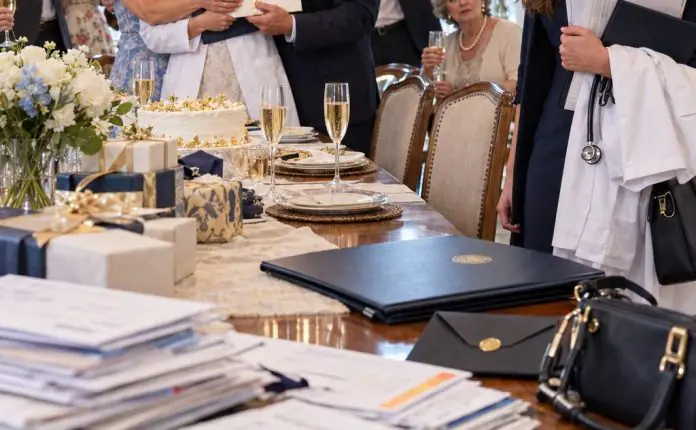
The announcement was timed for Christmas Eve.
Now apparently the final requirement for protecting Bryce’s professional confidence was removing me from the room.
“What do you want me to do with my ticket?” I asked.
Dad sounded relieved that we had moved to logistics.
“Cancel it. I’ll cover whatever fee there is.”
“I can pay my own cancellation fee.”
“That isn’t the point.”
“No. It actually is.”
He sighed.
“Why do you always make things difficult?”
I almost laughed.
I had just been told not to come home for Christmas so a thirty-one-year-old corporate executive would not feel overshadowed by his stepsister existing nearby.
Yet somehow I was difficult.
“All right,” I said.
Dad went silent.
He disliked that response because it meant I had stopped negotiating.
“Leah—”
“I understand.”
“Don’t be dramatic.”
“I’m not.”
“What are you going to tell people?”
“The truth if they ask.”
His tone sharpened immediately.
“There is no need to embarrass Bryce.”
“Then perhaps don’t ask me to lie.”
Celeste said something I could not make out.
Dad exhaled.
“We’ll talk after Christmas.”
“Sure.”
“Merry Christmas.”
I looked at the packed gifts.
“Merry Christmas, Dad.”
Then I ended the call.
For several minutes, I did nothing.
No crying.
No angry messages.
No dramatic confrontation in the family group chat.
I simply opened the airline app and canceled my flight to Virginia.
Then I called the duty desk.
A major winter system was moving toward the region, and Fort Mason had begun expanding emergency staffing. Several soldiers assigned to Christmas night had young children at home.
“I can cover overnight operations,” I said.
Sergeant Daniel Kim sounded surprised.
“Captain, weren’t you flying out?”
“Change of plans.”
“You sure?”
“Yes.”
By six that evening, another officer had been released to spend Christmas with his daughters.
That helped more than I expected.
My phone continued buzzing.
Celeste sent the first message.
This is probably best for everyone. Please don’t make your father feel guilty.
I stared at it and put the phone down.
Bryce followed ten minutes later.
Try not to invade the North Pole, Captain Spotlight.
I deleted nothing.
Two weeks earlier, an attorney named Sofia Alvarez had contacted me concerning my late mother’s trust.
I had almost ignored the call because I assumed it involved routine estate paperwork.
Instead, Ms. Alvarez asked an unexpected question.
“Captain Mercer, how much do you know about your ownership interest in Mercer Logistics?”
I told her I had none.
She became quiet.
“That is not what your mother’s trust says.”
The company had never belonged entirely to Dad.
My mother’s estate retained voting shares, held in trust for me under conditions that had recently changed.
More troubling, company records tied to federal contracts had triggered questions that made my position potentially significant.
Ms. Alvarez advised me not to discuss anything with Dad or Bryce until she completed her review.
I followed that advice.
Now, as Christmas Eve approached, Bryce was preparing to celebrate a promotion inside a company whose ownership structure he apparently understood even less than I did.
I still had no interest in ruining his evening.
Whatever Mercer Logistics had done would be handled through lawyers, auditors, and the proper process.
Christmas was separate.
Or at least I intended it to be.
At Fort Mason, weather reports worsened through the evening.
Snow turned heavy before eight.
Wind drove against the operations-center windows hard enough to rattle them.
State police reported spinouts across Route 17.
Then Sergeant Kim removed his headset and looked directly at me.
“Ma’am, we’ve got a major request.”
I crossed the room.
“What happened?”
“Pileup approximately fourteen miles east. Multiple vehicles. One tanker carrying fuel jackknifed across the highway.”
“Fire?”
“Not yet.”
That final word mattered.
I reached for the incident map.
“How many civilians?”
Kim listened to another transmission.
Then his expression changed.
“There’s a church bus trapped behind the tanker.”
“How many aboard?”
He looked at me.
“Twenty-six children.”
Every thought about Dad, Bryce, Christmas, Mercer Logistics, and the canceled ticket vanished.
I grabbed my jacket.
“Alert aviation support. Two Humvees. Medics, thermal equipment, emergency blankets, extraction tools.”
Kim was already moving.
Outside, the snow had become almost horizontal.
The convoy left Fort Mason forty minutes later.
As we drove into the storm, my phone lit up one last time.
A video from the family party.
Bryce stood beneath Christmas lights while Dad raised a champagne glass beside him.
Everyone applauded.
I locked the screen.
Ahead of us, emergency lights flickered through the snow.
Then the radio crackled.
The bus had shifted toward the shoulder.
The damaged tanker was leaking.
And someone on scene said the children needed to be moved immediately.
END PART 1