PART 5: Coffee With My Son Became the First Test of Our New Relationship
When Daniel asked whether we could have coffee, I said yes before I had time to decide how nervous the idea made me.
Not because I wanted things to go back to normal.
Normal had included too much rescuing, too much silence, and a son who could stand in my backyard while his wife handed me an eviction notice. I did not want that version of us restored simply because both of us were lonely enough to miss it.
We met the following Saturday at a small coffee shop halfway between my house and the apartment he shared with Victoria. I arrived first and chose a table near the window. Daniel came in five minutes later wearing work clothes instead of the button-down shirts he used to wear when he ran his own company.
He looked tired.
Not defeated.
Just stripped of the extra polish he once used to convince everyone, including himself, that things were under control.
“Hi, Mom.”
“Hi.”
He ordered black coffee and sat across from me.
For a while, we talked about harmless things.
The weather.
His new job.
Connie’s ongoing war with squirrels.
The furnace at my house, which had started making a faint clicking sound Harold would have insisted could be repaired with “one good afternoon.”
Daniel smiled at that.
Then the smile disappeared.
“I keep expecting you to ask how Victoria is.”
“I know.”
“Aren’t you curious?”
“Of course I’m curious.”
He waited.
“But your marriage is yours.”
Daniel looked down into his coffee.
“That’s new.”
“No. Saying it out loud is new.”
He rubbed one thumb against the cardboard sleeve.
“Things have been tense.”
I could hear the invitation inside the sentence. The old me would have leaned forward immediately. What happened? What did she say? Are you okay? Do you need somewhere to stay?
Instead, I let the sentence remain his.
After several seconds, he looked up.
“You’re really not going to ask.”
“No.”
A faint smile appeared.
“You’re serious about this boundaries thing.”
“I was serious when I changed the locks.”
That made him laugh.
It was the first easy sound between us since before the eviction notice.
Then he became quiet again.
“I’m trying not to make you the place I run when things go wrong.”
“Good.”
“I don’t know if I’m doing it very well.”
“You don’t have to do it perfectly.”
His eyes lifted.
“You just have to notice when you’re doing it.”
That became the beginning of how we learned to speak again.
Every few weeks, we met for coffee.
Sometimes Daniel came to my house, but more often we met somewhere neutral. I discovered I liked that. There was something useful about sitting across from each other at a table neither of us owned.
He told me about his new job in operations.
At first, he spoke about it apologetically.
The company belonged to an old business contact. Daniel was no longer the boss. He did not have employees, investors, or clients calling him at midnight. He handled schedules, vendor problems, and the kind of daily work he once would have delegated.
“I thought I’d hate it,” he admitted one morning.
“Do you?”
He shook his head.
“No.”
That surprised him more than it surprised me.
“I leave at five-thirty most days.”
“That sounds civilized.”
“I know.”
He looked embarrassed by how much he liked it.
The collapse of his company had wounded his pride more deeply than he had admitted. Victoria had hated the loss of status too. The house, I began to understand, had become part financial solution and part replacement symbol. If Daniel could no longer point to his business, perhaps owning the family home someday made failure feel temporary.
I did not tell him that.
Some realizations need to belong to the person having them.
I also refused to let our coffee meetings become a weekly report on Victoria.
Once, Daniel started describing an argument they had about money.
“She thinks if you had just—”
I raised one hand.
He stopped.
“I don’t want to be recruited into your marriage.”
“I’m not recruiting you.”
“You are beginning to.”
His jaw tightened.
For a moment, I saw the old defensiveness.
Then he exhaled.
“Okay.”
That mattered.
He could disagree with me and still stop.
I began to see the adult relationship I had wanted for us.
Not one without conflict.
One where conflict did not automatically become rescue.
At home, ordinary life continued.
The new locks stopped feeling new.
I kept important documents in the fireproof box, but I no longer checked it as though someone might appear overnight with another notice.
Harold’s study stayed exactly as I wanted it.
His books remained on the shelves.
The little wooden organizer sat beside his chair.
Sometimes I went into that room simply to sit.
At first, those quiet moments made me think of the boxes Victoria had put in the garage.
Later, they made me think of Harold again.
That felt like reclaiming something more important than square footage.
One afternoon, nearly four months after Daniel moved out, he came by to help me move a heavy planter away from the side of the house before a storm.
I had not asked.
He called first.
“Would it help if I came over?”
That question pleased me more than the actual help.
“Yes.”
He arrived twenty minutes later.
We moved the planter, checked the basement window wells, and stood in the garage while rain began tapping against the roof.
Daniel looked toward the shelves where his boxes had once been.
“I forgot how much stuff we had in here.”
“You occupied aggressively.”
He laughed.
“Victoria would not appreciate that wording.”
“She isn’t here.”
His expression changed, not dramatically, but enough that I noticed.
I did not ask.
He noticed that I did not ask.
That was becoming part of our language too.
Before leaving, he stood near the kitchen doorway.
“Mom?”
“Yes?”
“I’m glad you didn’t let us stay.”
The sentence startled me.
Daniel looked embarrassed.
“I hated it at the time.”
“I know.”
“I still hate how it happened.”
“So do I.”
“But if you’d let me stay after everything, I think I would have learned nothing.”
I leaned against the counter.
“What did you learn?”
He thought about it.
“That someone loving me doesn’t mean they’re supposed to keep making my mistakes affordable.”
I looked away for a moment.
That sounded painfully close to what I had been trying to teach myself.
A few weeks later, he called and asked if he could stop by Saturday morning.
He arrived carrying a small brown paper bag.
“What’s that?”
“Nothing dramatic.”
He placed it on the kitchen counter.
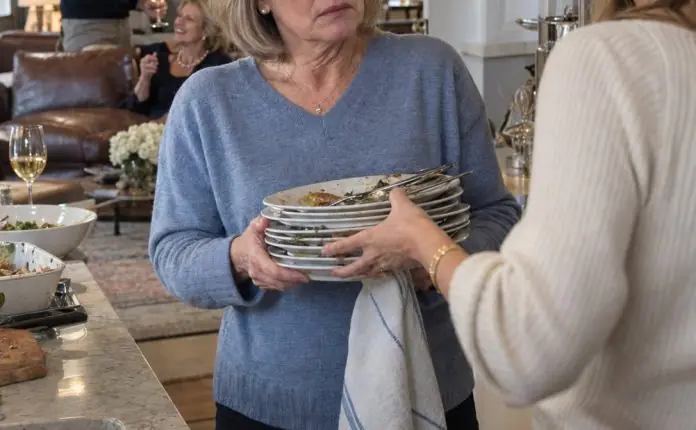
Inside was a blue-striped dish towel.
Not Harold’s towel.
A new one.
I lifted it by the corner.
The pattern was close enough to make me laugh.
“Where did you find this?”
“At a county fair.”
I looked at him.
“How much?”
“Eight dollars.”
I shook my head.
“Your father would’ve walked away.”
Daniel smiled.
“He would’ve talked them down to six and then told the story until everybody begged him to stop.”
We both laughed.
For a moment, the kitchen felt exactly like it had when Harold was alive.
Not because anything had been restored.
Because memory and the present were finally allowed to sit beside each other without competing.
Daniel’s smile faded.
“I’ve been thinking about the day Victoria gave you that notice.”
I set the towel down.
“So have I.”
“I keep remembering myself outside.”
His voice lowered.
“I knew it was wrong.”
I stayed silent.
“I didn’t want to fight with her. And I didn’t want to admit how much of our situation was because of me.”
He looked toward the window.
“If I sided with Victoria, then I could pretend we were solving something.”
I waited.
“Instead of taking something.”
That was the first explanation he had given me that sounded entirely like responsibility.
No excuse.
No helplessness.
No claim that Victoria had made the decision for him.
He had made choices too.
“I can’t undo it,” he said.
“No.”
His eyes returned to mine.
“But I am sorry.”
“I know.”
“I mean it differently now.”
I believed him.
For the first time since the move, I reached across the counter and placed my hand over his.
His fingers tightened around mine.
We stood there for several seconds.
It was the first time I had touched him since he walked out of the house.
I had wanted to hug him that day.
I had stopped myself.
Now, months later, the contact felt right.
Not because my anger had disappeared.
Because accountability had finally arrived before comfort.
Daniel looked down at our hands.
“I missed you.”
“I missed you too.”
That truth did not erase anything.
It did not need to.
I picked up the new towel and hung it beside Harold’s old one.
The faded original.
The brighter new cloth.
Two blue-striped towels hanging side by side.
Not replacement.
Not forgiveness made visible.
Something simpler.
Proof that what came next did not have to pretend nothing had happened.
END PART 5